Insurance Testing
P&C vs Life vs London Market Testing: Regression Guide

Rishabh Kumar
Published On

Table of contents
Lorem ipsum
Lorem ipsum
Lorem ipsum
Lorem ipsum
Lorem ipsum
The insurance testing problem changes with the line of business. In P&C, risk sits in high-volume rating, endorsements, renewals and claims, under frequent vendor and pricing change. In life and pensions, it sits in long-dated calculations and closed books that run for decades. In the London market, it sits in multi-party placement, delegated authority and market messaging between firms.
Many insurers run more than one of these businesses on shared platforms, which is why one testing approach rarely fits all of them. This page sets out what differs, what stays the same, and what each means for a regression suite.
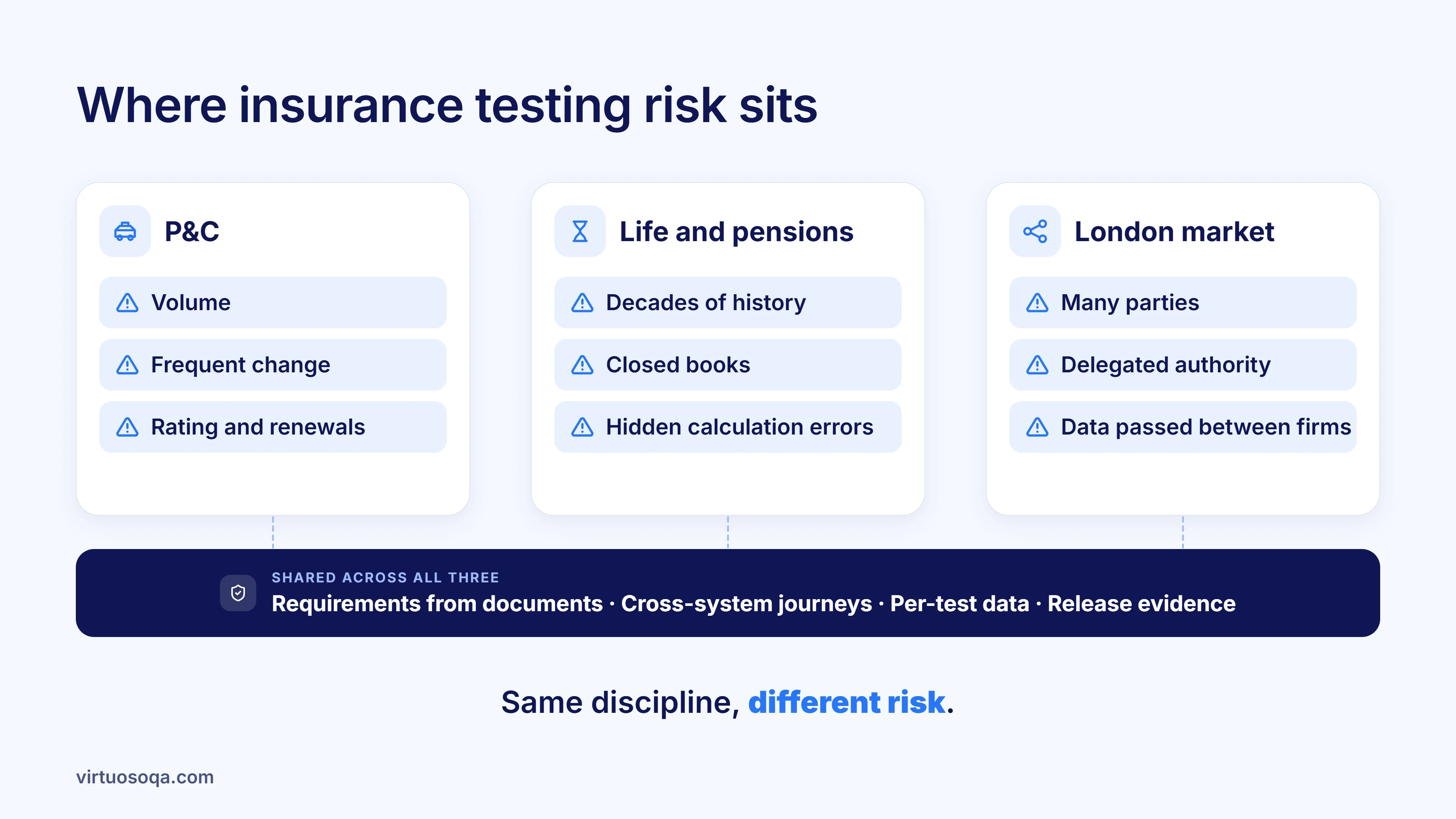
What is Different About Testing P&C Insurance?
P&C testing is dominated by volume and change. Products are priced by rating engines that change often, sold through many channels, adjusted mid-term, renewed every year and claimed against frequently. Most defects are small errors repeated across many policies, such as a mis-mapped rating factor, a wrong pro rata calculation or a renewal rule that skips a tenure band.
Core platforms add a fixed rhythm of change. Guidewire ships three cloud releases a year (Guidewire developer documentation) and Duck Creek runs three feature releases a year plus monthly updates (Duck Creek).
Each release must be regressed against the insurer’s own products and integrations. UK home and motor insurers also have to test renewal pricing rules under ICOBS 6B.
Virtuoso QA’s insurance testing follows the full policy and claims lifecycle, from quote to bind through to first notice of loss and settlement, so every vendor and pricing release is regressed end to end.
What is Different About Testing Life and Pensions?
Life and pensions testing is dominated by time. Contracts run for decades, so values, charges, unit allocations, guarantees and benefit options depend on long policy histories and on rules configured years ago. Errors often stay hidden until a customer retires, transfers, surrenders or dies, by which time thousands of policies may be affected.
Closed books are the defining risk. Products no longer sold are still administered, still touched by every platform release and tax change, and, in the UK, within the Consumer Duty since 31 July 2024. Testing must reconstruct and prove the rules of products nobody has examined for years.
Pension errors rarely fail loudly, and often surface decades later at retirement or transfer. With pension administration testing from Virtuoso QA, scheme rules become traceable tests and conversions are proven against recorded values.
What is Different About Testing the London Market?
London market testing is dominated by the number of parties. A single risk may involve a broker, a lead underwriter, several followers, coverholders under delegated authority and market processing services. Data agreed on a placing platform must arrive intact in every firm’s systems, and bordereaux and settlement must reconcile across them.
Modernisation is now firm by firm. After Lloyd’s decided in March 2026 to wind down Blueprint Two, the market is adopting Core Data Record standards and ACORD messages incrementally (LMA Operations Update, Q1 2026), so each firm owns the testing of its own mappings and integrations.
How Do the Three Compare Side by Side?
The table compares the three on the dimensions that shape a regression suite. Most insurers recognise their own estate in one column and feel the pull of a second.
Dimension | P&C | Life and Pensions | London Market |
|---|---|---|---|
Dominant risk | Volume and frequent change | Long-dated calculations and closed books | Multi-party data and delegated authority |
Typical defect | Rating, pro rata or renewal error repeated across many policies | Charge, value or benefit error hidden for years | Mapping or reconciliation error between firms |
Change drivers | Vendor releases, pricing changes, new products | Platform releases, tax and pension rule changes, migrations | Standards adoption, placing platform releases, binder changes |
Time in tests | Effective dates, mid-term changes, renewal windows | Decades of policy history, retirement dates | Contract periods, endorsement sequences |
Key regulation (UK) | ICOBS 6B pricing, Consumer Duty, claims handling | Consumer Duty including closed books, pensions rules | Lloyd’s and FCA delegated authority oversight |
Hardest test data | Many representative risks across channels | Policies with long, realistic histories | Multi-party placements with lead and follow lines |
What Stays the Same Across All Three?
Four things are common to every insurance line, and they’re where a shared testing approach pays off:
Requirements should come from business documents rather than screens.
Journeys must cross systems, because value is created and lost at handoffs.
Test data must be created per test, in a known state.
Every release needs evidence of what was tested and approved.
What This Means for Your Regression Suite
Line of Business | Where to Focus Regression |
|---|---|
All lines | Organise the suite by line of business first, then by journey, so each line’s dominant risk gets proportionate coverage |
P&C | Invest in data-driven rating and channel coverage that runs on every pricing and vendor release |
Life and pensions | Build representative policies with long histories, and keep closed-book products in standing regression |
London market | Test placement data into your own systems field by field, for lead and follow positions |
Shared components | Trace changes across every line, because a change made for one line can break another |
How Virtuoso QA Supports Each Line of Insurance
Virtuoso QA applies one governed testing approach across P&C, life and pensions, and the London market, with the emphasis each line needs. Every run records which requirement each test covers, how each step went and who approved the test, which gives insurers evidence for release boards, auditors and Consumer Duty reviews.
For P&C
Data-driven journeys run the same quote, endorsement or renewal across many risk profiles, channels and effective dates, so rating and pro rata errors that repeat across policies are caught before release
Regression suites run on every Guidewire or Duck Creek release and every pricing change, triggered from Jenkins, Azure DevOps or GitHub Actions
When a vendor release changes a screen, Virtuoso QA proposes repairs for a reviewer to accept or reject, so suites keep pace with the release calendar
For Life and Pensions
Touchstone drafts requirements and tests from product terms, policy documents and specifications, citing the source for each one, so closed-book rules can be rebuilt and approved by a named person before they’re tested
One journey can check the policy screen, the API behind it and the stored values in the database, so calculations are proven, not just displayed
Closed-book products stay in standing regression, so every platform release and tax change is tested against them
Where unit-linked funds sit on an investment platform, wealth management testing brings the same rigour to valuations, charges and reporting across the investment lifecycle.
For the London Market
API and database checks confirm placement data has arrived in your own systems field by field, for lead and follow positions
Business Process Orchestration follows a risk across systems, from placement through to policy administration, bordereaux and settlement, as one journey
Across Every Line
Composable components let shared steps, such as rating, documents and billing, be built once and traced across every line that uses them
Failures appear beside the last passing run, with screenshots, network data and a likely cause
Health insurers face the same mix of high volumes and data passed between parties, and Virtuoso QA’s healthcare testing covers payer workflows such as prior authorisation, claims and billing.