Release Evidence: Prove Every Release Before It Ships
Release evidence is the connected record that proves a software release was verified before it shipped: which requirements were covered, which tests proved them, what changed since the last release, who approved each change, and how any result can be reproduced. It is produced continuously as teams work, not assembled after the fact. Virtuoso QA produces that record as your team works, so the answer to whether a release was verified exists before anyone asks for it.
Release Evidence: Prove Every Release Before It Ships
Release evidence is the connected record that proves a software release was verified before it shipped: which requirements were covered, which tests proved them, what changed since the last release, who approved each change, and how any result can be reproduced. It is produced continuously as teams work, not assembled after the fact. Virtuoso QA produces that record as your team works, so the answer to whether a release was verified exists before anyone asks for it.
Release Evidence: Prove Every Release Before It Ships
Release evidence is the connected record that proves a software release was verified before it shipped: which requirements were covered, which tests proved them, what changed since the last release, who approved each change, and how any result can be reproduced. It is produced continuously as teams work, not assembled after the fact. Virtuoso QA produces that record as your team works, so the answer to whether a release was verified exists before anyone asks for it.
Used by the world's leading companies












Used by the world's leading companies
Used by the world's leading companies
Used by the world's leading companies
The Question Changed and the Record Has to Change With It
For decades, software teams asked one question. Can we build it? AI answered it. Code that took weeks now takes hours, from tools that never sleep, and a growing share of production software was never written by a person.
The question is no longer whether you can build it
It is whether you can trust it. That question is asked at every ship decision now, and a pass rate does not answer it.

More AI does not close the gap
The industry's first answer has been more agents, more generated coverage, more speed. You cannot close a trust gap with more of the thing you cannot trust.

Exposure is rising while trust falls
Organisations are shipping more AI-written change than ever, while practitioner confidence in AI making release decisions is falling. The distance between the two is the space release evidence exists to fill.

The Question Changed and the Record Has to Change With It
For decades, software teams asked one question. Can we build it? AI answered it. Code that took weeks now takes hours, from tools that never sleep, and a growing share of production software was never written by a person.
The question is no longer whether you can build it
It is whether you can trust it. That question is asked at every ship decision now, and a pass rate does not answer it.
More AI does not close the gap
The industry's first answer has been more agents, more generated coverage, more speed. You cannot close a trust gap with more of the thing you cannot trust.
Exposure is rising while trust falls
Organisations are shipping more AI-written change than ever, while practitioner confidence in AI making release decisions is falling. The distance between the two is the space release evidence exists to fill.
The Question Changed and the Record Has to Change With It
For decades, software teams asked one question. Can we build it? AI answered it. Code that took weeks now takes hours, from tools that never sleep, and a growing share of production software was never written by a person.
The question is no longer whether you can build it
It is whether you can trust it. That question is asked at every ship decision now, and a pass rate does not answer it.
More AI does not close the gap
The industry's first answer has been more agents, more generated coverage, more speed. You cannot close a trust gap with more of the thing you cannot trust.
Exposure is rising while trust falls
Organisations are shipping more AI-written change than ever, while practitioner confidence in AI making release decisions is falling. The distance between the two is the space release evidence exists to fill.
The Questions Release Evidence Has to Answer
If the record cannot answer all of these, it is not evidence. It is archaeology. And if producing the answers takes weeks of assembly, it is not evidence either, because evidence exists before anyone asks for it.

Which requirements does this release cover, and which tests prove them?
Traceability from business intent through to executed test. Not a pass count, a chain.

What changed since the last release, and what did each change affect?
Every modification identified, its downstream impact known, nothing updated quietly.

Who approved each change, and when?
A named person behind every decision that reached production. The AI did it is not an acceptable answer.

Can any result be reproduced on demand?
The same test producing the same outcome every run. A result that cannot be reproduced cannot be relied on.
The Questions Release Evidence Has to Answer
If the record cannot answer all of these, it is not evidence. It is archaeology. And if producing the answers takes weeks of assembly, it is not evidence either, because evidence exists before anyone asks for it.
Which requirements does this release cover, and which tests prove them?
Traceability from business intent through to executed test. Not a pass count, a chain.
What changed since the last release, and what did each change affect?
Every modification identified, its downstream impact known, nothing updated quietly.
Who approved each change, and when?
A named person behind every decision that reached production. The AI did it is not an acceptable answer.
Can any result be reproduced on demand?
The same test producing the same outcome every run. A result that cannot be reproduced cannot be relied on.
The Questions Release Evidence Has to Answer
If the record cannot answer all of these, it is not evidence. It is archaeology. And if producing the answers takes weeks of assembly, it is not evidence either, because evidence exists before anyone asks for it.
Which requirements does this release cover, and which tests prove them?
Traceability from business intent through to executed test. Not a pass count, a chain.
What changed since the last release, and what did each change affect?
Every modification identified, its downstream impact known, nothing updated quietly.
Who approved each change, and when?
A named person behind every decision that reached production. The AI did it is not an acceptable answer.
Can any result be reproduced on demand?
The same test producing the same outcome every run. A result that cannot be reproduced cannot be relied on.
The Questions Release Evidence Has to Answer
If the record cannot answer all of these, it is not evidence. It is archaeology. And if producing the answers takes weeks of assembly, it is not evidence either, because evidence exists before anyone asks for it.
Which requirements does this release cover, and which tests prove them?
Traceability from business intent through to executed test. Not a pass count, a chain.
What changed since the last release, and what did each change affect?
Every modification identified, its downstream impact known, nothing updated quietly.
Who approved each change, and when?
A named person behind every decision that reached production. The AI did it is not an acceptable answer.
Can any result be reproduced on demand?
The same test producing the same outcome every run. A result that cannot be reproduced cannot be relied on.
Three Things That Look Like Evidence and Are Not
Each of these is useful in its own right, and most teams have all three. None of them can answer the questions a release decision turns on, which is the difference between reporting on testing and being able to prove it.
A test report
Pass and fail counts prove that activity happened. Without the requirement sitting behind each test, they cannot tell you whether what the business actually needed was ever checked, only that a set of tests ran and most of them passed. A green report on the wrong coverage looks identical to a green report on the right coverage.
An audit log
Raw event streams record that things occurred and when. They do not record why the change was made, what else it affected downstream, or whether anyone with the authority to approve it agreed to it first. An auditor reading a log still has to reconstruct the decision from the people who made it.
A coverage percentage
A single number with no chain underneath it. Eighty per cent of what, proven by which tests, traced to which requirements, approved by whom? Coverage figures describe how much of something was touched, not whether the behaviour the business depends on was verified.
Three Things That Look Like Evidence and Are Not
Each of these is useful in its own right, and most teams have all three. None of them can answer the questions a release decision turns on, which is the difference between reporting on testing and being able to prove it.
A test report
Pass and fail counts prove that activity happened. Without the requirement sitting behind each test, they cannot tell you whether what the business actually needed was ever checked, only that a set of tests ran and most of them passed. A green report on the wrong coverage looks identical to a green report on the right coverage.
An audit log
Raw event streams record that things occurred and when. They do not record why the change was made, what else it affected downstream, or whether anyone with the authority to approve it agreed to it first. An auditor reading a log still has to reconstruct the decision from the people who made it.
A coverage percentage
A single number with no chain underneath it. Eighty per cent of what, proven by which tests, traced to which requirements, approved by whom? Coverage figures describe how much of something was touched, not whether the behaviour the business depends on was verified.
Three Things That Look Like Evidence and Are Not
Each of these is useful in its own right, and most teams have all three. None of them can answer the questions a release decision turns on, which is the difference between reporting on testing and being able to prove it.
A test report
Pass and fail counts prove that activity happened. Without the requirement sitting behind each test, they cannot tell you whether what the business actually needed was ever checked, only that a set of tests ran and most of them passed. A green report on the wrong coverage looks identical to a green report on the right coverage.
An audit log
Raw event streams record that things occurred and when. They do not record why the change was made, what else it affected downstream, or whether anyone with the authority to approve it agreed to it first. An auditor reading a log still has to reconstruct the decision from the people who made it.
A coverage percentage
A single number with no chain underneath it. Eighty per cent of what, proven by which tests, traced to which requirements, approved by whom? Coverage figures describe how much of something was touched, not whether the behaviour the business depends on was verified.
How Virtuoso QA Produces Release Evidence
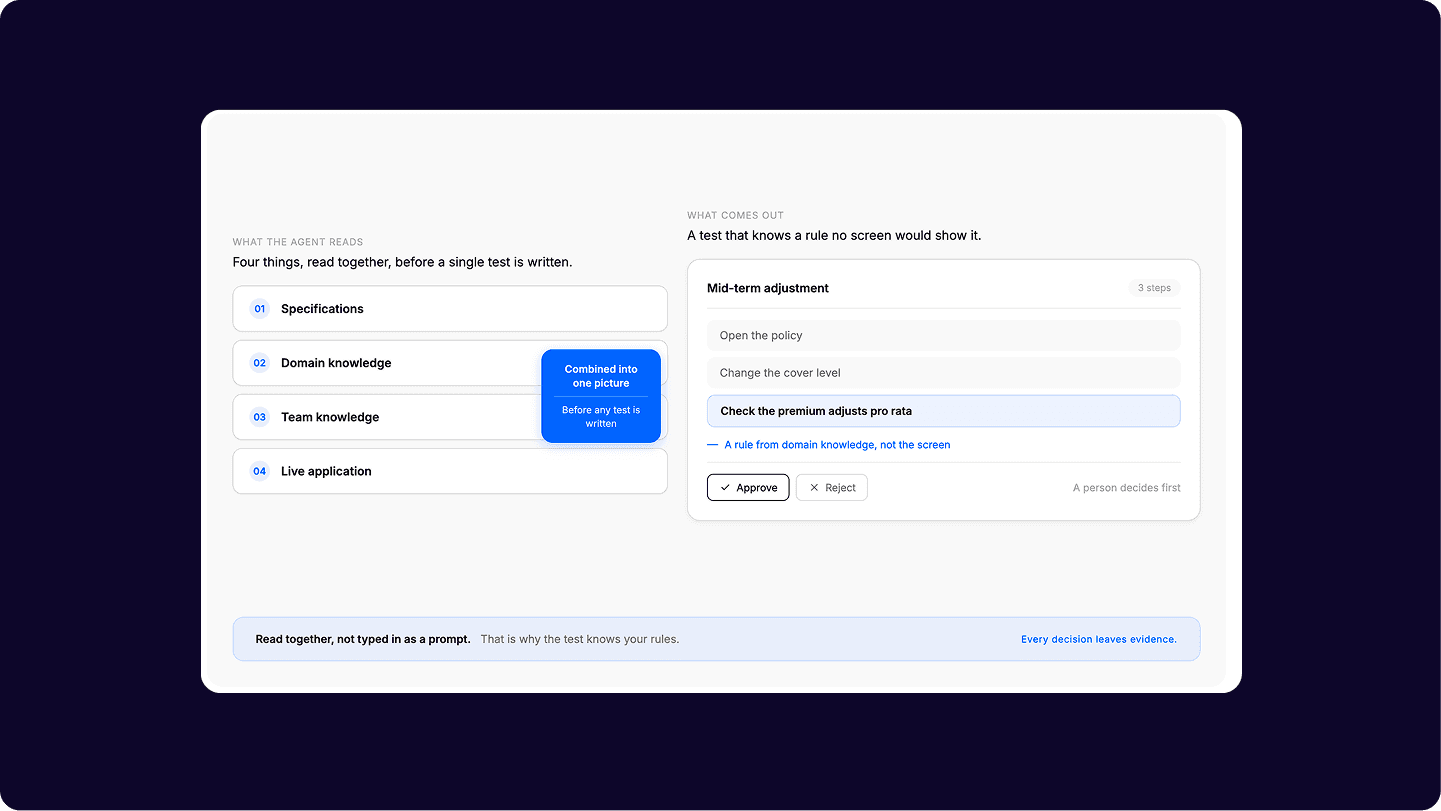
Virtuoso QA produces release evidence as a by-product of the work rather than as a project before an audit. AI proposes, a deterministic engine executes, a person approves what matters, and every decision leaves a record. Provenance, approvals and versions accumulate as your team works, so each question has a mechanism behind it rather than a promise.

Requirements proven by tests
Every artefact cites its origin, from source document through requirement and journey to the run that executed it, and the chain can be queried.

Change traced to what it affects
When a source is revised, Virtuoso QA identifies every affected asset and proposes the fix as a reviewable diff rather than updating anything quietly.

Approval held by a named person
Proposals land as drafts and only a named person's acceptance publishes them. There is no setting that removes that step.
Results that reproduce
Execution runs the defined steps on a deterministic engine in your existing CI, so the same journey against the same build returns the same result.
How Virtuoso QA Produces Release Evidence
Virtuoso QA produces release evidence as a by-product of the work rather than as a project before an audit. AI proposes, a deterministic engine executes, a person approves what matters, and every decision leaves a record. Provenance, approvals and versions accumulate as your team works, so each question has a mechanism behind it rather than a promise.
Requirements proven by tests
Every artefact cites its origin, from source document through requirement and journey to the run that executed it, and the chain can be queried.
Change traced to what it affects
When a source is revised, Virtuoso QA identifies every affected asset and proposes the fix as a reviewable diff rather than updating anything quietly.
Approval held by a named person
Proposals land as drafts and only a named person's acceptance publishes them. There is no setting that removes that step.
Results that reproduce
Execution runs the defined steps on a deterministic engine in your existing CI, so the same journey against the same build returns the same result.
How Virtuoso QA Produces Release Evidence
Virtuoso QA produces release evidence as a by-product of the work rather than as a project before an audit. AI proposes, a deterministic engine executes, a person approves what matters, and every decision leaves a record. Provenance, approvals and versions accumulate as your team works, so each question has a mechanism behind it rather than a promise.
Requirements proven by tests
Every artefact cites its origin, from source document through requirement and journey to the run that executed it, and the chain can be queried.
Change traced to what it affects
When a source is revised, Virtuoso QA identifies every affected asset and proposes the fix as a reviewable diff rather than updating anything quietly.
Approval held by a named person
Proposals land as drafts and only a named person's acceptance publishes them. There is no setting that removes that step.
Results that reproduce
Execution runs the defined steps on a deterministic engine in your existing CI, so the same journey against the same build returns the same result.
How Virtuoso QA Produces Release Evidence
Virtuoso QA produces release evidence as a by-product of the work rather than as a project before an audit. AI proposes, a deterministic engine executes, a person approves what matters, and every decision leaves a record. Provenance, approvals and versions accumulate as your team works, so each question has a mechanism behind it rather than a promise.
Requirements proven by tests
Every artefact cites its origin, from source document through requirement and journey to the run that executed it, and the chain can be queried.
Change traced to what it affects
When a source is revised, Virtuoso QA identifies every affected asset and proposes the fix as a reviewable diff rather than updating anything quietly.
Approval held by a named person
Proposals land as drafts and only a named person's acceptance publishes them. There is no setting that removes that step.
Results that reproduce
Execution runs the defined steps on a deterministic engine in your existing CI, so the same journey against the same build returns the same result.
Who Needs Release Evidence First
In banking, insurance, healthcare and government, release evidence is already a purchase condition, because the release does not go out without it. Trading platforms, policy administration systems, asset migrations and core business systems all sit in that category, and so does anywhere a failed release has a number attached to it.

Who Needs Release Evidence First
In banking, insurance, healthcare and government, release evidence is already a purchase condition, because the release does not go out without it. Trading platforms, policy administration systems, asset migrations and core business systems all sit in that category, and so does anywhere a failed release has a number attached to it.
Who Needs Release Evidence First
In banking, insurance, healthcare and government, release evidence is already a purchase condition, because the release does not go out without it. Trading platforms, policy administration systems, asset migrations and core business systems all sit in that category, and so does anywhere a failed release has a number attached to it.
Where the Category Goes Next
Composable testing builds test coverage from reusable, plain-English components: steps, checkpoints, data tables and environments that are created once and assembled into journeys wherever they are needed. When a component is updated, everything built from it inherits the change. Coverage stops being thousands of near-duplicate scripts and becomes a library your whole estate draws on. Most testing tools treat every platform, and every near-identical flow, as a separate problem. Composable testing treats your estate the way your business already does: as shared processes with platform- specific details.
Where the Category Goes Next
Composable testing builds test coverage from reusable, plain-English components: steps, checkpoints, data tables and environments that are created once and assembled into journeys wherever they are needed. When a component is updated, everything built from it inherits the change. Coverage stops being thousands of near-duplicate scripts and becomes a library your whole estate draws on. Most testing tools treat every platform, and every near-identical flow, as a separate problem. Composable testing treats your estate the way your business already does: as shared processes with platform- specific details.
Where the Category Goes Next
Composable testing builds test coverage from reusable, plain-English components: steps, checkpoints, data tables and environments that are created once and assembled into journeys wherever they are needed. When a component is updated, everything built from it inherits the change. Coverage stops being thousands of near-duplicate scripts and becomes a library your whole estate draws on. Most testing tools treat every platform, and every near-identical flow, as a separate problem. Composable testing treats your estate the way your business already does: as shared processes with platform- specific details.
AI-native, proven in production.
10x
Faster execution
9x
Faster authoring
85%
Less maintenance
50%
Lower QA cost
AI-native, proven in production.
10x
Faster execution
9x
Faster authoring
85%
Less maintenance
50%
Lower QA cost
AI-native, proven in production.
10x
Faster execution
9x
Faster authoring
85%
Less maintenance
50%
Lower QA cost
Proven where quality and accountability matter
Recognized by independent analysts, trusted by enterprise teams, and built with the security controls required for critical software.

WAVE STRONG PERFORMER
Proven where quality and accountability matter
Recognized by independent analysts, trusted by enterprise teams, and built with the security controls required for critical software.
WAVE STRONG PERFORMER
Proven where quality and accountability matter
Recognized by independent analysts, trusted by enterprise teams, and built with the security controls required for critical software.
WAVE STRONG PERFORMER
Frequently Asked Questions
Common questions about release evidence, from what separates it from a test report to who owns it inside an organisation.
How is release evidence different from a test report?
Does producing release evidence slow delivery down?
Is release evidence only for regulated industries?
Who owns release evidence in an organisation?
What does release evidence actually look like?
Frequently Asked Questions
Common questions about release evidence, from what separates it from a test report to who owns it inside an organisation.
How is release evidence different from a test report?
Does producing release evidence slow delivery down?
Is release evidence only for regulated industries?
Who owns release evidence in an organisation?
What does release evidence actually look like?
Frequently Asked Questions
Common questions about release evidence, from what separates it from a test report to who owns it inside an organisation.
How is release evidence different from a test report?
Does producing release evidence slow delivery down?
Is release evidence only for regulated industries?
Who owns release evidence in an organisation?
What does release evidence actually look like?

See what your next release looks like with Virtuoso
Book a walkthrough on your applications and your workflows. Bring a requirement, a user journey, or a brittle Selenium script, and watch the loop run on something you recognise.
See what your next release looks like with Virtuoso
Book a walkthrough on your applications and your workflows. Bring a requirement, a user journey, or a brittle Selenium script, and watch the loop run on something you recognise.
See what your next release looks like with Virtuoso
Book a walkthrough on your applications and your workflows. Bring a requirement, a user journey, or a brittle Selenium script, and watch the loop run on something you recognise.
AICPA
SOC

WAVE STRONG PERFORMER
@ Copyright 2026 SpotQA, Creators of Virtuoso QA
AICPA
SOC
WAVE STRONG PERFORMER
@ Copyright 2026 SpotQA, Creators of Virtuoso QA
AICPA
SOC
WAVE STRONG PERFORMER
@ Copyright 2026 SpotQA, Creators of Virtuoso QA