The Standard of Proof, Delivered
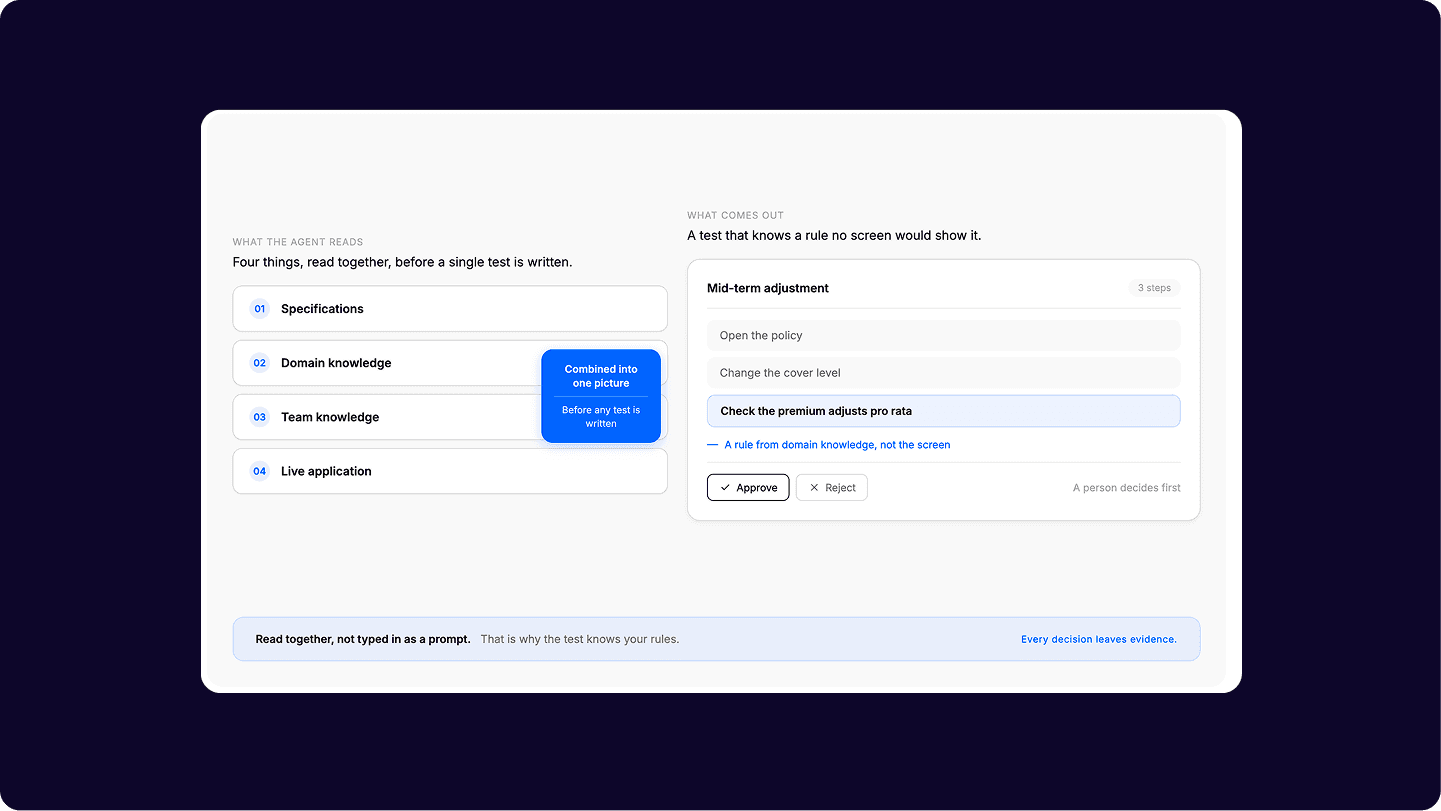
Touchstone is how Virtuoso QA meets the standard it is establishing. Quality runs as one closed loop, from source through requirement and journey to test and evidence. Three agents orchestrate the work, specialised agents drive the workflows beneath them, a deterministic engine executes, and your team governs. Nothing is generated without a person accepting it, and every artefact can tell you where it came from.
The Standard of Proof, Delivered
Touchstone is how Virtuoso QA meets the standard it is establishing. Quality runs as one closed loop, from source through requirement and journey to test and evidence. Three agents orchestrate the work, specialised agents drive the workflows beneath them, a deterministic engine executes, and your team governs. Nothing is generated without a person accepting it, and every artefact can tell you where it came from.
The Standard of Proof, Delivered
Touchstone is how Virtuoso QA meets the standard it is establishing. Quality runs as one closed loop, from source through requirement and journey to test and evidence. Three agents orchestrate the work, specialised agents drive the workflows beneath them, a deterministic engine executes, and your team governs. Nothing is generated without a person accepting it, and every artefact can tell you where it came from.
Used by the world's leading companies












Used by the world's leading companies
Used by the world's leading companies
Used by the world's leading companies
A Generator Gives You Tests, a Loop Gives You a System
Almost any AI tool can turn a prompt into test steps in seconds. What it leaves behind is a growing pile of scripts with no memory of why they exist, no owner for what they check and no plan for the day the application changes.
Generated tests carry no context
A script produced from a prompt reflects the prompt rather than the requirement, so nobody can say what business rule it exists to prove or whether that rule is still current.

Maintenance arrives as a separate bill
Generation solves the first hour. Everything after that, from tracing what a change affected to repairing what broke, stays manual and competes directly with new coverage.

Nothing connects to anything else
Without a chain from source to requirement to journey to run, a suite is a collection of tests rather than a system that can account for itself.

A Generator Gives You Tests, a Loop Gives You a System
Almost any AI tool can turn a prompt into test steps in seconds. What it leaves behind is a growing pile of scripts with no memory of why they exist, no owner for what they check and no plan for the day the application changes.
Generated tests carry no context
A script produced from a prompt reflects the prompt rather than the requirement, so nobody can say what business rule it exists to prove or whether that rule is still current.
Maintenance arrives as a separate bill
Generation solves the first hour. Everything after that, from tracing what a change affected to repairing what broke, stays manual and competes directly with new coverage.
Nothing connects to anything else
Without a chain from source to requirement to journey to run, a suite is a collection of tests rather than a system that can account for itself.
A Generator Gives You Tests, a Loop Gives You a System
Almost any AI tool can turn a prompt into test steps in seconds. What it leaves behind is a growing pile of scripts with no memory of why they exist, no owner for what they check and no plan for the day the application changes.
Generated tests carry no context
A script produced from a prompt reflects the prompt rather than the requirement, so nobody can say what business rule it exists to prove or whether that rule is still current.
Maintenance arrives as a separate bill
Generation solves the first hour. Everything after that, from tracing what a change affected to repairing what broke, stays manual and competes directly with new coverage.
Nothing connects to anything else
Without a chain from source to requirement to journey to run, a suite is a collection of tests rather than a system that can account for itself.
Three Agents Orchestrate, Specialised Agents Do the Work, Your Team Governs
Touchstone's agents work across requirements, journey design and authoring, and your team reviews, edits and approves at every stage.

The Analyst understands your documents
Your ticket or specification becomes structured, reviewable test requirements. The Analyst reads the sources you already have, proposes testable requirements, and cites the source behind each one.

The Architect shapes the journey
Accepted requirements are shaped into the structure of a full journey, with ordered steps, data scenarios and references to the library checkpoints, data tables and environments you already own. Reuse comes before generation.

The Autopilot builds and maintains it
The journey is built into a runnable automated test against the live application. The Autopilot plans, executes and validates in a real browser with its reasoning visible as it works, so when it hits a gap you can see why.

The Knowledge Base grounds every generation
Specifications, tickets, designs, policies and standards sit in a project-scoped Knowledge Base. Every generation is grounded in your sources and every output cites the sources it used.

Your conventions are applied at generation time
Naming conventions, output templates and domain rules are written in plain language and applied to everything the agents produce, at organisation or project scope and changeable at any time.

A deterministic engine executes
Beneath the orchestrators, specialised agents drive the workflows, from reading the live application to converting existing suites, and approved journeys run on the deterministic engine.
Three Agents Orchestrate, Specialised Agents Do the Work, Your Team Governs
Touchstone's agents work across requirements, journey design and authoring, and your team reviews, edits and approves at every stage.
The Analyst understands your documents
Your ticket or specification becomes structured, reviewable test requirements. The Analyst reads the sources you already have, proposes testable requirements, and cites the source behind each one.
The Architect shapes the journey
Accepted requirements are shaped into the structure of a full journey, with ordered steps, data scenarios and references to the library checkpoints, data tables and environments you already own. Reuse comes before generation.
The Autopilot builds and maintains it
The journey is built into a runnable automated test against the live application. The Autopilot plans, executes and validates in a real browser with its reasoning visible as it works, so when it hits a gap you can see why.
The Knowledge Base grounds every generation
Specifications, tickets, designs, policies and standards sit in a project-scoped Knowledge Base. Every generation is grounded in your sources and every output cites the sources it used.
Your conventions are applied at generation time
Naming conventions, output templates and domain rules are written in plain language and applied to everything the agents produce, at organisation or project scope and changeable at any time.
A deterministic engine executes
Beneath the orchestrators, specialised agents drive the workflows, from reading the live application to converting existing suites, and approved journeys run on the deterministic engine.
Three Agents Orchestrate, Specialised Agents Do the Work, Your Team Governs
Touchstone's agents work across requirements, journey design and authoring, and your team reviews, edits and approves at every stage.
The Analyst understands your documents
Your ticket or specification becomes structured, reviewable test requirements. The Analyst reads the sources you already have, proposes testable requirements, and cites the source behind each one.
The Architect shapes the journey
Accepted requirements are shaped into the structure of a full journey, with ordered steps, data scenarios and references to the library checkpoints, data tables and environments you already own. Reuse comes before generation.
The Autopilot builds and maintains it
The journey is built into a runnable automated test against the live application. The Autopilot plans, executes and validates in a real browser with its reasoning visible as it works, so when it hits a gap you can see why.
The Knowledge Base grounds every generation
Specifications, tickets, designs, policies and standards sit in a project-scoped Knowledge Base. Every generation is grounded in your sources and every output cites the sources it used.
Your conventions are applied at generation time
Naming conventions, output templates and domain rules are written in plain language and applied to everything the agents produce, at organisation or project scope and changeable at any time.
A deterministic engine executes
Beneath the orchestrators, specialised agents drive the workflows, from reading the live application to converting existing suites, and approved journeys run on the deterministic engine.
AI Proposes, a Person Approves, Everything is Recorded
AI proposes, a deterministic engine executes, a person approves what matters, and every decision leaves evidence. Keeping reasoning apart from execution is what makes a result something you can reproduce rather than something you have to trust.

AI lives in the workflow
The orchestrators and specialised agents propose requirements, scaffold journeys, analyse failures and draft repairs. They reason over your context and show their working, so a reviewer can correct an interpretation before it becomes coverage.

Execution stays deterministic
Tests run on Virtuoso QA's engine in your existing CI. The same journey produces the same result every time, so outcomes can be compared, reproduced and relied on. Your release never depends on what a model did differently today.
Approval is structural
Human sign-off is not a setting someone can switch off. It is a gate built into the data model. Proposals land as drafts, a named person accepts or rejects, and only accepted changes publish.

Evidence is a by-product of working
Provenance, versions, decisions and history accumulate as your team goes, rather than as a project someone runs before an audit. When someone asks what was verified, the answer already exists.
AI Proposes, a Person Approves, Everything is Recorded
AI proposes, a deterministic engine executes, a person approves what matters, and every decision leaves evidence. Keeping reasoning apart from execution is what makes a result something you can reproduce rather than something you have to trust.
AI lives in the workflow
The orchestrators and specialised agents propose requirements, scaffold journeys, analyse failures and draft repairs. They reason over your context and show their working, so a reviewer can correct an interpretation before it becomes coverage.
Execution stays deterministic
Tests run on Virtuoso QA's engine in your existing CI. The same journey produces the same result every time, so outcomes can be compared, reproduced and relied on. Your release never depends on what a model did differently today.
Approval is structural
Human sign-off is not a setting someone can switch off. It is a gate built into the data model. Proposals land as drafts, a named person accepts or rejects, and only accepted changes publish.
Evidence is a by-product of working
Provenance, versions, decisions and history accumulate as your team goes, rather than as a project someone runs before an audit. When someone asks what was verified, the answer already exists.
AI Proposes, a Person Approves, Everything is Recorded
AI proposes, a deterministic engine executes, a person approves what matters, and every decision leaves evidence. Keeping reasoning apart from execution is what makes a result something you can reproduce rather than something you have to trust.
AI lives in the workflow
The orchestrators and specialised agents propose requirements, scaffold journeys, analyse failures and draft repairs. They reason over your context and show their working, so a reviewer can correct an interpretation before it becomes coverage.
Execution stays deterministic
Tests run on Virtuoso QA's engine in your existing CI. The same journey produces the same result every time, so outcomes can be compared, reproduced and relied on. Your release never depends on what a model did differently today.
Approval is structural
Human sign-off is not a setting someone can switch off. It is a gate built into the data model. Proposals land as drafts, a named person accepts or rejects, and only accepted changes publish.
Evidence is a by-product of working
Provenance, versions, decisions and history accumulate as your team goes, rather than as a project someone runs before an audit. When someone asks what was verified, the answer already exists.
AI Proposes, a Person Approves, Everything is Recorded
AI proposes, a deterministic engine executes, a person approves what matters, and every decision leaves evidence. Keeping reasoning apart from execution is what makes a result something you can reproduce rather than something you have to trust.
AI lives in the workflow
The orchestrators and specialised agents propose requirements, scaffold journeys, analyse failures and draft repairs. They reason over your context and show their working, so a reviewer can correct an interpretation before it becomes coverage.
Execution stays deterministic
Tests run on Virtuoso QA's engine in your existing CI. The same journey produces the same result every time, so outcomes can be compared, reproduced and relied on. Your release never depends on what a model did differently today.
Approval is structural
Human sign-off is not a setting someone can switch off. It is a gate built into the data model. Proposals land as drafts, a named person accepts or rejects, and only accepted changes publish.
Evidence is a by-product of working
Provenance, versions, decisions and history accumulate as your team goes, rather than as a project someone runs before an audit. When someone asks what was verified, the answer already exists.
Keep Test Coverage Aligned with Application Change
When an application changes, Touchstone preserves the traceability between the updated source and the requirements derived. It compares document versions, filters out cosmetic edits and surfaces only changes that may affect test coverage. Only affected requirements are flagged for review. Each receives a Mandatory, Optional or No change verdict, after which approved requirement changes flag the journeys linked to them. Coverage is not rewritten automatically, giving teams traceability across every change and control over what moves forward.

Keep Test Coverage Aligned with Application Change
When an application changes, Touchstone preserves the traceability between the updated source and the requirements derived. It compares document versions, filters out cosmetic edits and surfaces only changes that may affect test coverage. Only affected requirements are flagged for review. Each receives a Mandatory, Optional or No change verdict, after which approved requirement changes flag the journeys linked to them. Coverage is not rewritten automatically, giving teams traceability across every change and control over what moves forward.
Keep Test Coverage Aligned with Application Change
When an application changes, Touchstone preserves the traceability between the updated source and the requirements derived. It compares document versions, filters out cosmetic edits and surfaces only changes that may affect test coverage. Only affected requirements are flagged for review. Each receives a Mandatory, Optional or No change verdict, after which approved requirement changes flag the journeys linked to them. Coverage is not rewritten automatically, giving teams traceability across every change and control over what moves forward.
Keep Test Coverage Aligned with Application Change
When an application changes, Touchstone preserves the traceability between the updated source and the requirements derived. It compares document versions, filters out cosmetic edits and surfaces only changes that may affect test coverage. Only affected requirements are flagged for review. Each receives a Mandatory, Optional or No change verdict, after which approved requirement changes flag the journeys linked to them. Coverage is not rewritten automatically, giving teams traceability across every change and control over what moves forward.
Where Touchstone Draws the Line
Boundaries worth stating before an evaluation rather than during one.

It is not hands-off
Every change passes a human gate by design. If you want ungoverned autonomy with nobody accountable, this is the wrong platform.
It does not read everything at once
Retrieval is semantic, so agents pull the most relevant sources for each task rather than re-reading your entire repository on every generation. Very large documents work best split into their natural sections.

It shows its misses
The Autopilot's reasoning is visible while it authors, including the attempts that fail validation. You watch it work rather than seeing only the result.

It does not test what a browser cannot reach
Browser-based surfaces and the API and data layers behind them are in scope. Thick desktop clients, terminal applications and native mobile are not, and that boundary is worth establishing early in a programme.
Where Touchstone Draws the Line
Boundaries worth stating before an evaluation rather than during one.
It is not hands-off
Every change passes a human gate by design. If you want ungoverned autonomy with nobody accountable, this is the wrong platform.
It does not read everything at once
Retrieval is semantic, so agents pull the most relevant sources for each task rather than re-reading your entire repository on every generation. Very large documents work best split into their natural sections.
It shows its misses
The Autopilot's reasoning is visible while it authors, including the attempts that fail validation. You watch it work rather than seeing only the result.
It does not test what a browser cannot reach
Browser-based surfaces and the API and data layers behind them are in scope. Thick desktop clients, terminal applications and native mobile are not, and that boundary is worth establishing early in a programme.
Where Touchstone Draws the Line
Boundaries worth stating before an evaluation rather than during one.
It is not hands-off
Every change passes a human gate by design. If you want ungoverned autonomy with nobody accountable, this is the wrong platform.
It does not read everything at once
Retrieval is semantic, so agents pull the most relevant sources for each task rather than re-reading your entire repository on every generation. Very large documents work best split into their natural sections.
It shows its misses
The Autopilot's reasoning is visible while it authors, including the attempts that fail validation. You watch it work rather than seeing only the result.
It does not test what a browser cannot reach
Browser-based surfaces and the API and data layers behind them are in scope. Thick desktop clients, terminal applications and native mobile are not, and that boundary is worth establishing early in a programme.
Where Touchstone Draws the Line
Boundaries worth stating before an evaluation rather than during one.
It is not hands-off
Every change passes a human gate by design. If you want ungoverned autonomy with nobody accountable, this is the wrong platform.
It does not read everything at once
Retrieval is semantic, so agents pull the most relevant sources for each task rather than re-reading your entire repository on every generation. Very large documents work best split into their natural sections.
It shows its misses
The Autopilot's reasoning is visible while it authors, including the attempts that fail validation. You watch it work rather than seeing only the result.
It does not test what a browser cannot reach
Browser-based surfaces and the API and data layers behind them are in scope. Thick desktop clients, terminal applications and native mobile are not, and that boundary is worth establishing early in a programme.
What the Release Evidence Contains
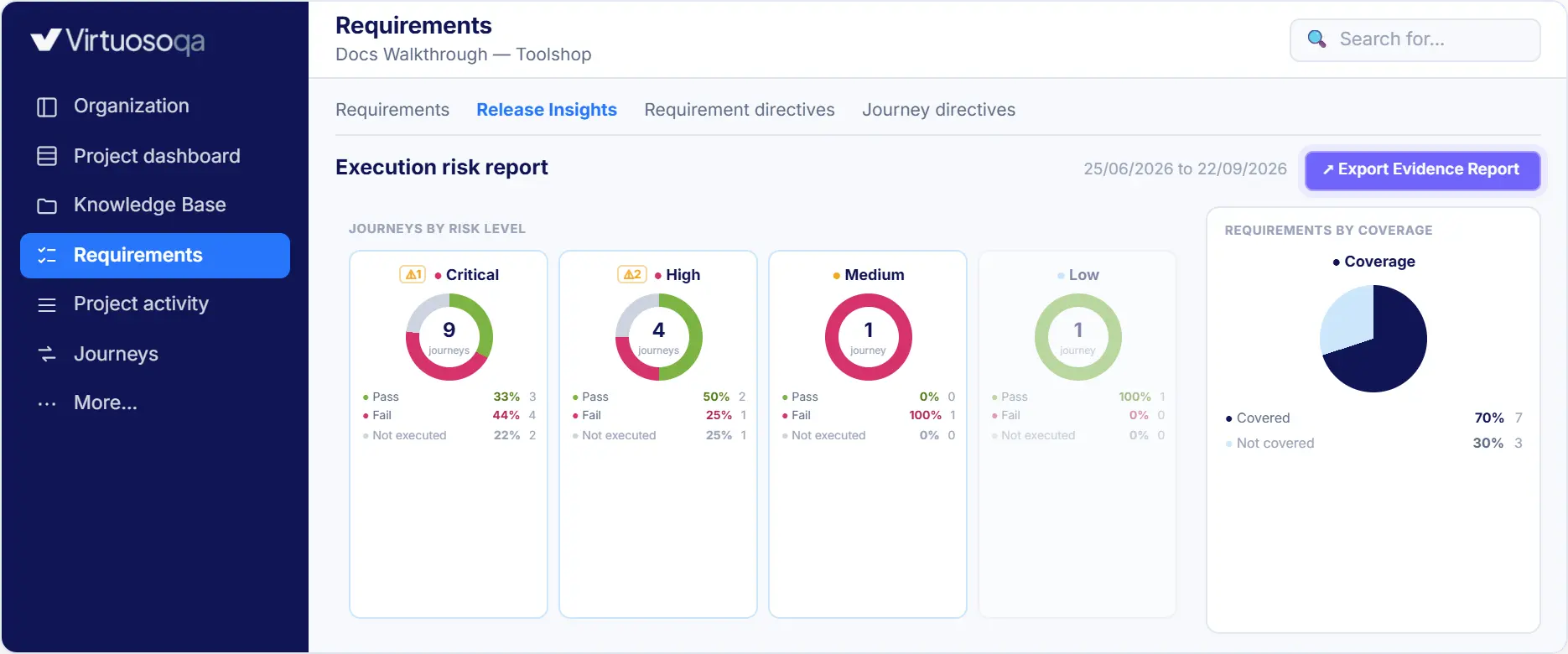

Trace each requirement back to its source, each journey back to its requirement and each execution back to the coverage it verified. Query the complete chain directly, with no manual reconstruction.

Every proposal, approval, rejection and repair is attributed to a person, with everything that change touched linked in the same history, so a decision can be traced back long after it was made.

Any two versions of a requirement or journey compare side by side. Nothing is overwritten and every earlier version stays recoverable, so a change can be reviewed against what it replaced.

Every flag, proposal and result links to the exact review surface, fan-outs collapse into digests rather than notification storms, and pending decisions sit in one list.
What the Release Evidence Contains
Trace each requirement back to its source, each journey back to its requirement and each execution back to the coverage it verified. Query the complete chain directly, with no manual reconstruction.
Every proposal, approval, rejection and repair is attributed to a person, with everything that change touched linked in the same history, so a decision can be traced back long after it was made.
Any two versions of a requirement or journey compare side by side. Nothing is overwritten and every earlier version stays recoverable, so a change can be reviewed against what it replaced.
Every flag, proposal and result links to the exact review surface, fan-outs collapse into digests rather than notification storms, and pending decisions sit in one list.
What the Release Evidence Contains
Trace each requirement back to its source, each journey back to its requirement and each execution back to the coverage it verified. Query the complete chain directly, with no manual reconstruction.
Every proposal, approval, rejection and repair is attributed to a person, with everything that change touched linked in the same history, so a decision can be traced back long after it was made.
Any two versions of a requirement or journey compare side by side. Nothing is overwritten and every earlier version stays recoverable, so a change can be reviewed against what it replaced.
Every flag, proposal and result links to the exact review surface, fan-outs collapse into digests rather than notification storms, and pending decisions sit in one list.
What the Release Evidence Contains
Trace each requirement back to its source, each journey back to its requirement and each execution back to the coverage it verified. Query the complete chain directly, with no manual reconstruction.
Every proposal, approval, rejection and repair is attributed to a person, with everything that change touched linked in the same history, so a decision can be traced back long after it was made.
Any two versions of a requirement or journey compare side by side. Nothing is overwritten and every earlier version stays recoverable, so a change can be reviewed against what it replaced.
Every flag, proposal and result links to the exact review surface, fan-outs collapse into digests rather than notification storms, and pending decisions sit in one list.
What the Evidence Becomes Over Time
Every decision your team makes inside the loop is evidenced, meaning what was approved, what was repaired, what was rejected and why. Over the coming releases that record becomes intelligence. Autonomous QA Intelligence will learn your application's intent, execution history and change patterns, and take on more of the QA decision over time, under the same governance rather than beyond it. The loop you run today is what earns it.
What the Evidence Becomes Over Time
Every decision your team makes inside the loop is evidenced, meaning what was approved, what was repaired, what was rejected and why. Over the coming releases that record becomes intelligence. Autonomous QA Intelligence will learn your application's intent, execution history and change patterns, and take on more of the QA decision over time, under the same governance rather than beyond it. The loop you run today is what earns it.
What the Evidence Becomes Over Time
Every decision your team makes inside the loop is evidenced, meaning what was approved, what was repaired, what was rejected and why. Over the coming releases that record becomes intelligence. Autonomous QA Intelligence will learn your application's intent, execution history and change patterns, and take on more of the QA decision over time, under the same governance rather than beyond it. The loop you run today is what earns it.
AI-native, proven in production.
10x
Faster execution
9x
Faster authoring
85%
Less maintenance
50%
Lower QA cost
AI-native, proven in production.
10x
Faster execution
9x
Faster authoring
85%
Less maintenance
50%
Lower QA cost
AI-native, proven in production.
10x
Faster execution
9x
Faster authoring
85%
Less maintenance
50%
Lower QA cost
Proven where quality and accountability matter
Recognized by independent analysts, trusted by enterprise teams, and built with the security controls required for critical software.

WAVE STRONG PERFORMER
Proven where quality and accountability matter
Recognized by independent analysts, trusted by enterprise teams, and built with the security controls required for critical software.
WAVE STRONG PERFORMER
Proven where quality and accountability matter
Recognized by independent analysts, trusted by enterprise teams, and built with the security controls required for critical software.
WAVE STRONG PERFORMER
Frequently Asked Questions
How Touchstone works in practice, from what each agent produces to what your team still approves.
What is Touchstone?
What do the three Touchstone agents do?
What happens when a specification changes?
Does test execution depend on the AI?
What does the evidence include?
Frequently Asked Questions
How Touchstone works in practice, from what each agent produces to what your team still approves.
What is Touchstone?
What do the three Touchstone agents do?
What happens when a specification changes?
Does test execution depend on the AI?
What does the evidence include?
Frequently Asked Questions
How Touchstone works in practice, from what each agent produces to what your team still approves.
What is Touchstone?
What do the three Touchstone agents do?
What happens when a specification changes?
Does test execution depend on the AI?
What does the evidence include?

See what your next release looks like with Virtuoso
Book a walkthrough on your applications and your workflows. Bring a requirement, a user journey, or a brittle Selenium script, and watch the loop run on something you recognise.
See what your next release looks like with Virtuoso
Book a walkthrough on your applications and your workflows. Bring a requirement, a user journey, or a brittle Selenium script, and watch the loop run on something you recognise.
See what your next release looks like with Virtuoso
Book a walkthrough on your applications and your workflows. Bring a requirement, a user journey, or a brittle Selenium script, and watch the loop run on something you recognise.
AICPA
SOC

WAVE STRONG PERFORMER
@ Copyright 2026 SpotQA, Creators of Virtuoso QA
AICPA
SOC
WAVE STRONG PERFORMER
@ Copyright 2026 SpotQA, Creators of Virtuoso QA
AICPA
SOC
WAVE STRONG PERFORMER
@ Copyright 2026 SpotQA, Creators of Virtuoso QA