Autonomous QA Intelligence for the Enterprise Estate
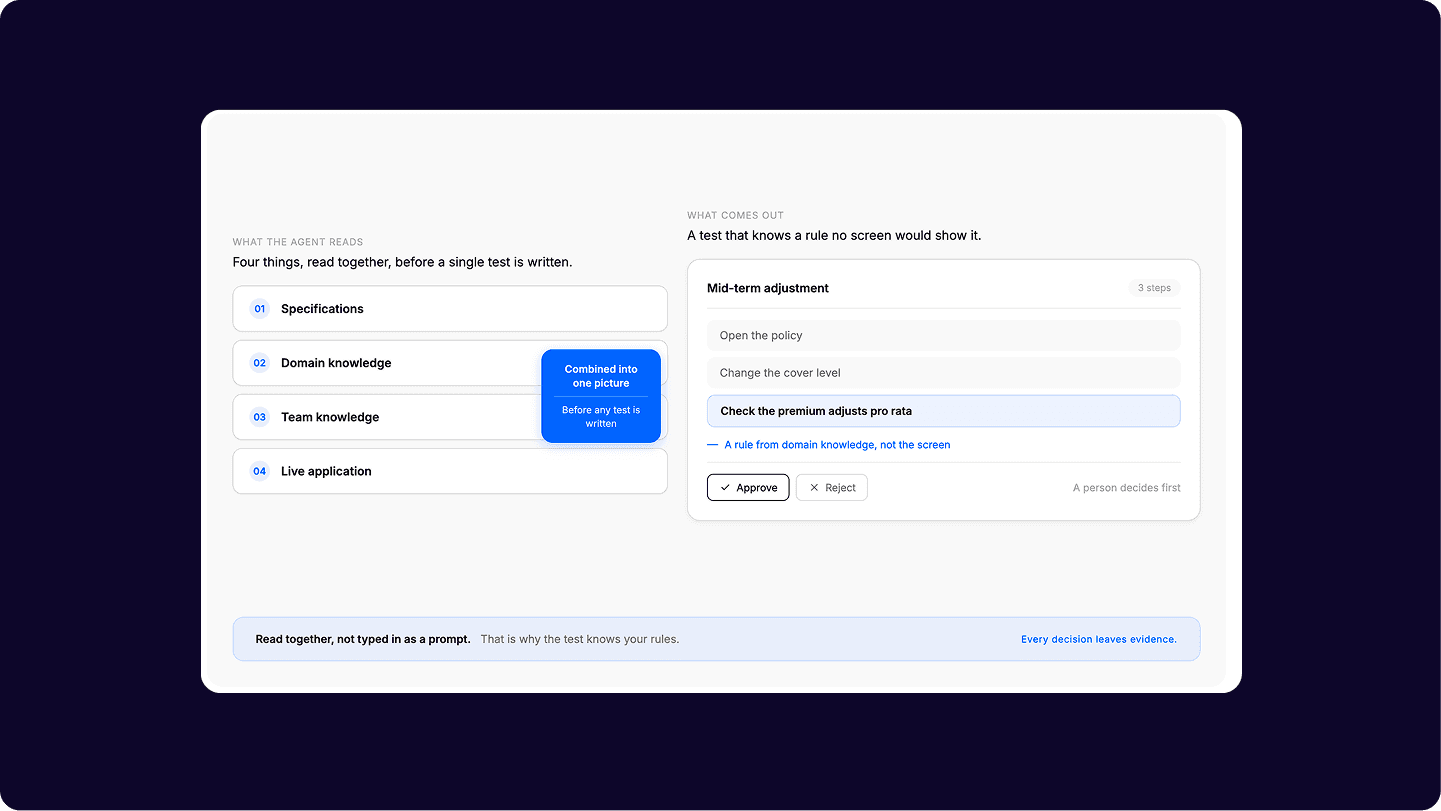
A test suite is a static asset that decays as your application changes. Autonomous testing is where Virtuoso QA is going, a platform that will learn your application release after release, remember every decision your team makes, and take on more of the QA work over time, under the same governance rather than beyond it.
Autonomous QA Intelligence for the Enterprise Estate
A test suite is a static asset that decays as your application changes. Autonomous testing is where Virtuoso QA is going, a platform that will learn your application release after release, remember every decision your team makes, and take on more of the QA work over time, under the same governance rather than beyond it.
Autonomous QA Intelligence for the Enterprise Estate
A test suite is a static asset that decays as your application changes. Autonomous testing is where Virtuoso QA is going, a platform that will learn your application release after release, remember every decision your team makes, and take on more of the QA work over time, under the same governance rather than beyond it.
Used by the world's leading companies






Used by the world's leading companies
Used by the world's leading companies
Used by the world's leading companies
What Enterprise Test Suites Cannot Do Today
Most platforms keep the tests and discard everything that explains them. The suite survives, the reasoning behind it does not, and each release starts from the same blank position as the one before it.
Coverage decays without failing
A suite built for one version of the product keeps passing as the product moves, so what is checked drifts from what matters and nothing signals it.

Decisions leave no trace
What a team approved, repaired or rejected, and why, sits in people's heads and in tickets nobody reopens, so the same judgement is made again next quarter.

Every platform starts from nothing
A tool that forgets each sprint cannot get better at your application, only faster at producing tests for it.

What Enterprise Test Suites Cannot Do Today
Most platforms keep the tests and discard everything that explains them. The suite survives, the reasoning behind it does not, and each release starts from the same blank position as the one before it.
Coverage decays without failing
A suite built for one version of the product keeps passing as the product moves, so what is checked drifts from what matters and nothing signals it.
Decisions leave no trace
What a team approved, repaired or rejected, and why, sits in people's heads and in tickets nobody reopens, so the same judgement is made again next quarter.
Every platform starts from nothing
A tool that forgets each sprint cannot get better at your application, only faster at producing tests for it.
What Enterprise Test Suites Cannot Do Today
Most platforms keep the tests and discard everything that explains them. The suite survives, the reasoning behind it does not, and each release starts from the same blank position as the one before it.
Coverage decays without failing
A suite built for one version of the product keeps passing as the product moves, so what is checked drifts from what matters and nothing signals it.
Decisions leave no trace
What a team approved, repaired or rejected, and why, sits in people's heads and in tickets nobody reopens, so the same judgement is made again next quarter.
Every platform starts from nothing
A tool that forgets each sprint cannot get better at your application, only faster at producing tests for it.
What Virtuoso QA Records on Every Release
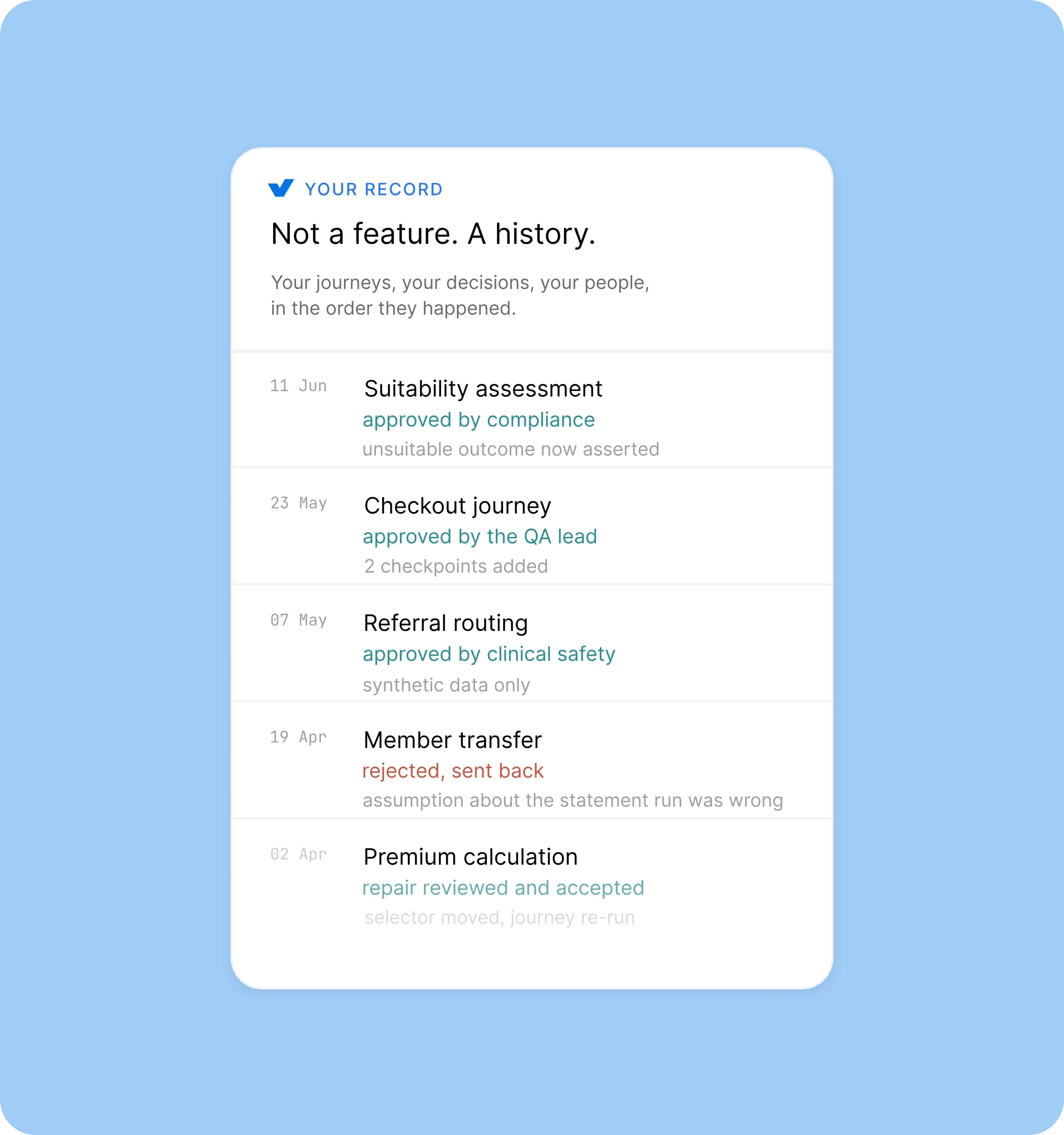
Everything Autonomous QA Intelligence will be built from is already accumulating inside the governed loop your team runs today. None of it is a separate exercise or an extra step, since the record is produced by the work itself as requirements are approved, journeys are built and runs complete.

Provenance on every artefact
Which source produced which requirement, and which requirement produced which journey, is recorded rather than inferred afterwards.

Attribution on every decision
What was approved, what was repaired, what was rejected and by whom is captured as the work happens.

Versions kept and comparable
Every accepted change creates a version, previous versions stay available for comparison, and rollback is a reviewed change rather than a quiet revert.

Reproducible runs
Approved journeys run the defined steps on a deterministic engine, so a result can be compared against the run before it rather than reinterpreted.
What Virtuoso QA Records on Every Release
Everything Autonomous QA Intelligence will be built from is already accumulating inside the governed loop your team runs today. None of it is a separate exercise or an extra step, since the record is produced by the work itself as requirements are approved, journeys are built and runs complete.
Provenance on every artefact
Which source produced which requirement, and which requirement produced which journey, is recorded rather than inferred afterwards.
Attribution on every decision
What was approved, what was repaired, what was rejected and by whom is captured as the work happens.
Versions kept and comparable
Every accepted change creates a version, previous versions stay available for comparison, and rollback is a reviewed change rather than a quiet revert.
Reproducible runs
Approved journeys run the defined steps on a deterministic engine, so a result can be compared against the run before it rather than reinterpreted.
What Virtuoso QA Records on Every Release
Everything Autonomous QA Intelligence will be built from is already accumulating inside the governed loop your team runs today. None of it is a separate exercise or an extra step, since the record is produced by the work itself as requirements are approved, journeys are built and runs complete.
Provenance on every artefact
Which source produced which requirement, and which requirement produced which journey, is recorded rather than inferred afterwards.
Attribution on every decision
What was approved, what was repaired, what was rejected and by whom is captured as the work happens.
Versions kept and comparable
Every accepted change creates a version, previous versions stay available for comparison, and rollback is a reviewed change rather than a quiet revert.
Reproducible runs
Approved journeys run the defined steps on a deterministic engine, so a result can be compared against the run before it rather than reinterpreted.
What Virtuoso QA Records on Every Release
Everything Autonomous QA Intelligence will be built from is already accumulating inside the governed loop your team runs today. None of it is a separate exercise or an extra step, since the record is produced by the work itself as requirements are approved, journeys are built and runs complete.
Provenance on every artefact
Which source produced which requirement, and which requirement produced which journey, is recorded rather than inferred afterwards.
Attribution on every decision
What was approved, what was repaired, what was rejected and by whom is captured as the work happens.
Versions kept and comparable
Every accepted change creates a version, previous versions stay available for comparison, and rollback is a reviewed change rather than a quiet revert.
Reproducible runs
Approved journeys run the defined steps on a deterministic engine, so a result can be compared against the run before it rather than reinterpreted.
The Four Layers Virtuoso QA Will Learn From
Autonomous QA Intelligence will organise that record into an understanding of your application, four layers deep. Each layer answers a different question, and each deepens with every release your team puts through the loop.
Intent
What your application is meant to do, learned from the requirements, source documents and standards your team already maintains.
Execution
What actually happens when the application runs, learned from every deterministic run against every environment and dataset.
Change and risk
What changes, how often and what it reaches, learned from every impact traced and every vendor release the estate absorbs.
Historical decisions
What your team approved, repaired and rejected, learned from the judgement no general model can supply.

The Four Layers Virtuoso QA Will Learn From
Autonomous QA Intelligence will organise that record into an understanding of your application, four layers deep. Each layer answers a different question, and each deepens with every release your team puts through the loop.
Intent
What your application is meant to do, learned from the requirements, source documents and standards your team already maintains.
Execution
What actually happens when the application runs, learned from every deterministic run against every environment and dataset.
Change and risk
What changes, how often and what it reaches, learned from every impact traced and every vendor release the estate absorbs.
Historical decisions
What your team approved, repaired and rejected, learned from the judgement no general model can supply.
The Four Layers Virtuoso QA Will Learn From
Autonomous QA Intelligence will organise that record into an understanding of your application, four layers deep. Each layer answers a different question, and each deepens with every release your team puts through the loop.
Intent
What your application is meant to do, learned from the requirements, source documents and standards your team already maintains.
Execution
What actually happens when the application runs, learned from every deterministic run against every environment and dataset.
Change and risk
What changes, how often and what it reaches, learned from every impact traced and every vendor release the estate absorbs.
Historical decisions
What your team approved, repaired and rejected, learned from the judgement no general model can supply.
How Virtuoso QA Keeps Autonomy Under Enterprise Control
The controls that autonomy will grow inside are live now rather than planned. Each of them already governs what the agents propose today, which is why more autonomy will not mean a different approval model, only more decisions arriving through the same one.

Reviewable
Every proposal is visible before it takes effect, with the reasoning behind it attached so a reviewer can judge it rather than accept it.

Recorded
The change, the approver and everything it touched stay linked in one history, so a decision can be traced back long after it was made.

Reversible
Anything approved can be rolled back as a reviewed change, without rebuilding the suite or losing the record of what was reverted.

Bounded
Each new decision the platform takes on has to be reviewable, recorded and reversible, so autonomy is earned rather than assumed.
How Virtuoso QA Keeps Autonomy Under Enterprise Control
The controls that autonomy will grow inside are live now rather than planned. Each of them already governs what the agents propose today, which is why more autonomy will not mean a different approval model, only more decisions arriving through the same one.
Reviewable
Every proposal is visible before it takes effect, with the reasoning behind it attached so a reviewer can judge it rather than accept it.
Recorded
The change, the approver and everything it touched stay linked in one history, so a decision can be traced back long after it was made.
Reversible
Anything approved can be rolled back as a reviewed change, without rebuilding the suite or losing the record of what was reverted.
Bounded
Each new decision the platform takes on has to be reviewable, recorded and reversible, so autonomy is earned rather than assumed.
How Virtuoso QA Keeps Autonomy Under Enterprise Control
The controls that autonomy will grow inside are live now rather than planned. Each of them already governs what the agents propose today, which is why more autonomy will not mean a different approval model, only more decisions arriving through the same one.
Reviewable
Every proposal is visible before it takes effect, with the reasoning behind it attached so a reviewer can judge it rather than accept it.
Recorded
The change, the approver and everything it touched stay linked in one history, so a decision can be traced back long after it was made.
Reversible
Anything approved can be rolled back as a reviewed change, without rebuilding the suite or losing the record of what was reverted.
Bounded
Each new decision the platform takes on has to be reviewable, recorded and reversible, so autonomy is earned rather than assumed.
Where Virtuoso QA is Taking Enterprise Autonomous Testing
The destination is a system that holds bounded QA decisions across the lifecycle with full traceability, watching change arrive, knowing what it threatens, proposing what to verify, executing deterministically and presenting your team with decisions rather than chores.

Where Virtuoso QA is Taking Enterprise Autonomous Testing
The destination is a system that holds bounded QA decisions across the lifecycle with full traceability, watching change arrive, knowing what it threatens, proposing what to verify, executing deterministically and presenting your team with decisions rather than chores.
Where Virtuoso QA is Taking Enterprise Autonomous Testing
The destination is a system that holds bounded QA decisions across the lifecycle with full traceability, watching change arrive, knowing what it threatens, proposing what to verify, executing deterministically and presenting your team with decisions rather than chores.
Why Virtuoso QA Gets Stronger on Your Estate
Any vendor can ship an agent. What no competitor can replicate is the understanding a platform builds from your releases, meaning your intent, your execution history, your change patterns and your team's decisions. That accumulates one way only, by running your loop.
Why Virtuoso QA Gets Stronger on Your Estate
Any vendor can ship an agent. What no competitor can replicate is the understanding a platform builds from your releases, meaning your intent, your execution history, your change patterns and your team's decisions. That accumulates one way only, by running your loop.
Why Virtuoso QA Gets Stronger on Your Estate
Any vendor can ship an agent. What no competitor can replicate is the understanding a platform builds from your releases, meaning your intent, your execution history, your change patterns and your team's decisions. That accumulates one way only, by running your loop.
Explore Related Virtuoso QA Solutions
Agents propose requirements, journeys and repairs, and your team approves what enters the suite.
Agents propose requirements, journeys and repairs, and your team approves what enters the suite.
Build coverage from your documentation
Specifications, stories and process documents become source-cited requirements and proposed journeys.
Explore Related Virtuoso QA Solutions
Agents propose requirements, journeys and repairs, and your team approves what enters the suite.
Agents propose requirements, journeys and repairs, and your team approves what enters the suite.
Build coverage from your documentation
Specifications, stories and process documents become source-cited requirements and proposed journeys.
Explore Related Virtuoso QA Solutions
Agents propose requirements, journeys and repairs, and your team approves what enters the suite.
Agents propose requirements, journeys and repairs, and your team approves what enters the suite.
Build coverage from your documentation
Specifications, stories and process documents become source-cited requirements and proposed journeys.
AI-native, proven in production.
10x
Faster execution
9x
Faster authoring
85%
Less maintenance
50%
Lower QA cost
AI-native, proven in production.
10x
Faster execution
9x
Faster authoring
85%
Less maintenance
50%
Lower QA cost
AI-native, proven in production.
10x
Faster execution
9x
Faster authoring
85%
Less maintenance
50%
Lower QA cost
Proven where quality and accountability matter
Recognised by independent analysts, trusted by enterprise teams, and built with the security controls required for critical software.

WAVE STRONG PERFORMER
Proven where quality and accountability matter
Recognised by independent analysts, trusted by enterprise teams, and built with the security controls required for critical software.
WAVE STRONG PERFORMER
Proven where quality and accountability matter
Recognised by independent analysts, trusted by enterprise teams, and built with the security controls required for critical software.
WAVE STRONG PERFORMER
Frequently Asked Questions
How Autonomous QA Intelligence relates to what Virtuoso QA does today, and what stays under your approval as autonomy grows.
What is Autonomous QA Intelligence?
How is this different from self-healing?
Does more autonomy mean less human control?
What can we see now?
Will this replace the QA team?
Frequently Asked Questions
How Autonomous QA Intelligence relates to what Virtuoso QA does today, and what stays under your approval as autonomy grows.
What is Autonomous QA Intelligence?
How is this different from self-healing?
Does more autonomy mean less human control?
What can we see now?
Will this replace the QA team?
Frequently Asked Questions
How Autonomous QA Intelligence relates to what Virtuoso QA does today, and what stays under your approval as autonomy grows.
What is Autonomous QA Intelligence?
How is this different from self-healing?
Does more autonomy mean less human control?
What can we see now?
Will this replace the QA team?

See what your next release looks like with Virtuoso
Book a walkthrough on your applications and your workflows. Bring a requirement, a user journey, or a brittle Selenium script, and watch the loop run on something you recognise.
See what your next release looks like with Virtuoso
Book a walkthrough on your applications and your workflows. Bring a requirement, a user journey, or a brittle Selenium script, and watch the loop run on something you recognise.
See what your next release looks like with Virtuoso
Book a walkthrough on your applications and your workflows. Bring a requirement, a user journey, or a brittle Selenium script, and watch the loop run on something you recognise.
AICPA
SOC

WAVE STRONG PERFORMER
@ Copyright 2026 SpotQA, Creators of Virtuoso QA
AICPA
SOC
WAVE STRONG PERFORMER
@ Copyright 2026 SpotQA, Creators of Virtuoso QA
AICPA
SOC
WAVE STRONG PERFORMER
@ Copyright 2026 SpotQA, Creators of Virtuoso QA