Agentic AI Software Testing That Produces Evidence, Not Just Tests
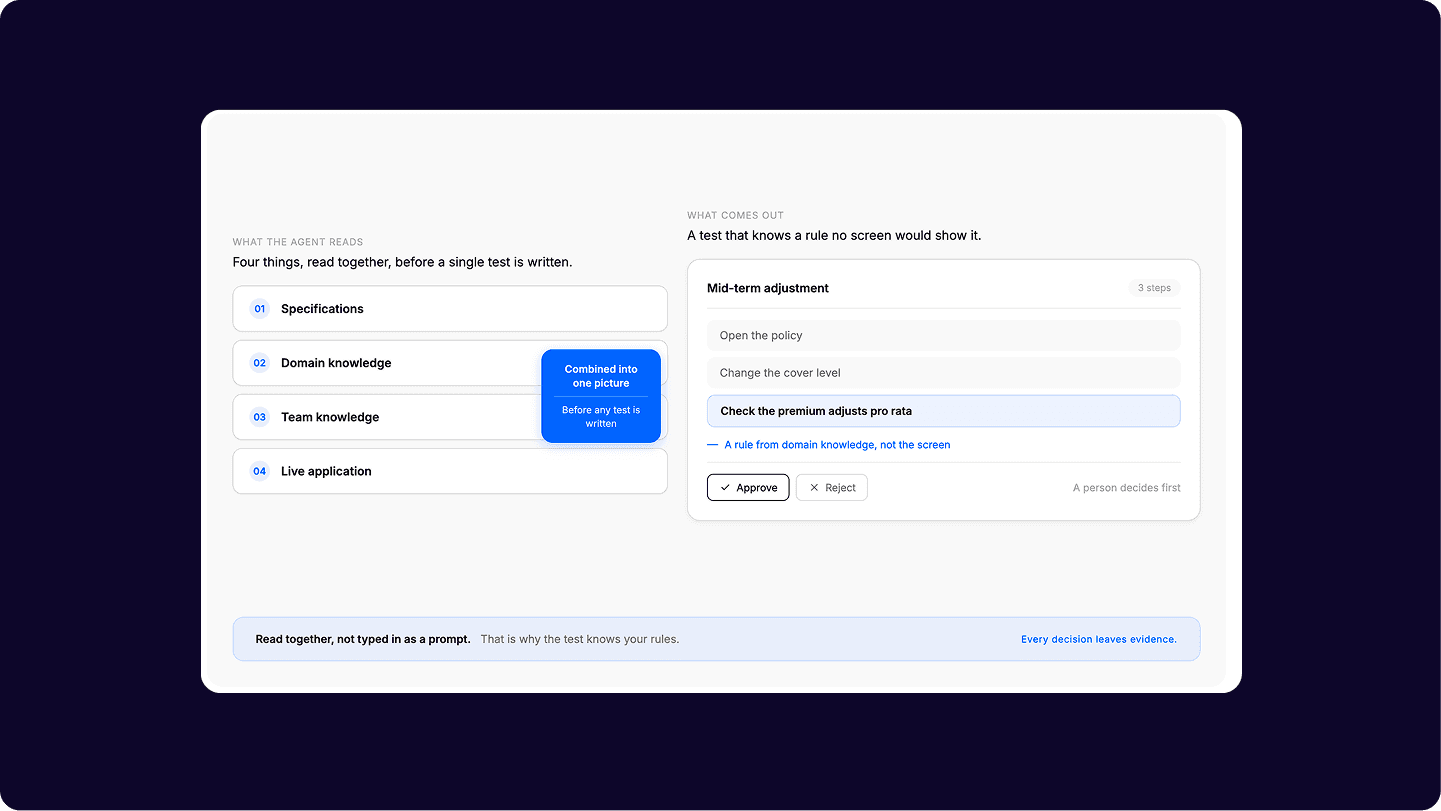
AI has changed how quickly software can be built. Testing now needs to move just as fast, without losing control. Touchstone, Virtuoso QA’s agentic testing capability, turns your documentation into source-cited requirements, suggests the journeys needed to prove them, and records every decision along the way. So every release is backed by evidence, not just confidence.
Agentic AI Software Testing That Produces Evidence, Not Just Tests
AI has changed how quickly software can be built. Testing now needs to move just as fast, without losing control. Touchstone, Virtuoso QA’s agentic testing capability, turns your documentation into source-cited requirements, suggests the journeys needed to prove them, and records every decision along the way. So every release is backed by evidence, not just confidence.
Agentic AI Software Testing That Produces Evidence, Not Just Tests
AI has changed how quickly software can be built. Testing now needs to move just as fast, without losing control. Touchstone, Virtuoso QA’s agentic testing capability, turns your documentation into source-cited requirements, suggests the journeys needed to prove them, and records every decision along the way. So every release is backed by evidence, not just confidence.
Used by the world's leading companies












Used by the world's leading companies
Used by the world's leading companies
Used by the world's leading companies
Software is No Longer the Bottleneck. Confidence is.
AI-generated code, coding agents and increasingly autonomous development have changed both the speed and the volume at which software is produced. The constraint has moved downstream.
Building Software is Not the Hardest Part
AI-generated code and autonomous development have made it faster to produce software. The harder question is whether teams can trust what has been built and know when it is ready to ship.

More AI does not answer it
A tool that generates four hundred tests in an afternoon has produced four hundred assertions nobody has reviewed and four hundred assets somebody now maintains. Generation is not verification.

Pass rates are not evidence
A green suite tells you that tests passed. It does not say which requirements were covered, what changed since, or who accepted that change.

Software is No Longer the Bottleneck. Confidence is.
AI-generated code, coding agents and increasingly autonomous development have changed both the speed and the volume at which software is produced. The constraint has moved downstream.
Building Software is Not the Hardest Part
AI-generated code and autonomous development have made it faster to produce software. The harder question is whether teams can trust what has been built and know when it is ready to ship.
More AI does not answer it
A tool that generates four hundred tests in an afternoon has produced four hundred assertions nobody has reviewed and four hundred assets somebody now maintains. Generation is not verification.
Pass rates are not evidence
A green suite tells you that tests passed. It does not say which requirements were covered, what changed since, or who accepted that change.
Software is No Longer the Bottleneck. Confidence is.
AI-generated code, coding agents and increasingly autonomous development have changed both the speed and the volume at which software is produced. The constraint has moved downstream.
Building Software is Not the Hardest Part
AI-generated code and autonomous development have made it faster to produce software. The harder question is whether teams can trust what has been built and know when it is ready to ship.
More AI does not answer it
A tool that generates four hundred tests in an afternoon has produced four hundred assertions nobody has reviewed and four hundred assets somebody now maintains. Generation is not verification.
Pass rates are not evidence
A green suite tells you that tests passed. It does not say which requirements were covered, what changed since, or who accepted that change.
Agentic Software Testing, Governed End to End
Touchstone, Virtuoso QA's agentic capability, runs as a governed loop rather than a generator. Each stage produces something reviewable, and nothing moves forward without a person accepting it.

Ingest: Bring the context the agents work from
Specifications, tickets, process documents, configuration notes and policies are ingested into a project-scoped Knowledge Base across more than thirty formats. Generic AI knows nothing about your product, your domain or your vocabulary. This is what removes that gap.

Propose: Requirements that cite their source
Structured, testable requirements are generated from that material, each carrying a citation back to the document behind it, and routed as new, updated or unchanged so a revision produces targeted work rather than a regenerated set.

Approve: The gate is structural
Requirements, journey structures and repairs all arrive as proposals. Your team accepts, edits or rejects. Approval is not a setting that can be switched off; it is how the system is built.

Verify: Journeys that prove the requirement
Approved structures are built into working steps in a real browser and validated, then executed on Virtuoso QA's deterministic engine. Agentic reasoning shapes the proposal. It plays no part in the verdict.

Record: What was proved, and who decided
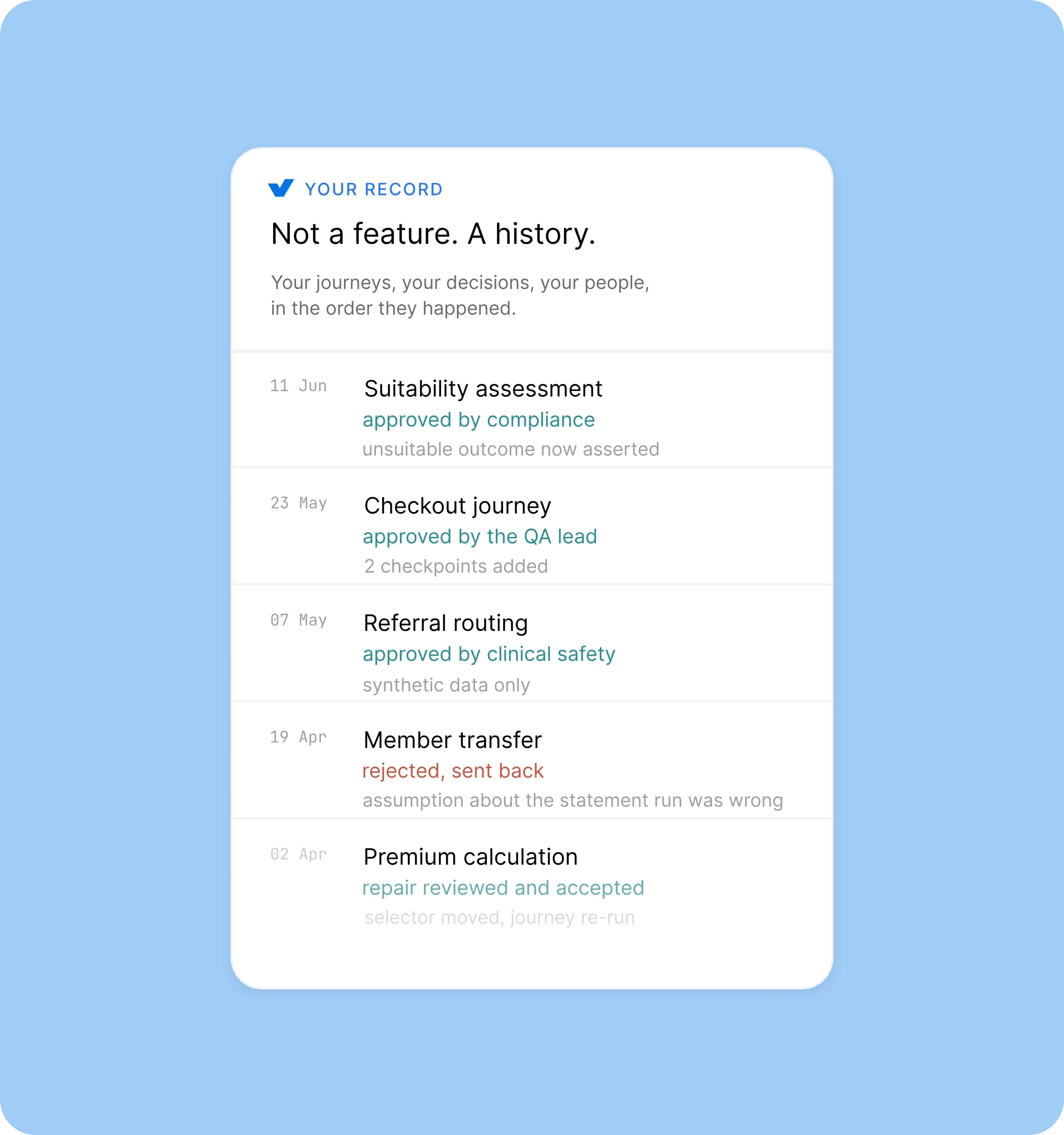
Every accepted change creates a version. Downstream assets record which upstream version they were built against. History is comparable, and rollback is itself a reviewed change rather than a silent revert.

Maintain: Change arrives as a proposal
When a source document is revised, the requirements and journeys built on it are flagged rather than silently updated, with fixes proposed as editable diffs citing the clause that moved.
Agentic Software Testing, Governed End to End
Touchstone, Virtuoso QA's agentic capability, runs as a governed loop rather than a generator. Each stage produces something reviewable, and nothing moves forward without a person accepting it.
Ingest: Bring the context the agents work from
Specifications, tickets, process documents, configuration notes and policies are ingested into a project-scoped Knowledge Base across more than thirty formats. Generic AI knows nothing about your product, your domain or your vocabulary. This is what removes that gap.
Propose: Requirements that cite their source
Structured, testable requirements are generated from that material, each carrying a citation back to the document behind it, and routed as new, updated or unchanged so a revision produces targeted work rather than a regenerated set.
Approve: The gate is structural
Requirements, journey structures and repairs all arrive as proposals. Your team accepts, edits or rejects. Approval is not a setting that can be switched off; it is how the system is built.
Verify: Journeys that prove the requirement
Approved structures are built into working steps in a real browser and validated, then executed on Virtuoso QA's deterministic engine. Agentic reasoning shapes the proposal. It plays no part in the verdict.
Record: What was proved, and who decided
Every accepted change creates a version. Downstream assets record which upstream version they were built against. History is comparable, and rollback is itself a reviewed change rather than a silent revert.
Maintain: Change arrives as a proposal
When a source document is revised, the requirements and journeys built on it are flagged rather than silently updated, with fixes proposed as editable diffs citing the clause that moved.
Agentic Software Testing, Governed End to End
Touchstone, Virtuoso QA's agentic capability, runs as a governed loop rather than a generator. Each stage produces something reviewable, and nothing moves forward without a person accepting it.
Ingest: Bring the context the agents work from
Specifications, tickets, process documents, configuration notes and policies are ingested into a project-scoped Knowledge Base across more than thirty formats. Generic AI knows nothing about your product, your domain or your vocabulary. This is what removes that gap.
Propose: Requirements that cite their source
Structured, testable requirements are generated from that material, each carrying a citation back to the document behind it, and routed as new, updated or unchanged so a revision produces targeted work rather than a regenerated set.
Approve: The gate is structural
Requirements, journey structures and repairs all arrive as proposals. Your team accepts, edits or rejects. Approval is not a setting that can be switched off; it is how the system is built.
Verify: Journeys that prove the requirement
Approved structures are built into working steps in a real browser and validated, then executed on Virtuoso QA's deterministic engine. Agentic reasoning shapes the proposal. It plays no part in the verdict.
Record: What was proved, and who decided
Every accepted change creates a version. Downstream assets record which upstream version they were built against. History is comparable, and rollback is itself a reviewed change rather than a silent revert.
Maintain: Change arrives as a proposal
When a source document is revised, the requirements and journeys built on it are flagged rather than silently updated, with fixes proposed as editable diffs citing the clause that moved.
The Agents Behind Virtuoso QA's Agentic Software Testing
Touchstone coordinates around thirty specialised agents, organised around three roles. The customer governs; the agents implement.
The Analyst
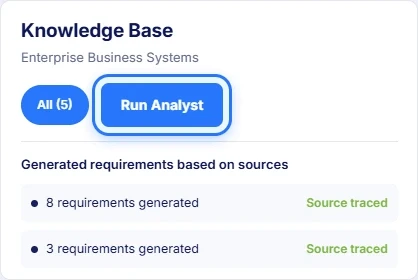
The Analyst turns your documentation into source-cited requirements, flagging ambiguity rather than filling it with an assumption. Each requirement keeps the citation behind it, so a later change can be traced to the clause that moved.
The Architect
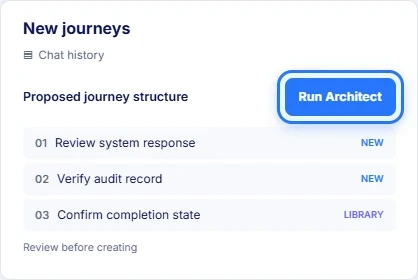
The Architect takes an approved requirement and designs the journey around it, setting the ordered checkpoints and the data scenarios it needs. Existing library checkpoints, data tables and environments are referenced before anything new is created.
The Autopilot
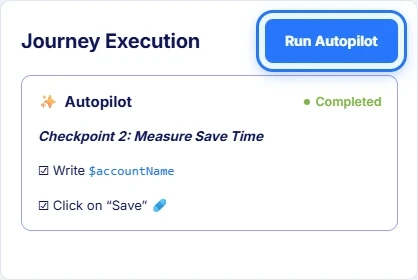
The Autopilot implements the approved structure against the target application, driving a real browser and surfacing its reasoning as it works, so a reviewer can follow what it decided and correct it rather than accepting the output on trust.
The Agents Behind Virtuoso QA's Agentic Software Testing
Touchstone coordinates around thirty specialised agents, organised around three roles. The customer governs; the agents implement.
The Analyst
The Analyst turns your documentation into source-cited requirements, flagging ambiguity rather than filling it with an assumption. Each requirement keeps the citation behind it, so a later change can be traced to the clause that moved.
The Architect
The Architect takes an approved requirement and designs the journey around it, setting the ordered checkpoints and the data scenarios it needs. Existing library checkpoints, data tables and environments are referenced before anything new is created.
The Autopilot
The Autopilot implements the approved structure against the target application, driving a real browser and surfacing its reasoning as it works, so a reviewer can follow what it decided and correct it rather than accepting the output on trust.
The Agents Behind Virtuoso QA's Agentic Software Testing
Touchstone coordinates around thirty specialised agents, organised around three roles. The customer governs; the agents implement.
The Analyst
The Analyst turns your documentation into source-cited requirements, flagging ambiguity rather than filling it with an assumption. Each requirement keeps the citation behind it, so a later change can be traced to the clause that moved.
The Architect
The Architect takes an approved requirement and designs the journey around it, setting the ordered checkpoints and the data scenarios it needs. Existing library checkpoints, data tables and environments are referenced before anything new is created.
The Autopilot
The Autopilot implements the approved structure against the target application, driving a real browser and surfacing its reasoning as it works, so a reviewer can follow what it decided and correct it rather than accepting the output on trust.
Who Virtuoso QA is Built for and Where it Fits
Virtuoso QA is built for teams where writing tests faster is not the problem. QA cannot keep pace with development, releases need evidence rather than a pass rate, AI is writing more of the code, or the people who know the product cannot get into the automation.

QA cannot keep pace with development
Teams ship more often than they can re-prove what already worked, so coverage falls behind the product it is meant to check. Virtuoso QA gives the agents the repetitive work of building and repairing journeys, so coverage grows without the team growing with it.
Releases have to be evidenced
In a regulated or business-critical estate, someone will ask what was verified before a release went out. Virtuoso QA records the requirement behind each journey, the approver of each change and the run that followed, so the answer exists before the question is asked.

AI is writing more of your code
When code is generated faster and reviewed less closely than it used to be, testing is the only place a mistake gets caught before production. Virtuoso QA keeps that layer under human approval, so what verifies the AI is not itself unchecked.

The people who know the product cannot test it
Analysts and subject matter experts understand what correct looks like, but the automation that checks it sits behind code they cannot read. Virtuoso QA journeys are written in plain English, so the person who knows the rule reviews the test that proves it.
Who Virtuoso QA is Built for and Where it Fits
Virtuoso QA is built for teams where writing tests faster is not the problem. QA cannot keep pace with development, releases need evidence rather than a pass rate, AI is writing more of the code, or the people who know the product cannot get into the automation.
QA cannot keep pace with development
Teams ship more often than they can re-prove what already worked, so coverage falls behind the product it is meant to check. Virtuoso QA gives the agents the repetitive work of building and repairing journeys, so coverage grows without the team growing with it.
Releases have to be evidenced
In a regulated or business-critical estate, someone will ask what was verified before a release went out. Virtuoso QA records the requirement behind each journey, the approver of each change and the run that followed, so the answer exists before the question is asked.
AI is writing more of your code
When code is generated faster and reviewed less closely than it used to be, testing is the only place a mistake gets caught before production. Virtuoso QA keeps that layer under human approval, so what verifies the AI is not itself unchecked.
The people who know the product cannot test it
Analysts and subject matter experts understand what correct looks like, but the automation that checks it sits behind code they cannot read. Virtuoso QA journeys are written in plain English, so the person who knows the rule reviews the test that proves it.
Who Virtuoso QA is Built for and Where it Fits
Virtuoso QA is built for teams where writing tests faster is not the problem. QA cannot keep pace with development, releases need evidence rather than a pass rate, AI is writing more of the code, or the people who know the product cannot get into the automation.
QA cannot keep pace with development
Teams ship more often than they can re-prove what already worked, so coverage falls behind the product it is meant to check. Virtuoso QA gives the agents the repetitive work of building and repairing journeys, so coverage grows without the team growing with it.
Releases have to be evidenced
In a regulated or business-critical estate, someone will ask what was verified before a release went out. Virtuoso QA records the requirement behind each journey, the approver of each change and the run that followed, so the answer exists before the question is asked.
AI is writing more of your code
When code is generated faster and reviewed less closely than it used to be, testing is the only place a mistake gets caught before production. Virtuoso QA keeps that layer under human approval, so what verifies the AI is not itself unchecked.
The people who know the product cannot test it
Analysts and subject matter experts understand what correct looks like, but the automation that checks it sits behind code they cannot read. Virtuoso QA journeys are written in plain English, so the person who knows the rule reviews the test that proves it.
Who Virtuoso QA is Built for and Where it Fits
Virtuoso QA is built for teams where writing tests faster is not the problem. QA cannot keep pace with development, releases need evidence rather than a pass rate, AI is writing more of the code, or the people who know the product cannot get into the automation.
QA cannot keep pace with development
Teams ship more often than they can re-prove what already worked, so coverage falls behind the product it is meant to check. Virtuoso QA gives the agents the repetitive work of building and repairing journeys, so coverage grows without the team growing with it.
Releases have to be evidenced
In a regulated or business-critical estate, someone will ask what was verified before a release went out. Virtuoso QA records the requirement behind each journey, the approver of each change and the run that followed, so the answer exists before the question is asked.
AI is writing more of your code
When code is generated faster and reviewed less closely than it used to be, testing is the only place a mistake gets caught before production. Virtuoso QA keeps that layer under human approval, so what verifies the AI is not itself unchecked.
The people who know the product cannot test it
Analysts and subject matter experts understand what correct looks like, but the automation that checks it sits behind code they cannot read. Virtuoso QA journeys are written in plain English, so the person who knows the rule reviews the test that proves it.
Adopt Agentic Testing Against What You Already Have
You do not start from an empty project. The documentation your organisation already produces, specifications, tickets, process notes and policies, is the input the agents work from, so the first requirements come from material that exists today. Existing checkpoints, data tables and environments are referenced by proposed journeys before anything new is created, so coverage you have built is extended rather than replaced. Your team reviews and validates every proposal before approving it for execution.

Adopt Agentic Testing Against What You Already Have
You do not start from an empty project. The documentation your organisation already produces, specifications, tickets, process notes and policies, is the input the agents work from, so the first requirements come from material that exists today. Existing checkpoints, data tables and environments are referenced by proposed journeys before anything new is created, so coverage you have built is extended rather than replaced. Your team reviews and validates every proposal before approving it for execution.
Adopt Agentic Testing Against What You Already Have
You do not start from an empty project. The documentation your organisation already produces, specifications, tickets, process notes and policies, is the input the agents work from, so the first requirements come from material that exists today. Existing checkpoints, data tables and environments are referenced by proposed journeys before anything new is created, so coverage you have built is extended rather than replaced. Your team reviews and validates every proposal before approving it for execution.
What Enterprises Get from Governed Agentic Testing
Virtuoso QA changes what coverage costs to grow, what a release decision rests on and who stays in control as the agents take on more of the work.
Verification keeps pace with development
The agents turn documentation into coverage, so the quality function stops being the thing a release waits on.

Coverage becomes answerable
Coverage is requirements with journeys behind them, each traced to a source document and a run, rather than a count of tests whose purpose nobody can reconstruct.
Release decisions rest on a record
What was verified, against which requirement version and approved by whom is retrievable rather than reassembled the week an auditor asks.
The team decides, the agents implement
Approval is structural rather than configured, so scaling agentic testing does not mean scaling the amount of unreviewed output in your estate.
What Enterprises Get from Governed Agentic Testing
Virtuoso QA changes what coverage costs to grow, what a release decision rests on and who stays in control as the agents take on more of the work.
Verification keeps pace with development
The agents turn documentation into coverage, so the quality function stops being the thing a release waits on.
Coverage becomes answerable
Coverage is requirements with journeys behind them, each traced to a source document and a run, rather than a count of tests whose purpose nobody can reconstruct.
Release decisions rest on a record
What was verified, against which requirement version and approved by whom is retrievable rather than reassembled the week an auditor asks.
The team decides, the agents implement
Approval is structural rather than configured, so scaling agentic testing does not mean scaling the amount of unreviewed output in your estate.
What Enterprises Get from Governed Agentic Testing
Virtuoso QA changes what coverage costs to grow, what a release decision rests on and who stays in control as the agents take on more of the work.
Verification keeps pace with development
The agents turn documentation into coverage, so the quality function stops being the thing a release waits on.
Coverage becomes answerable
Coverage is requirements with journeys behind them, each traced to a source document and a run, rather than a count of tests whose purpose nobody can reconstruct.
Release decisions rest on a record
What was verified, against which requirement version and approved by whom is retrievable rather than reassembled the week an auditor asks.
The team decides, the agents implement
Approval is structural rather than configured, so scaling agentic testing does not mean scaling the amount of unreviewed output in your estate.
How Virtuoso QA Compares to Generate-First and Scripted Automation
Virtuoso QA starts from your requirements rather than a prompt or a script, keeps the agents out of the execution path, and produces a record rather than a result.

Where coverage comes from
Generate-first tools produce tests from a prompt, so the output reflects the prompt rather than the requirement. Scripted automation reflects whatever the engineer understood at the time of writing. Virtuoso QA generates requirements from your documentation with citations, then builds journeys against the approved ones.
What happens when a specification changes
Generate-first tools regenerate, producing new output to review. Scripted suites notice nothing and keep passing. Virtuoso QA identifies the requirements and journeys built on the revised source and proposes updates as diffs.

What the agents do at execution
Some agentic platforms keep the agents in the run and the analysis. Virtuoso QA keeps them out of the execution path, so the same journey against the same build returns the same verdict.
What the estate produces
Generate-first tools produce tests. Scripted automation produces results. Virtuoso QA produces a record of what was verified, against which requirement and approved by whom.
How Virtuoso QA Compares to Generate-First and Scripted Automation
Virtuoso QA starts from your requirements rather than a prompt or a script, keeps the agents out of the execution path, and produces a record rather than a result.
Where coverage comes from
Generate-first tools produce tests from a prompt, so the output reflects the prompt rather than the requirement. Scripted automation reflects whatever the engineer understood at the time of writing. Virtuoso QA generates requirements from your documentation with citations, then builds journeys against the approved ones.
What happens when a specification changes
Generate-first tools regenerate, producing new output to review. Scripted suites notice nothing and keep passing. Virtuoso QA identifies the requirements and journeys built on the revised source and proposes updates as diffs.
What the agents do at execution
Some agentic platforms keep the agents in the run and the analysis. Virtuoso QA keeps them out of the execution path, so the same journey against the same build returns the same verdict.
What the estate produces
Generate-first tools produce tests. Scripted automation produces results. Virtuoso QA produces a record of what was verified, against which requirement and approved by whom.
How Virtuoso QA Compares to Generate-First and Scripted Automation
Virtuoso QA starts from your requirements rather than a prompt or a script, keeps the agents out of the execution path, and produces a record rather than a result.
Where coverage comes from
Generate-first tools produce tests from a prompt, so the output reflects the prompt rather than the requirement. Scripted automation reflects whatever the engineer understood at the time of writing. Virtuoso QA generates requirements from your documentation with citations, then builds journeys against the approved ones.
What happens when a specification changes
Generate-first tools regenerate, producing new output to review. Scripted suites notice nothing and keep passing. Virtuoso QA identifies the requirements and journeys built on the revised source and proposes updates as diffs.
What the agents do at execution
Some agentic platforms keep the agents in the run and the analysis. Virtuoso QA keeps them out of the execution path, so the same journey against the same build returns the same verdict.
What the estate produces
Generate-first tools produce tests. Scripted automation produces results. Virtuoso QA produces a record of what was verified, against which requirement and approved by whom.
How Virtuoso QA Compares to Generate-First and Scripted Automation
Virtuoso QA starts from your requirements rather than a prompt or a script, keeps the agents out of the execution path, and produces a record rather than a result.
Where coverage comes from
Generate-first tools produce tests from a prompt, so the output reflects the prompt rather than the requirement. Scripted automation reflects whatever the engineer understood at the time of writing. Virtuoso QA generates requirements from your documentation with citations, then builds journeys against the approved ones.
What happens when a specification changes
Generate-first tools regenerate, producing new output to review. Scripted suites notice nothing and keep passing. Virtuoso QA identifies the requirements and journeys built on the revised source and proposes updates as diffs.
What the agents do at execution
Some agentic platforms keep the agents in the run and the analysis. Virtuoso QA keeps them out of the execution path, so the same journey against the same build returns the same verdict.
What the estate produces
Generate-first tools produce tests. Scripted automation produces results. Virtuoso QA produces a record of what was verified, against which requirement and approved by whom.
Explore Related Virtuoso QA Solutions
Reuse what the agents build
Components created once and assembled across platforms, so generated coverage extends a library rather than growing beside it.
Open authoring beyond the automation team
Readable journeys in plain English, so analysts, manual testers and subject matter experts contribute coverage directly.
Explore Related Virtuoso QA Solutions
Reuse what the agents build
Components created once and assembled across platforms, so generated coverage extends a library rather than growing beside it.
Open authoring beyond the automation team
Readable journeys in plain English, so analysts, manual testers and subject matter experts contribute coverage directly.
Explore Related Virtuoso QA Solutions
Reuse what the agents build
Components created once and assembled across platforms, so generated coverage extends a library rather than growing beside it.
Open authoring beyond the automation team
Readable journeys in plain English, so analysts, manual testers and subject matter experts contribute coverage directly.
Al-native, proven in production.
10x
Faster execution
9x
Faster authoring
85%
Less maintenance
50%
Lower QA cost
Al-native, proven in production.
10x
Faster execution
9x
Faster authoring
85%
Less maintenance
50%
Lower QA cost
Al-native, proven in production.
10x
Faster execution
9x
Faster authoring
85%
Less maintenance
50%
Lower QA cost
Proven where quality and accountability matter
Recognized by independent analysts, trusted by enterprise teams, and built with the security controls required for critical software.

WAVE STRONG PERFORMER
Proven where quality and accountability matter
Recognized by independent analysts, trusted by enterprise teams, and built with the security controls required for critical software.
WAVE STRONG PERFORMER
Proven where quality and accountability matter
Recognized by independent analysts, trusted by enterprise teams, and built with the security controls required for critical software.
WAVE STRONG PERFORMER
Frequently Asked Questions
How agentic software testing works in Virtuoso QA, from what the agents actually do to what still needs your approval before it enters the suite.
What is agentic AI testing?
How is this Virtuoso QA from a tool that generates tests with AI?
Can we shape what the agents produce?
What happens when a requirement changes after journeys are built?
What evidence does a run actually produce?
Frequently Asked Questions
How agentic software testing works in Virtuoso QA, from what the agents actually do to what still needs your approval before it enters the suite.
What is agentic AI testing?
How is this Virtuoso QA from a tool that generates tests with AI?
Can we shape what the agents produce?
What happens when a requirement changes after journeys are built?
What evidence does a run actually produce?
Frequently Asked Questions
How agentic software testing works in Virtuoso QA, from what the agents actually do to what still needs your approval before it enters the suite.
What is agentic AI testing?
How is this Virtuoso QA from a tool that generates tests with AI?
Can we shape what the agents produce?
What happens when a requirement changes after journeys are built?
What evidence does a run actually produce?

See what your next release looks like with Virtuoso
Book a walkthrough on your applications and your workflows. Bring a requirement, a user journey, or a brittle Selenium script, and watch the loop run on something you recognise.
See what your next release looks like with Virtuoso
Book a walkthrough on your applications and your workflows. Bring a requirement, a user journey, or a brittle Selenium script, and watch the loop run on something you recognise.
See what your next release looks like with Virtuoso
Book a walkthrough on your applications and your workflows. Bring a requirement, a user journey, or a brittle Selenium script, and watch the loop run on something you recognise.

Trust Center
AICPA
SOC

WAVE STRONG PERFORMER


@ Copyright 2026 SpotQA, Creators of Virtuoso QA
Trust Center
AICPA
SOC
WAVE STRONG PERFORMER
@ Copyright 2026 SpotQA, Creators of Virtuoso QA
Trust Center
AICPA
SOC
WAVE STRONG PERFORMER
@ Copyright 2026 SpotQA, Creators of Virtuoso QA