Blog
14 Best Functional Testing Tools and Frameworks in 2026

Rishabh Kumar
Published on

Table of contents
Lorem ipsum
Lorem ipsum
Lorem ipsum
Lorem ipsum
Lorem ipsum
Functional testing validates that software applications perform specified functions correctly, meeting requirements and user expectations. Yet most organizations struggle to execute comprehensive functional validation at the speed modern development demands. Manual functional testing cannot scale to continuous delivery. Traditional automation frameworks require specialized engineering teams. In 2026, AI native functional testing platforms fundamentally transform this equation, delivering autonomous test generation, natural language test creation, and self-healing maintenance that enables comprehensive functional validation at 10x speed with 88% less effort.
This analysis examines 14 leading platforms, revealing why enterprises are migrating from traditional approaches to AI native solutions that democratize functional testing across entire QA organizations.
Understanding Functional Testing in Modern Software Development
Functional testing verifies that applications perform their intended functions according to specifications, requirements, and user stories. Unlike non-functional testing examining performance, security, or usability, functional testing focuses on what software does: calculations produce correct results, workflows complete successfully, data persists accurately, integrations function properly, and business logic executes as specified.
Why Functional Testing Defines Software Quality
Applications that perform functions incorrectly fail to deliver business value regardless of how fast they run, how beautiful they look, or how secure they are. A banking application that calculates interest incorrectly causes customer dissatisfaction and regulatory violations. An e-commerce checkout that fails to process payments loses revenue. Healthcare systems that display wrong patient data create safety risks.
Functional testing catches these critical defects before production deployment. Comprehensive functional validation ensures applications actually work, meeting the fundamental quality requirement that all other attributes depend upon.
The Functional Testing Complexity Challenge
Modern applications implement increasingly complex functionality spanning multiple systems, integrations, and business processes. A simple user action like placing an order triggers dozens of functional requirements: inventory checks, price calculations, payment processing, shipping cost determinations, tax computations, promotional code applications, customer notification, CRM updates, and analytics tracking.
Manually testing all these functional requirements for each release is impossible at continuous delivery speeds. Traditional automation frameworks enable functional test automation but require specialized engineering teams writing and maintaining thousands of lines of code. Organizations discover that functional test creation and maintenance consumes entire QA budgets, leaving insufficient resources for actually expanding coverage.
The AI Native Functional Testing Revolution
AI native platforms transform functional testing from bottleneck to competitive advantage. Natural language test creation enables anyone who understands requirements to create functional validation without coding. Autonomous test generation produces comprehensive functional test suites from specifications in hours instead of months. Self-healing maintains functional tests automatically as applications change, eliminating 88% of maintenance burden. Unified UI and API testing validates complete functional workflows in single scenarios.
The result: comprehensive functional coverage expanding continuously, executed automatically in CI/CD pipelines, maintained autonomously as applications evolve, and created by entire QA organizations rather than limited to specialized engineers.
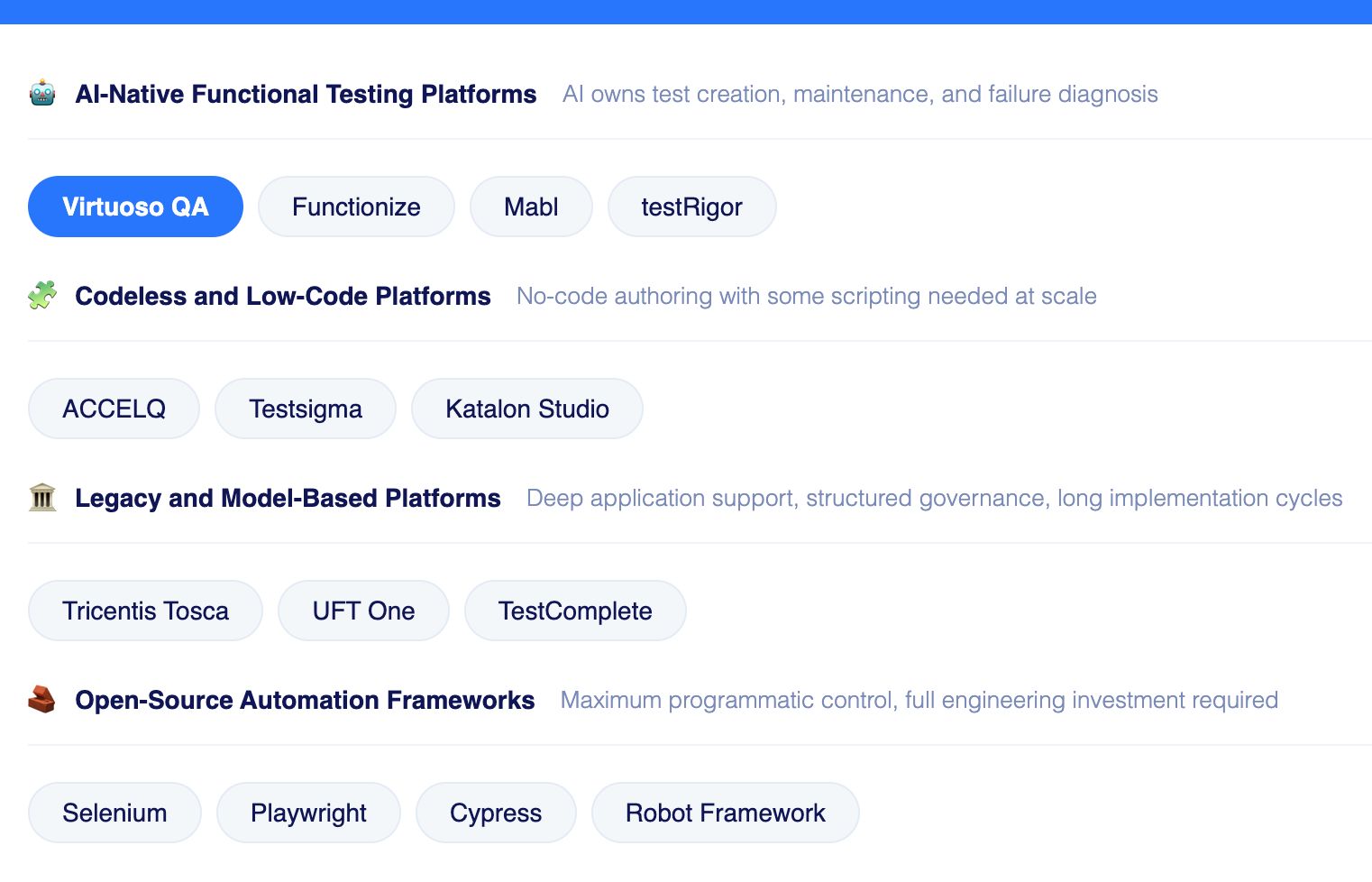
Best Functional Testing Platforms in 2026
1. Virtuoso QA: The AI Native Functional Testing Category Leader
Virtuoso QA is an AI-native functional testing platform built for enterprise web applications. Functional test scenarios are written in plain English, validated in real time as they are authored, and automatically kept current as the application changes. A single test journey verifies functional behaviour across the UI, the API response it triggers, and the database state it produces, without needing separate tools for each layer. When an interface change has no effect on functional behaviour, the platform distinguishes that from a genuine functional defect so QA teams are not chasing false failures.
Platform: Cloud SaaS
Pricing: Custom enterprise pricing
Security: SOC 2 Type 2 certified
Ratings (As of June 2026): G2: 4.5 | Gartner: 4.5
Best for: Enterprise teams that need to verify application behaviour against functional requirements without translating those requirements into code
Key Strengths:
Functional requirements and acceptance criteria written in plain English translate directly into executable tests, closing the gap between what the business specified and what gets validated
Validates functional outcomes end to end: input submitted through the UI produces the right API response, updates the correct database record, and triggers the expected downstream action
When the application interface changes without changing functional behaviour, tests adapt automatically rather than raising false functional failures
Business process functional validation spans connected enterprise systems including Salesforce, SAP, Oracle, and Guidewire in a single test journey
Live Authoring shows in real time whether a functional test step is validating what the author intended, catching coverage mistakes at authoring time
AI separates genuine functional defects from test breakage caused by interface changes, reducing triage time by approximately 75%
GENerator converts functional test suites from Selenium, UFT, Tosca, and TestComplete into Virtuoso without manually reconstructing acceptance scenarios
Watch the video to learn how to perform functional UI testing with Virtuoso QA, combining UI interactions with API calls to improve efficiency when setting up and cleaning down test data.
2. Functionize
Functionize is an AI-powered functional testing platform that generates test scenarios by analysing the application itself rather than waiting for a human to script them. Its machine learning engine processes application pages to understand element relationships and functional behaviour, then produces test cases from that analysis. When the application changes between releases, SmartFix identifies alternative element resolution strategies to keep functional scenarios running without manual rework.
Platform: Cloud SaaS
Ratings (As of June 2026): G2: 4.6 | Gartner: 4.2
Best for: Enterprise teams wanting fully autonomous UI test creation and execution driven by AI agents
Key Strengths:
Generates functional test scenarios by analysing application behaviour rather than requiring complete requirements documentation upfront
SmartFix autonomously identifies working element alternatives when functional test steps stop resolving after application changes
Visual functional checks run alongside logical functional validation in the same execution pass
Natural language authoring allows non-engineers to define functional acceptance criteria without understanding the underlying mechanics
Drawbacks:
Functional coverage limited to UI and visual layers; API contract validation and database state verification require separate tooling
No migration tooling for teams moving existing functional suites from Selenium or legacy platforms
AI augments a traditional automation foundation rather than replacing it architecturally, which limits maintenance reduction compared to AI-native platforms
3. Mabl
Mabl is a low-code functional testing platform designed for teams running continuous delivery. Functional scenarios are created through an interactive recorder, and a machine learning layer refines those scenarios over time based on execution history to keep them stable across application changes. A single test covers both UI interactions and API responses, and functional suites trigger automatically through CI/CD integrations on every code change.
Platform: Cloud SaaS
Ratings (As of June 2026): G2: 4.4 | Gartner: 4.7
Best for: Agile teams that need functional test scenarios to stay valid across frequent releases without a dedicated maintenance engineer
Key Strengths:
ML layer refines functional test stability based on execution history without requiring manual tuning between releases
UI functional validation and API functional verification combined in one test, confirming the full functional transaction completes correctly
Functional suites trigger on every code merge, turning functional validation from a release gate into a continuous quality signal
Performance anomaly detection flags functional response time deviations from baseline before they reach users
Drawbacks:
Functional validation scope covers web UI and API responses; database state and backend system functional checks need separate tooling
Not suited to functional testing of enterprise applications with complex multi-system business rules spanning ERP and legacy platforms
Business analysts who own functional requirements face a steeper learning curve than engineers when authoring scenarios
Functional test intelligence accumulated in Mabl is platform-specific and cannot be exported if the team changes tools
4. testRigor
testRigor is a cloud-based functional testing platform where scenarios are written in plain English without any reference to XPath, CSS selectors, or DOM structure. Its AI maps test instructions to application elements by visual context and semantic meaning rather than technical position, which means functional scenarios remain valid when the interface is redesigned without changing the underlying behaviour. Coverage spans web, mobile, and desktop within the same test suite.
Platform: Cloud SaaS; web, mobile, and desktop
Ratings (As of June 2026): G2: 4.7 | Gartner: 4.6
Best for: QA teams migrating away from locator-based functional testing who need acceptance criteria to survive UI redesigns without rewriting the functional suite
Key Strengths:
Functional acceptance scenarios reference what users see and what the application should do, not where elements sit in the DOM
Functional tests survive major UI framework migrations and interface redesigns without rewriting acceptance scenarios
Validates functional outcomes across authentication flows, form submissions, multi-step checkout processes, and verification triggers in one test
Functional coverage extends across web, mobile, and desktop within the same suite without switching tools
Drawbacks:
Functional scenarios with complex conditional branching or multiple interdependent data states can be difficult to express in natural language alone
Functional validation of multi-system business processes spanning external APIs and backend databases needs proof of concept before committing at scale
Pricing from approximately $900/month creates a meaningful evaluation commitment before functional programme value is established
Highly interactive or dynamically rendered functional interfaces can challenge the semantic recognition model
5. ACCELQ
ACCELQ is a codeless functional testing platform that connects automated scenarios directly to the business requirements they validate. Its Autopilot AI drafts functional test cases from requirement documentation, and a model-based component structure means updating one shared functional step propagates across every scenario that uses it. Coverage spans web, mobile, API, and desktop interactions within a single governed platform with built-in requirement traceability.
Platform: Cloud SaaS with on-premises option
Ratings: G2 (As of June 2026): G2: 4.8 | Gartner: 4.5
Best for: Enterprise teams that need functional test coverage to be traceable directly back to business requirements within a single governed platform
Key Strengths:
Each functional test scenario maps directly to the requirement or user story it validates, making functional coverage gaps visible before they become production defects
Autopilot AI reads requirement documentation and drafts functional test scenarios from it, reducing the manual translation step from specification to automation
Shared functional components mean a change to one business rule updates every scenario that validates that rule without finding each one individually
Functional defects link to the specific requirements they violate, accelerating root cause identification and defect reporting
Drawbacks:
Functional test quality generated by Autopilot depends on how clearly input requirements are written
Complex multi-system functional scenarios covering connected enterprise applications take meaningful time to configure and validate
Full feature access and pricing require a sales conversation before functional programme evaluation can begin
Teams new to model-based functional testing face an onboarding investment before reaching full productivity
6. Testsigma
Testsigma is a cloud-based scriptless functional testing platform where test scenarios are authored in simple English and executed on real devices and browsers without any infrastructure setup. An AI maintenance layer updates functional test steps when application elements change. Functional coverage spans web, mobile, and API from a single platform, removing the need to manage separate tools and suites for different application layers.
Platform: Cloud SaaS; web, mobile, API, and desktop
Ratings (As of June 2026): G2: 4.6 | Gartner: 4.7
Best for: QA teams that need to automate functional acceptance scenarios across web, mobile, and API without specialist automation engineers
Key Strengths:
Functional acceptance scenarios authored in plain English without scripting or framework knowledge
AI maintenance updates functional test steps when application elements change, keeping coverage current without manual effort
Smart test prioritisation runs functional scenarios most relevant to recent code changes first in CI/CD pipelines
Unified functional coverage across web, mobile, and API avoids managing separate functional suites per platform
Drawbacks:
Functional self-healing accuracy for complex scenarios is still maturing compared to purpose-built AI-native platforms
Functional test scenarios with deep conditional logic or highly parameterised business rules can reach the limits of natural language expression
Enterprise-scale functional programme references are fewer than established alternatives
7. Katalon Studio
Katalon Studio is a functional testing platform built on Selenium and Appium foundations that supports both visual recording and full scripting in the same environment. Teams with mixed skill levels can contribute: business-side contributors record functional scenarios while engineers extend them with scripted assertions for complex business rule validation. TestOps provides centralised execution tracking and functional coverage visibility across distributed teams.
Platform: Desktop app (Windows, macOS, Linux) plus cloud services
Ratings : G2: 4.4 | Gartner: 4.5
Best for: Teams that need both recorder-based and scripted UI test authoring in one platform across web, mobile, and API
Key Strengths:
Business analysts can record functional scenarios visually while engineers extend them with scripted assertions in the same environment
Data-driven functional testing parameterises acceptance scenarios across multiple data sets, validating business rule boundaries and edge cases systematically
TestOps centralises functional test results, requirement coverage, and execution history across distributed QA teams
Functional test suites run automatically on code changes through native CI/CD integration
Drawbacks:
Complex functional business rule validation requires scripting knowledge; not fully codeless for advanced acceptance criteria
Functional test scenarios use element locators, meaning UI changes unrelated to functional behaviour can break functional coverage
Proprietary functional test asset format makes platform migration costly once a significant suite has been built
Functional self-healing is less reliable than AI-native platforms where self-healing is architecturally central
8. Tricentis Tosca
Tricentis Tosca is an enterprise functional testing platform that generates test cases from business process models rather than from element-level scripting. It has deep native support for SAP, Oracle, and Salesforce functional workflows, and its risk-based optimisation engine selects which functional scenarios to run based on what changed in the application. Functional test governance including requirement traceability, audit trails, and compliance reporting is built into the platform.
Platform: On-premises and cloud
Ratings (As of June 2026): G2: 4.3 | Gartner: 4.5
Best for: Large enterprises running functional testing of complex ERP estates where model-based test generation and strict governance are non-negotiable
Key Strengths:
Model-based functional test generation from business process definitions rather than element-level scripting
Risk-based optimisation selects which functional scenarios to prioritise based on what changed and which business processes it affects
Deep functional testing support for SAP, Oracle, and Salesforce that validates business rule execution within those systems, not just surface UI behaviour
Complete functional test governance: requirement coverage tracking, audit trails, and compliance reporting built in
Synthetic test data management generates realistic functional test datasets for complex parameterised business scenarios
Drawbacks:
Functional programme implementation takes several months to configure correctly at enterprise scale
Total cost of ownership significantly exceeds modern AI-native alternatives delivering comparable functional coverage
Specialist training required before teams can build and maintain functional test models independently
9. OpenText UFT One
UFT One is an enterprise functional testing tool from OpenText with established support for SAP GUI, Oracle Forms, Siebel, and legacy Windows desktop applications that most modern platforms cannot automate. Functional scenarios can be built through its Business Process Testing framework, which structures tests around business workflows rather than individual UI interactions. It integrates with ALM platforms for functional requirement traceability and defect management.
Platform: Windows-based; on-premises and cloud execution options
Ratings (As of June 2026): G2: 4.3 | Gartner: 4.5
Best for: Enterprises with significant existing UFT investment in functional test suites for SAP, Oracle, Siebel, or legacy Windows desktop applications
Key Strengths:
Functional testing of SAP GUI, Oracle Forms, Siebel, and legacy Windows desktop applications that no modern functional testing platform can replicate
Business Process Testing framework structures functional scenarios around business workflows rather than individual UI interactions
VBScript and JavaScript scripting for complex functional assertion logic and conditional business rule validation
ALM integration for functional requirement traceability, coverage reporting, and defect linking
Drawbacks:
Functional tests break when interfaces change; no self-healing means functional coverage degrades silently between release cycles
Specialist VBScript and UFT expertise is increasingly scarce; functional test maintenance becomes a talent retention risk
High licensing costs and professional services make total functional programme cost significant
Limited CI/CD integration constrains how frequently functional validation can run in modern delivery pipelines
10. TestComplete
TestComplete is a commercial functional testing platform from SmartBear that covers Windows desktop, web, and mobile applications from a single environment. It supports both codeless recording and scripting across JavaScript, Python, and VBScript for functional validation of complex business logic. Its object recognition engine handles legacy Windows interfaces including WinForms and WPF that modern web-focused functional testing tools cannot reach.
Platform: Windows desktop app; web, mobile, and Windows desktop testing
Ratings (As of June 2026): G2: 4.2 | Gartner: 4.3
Best for: Windows-based organisations that need functional testing of legacy desktop applications alongside modern web interfaces from a single commercial platform
Key Strengths:
Functional testing of Windows desktop applications including WinForms and WPF that modern platforms cannot automate
Mixed codeless and scripted authoring accommodates contributors with different technical skill levels
Object recognition handles complex Windows application interfaces reliably for stable functional execution
SmartBear ecosystem connects functional execution to Zephyr for test management and defect tracking
Drawbacks:
Functional test scenarios break when interfaces change; no AI self-healing means coverage degrades silently
Functional test authoring is Windows-only; macOS and Linux teams cannot contribute to the programme
Per-user licensing and annual maintenance is among the highest functional testing TCOs available
Migrating functional test assets away from TestComplete requires substantial refactoring effort

4 Popular Functional Testing Frameworks
1. Selenium
Selenium is an open-source functional testing framework that gives engineering teams programmatic control over browser behaviour through WebDriver APIs. Functional assertions, data validations, and business rule checks are written in code, supporting Java, Python, C#, Ruby, JavaScript, and Kotlin. Selenium Grid distributes functional test execution across browser and operating system combinations in parallel. It integrates with every major CI/CD pipeline, test management platform, and BDD framework used in functional testing.
Platform: Open-source; Windows, macOS, Linux
Best for: Engineering teams with existing Selenium functional test investment or teams needing maximum programmatic control over functional assertion logic
Key Strengths:
Full programmatic control over functional assertions allows precise validation of complex business rule logic and edge case boundaries
Multi-language WebDriver support means functional tests can be written in the language the engineering team already uses
Selenium Grid distributes functional execution across browser and OS combinations in parallel
Compatible with every BDD framework, test management tool, and CI/CD pipeline used for functional testing
Drawbacks:
Every functional requirement change requires manually finding and updating every affected functional test scenario
Functional test maintenance consumes approximately 80% of team effort; new functional coverage creation gets the remaining 20%
False functional failures from UI changes unrelated to functional behaviour are a persistent source of wasted triage effort
2. Playwright
Playwright is an open-source functional testing framework from Microsoft that runs cross-browser scenarios across Chromium, Firefox, and WebKit from a single API. Browser context isolation gives each functional test a clean execution environment with no shared state from previous scenarios. Its trace viewer records every step of a functional test run, making post-failure analysis faster than older frameworks. It handles multi-tab workflows, shadow DOM, and file interactions natively within functional test scenarios.
Platform: Open-source; Node.js, Python, Java, and .NET on Windows, macOS, and Linux
Best for: Engineering teams building new functional test suites for modern web applications who need cross-browser functional validation with reliable execution and deep failure diagnostics
Key Strengths:
Browser context isolation guarantees each functional scenario runs in a clean state with no contamination from previous test data
Trace viewer records every functional test step for post-failure analysis without reproducing the failure manually
Cross-browser functional validation across Chromium, Firefox, and WebKit from a single test codebase
Handles multi-tab functional workflows, shadow DOM interactions, and file-based scenarios natively
Drawbacks:
All functional scenarios must be written in code; business analysts who own functional requirements cannot author or review tests directly
No self-healing for functional tests; every interface change affecting element resolution requires manual engineering updates
Functional framework architecture, reporting, and retry logic must all be built and maintained internally
Functional maintenance at scale requires supplementary tooling investment to remain manageable
3. Cypress
Cypress is an open-source functional testing framework that runs test scenarios inside the browser alongside the application. This gives functional tests direct access to application state and the JavaScript runtime, producing more accurate validation of asynchronous behaviour than external browser automation. Network interception allows functional testing of error-handling paths and business rule edge cases without back-end changes. It works best for functional testing of JavaScript-heavy web applications built on React, Vue, or Angular.
Platform: Open-source on Node.js; Windows, macOS, Linux
Best for: Frontend engineering teams that own functional testing of JavaScript-heavy web applications and need immediate feedback on functional behaviour during active development
Key Strengths:
Direct access to application state from inside the browser runtime produces more accurate functional validation than external simulation
Network interception enables functional testing of error-handling paths and business rule edge cases without back-end manipulation
Automatic waiting eliminates false functional failures caused by asynchronous application behaviour
Real-time test runner shows exactly which functional assertion failed and what the application state was at that moment
Drawbacks:
JavaScript and TypeScript only; business analysts and non-developer QA contributors cannot write or review functional scenarios
Single-tab architecture limits functional testing of business workflows requiring multiple browser windows
No self-healing; functional test scenarios require manual code updates when application structure changes
Large functional test suites need a cloud execution grid for practical parallel execution
4. Robot Framework
Robot Framework is an open-source keyword-driven functional testing framework that produces test scenarios in a tabular format readable by product owners and business stakeholders. Functional coverage spans UI, API, and database layers through its SeleniumLibrary, REST testing, and database integration libraries. Its readable structure supports review of functional scenario accuracy against requirements by people who are not engineers. Custom keyword libraries written in Python or Java extend coverage to functional validation logic not covered by standard libraries.
Platform: Open-source; Windows, macOS, Linux
Best for: Teams that need functional test scenarios in a structured human-readable format that business stakeholders can review for accuracy against requirements
Key Strengths:
Keyword-driven functional scenarios are readable by product owners and business stakeholders, enabling requirement-to-coverage review without engineering interpretation
SeleniumLibrary, REST testing, and database libraries cover functional validation across UI, API, and data layers from one framework
BDD-style scenario structure aligns with Given/When/Then acceptance criteria format used in agile functional requirement writing
Detailed execution logs capture every functional test step and assertion outcome for post-run analysis
Drawbacks:
Keyword libraries that execute functional business logic must be written and maintained in Python or Java; this is where engineering effort concentrates
Complex conditional business rule validation creates keyword structures that become difficult to maintain over time
No self-healing; functional test keyword resolution breaks when application interfaces change and requires manual updates
Functional test governance at scale requires team discipline to prevent keyword sprawl and duplication across the suite

Critical Capabilities for Functional Testing Platforms
Requirements Coverage and Traceability
Effective functional testing platforms provide bidirectional traceability linking tests to requirements, specifications, and user stories. Organizations need visibility into which functional requirements have comprehensive test coverage and which need additional validation. Modern platforms enable tagging tests with requirement IDs, generating coverage reports automatically, and identifying gaps requiring attention.
AI native platforms like Virtuoso QA take this further through autonomous test generation that analyzes requirements and specifications, creating functional tests that directly validate stated criteria with built-in traceability.
Test Data Management
Functional testing requires appropriate test data representing realistic scenarios. A banking application needs account balances, transaction histories, and customer profiles. E-commerce functional testing requires product catalogs, inventory levels, and customer orders. Healthcare applications need patient records, appointment schedules, and treatment plans.
Platforms providing AI-powered test data generation, integration with external data sources, data subsetting and masking capabilities, and synthetic data creation enable comprehensive functional testing without exposing production data or requiring massive manual data preparation efforts.
UI and API Functional Testing
Modern functional validation must test both user-visible behaviors and backend processing. A purchase transaction includes UI interactions users see and API operations systems execute behind the scenes. Platforms requiring separate tools for UI and API testing create fragmentation where functional validation is incomplete.
Unified platforms enabling single test scenarios that validate complete functional workflows spanning UI interactions, API calls, database updates, and external integrations provide superior functional coverage while simplifying test creation and maintenance.
Cross-Browser and Cross-Device Validation
Functional correctness must extend across all supported browsers, devices, and operating systems. Applications working correctly in Chrome but failing in Safari or mobile browsers deliver poor user experiences. Functional testing platforms must provide execution infrastructure covering browser and device matrices without organizations maintaining physical test labs.
Integration with Development Workflows
Functional testing platforms must integrate seamlessly with CI/CD pipelines, triggering automatically on code commits, executing in parallel for speed, providing instant results to development teams, and failing builds when functional validation detects regressions. Integration with issue tracking systems enables automatic defect creation for functional test failures.
Reporting and Analytics
Comprehensive reporting showing functional test execution results, trend analysis revealing functional quality over time, coverage metrics identifying functional gaps, and failure analysis enabling rapid defect resolution are essential for enterprise functional testing programs.
AI-powered root cause analysis that automatically diagnoses functional test failures, compares expected versus actual behaviors, and provides remediation recommendations dramatically accelerates defect resolution.
Transform Functional Validation with AI Native Intelligence
Functional testing validates the fundamental software quality requirement: does the application work correctly? Yet most organizations struggle to execute comprehensive functional validation at continuous delivery speeds. Manual functional testing cannot scale. Traditional automation requires specialized teams and consumes 80% effort on maintenance. Low-code platforms reduce but do not eliminate coding requirements and maintenance burdens.
AI native test platform like Virtuoso QA resolve this challenge completely. Natural language enables anyone understanding requirements to create functional tests without coding. Autonomous test generation produces comprehensive functional validation from specifications in hours. Self-healing maintains functional tests with 95% accuracy, eliminating maintenance burden. Unified testing validates complete functional workflows spanning UI and API in single scenarios.
Organizations serious about functional quality should evaluate AI native platforms immediately. The time between adoption and realized value typically spans 6 to 12 months. Delays mean competitors moving faster gain compounding advantages in release velocity, software quality, and operational efficiency.
Related Reads
Frequently Asked Questions
Can non-technical team members create functional tests?
How does AI improve functional testing?
How do you measure functional testing coverage?
What are functional testing best practices?