

Blog
Test Driven Development - Guide to TDD Principles and Practices

Published on
December 12, 2025


in Test Driven Development, developers write automated tests specifying desired behavior before writing production code implementing that behavior.
Test Driven Development (TDD) inverts traditional development workflows by writing tests before implementation code. This discipline enforces testable design, prevents defects through continuous validation, and creates living documentation demonstrating intended behavior.
While TDD originated as developer practice focused on unit testing, its underlying philosophy of quality-first thinking and continuous validation extends across all testing levels. Organizations embracing TDD at unit level increasingly recognize parallel principles apply to integration testing, end-to-end testing, and acceptance testing when supported by appropriate automation capabilities.
Test Driven Development is a software development methodology where developers write automated tests specifying desired behavior before writing production code implementing that behavior. Rather than code-then-test traditional approaches, TDD follows test-first cycles ensuring all production code exists to satisfy specific test requirements.
TDD operates through iterative Red-Green-Refactor cycles representing the discipline's core workflow:
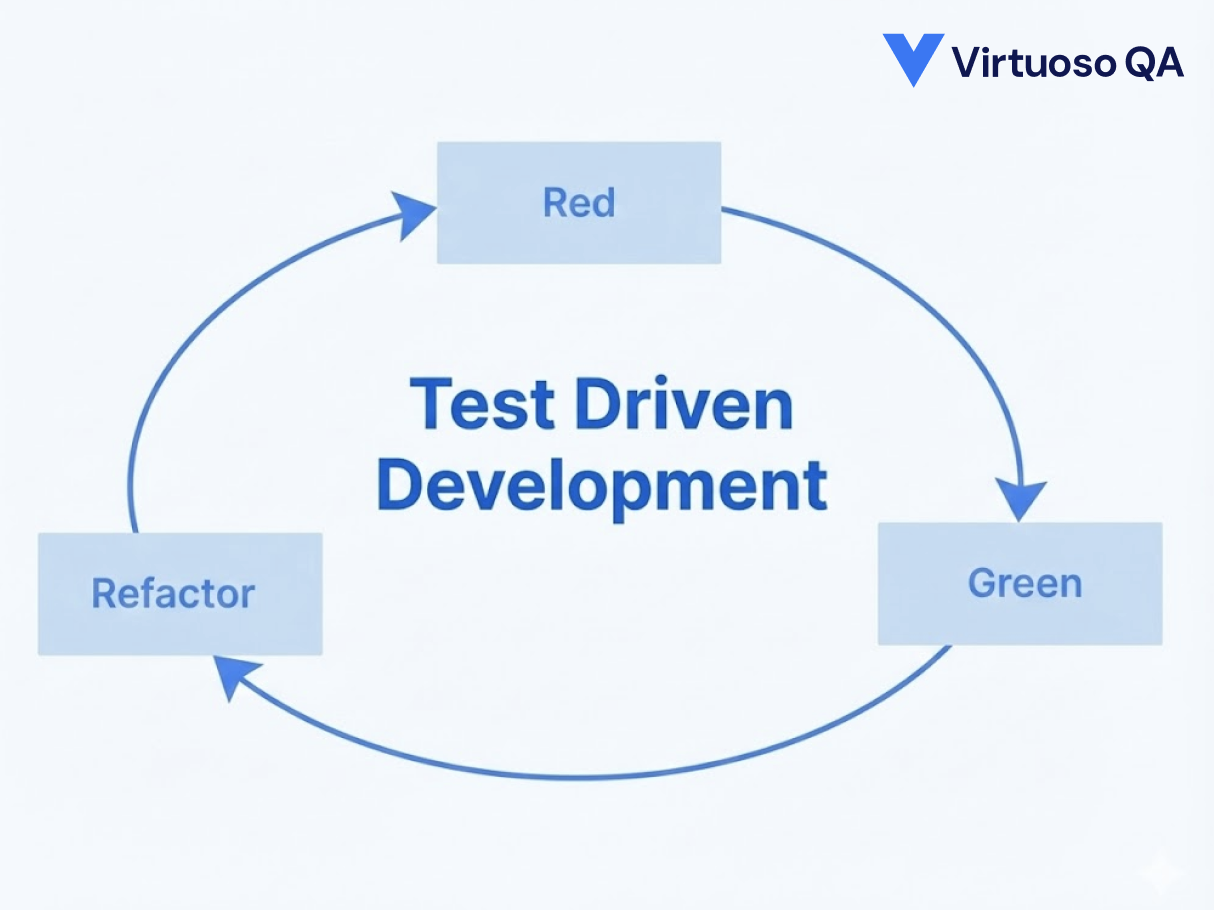
Write a failing test for functionality that doesn't yet exist. The test defines expected behavior through executable specifications. Running tests at this stage produces failures because implementation doesn't exist, hence "red" representing failed test state.
Write minimal production code necessary to make the failing test pass. Focus is satisfying test requirements rather than creating perfect implementation. The goal is reaching "green" passing test state as quickly as possible.
Improve code quality without changing behavior. With passing tests providing safety net, developers refactor implementation eliminating duplication, improving clarity, and optimizing design. Tests ensure refactoring doesn't break functionality.
This cycle repeats continuously, with each iteration adding small increments of tested functionality. Over time, these micro-cycles compound into comprehensive test suites and robust production code.
While TDD traditionally focuses on unit testing where developers test individual functions or methods, TDD principles extend to other testing levels:
Developers write unit tests before implementing functions, methods, or classes. Tests verify isolated component behavior independent of external dependencies.
Teams write integration tests before building component interactions, ensuring modules work together correctly before integration code exists.
Collaborative practice where developers, testers, and business stakeholders define acceptance tests before implementation, ensuring features meet business requirements.
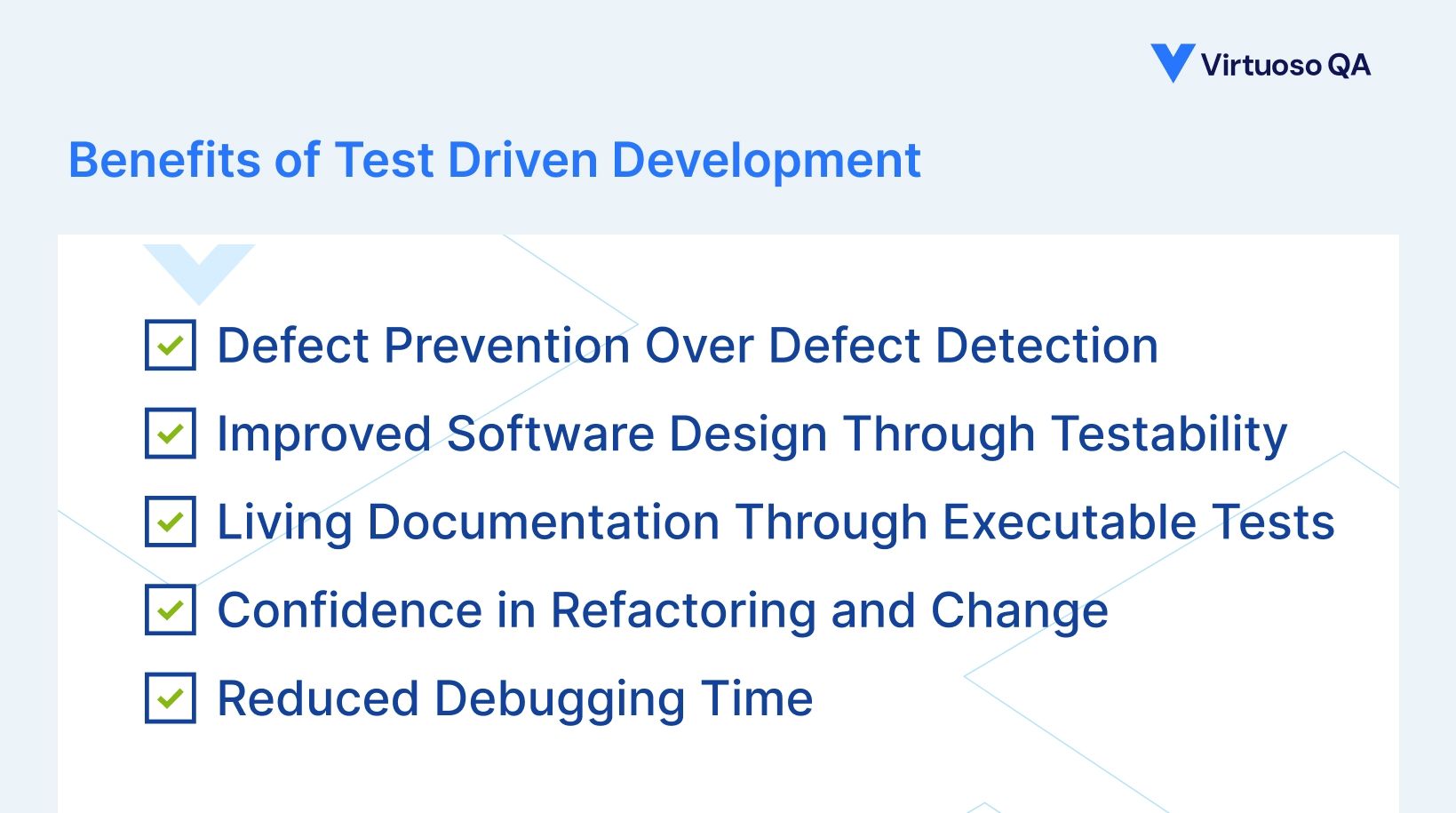
Traditional software testing detects defects after code is written. TDD prevents defects by ensuring code correctness before production code exists. When tests define requirements and code is written to satisfy those requirements, implementations inherently meet specifications.
This prevention-over-detection philosophy reduces debugging time dramatically. Rather than discovering bugs weeks after implementation when context is lost, TDD catches issues immediately when context is fresh and fixes are simple.
Writing tests before implementation forces developers to consider design testability upfront. Code designed to be testable exhibits better architectural qualities including loose coupling between components, clear interfaces and contracts, single responsibility principle adherence, and dependency injection enabling component isolation.
These testability requirements naturally guide developers toward cleaner, more maintainable designs. The act of writing tests first serves as design review before code exists.
Test suites written in TDD serve as executable documentation demonstrating how components should behave. Unlike written documentation that becomes outdated, tests remain synchronized with implementation through continuous execution. When tests pass, documentation is accurate by definition.
This living documentation particularly benefits new team members understanding codebases. Reading tests reveals intended behavior more reliably than reading implementation code where intent may be obscured.
Comprehensive test suites created through TDD provide safety nets enabling confident refactoring. Developers can improve code structure, optimize algorithms, and modernize implementations knowing tests will catch regressions immediately.
This confidence accelerates technical debt reduction and continuous improvement. Without TDD test coverage, refactoring becomes risky activity often deferred indefinitely.
When tests are written continuously alongside implementation and all tests pass consistently, bugs are caught immediately at point of introduction. Debugging becomes trivial because failures point directly to recently written code causing problems.
Traditional debugging, by contrast, involves complex detective work determining when and where bugs were introduced. The later bugs are discovered, the more expensive fixes become.

Organizations adopting TDD typically begin at unit test level where cycles are fastest and principles are clearest.
After establishing unit TDD practices, teams extend test-first principles to integration testing validating component interactions.
ATDD applies TDD principles at acceptance testing level, involving collaboration between developers, testers, and business stakeholders.
Each test should verify single behavior or requirement. Overly complex tests covering multiple scenarios become difficult to understand and maintain. When tests fail, simple focused tests clearly identify problem cause.
TDD depends on rapid feedback cycles. Slow tests discourage frequent execution, undermining TDD discipline. Unit tests should execute in milliseconds, integration tests in seconds, and full test suites in minutes at most.
Optimize for Speed: Use in-memory databases rather than actual databases, mock external services eliminating network latency, and parallelize test execution across available cores.
Tests are first-class code requiring same quality standards as production code. Poorly written tests create maintenance burden undermining TDD benefits.
Readable Tests: Tests should read as specifications, clearly expressing what is being tested and expected outcome. Good test names and clear assertion messages make test intent obvious.
Remove Test Duplication: Apply DRY (Don't Repeat Yourself) principle to test code using setup methods, helper functions, and test fixtures eliminating repetitive test code.
TDD effectiveness depends on executing tests constantly. Run affected tests after every code change, full test suite before commits, and continuous integration builds after every push.
Modern IDEs integrate test execution into development workflows, running tests automatically on file save and highlighting failures immediately.
Teams new to TDD often experience initial productivity slowdown as they learn discipline and build testing habits. Writing tests first feels counterintuitive after years of code-first approaches.
Applying TDD to existing codebases without tests presents challenges. Code not designed for testability resists testing without extensive refactoring.
As codebases grow, test suites grow proportionally. Large test suites require maintenance, especially when production code changes necessitate test updates.
TDD aligns naturally with Agile methodologies emphasizing iterative development, continuous feedback, and quality built-in rather than tested-in.
DevOps practices emphasizing automation, continuous delivery, and rapid feedback loops benefit from TDD-created test automation.
While classical TDD focuses on unit testing by developers, its underlying quality-first philosophy applies across entire testing pyramid.
Traditional TDD requires significant developer expertise and discipline. Modern testing platforms extend quality-first thinking to broader teams through capabilities reducing technical barriers.
Web application TDD combines unit testing for business logic with higher-level testing for UI behavior.
Enterprise applications like ERP systems, CRM platforms, and custom business systems require TDD adapted to complex integration scenarios.
API development particularly benefits from TDD as tests serve as contract specifications for service consumers.
Test Driven Development represents more than technical practice. It embodies quality-first philosophy where correctness is built into software from first line of code rather than verified after implementation completes.
While TDD discipline requires investment in learning and initially slows development, long-term benefits of defect prevention, improved design, and reduced debugging time create positive return compounding over software lifetime.
Organizations adopting TDD at unit test level increasingly recognize parallel principles apply across entire testing pyramid. When acceptance tests are written before features, integration tests before component interactions, and end-to-end tests before workflow implementation, quality-first thinking extends throughout delivery lifecycle.
Modern testing platforms enable this scaled quality-first approach by reducing technical barriers through natural language test authoring, accelerating test creation through AI-assisted generation, and ensuring continuous validation through automated execution in CI/CD pipelines.
The future belongs to organizations embracing quality-first thinking at all levels, from developer unit TDD to enterprise-wide continuous testing strategies.

Try Virtuoso QA in Action
See how Virtuoso QA transforms plain English into fully executable tests within seconds.
