Codeless API Testing Within End-to-End Business Journeys
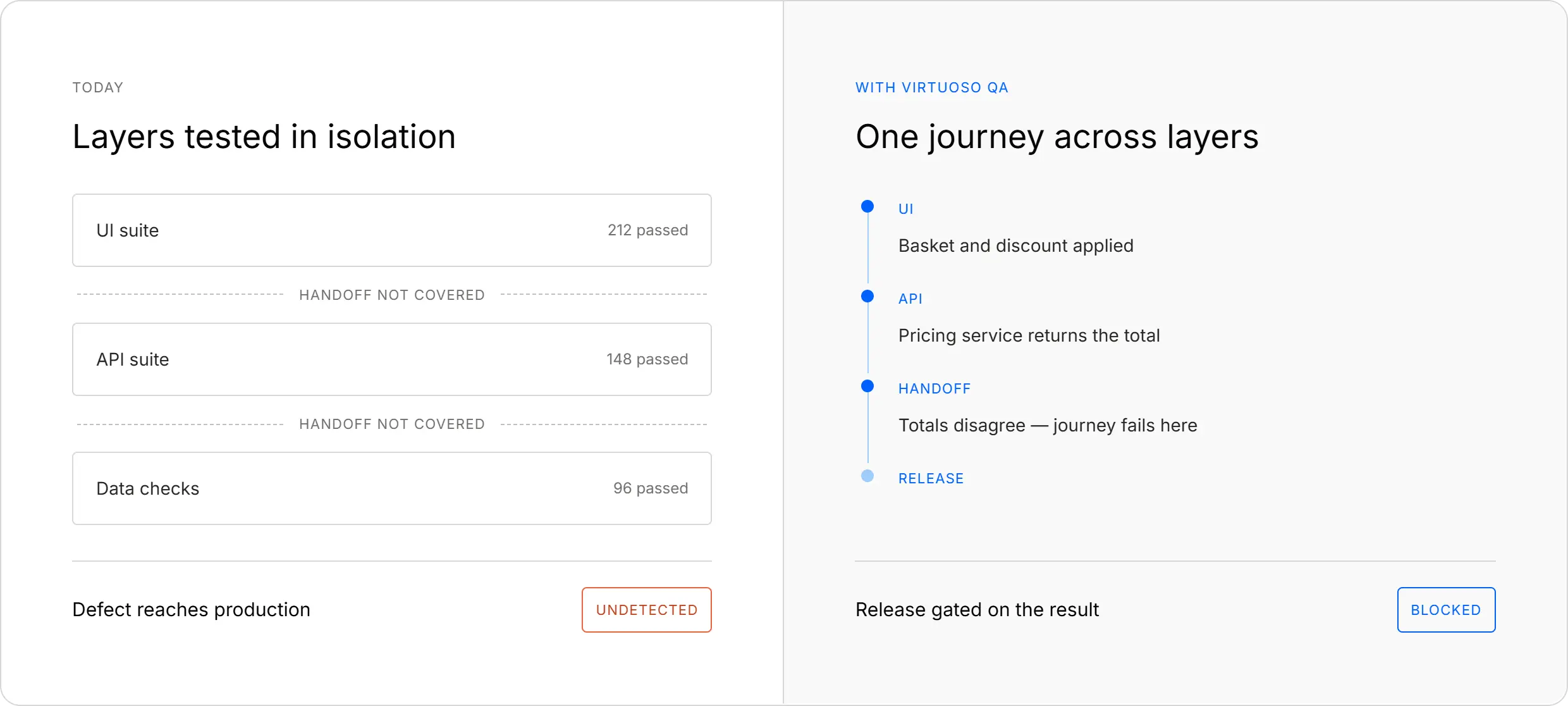
When API and interface testing are performed in separate tools, the integration points between them remain unproven. Virtuoso QA validates both within a single journey, combining API calls, data checks and user steps in plain English, so the complete business process is verified rather than each layer in isolation.
Codeless API Testing Within End-to-End Business Journeys
When API and interface testing are performed in separate tools, the integration points between them remain unproven. Virtuoso QA validates both within a single journey, combining API calls, data checks and user steps in plain English, so the complete business process is verified rather than each layer in isolation.
Codeless API Testing Within End-to-End Business Journeys
When API and interface testing are performed in separate tools, the integration points between them remain unproven. Virtuoso QA validates both within a single journey, combining API calls, data checks and user steps in plain English, so the complete business process is verified rather than each layer in isolation.
Used by the world's leading companies












Used by the world's leading companies
Used by the world's leading companies
Used by the world's leading companies
Why Separate API Testing Leaves a Gap
Running decoupled API and UI testing suites creates an architectural blind spot across application layers.
Isolated Layer Validation Hides Integration Defects
An API suite confirms an endpoint returns a 201 status, while a browser suite confirms a receipt page renders. Neither verifies that payload attributes, rounding logic, or database transactions match client state. Defect risk concentrates at these integration seams.

Opaque Test State Management Outside the Test Runner
Configuring application state relies on external setup scripts, pre-seeded databases, or manual steps. Because these preconditions exist outside the test runner, they break independently and obscure execution context.

High Maintenance Overhead of Scripted API Frameworks
Maintaining custom codebases or Postman collections with pre-request scripts introduces significant friction. Script maintenance restricts test authoring to specialized developers and caps overall coverage.

Why Separate API Testing Leaves a Gap
Running decoupled API and UI testing suites creates an architectural blind spot across application layers.
Isolated Layer Validation Hides Integration Defects
An API suite confirms an endpoint returns a 201 status, while a browser suite confirms a receipt page renders. Neither verifies that payload attributes, rounding logic, or database transactions match client state. Defect risk concentrates at these integration seams.
Opaque Test State Management Outside the Test Runner
Configuring application state relies on external setup scripts, pre-seeded databases, or manual steps. Because these preconditions exist outside the test runner, they break independently and obscure execution context.
High Maintenance Overhead of Scripted API Frameworks
Maintaining custom codebases or Postman collections with pre-request scripts introduces significant friction. Script maintenance restricts test authoring to specialized developers and caps overall coverage.
Why Separate API Testing Leaves a Gap
Running decoupled API and UI testing suites creates an architectural blind spot across application layers.
Isolated Layer Validation Hides Integration Defects
An API suite confirms an endpoint returns a 201 status, while a browser suite confirms a receipt page renders. Neither verifies that payload attributes, rounding logic, or database transactions match client state. Defect risk concentrates at these integration seams.
Opaque Test State Management Outside the Test Runner
Configuring application state relies on external setup scripts, pre-seeded databases, or manual steps. Because these preconditions exist outside the test runner, they break independently and obscure execution context.
High Maintenance Overhead of Scripted API Frameworks
Maintaining custom codebases or Postman collections with pre-request scripts introduces significant friction. Script maintenance restricts test authoring to specialized developers and caps overall coverage.
Multi-Layer API Testing as Native Journey Steps
API validation in Virtuoso QA is not a parallel suite kept in step with the interface tests. Requests, assertions, database queries and interface actions are authored in the same syntax and execute inside the same journey, so a business process is verified across every layer it touches. What follows is what that makes possible in practice.

Inline API Step Authoring
API requests use the same natural-language syntax as interface steps, residing directly within journey checkpoints. Place calls before interface steps to establish state, between checkpoints to advance the process, or after interface steps to validate the outcome, removing the need for a separate API suite.

Direct Database Verification
Query target databases mid-journey to confirm transactional changes, record creation, status updates or calculated values. Processes are verified at the persistence layer rather than on the strength of an interface success message.

Cross-Layer Variable Passing
Extract values, session tokens or transaction identifiers from an API response and reference them in later interface, database or cross-application steps. The journey follows a single record across every system layer rather than checking three unrelated things.

Centralised Library Checkpoints
Package recurring calls, such as authentication or state initialisation, into reusable library checkpoints. When an endpoint changes, the checkpoint is edited once and the journeys built on it carry the change, with version history behind it.

Full-Stack Execution Evidence
Every run captures diagnostic detail at each step: the request and response payloads for API calls, the returned rows for database queries, and DOM state, network activity and screenshots for interface steps. A failure is investigated from what was recorded rather than reproduced first.

Targeted Code Extensions
Where a step requires logic the natural-language syntax does not express, extensions allow code for that step alone. The surrounding journey stays readable and the suite does not become a code-based framework.
Multi-Layer API Testing as Native Journey Steps
API validation in Virtuoso QA is not a parallel suite kept in step with the interface tests. Requests, assertions, database queries and interface actions are authored in the same syntax and execute inside the same journey, so a business process is verified across every layer it touches. What follows is what that makes possible in practice.
Inline API Step Authoring
API requests use the same natural-language syntax as interface steps, residing directly within journey checkpoints. Place calls before interface steps to establish state, between checkpoints to advance the process, or after interface steps to validate the outcome, removing the need for a separate API suite.
Direct Database Verification
Query target databases mid-journey to confirm transactional changes, record creation, status updates or calculated values. Processes are verified at the persistence layer rather than on the strength of an interface success message.
Cross-Layer Variable Passing
Extract values, session tokens or transaction identifiers from an API response and reference them in later interface, database or cross-application steps. The journey follows a single record across every system layer rather than checking three unrelated things.
Centralised Library Checkpoints
Package recurring calls, such as authentication or state initialisation, into reusable library checkpoints. When an endpoint changes, the checkpoint is edited once and the journeys built on it carry the change, with version history behind it.
Full-Stack Execution Evidence
Every run captures diagnostic detail at each step: the request and response payloads for API calls, the returned rows for database queries, and DOM state, network activity and screenshots for interface steps. A failure is investigated from what was recorded rather than reproduced first.
Targeted Code Extensions
Where a step requires logic the natural-language syntax does not express, extensions allow code for that step alone. The surrounding journey stays readable and the suite does not become a code-based framework.
Multi-Layer API Testing as Native Journey Steps
API validation in Virtuoso QA is not a parallel suite kept in step with the interface tests. Requests, assertions, database queries and interface actions are authored in the same syntax and execute inside the same journey, so a business process is verified across every layer it touches. What follows is what that makes possible in practice.
Inline API Step Authoring
API requests use the same natural-language syntax as interface steps, residing directly within journey checkpoints. Place calls before interface steps to establish state, between checkpoints to advance the process, or after interface steps to validate the outcome, removing the need for a separate API suite.
Direct Database Verification
Query target databases mid-journey to confirm transactional changes, record creation, status updates or calculated values. Processes are verified at the persistence layer rather than on the strength of an interface success message.
Cross-Layer Variable Passing
Extract values, session tokens or transaction identifiers from an API response and reference them in later interface, database or cross-application steps. The journey follows a single record across every system layer rather than checking three unrelated things.
Centralised Library Checkpoints
Package recurring calls, such as authentication or state initialisation, into reusable library checkpoints. When an endpoint changes, the checkpoint is edited once and the journeys built on it carry the change, with version history behind it.
Full-Stack Execution Evidence
Every run captures diagnostic detail at each step: the request and response payloads for API calls, the returned rows for database queries, and DOM state, network activity and screenshots for interface steps. A failure is investigated from what was recorded rather than reproduced first.
Targeted Code Extensions
Where a step requires logic the natural-language syntax does not express, extensions allow code for that step alone. The surrounding journey stays readable and the suite does not become a code-based framework.
How a Single Journey in Virtuoso QA Validates the Interface, the API and the Database
Sign in as an administrator. Call GET /accounts and check the response contains account 12345. Query the accounts table and confirm the status is active. Open the dashboard and check the account appears in the list. That is one test. It reads as a sentence, a business analyst can review it, and it fails at the layer where the problem actually is rather than three layers above it. The same pattern covers the case most suites miss. Create the state through the API, exercise the process through the interface, then verify through the data what the process was supposed to write. Setup, action and verification in one artefact, with nothing depending on a fixture nobody maintains.

How a Single Journey in Virtuoso QA Validates the Interface, the API and the Database
Sign in as an administrator. Call GET /accounts and check the response contains account 12345. Query the accounts table and confirm the status is active. Open the dashboard and check the account appears in the list. That is one test. It reads as a sentence, a business analyst can review it, and it fails at the layer where the problem actually is rather than three layers above it. The same pattern covers the case most suites miss. Create the state through the API, exercise the process through the interface, then verify through the data what the process was supposed to write. Setup, action and verification in one artefact, with nothing depending on a fixture nobody maintains.
How a Single Journey in Virtuoso QA Validates the Interface, the API and the Database
Sign in as an administrator. Call GET /accounts and check the response contains account 12345. Query the accounts table and confirm the status is active. Open the dashboard and check the account appears in the list. That is one test. It reads as a sentence, a business analyst can review it, and it fails at the layer where the problem actually is rather than three layers above it. The same pattern covers the case most suites miss. Create the state through the API, exercise the process through the interface, then verify through the data what the process was supposed to write. Setup, action and verification in one artefact, with nothing depending on a fixture nobody maintains.
Where Our Agentic AI Fits Into Codeless API Testing
Touchstone, Virtuoso QA's agentic testing capability, generates requirements from your documentation and proposes the journey structures that prove them. For API coverage specifically, two things about how it works matter.
API Definitions as Requirement Sources
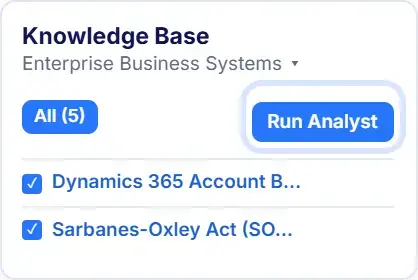
API definitions are ingested into the Knowledge Base alongside process specifications and stories. Requirements generated from them cite both the business process and the service definition behind it, so the link holds when either one changes.
Review Objective Before an API Call
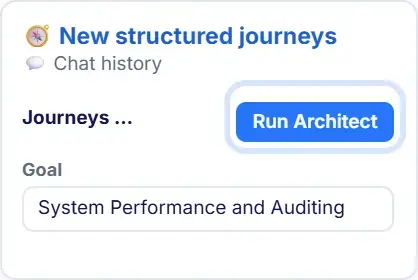
Touchstone proposes journey structures as ordered checkpoints, each carrying a stated objective, before any steps are generated. Your team reviews the functional intent first, then Autopilot builds the steps against your live application.
Every Layer Approved, Every Run Deterministic
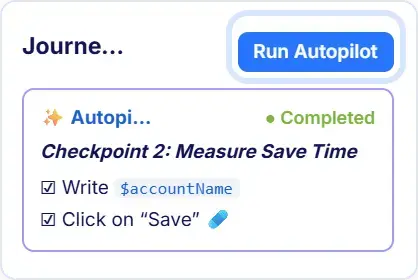
Every generated requirement and journey structure requires explicit approval before entering the suite. Approved journeys then execute on the deterministic engine with no AI at runtime, so the same journey returns the same verdict.
Where Our Agentic AI Fits Into Codeless API Testing
Touchstone, Virtuoso QA's agentic testing capability, generates requirements from your documentation and proposes the journey structures that prove them. For API coverage specifically, two things about how it works matter.
API Definitions as Requirement Sources
API definitions are ingested into the Knowledge Base alongside process specifications and stories. Requirements generated from them cite both the business process and the service definition behind it, so the link holds when either one changes.
Review Objective Before an API Call
Touchstone proposes journey structures as ordered checkpoints, each carrying a stated objective, before any steps are generated. Your team reviews the functional intent first, then Autopilot builds the steps against your live application.
Every Layer Approved, Every Run Deterministic
Every generated requirement and journey structure requires explicit approval before entering the suite. Approved journeys then execute on the deterministic engine with no AI at runtime, so the same journey returns the same verdict.
Where Our Agentic AI Fits Into Codeless API Testing
Touchstone, Virtuoso QA's agentic testing capability, generates requirements from your documentation and proposes the journey structures that prove them. For API coverage specifically, two things about how it works matter.
API Definitions as Requirement Sources
API definitions are ingested into the Knowledge Base alongside process specifications and stories. Requirements generated from them cite both the business process and the service definition behind it, so the link holds when either one changes.
Review Objective Before an API Call
Touchstone proposes journey structures as ordered checkpoints, each carrying a stated objective, before any steps are generated. Your team reviews the functional intent first, then Autopilot builds the steps against your live application.
Every Layer Approved, Every Run Deterministic
Every generated requirement and journey structure requires explicit approval before entering the suite. Approved journeys then execute on the deterministic engine with no AI at runtime, so the same journey returns the same verdict.
Strategic Outcomes for Engineering and Quality Teams
Testing the interface, the API and the data in one journey changes what a failure tells you, who can read the test that produced it and what it costs to keep that coverage current.

Precise Root-Cause Isolation
Validating the interface, the API request, and the underlying database record in a single run immediately isolates the exact failing layer. A failed test identifies whether the issue lies in the UI, the service payload, or data persistence, rather than returning a generic error that an end-to-end process failed to complete.
Unified Team Alignment and Integrated Coverage
Consolidating UI and API coverage into one framework eliminates the gap between separate front-end and back-end test suites. Interface and API steps share a single definition of done, closing the coverage gap between disparate tools where integration defects typically survive.

Democratised API Test Governance
Expressing API requests, assertions, and data validations in plain English enables Business Analysts, Product Owners, and domain specialists to inspect and audit complex multi-layer tests. Stakeholders can verify coverage directly without needing experience in code repositories or Postman collections.

Reduced Setup and Maintenance Overhead
Using API calls to establish application state inside the journey removes the external setup scripts and pre-seeded databases that break independently of the tests relying on them. When the application changes, repairs arrive as reviewable diffs rather than as framework code somebody has to debug, so maintaining coverage becomes a review rather than an engineering task.
Strategic Outcomes for Engineering and Quality Teams
Testing the interface, the API and the data in one journey changes what a failure tells you, who can read the test that produced it and what it costs to keep that coverage current.
Precise Root-Cause Isolation
Validating the interface, the API request, and the underlying database record in a single run immediately isolates the exact failing layer. A failed test identifies whether the issue lies in the UI, the service payload, or data persistence, rather than returning a generic error that an end-to-end process failed to complete.
Unified Team Alignment and Integrated Coverage
Consolidating UI and API coverage into one framework eliminates the gap between separate front-end and back-end test suites. Interface and API steps share a single definition of done, closing the coverage gap between disparate tools where integration defects typically survive.
Democratised API Test Governance
Expressing API requests, assertions, and data validations in plain English enables Business Analysts, Product Owners, and domain specialists to inspect and audit complex multi-layer tests. Stakeholders can verify coverage directly without needing experience in code repositories or Postman collections.
Reduced Setup and Maintenance Overhead
Using API calls to establish application state inside the journey removes the external setup scripts and pre-seeded databases that break independently of the tests relying on them. When the application changes, repairs arrive as reviewable diffs rather than as framework code somebody has to debug, so maintaining coverage becomes a review rather than an engineering task.
Strategic Outcomes for Engineering and Quality Teams
Testing the interface, the API and the data in one journey changes what a failure tells you, who can read the test that produced it and what it costs to keep that coverage current.
Precise Root-Cause Isolation
Validating the interface, the API request, and the underlying database record in a single run immediately isolates the exact failing layer. A failed test identifies whether the issue lies in the UI, the service payload, or data persistence, rather than returning a generic error that an end-to-end process failed to complete.
Unified Team Alignment and Integrated Coverage
Consolidating UI and API coverage into one framework eliminates the gap between separate front-end and back-end test suites. Interface and API steps share a single definition of done, closing the coverage gap between disparate tools where integration defects typically survive.
Democratised API Test Governance
Expressing API requests, assertions, and data validations in plain English enables Business Analysts, Product Owners, and domain specialists to inspect and audit complex multi-layer tests. Stakeholders can verify coverage directly without needing experience in code repositories or Postman collections.
Reduced Setup and Maintenance Overhead
Using API calls to establish application state inside the journey removes the external setup scripts and pre-seeded databases that break independently of the tests relying on them. When the application changes, repairs arrive as reviewable diffs rather than as framework code somebody has to debug, so maintaining coverage becomes a review rather than an engineering task.
Strategic Outcomes for Engineering and Quality Teams
Testing the interface, the API and the data in one journey changes what a failure tells you, who can read the test that produced it and what it costs to keep that coverage current.
Precise Root-Cause Isolation
Validating the interface, the API request, and the underlying database record in a single run immediately isolates the exact failing layer. A failed test identifies whether the issue lies in the UI, the service payload, or data persistence, rather than returning a generic error that an end-to-end process failed to complete.
Unified Team Alignment and Integrated Coverage
Consolidating UI and API coverage into one framework eliminates the gap between separate front-end and back-end test suites. Interface and API steps share a single definition of done, closing the coverage gap between disparate tools where integration defects typically survive.
Democratised API Test Governance
Expressing API requests, assertions, and data validations in plain English enables Business Analysts, Product Owners, and domain specialists to inspect and audit complex multi-layer tests. Stakeholders can verify coverage directly without needing experience in code repositories or Postman collections.
Reduced Setup and Maintenance Overhead
Using API calls to establish application state inside the journey removes the external setup scripts and pre-seeded databases that break independently of the tests relying on them. When the application changes, repairs arrive as reviewable diffs rather than as framework code somebody has to debug, so maintaining coverage becomes a review rather than an engineering task.
Explore Other Virtuoso QA Capabilities
Protect what already works across releases
Reuse approved journeys, checkpoints and data as the estate changes, with affected coverage flagged when a requirement moves.
Generate coverage from your documentation
Touchstone turns specifications and service definitions into source-cited requirements and proposed journeys, reviewed before anything enters the suite.

Explore Other Virtuoso QA Capabilities
Protect what already works across releases
Reuse approved journeys, checkpoints and data as the estate changes, with affected coverage flagged when a requirement moves.
Generate coverage from your documentation
Touchstone turns specifications and service definitions into source-cited requirements and proposed journeys, reviewed before anything enters the suite.
Explore Other Virtuoso QA Capabilities
Protect what already works across releases
Reuse approved journeys, checkpoints and data as the estate changes, with affected coverage flagged when a requirement moves.
Generate coverage from your documentation
Touchstone turns specifications and service definitions into source-cited requirements and proposed journeys, reviewed before anything enters the suite.
Al-native, proven in production.
10x
Faster execution
9x
Faster authoring
85%
Less maintenance
50%
Lower QA cost
Al-native, proven in production.
10x
Faster execution
9x
Faster authoring
85%
Less maintenance
50%
Lower QA cost
Al-native, proven in production.
10x
Faster execution
9x
Faster authoring
85%
Less maintenance
50%
Lower QA cost
Proven where quality and accountability matter
Recognized by independent analysts, trusted by enterprise teams, and built with the security controls required for critical software.

WAVE STRONG PERFORMER
Proven where quality and accountability matter
Recognized by independent analysts, trusted by enterprise teams, and built with the security controls required for critical software.
WAVE STRONG PERFORMER
Proven where quality and accountability matter
Recognized by independent analysts, trusted by enterprise teams, and built with the security controls required for critical software.
WAVE STRONG PERFORMER
Frequently Asked Questions
How API testing works in Virtuoso QA, from combining interface and service steps in one journey to what still needs your team's approval.
Can I test an API without any interface steps?
How is this different from Postman or REST Assured?
Can a value from a response be used later in the journey?
How do payloads vary across test cases?
Can we authenticate against a secured API?
Frequently Asked Questions
How API testing works in Virtuoso QA, from combining interface and service steps in one journey to what still needs your team's approval.
Can I test an API without any interface steps?
How is this different from Postman or REST Assured?
Can a value from a response be used later in the journey?
How do payloads vary across test cases?
Can we authenticate against a secured API?
Frequently Asked Questions
How API testing works in Virtuoso QA, from combining interface and service steps in one journey to what still needs your team's approval.
Can I test an API without any interface steps?
How is this different from Postman or REST Assured?
Can a value from a response be used later in the journey?
How do payloads vary across test cases?
Can we authenticate against a secured API?

See what your next release looks like with Virtuoso
Book a walkthrough on your applications and your workflows. Bring a requirement, a user journey, or a brittle Selenium script, and watch the loop run on something you recognise.
See what your next release looks like with Virtuoso
Book a walkthrough on your applications and your workflows. Bring a requirement, a user journey, or a brittle Selenium script, and watch the loop run on something you recognise.
See what your next release looks like with Virtuoso
Book a walkthrough on your applications and your workflows. Bring a requirement, a user journey, or a brittle Selenium script, and watch the loop run on something you recognise.
AICPA
SOC

WAVE STRONG PERFORMER
@ Copyright 2026 SpotQA, Creators of Virtuoso QA
AICPA
SOC
WAVE STRONG PERFORMER
@ Copyright 2026 SpotQA, Creators of Virtuoso QA
AICPA
SOC
WAVE STRONG PERFORMER
@ Copyright 2026 SpotQA, Creators of Virtuoso QA