Blog
Migrating From RSAT Without Losing Your Test Library

Abhilash
Published on

Table of contents
Lorem ipsum
Lorem ipsum
Lorem ipsum
Lorem ipsum
Lorem ipsum
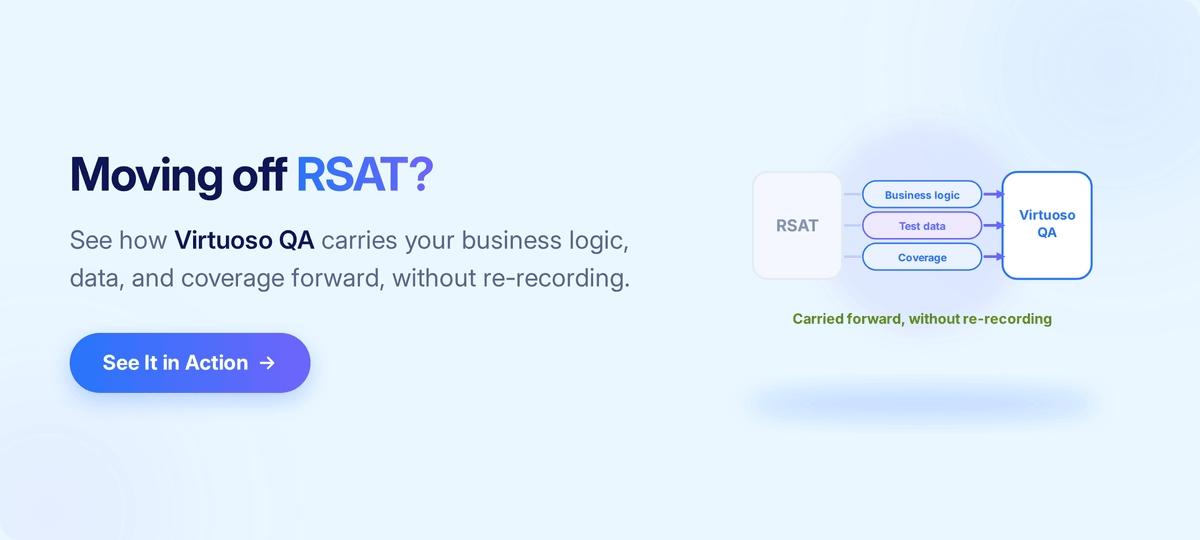
The fear that stops most RSAT migrations is the thought of throwing away years of test work. The fear is misplaced. The valuable part of an RSAT library is not the recordings themselves but the business logic, test data, coverage map, and traceability they hold, and all four can be carried into a new platform.
What does need to go is the brittle part, the fixed sequence of UI clicks that breaks with every release wave. A migration done well preserves the knowledge, discards the fragility, and tends to leave a team with broader coverage than it started with.
What an RSAT Test Library Actually Contains
Before deciding what to keep, it helps to see a library for what it is rather than as a single blob of tests.
An RSAT estate is really four distinct assets bundled together, and they hold very different amounts of value.
Recordings: Task Recorder captures of business processes, each a step-by-step replay of a user journey through Finance and Operations.
Test cases in Azure DevOps: The test plans and suites that organise the recordings and tie them to the wider project.
Excel parameter files: The test data, deliberately decoupled from the steps, that lets one recording run across many scenarios.
Traceability: The links between tests and requirements, plus the coverage map showing which processes are tested and which are not.
Seen this way, the migration question changes. The task is not to move recordings, but to preserve the knowledge those four assets represent while leaving behind the one that ages badly.
What is Worth Keeping, and What is Not
The single most useful distinction in any RSAT migration is between the process and the playback. Confusing the two is what makes teams believe they have to rebuild from scratch.
The playback is the recorded click path, meaning open this form, fill this field, press this button. It is tied to a specific interface that Microsoft will reshape at the next wave, which is precisely why RSAT recordings break and need re-recording. The playback is the disposable part.
The process is what the test was checking, that a sales order flows to invoice and posts correctly, that a period close balances, that a purchase requisition routes for approval. That logic does not change when the interface moves a button. The process, the data behind it, and the record of what it covers are the assets worth carrying forward.
Carrying the Four Assets Forward
A migration succeeds when each of the four assets has a clear path into the new platform. Treating them separately, rather than as one migration, keeps coverage intact and avoids silent gaps.
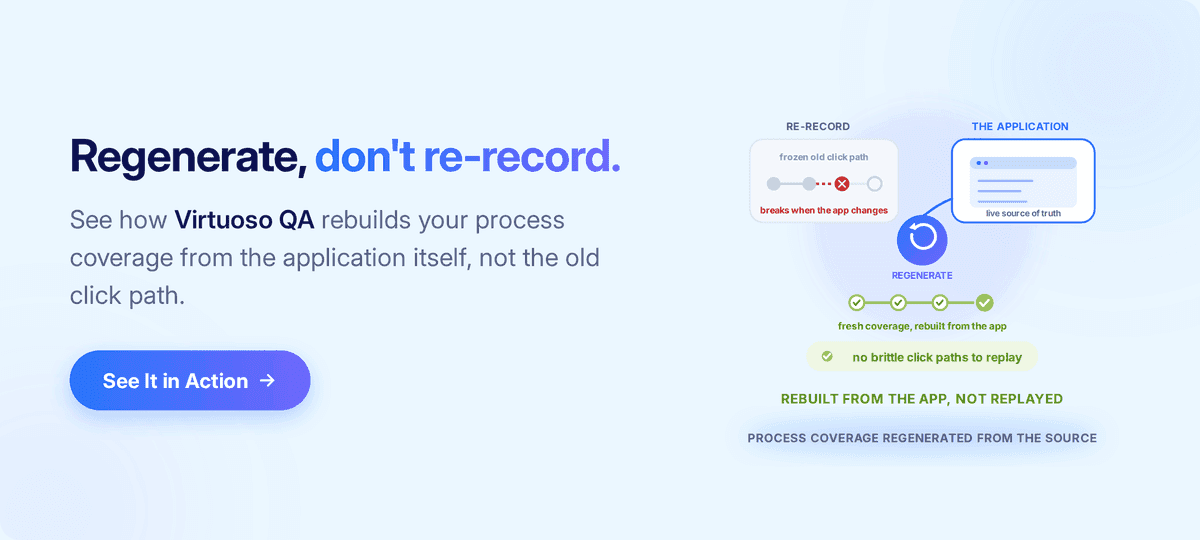
Process Logic: Regenerate Rather Than Re-Record
The process knowledge inside a recording is the asset that matters most, and modern platforms let you reconstitute it without replaying old clicks. Two routes cover almost every case.
For standard Finance and Operations processes such as order-to-cash, procure-to-pay, and month-end close, a composable test library already holds pre-built coverage. Rather than rebuild, a team configures the existing component to its own setup, which turns the bulk of a standard suite into a configuration exercise.
For customised or unique processes, AI-driven generation builds a fresh test from the live application screens or from the documented process steps, producing a maintainable journey instead of a recorded one.
Test Data: Preserve the Parameter Sets
The data in your Excel parameter files is reusable independent of the tool that consumed it. The scenarios encoded there, namely valid and invalid inputs, boundary values, and role variations, took real effort to assemble and remain valid after migration.
Exporting those data sets and re-attaching them to the new tests preserves the breadth of scenario coverage that made the original suite useful. The data outlives the recording it was paired with.
Traceability: Re-Establish the Links
Coverage is only trustworthy when it is traceable. The links between tests and requirements in Azure DevOps are part of what makes an audit or a release sign-off defensible, and they deserve deliberate handling rather than being left behind.
Because mature platforms integrate with Azure DevOps and common test management tools, the new tests can be re-linked to the same work items, preserving the requirement-to-test mapping. The coverage map moves with the tests rather than being rebuilt from memory.
Documentation: Retain the Process Record
Recordings doubled as documentation, and that value survives the migration even where the automation does not. The captured steps remain an accurate description of how a process runs, useful for onboarding, audit, and knowledge transfer.
Keeping the Task Recorder output as process documentation means none of the institutional knowledge is lost, even as the executable tests move to a more durable form.
Sequencing the Move to Avoid a Coverage Gap
The risk in any migration is a window where neither the old nor the new suite is fully trusted. A staged sequence removes that risk by keeping RSAT running until the replacement has earned its place.
Map current coverage first, so the target is explicit and nothing falls through unnoticed.
Migrate the highest-risk processes first, the cross-module flows whose failure would hurt most in production.
Run the new tests alongside the existing RSAT suite through at least one full release wave.
Compare results directly, meaning which suite caught what, which needed maintenance, and which survived the wave untouched.
Retire each RSAT test only once its replacement has passed a wave and matched or beaten its coverage.
Parallel running is the safeguard. It means the migration never trades away regression confidence, because the old net stays in place until the new one is proven.
Proving Nothing Was Lost
A migration is only finished when a team can demonstrate coverage parity, not merely assert it. Three checks turn a leap of faith into evidence.
Coverage parity confirms that every process the old suite tested has a counterpart in the new one, mapped against the original coverage list. Result comparison across a shared release wave shows the new tests catching the same regressions the old ones would have, and ideally more. Traceability verification confirms each migrated test is linked back to its requirement, so the audit trail is intact.
Pass those three checks and the library has not been lost. It has been upgraded, with the fragile dependency on a fixed interface removed.
Where Virtuoso QA Fits
Virtuoso QA is built for the carry-forward approach rather than a rebuild. Its GENerator capability regenerates tests from three starting points, an existing test suite, the live application screens, or written requirements and manual cases, which means an RSAT estate can be reconstituted from the application itself and the process knowledge the recordings already hold.
A composable library covers standard Finance and Operations and Customer Engagement processes out of the box, so much of a standard suite becomes configuration rather than authoring.
Self-healing then keeps the migrated tests stable across release waves with around 95% user acceptance, removing the re-recording cycle that made RSAT costly. The combination removes most of the authoring effort a from-scratch rebuild would demand, and it takes a suite from a slow, recording-bound cycle to one that survives release waves without constant re-work.
Related Reads
Frequently Asked Questions
Can I Keep My RSAT Tests When I Migrate to Virtuoso QA?
Do I Have to Rebuild Every Test From Scratch in Virtuoso QA?
What Happens to My Excel Parameter Files?
How Do I Prove the Migrated Library Covers Everything the Old One Did?
Will I Lose the Traceability Between Tests and Requirements?
Is It Faster to Migrate to Virtuoso QA or to Start Over?