Blog
Agentic AI Vs AI Agents - 12 Key Differences

Abhilash
Published on

Table of contents
Lorem ipsum
Lorem ipsum
Lorem ipsum
Lorem ipsum
Lorem ipsum
There are a lot of new terms dominating the artificial intelligence world lately, "Agentic AI" and "AI agents" being two of them. Oftentimes, they're being used interchangeably, but the two phrases have their own distinct meanings.
Organizations that understand when to deploy AI agents versus agentic AI will automate intelligently while others automate blindly. The revolution isn't just about AI doing tasks; it's about AI pursuing goals. That difference changes everything. In this blog, we explore agentic AI vs AI agents, what makes them different, and how they will change the way we work.
What is an AI Agent?
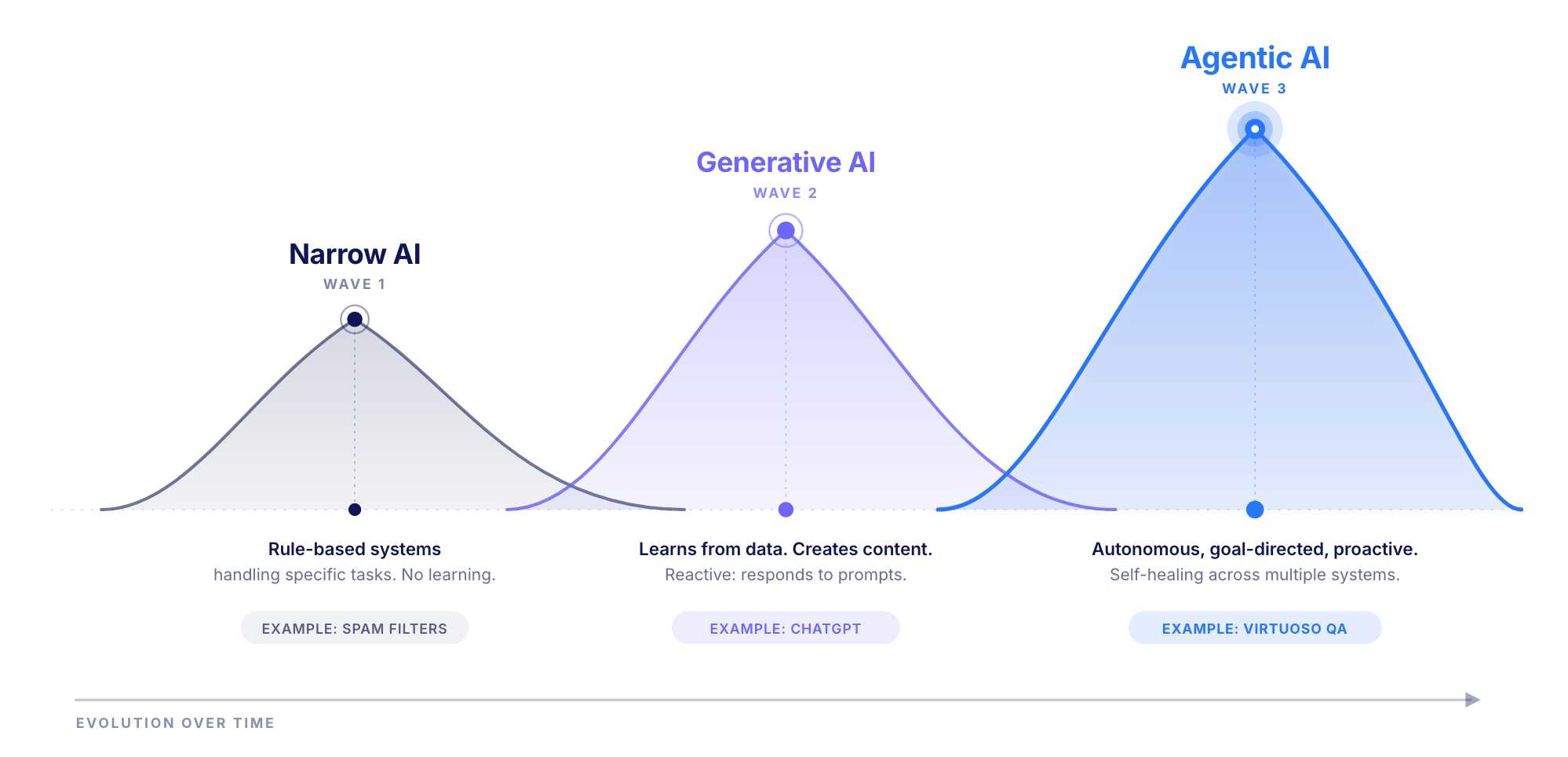
An AI agent is a software program designed to perform specific tasks on behalf of users, responding to inputs with predetermined or learned behaviors. Think of AI agents as sophisticated digital assistants that excel at defined functions within established parameters. They perceive their environment through inputs, process information using programmed logic or trained models, and execute actions to achieve specific outcomes.
The term "agent" implies agency, but AI agents possess limited autonomy. They operate within boundaries, following scripts, rules, or patterns learned from training data. A customer service chatbot represents a classic AI agent: it interprets queries, searches knowledge bases, and provides responses, but cannot independently decide to redesign the customer experience or proactively reach out to at-risk customers.
AI agents have evolved significantly from simple rule-based systems. Modern AI agents leverage machine learning, natural language processing, and sophisticated decision trees to handle complex interactions. They can learn from experience, improving responses over time. Yet they remain fundamentally reactive, task-oriented tools waiting for activation rather than independently pursuing objectives.
Examples of AI agents permeate our digital lives:
Chatbots and Virtual Assistants: From Siri to enterprise customer service bots, these agents respond to queries and execute simple commands. They parse language, match intents, and deliver programmed responses.
Recommendation Engines: Netflix's content suggestions and Amazon's product recommendations are AI agents analyzing behavior patterns to predict preferences. They excel at pattern matching but don't independently decide to revolutionize recommendation strategies.
Robotic Process Automation (RPA) Bots: These agents automate repetitive tasks like data entry, form processing, and report generation. They follow defined workflows efficiently but cannot reimagine business processes.
Trading Bots: Algorithmic trading agents execute trades based on market signals and predetermined strategies. They react quickly to market conditions but don't independently develop new trading philosophies.
Email Filters: Spam detection agents classify messages using learned patterns. They improve accuracy through feedback but don't autonomously investigate new spam techniques.
What unites these AI agents is their fundamental characteristic: they are tools wielded by humans rather than autonomous collaborators. They augment human capabilities within defined scopes but don't independently identify problems to solve or goals to pursue.
Different Categories of AI Agents
Understanding AI agent categories helps clarify why not all agents are agentic. Each category serves specific purposes, with distinct capabilities and limitations that determine their appropriate applications.
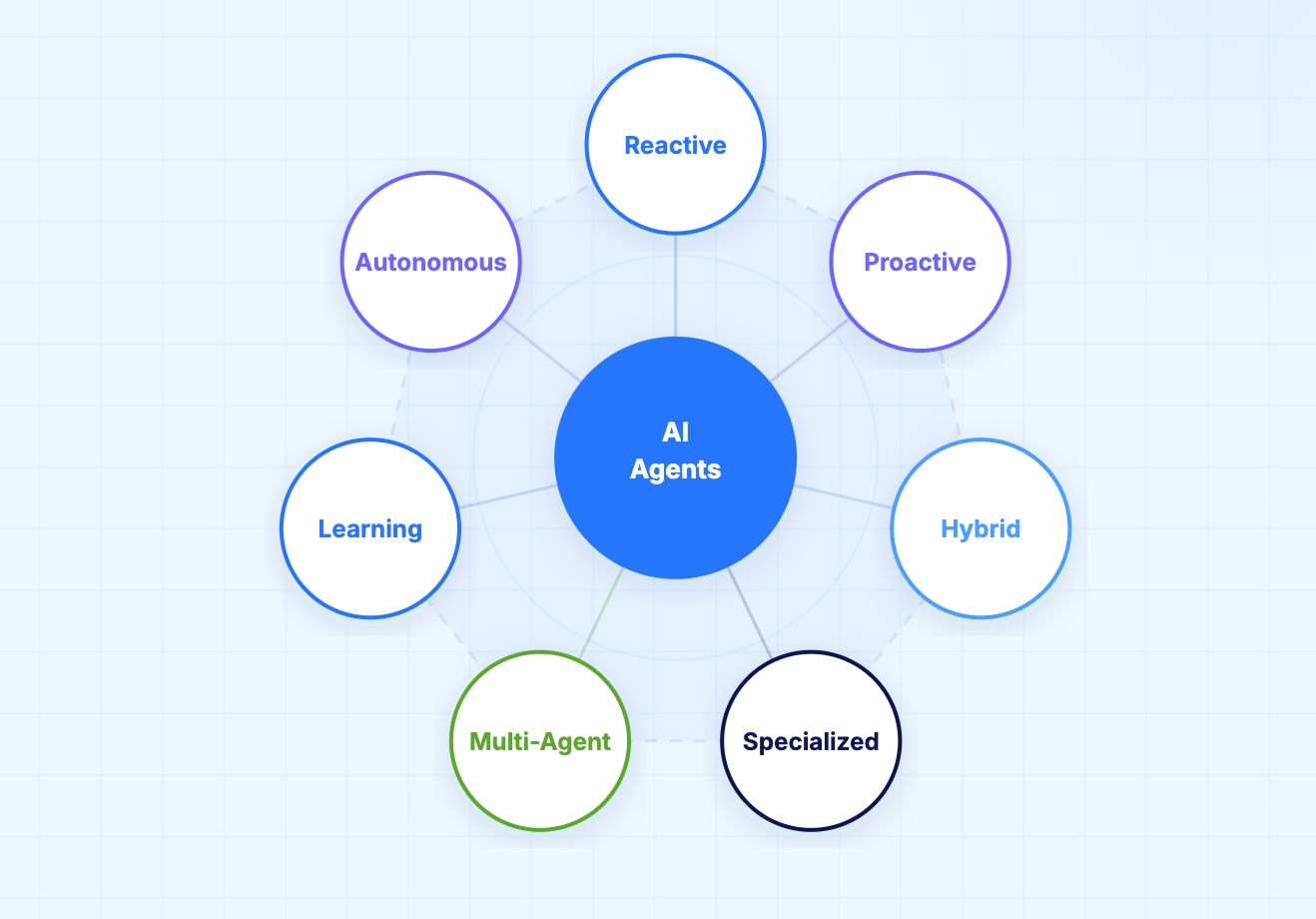
Reactive Agents
Reactive agents represent the simplest form, responding directly to current stimuli without memory or planning. They excel at immediate response scenarios where historical context is irrelevant.
Characteristics: No internal state, immediate stimulus-response, consistent behavior for identical inputs.
Examples: Basic chatbots with scripted responses, simple email autoresponders, rule-based alert systems.
Limitations: Cannot learn from experience, no context awareness, fails with complex multi-step tasks.
Use Cases: FAQ responses, simple notifications, basic data validation.
Proactive Agents
Proactive agents anticipate needs and initiate actions without explicit user commands. They monitor conditions and trigger responses when specific criteria are met.
Characteristics: Environmental monitoring, threshold-based activation, predictive capabilities.
Examples: Predictive maintenance systems, inventory reorder agents, calendar scheduling assistants.
Strengths: Reduces human oversight, prevents problems before they occur, improves efficiency.
Limitations: Operates within predefined parameters, cannot adapt strategies autonomously.
Hybrid Agents
Hybrid agents combine reactive and proactive behaviors, switching modes based on context. They respond to requests while also initiating beneficial actions.
Characteristics: Dual-mode operation, context-sensitive behavior, balanced autonomy.
Examples: Modern virtual assistants like Google Assistant, enterprise monitoring systems, smart home controllers.
Advantages: Versatile application, user-friendly interaction, efficient resource utilization.
Challenges: Complex design, mode-switching logic, user expectation management.
Specialized vs Generalist Agents
The specialization spectrum determines an agent's breadth versus depth of capabilities.
Specialized Agents: Excel at specific tasks with deep expertise. Example: Medical diagnosis agents trained on radiology images.
Generalist Agents: Handle diverse tasks with moderate proficiency. Example: GPT-based assistants answering various queries.
Trade-offs: Specialists offer superior performance in narrow domains. Generalists provide flexibility across multiple applications.
Multi-Agent Systems
Multi-agent systems coordinate multiple specialized agents to achieve complex objectives. Each agent handles specific sub-tasks while communicating with others.
Architecture: Distributed intelligence, inter-agent communication protocols, coordinated goal pursuit.
Examples: Supply chain optimization systems, smart grid management, autonomous vehicle fleets.
Benefits: Scalability, fault tolerance, parallel processing, emergent intelligence.
Complexities: Coordination overhead, conflict resolution, communication bottlenecks.
Learning Agents
Learning agents improve performance through experience, adapting behaviors based on feedback and outcomes.
Learning Mechanisms: Supervised learning from labeled data, reinforcement learning from rewards, unsupervised pattern discovery.
Examples: Recommendation systems, fraud detection agents, game-playing AI.
Evolution: From simple parameter adjustment to complex strategy development.
Limitations: Requires quality training data, can learn biases, may overfit to specific scenarios.
Autonomous Agents
Autonomous agents operate independently within defined parameters, making decisions without human intervention.
Autonomy Levels: From simple script execution to complex decision-making within boundaries.
Examples: Autonomous testing bots, robotic process automation, industrial control systems.
Requirements: Robust error handling, safety constraints, performance monitoring.
Distinction: Autonomous operation doesn't equal agentic AI; autonomy can exist without goal-setting capability.

What is Agentic AI?
Agentic AI represents a fundamental leap beyond traditional AI agents: artificial intelligence systems capable of independent goal formulation, strategic planning, and autonomous pursuit of objectives without constant human direction. While AI agents execute tasks, agentic AI owns outcomes. This distinction transforms AI from a tool into a collaborator, from an assistant into a strategic partner.
The "agentic" qualifier signifies genuine agency: the capacity to act independently based on internal goals rather than external commands. Agentic AI doesn't just respond to "do this task" commands; it understands "achieve this outcome" objectives and independently determines how to reach them. It's the difference between a chess program that evaluates moves and one that decides whether playing chess serves its broader objectives.
Virtuoso QA exemplifies agentic AI in software testing. Rather than simply executing test scripts when commanded, it autonomously identifies testing needs, develops comprehensive strategies, allocates resources, executes tests, analyzes results, maintains test suites, and ensures quality objectives are met. It doesn't wait for instructions; it proactively pursues quality outcomes.
What makes AI truly agentic involves several critical capabilities working in concert:
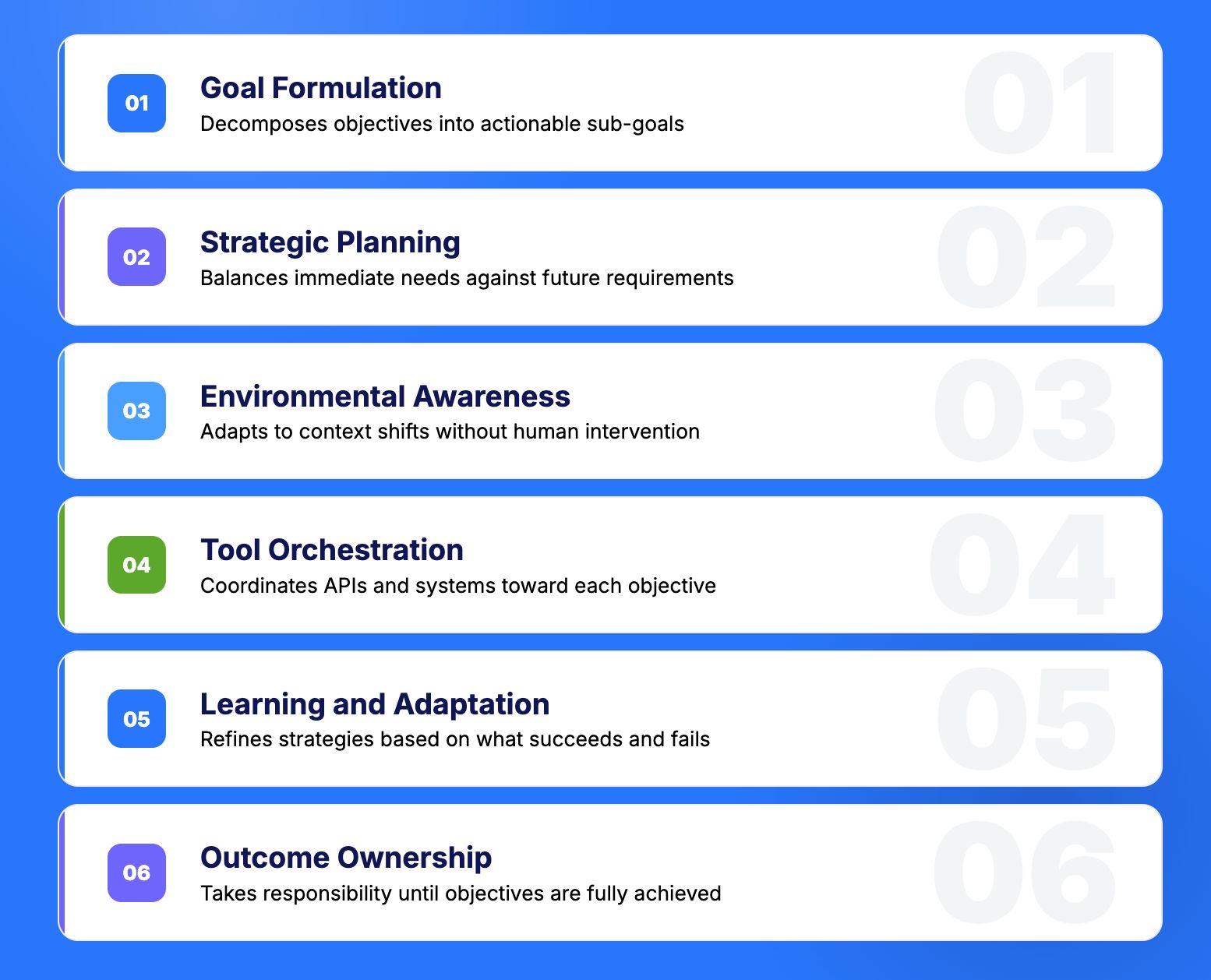
Goal Formulation: Agentic AI can decompose high-level objectives into actionable sub-goals. Given "ensure application quality," it determines what must be tested, when, and how thoroughly.
Strategic Planning: Beyond tactical execution, agentic AI develops long-term strategies. It balances immediate needs with future requirements, optimizing resource allocation across time horizons.
Environmental Awareness: Agentic AI perceives and adapts to its operational context. It recognizes when conditions change and adjusts strategies accordingly without human intervention.
Tool Orchestration: Rather than being a tool, agentic AI uses tools. It coordinates multiple resources, APIs, and systems to achieve objectives, selecting appropriate tools for each situation.
Learning and Adaptation: Agentic AI doesn't just learn patterns; it learns strategies. Failed approaches inform future planning. Successful tactics become part of its strategic repertoire.
Outcome Ownership: Most critically, agentic AI takes responsibility for results. It doesn't just execute steps; it ensures objectives are achieved, trying alternative approaches when initial strategies fail.
Examples of agentic AI in action:
Autonomous Research Assistants: Systems that independently investigate topics, synthesize information from multiple sources, identify knowledge gaps, and produce comprehensive analyses without step-by-step human guidance.
Business Process Orchestrators: AI that manages entire workflows, coordinating between departments, optimizing resource allocation, and adapting processes based on changing business conditions.
Intelligent Quality Systems: Like Virtuoso QA, platforms that autonomously ensure software quality through strategic test planning, execution, and maintenance.
AI Copilots: Advanced systems that collaborate with humans as peers, independently handling assigned responsibilities while coordinating on shared objectives.
The philosophical shift is profound. Agentic AI doesn't ask "What should I do?" but rather "What needs to be achieved?" This reframing transforms every interaction, every decision, every outcome.
Want to find out more about Agentic AI in software testing? Then watch our video on how Agentic AI is transforming software testing:
Agentic AI vs AI Agents: Key Differences
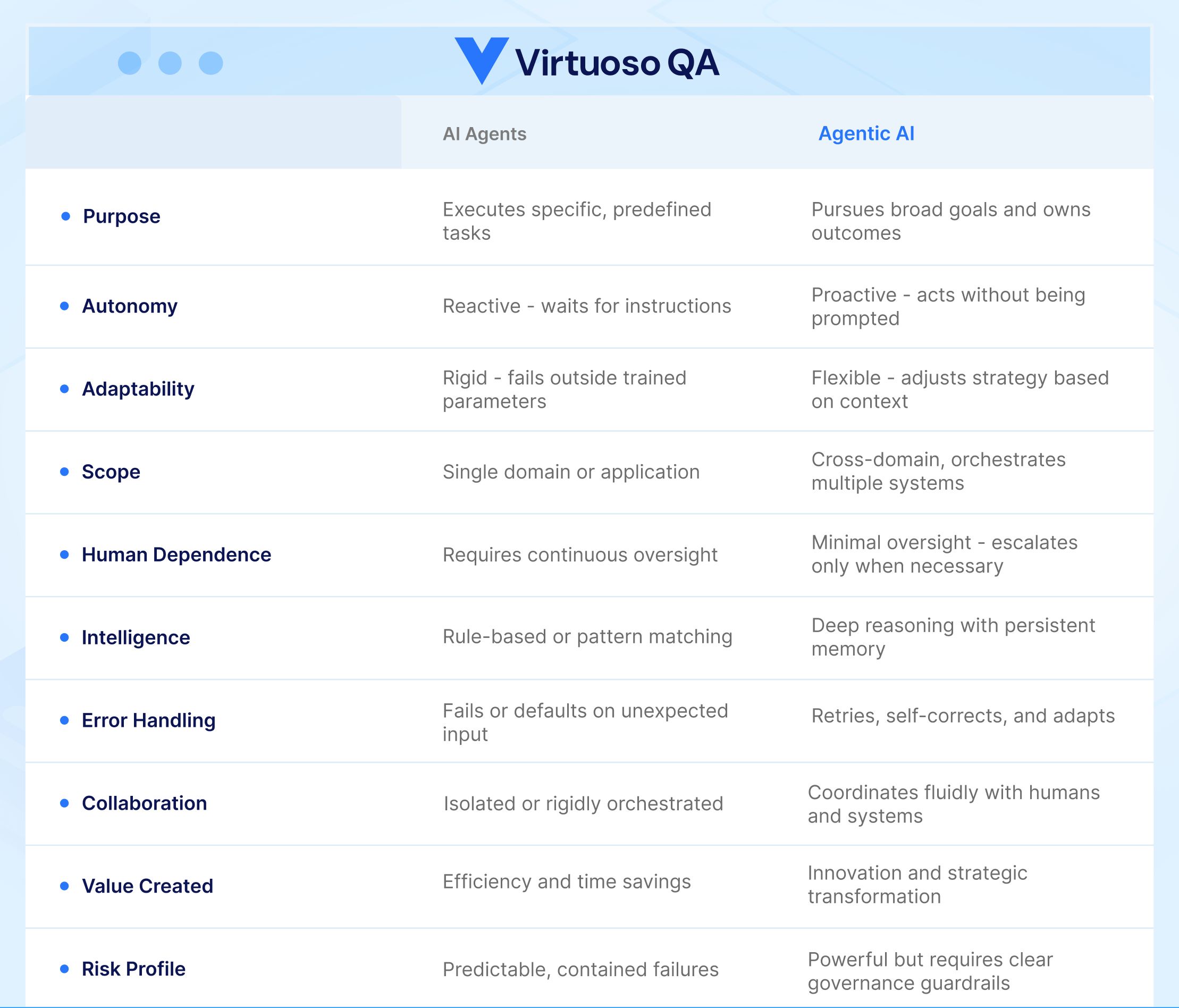
1. Purpose Orientation
AI Agents: Narrow Task Execution
AI agents are built for specific, well-defined tasks. A customer service chatbot answers queries. A recommendation engine suggests products. A scheduling assistant books meetings. Each operates within a narrow mandate and measures success by task completion, not broader outcomes.
Agentic AI: Broad Goal Achievement
Agentic AI pursues comprehensive objectives rather than individual tasks. Given a goal like "maximise customer satisfaction," it evaluates every action against that objective, balancing short-term task completion with long-term outcome. The shift is from doing what is asked to owning what needs to happen.
2. Autonomy Level
AI Agents: Dependent on Instructions
AI agents require explicit activation for every action. They wait for commands, execute prescribed responses, and return to dormancy. Even sophisticated agents remain fundamentally reactive. They cannot independently identify opportunities or decide when to act.
Agentic AI: Independent Initiative
Agentic AI monitors its environment, recognises opportunities or problems, and initiates appropriate responses without waiting for human commands. It does not wait to be told something needs attention. It notices and acts.
In testing, this means the platform continuously monitors application changes and adjusts test strategies without a human first flagging that something has changed.
3. Adaptability
AI Agents: Rigid and Pre-Programmed
Traditional AI agents operate within fixed parameters. They follow predetermined logic or learned patterns and cannot fundamentally alter their approach. When they encounter scenarios outside their training, they fail predictably.
Agentic AI: Flexible and Context-Aware
Agentic AI recognises when an approach is not working and tries alternatives. It adjusts to new environments, incorporates new information, and evolves strategies based on experience.
In practice, when an application interface changes, an agentic testing platform adapts to the new structure rather than simply failing and waiting for a human to intervene.
4. Scope of Execution
AI Agents: Single-Domain Operation
AI agents typically operate within a single domain or application. Expanding scope requires significant engineering effort and often results in degraded performance. They are built for specific contexts and struggle outside them.
Agentic AI: Cross-Domain Problem Solving
Agentic AI operates across domains, orchestrating multiple systems to achieve objectives. If reaching a goal requires coordinating between a CRM, an ERP, and a communication tool, it does so without treating the boundaries between those systems as constraints.
5. Human Dependence
AI Agents: Require Continuous Oversight
AI agents require continuous human supervision from initial activation through result interpretation. Humans must monitor performance, handle exceptions, and make strategic decisions at every stage. As agent deployments scale, the human management burden scales with them.
Agentic AI: Proactive with Minimal Oversight
Agentic AI requires human input for strategic direction and exceptional situations. Routine decisions, exception handling, and day-to-day execution happen autonomously. The human role shifts from operator to governor.
This is where AI-native testing platforms deliver their maintenance reduction: the system handles the routine work, and humans focus on strategy and outcomes.
6. Intelligence Depth
AI Agents: Shallow Logic
Most AI agents apply rules, patterns, or simple learning algorithms. They excel at pattern matching and response generation but lack deep reasoning capability. They can produce a grammatically correct response without understanding its meaning.
Agentic AI: Advanced Reasoning and Memory
Agentic AI maintains context across interactions, builds understanding over time, and reasons about complex situations rather than just matching patterns. It understands principles, not just syntax. This depth enables meaningful problem-solving rather than surface-level task execution.
7. Interaction Style
AI Agents: Transactional
AI agents engage in discrete interactions: receive a query, provide a response, await the next query. Each interaction stands alone. The experience feels mechanical because the agent is not pursuing a shared objective with the user. It is simply responding to individual requests.
Agentic AI: Collaborative and Strategic
Agentic AI maintains continuous dialogue toward a shared objective. It does not just answer questions. It asks them. It does not just execute commands. It proposes strategies and surfaces information the user has not thought to request yet.
8. Error Handling
AI Agents: Fail Outside Scripts
When AI agents encounter unexpected situations, they typically fail completely or default to generic responses. Error handling is often binary: success or failure. They lack the capability to reason through novel problems or find alternative paths.
Agentic AI: Retries and Self-Corrects
Agentic AI treats errors as information rather than endpoints. When a strategy fails, it analyses why, adjusts its approach, and tries again. This resilience allows it to operate in dynamic, uncertain environments where predictable failure modes are not the only scenarios to plan for.
9. Tool and Resource Usage
AI Agents: Limited to Built-in Tools
AI agents operate with a fixed set of tools determined at design time. Expanding what they can access requires explicit engineering work and often architectural changes. They cannot discover new capabilities or learn to use tools they were not designed for.
Agentic AI: Orchestrates Multiple Systems
Agentic AI dynamically coordinates whatever tools and resources are necessary to achieve its objective. Tool use is the means, not the constraint. It discovers available capabilities and coordinates across systems without those systems needing to be preconfigured into its design.
10. Collaboration Ability
AI Agents: Isolated or Orchestrated
AI agents typically operate in isolation or under rigid orchestration. When multiple agents work together, they follow predetermined interaction patterns managed by an external layer. They cannot spontaneously collaborate to solve problems that exceed their individual scope.
Agentic AI: Coordinates Like a Team Member
Agentic AI collaborates with humans and other systems as a peer rather than a managed tool. It negotiates responsibilities, shares relevant information, and adjusts its role based on what the team needs. The coordination is organic rather than programmed in advance.
11. Value Creation
AI Agents: Efficiency and Time Saving
AI agents create value primarily through efficiency: faster task completion, reduced human effort, lower error rates. That value is real and measurable in time or cost saved. The limitation is that agents make existing processes faster without fundamentally reconsidering them.
Agentic AI: Strategic and Transformative
Agentic AI creates value by discovering new approaches rather than just optimising existing ones. It does not just reduce the time spent on a process. It changes what the process looks like and what outcomes it can produce. The value shows up in competitive capability rather than just cost reduction.
12. Risk Profile
AI Agents: Safer and Predictable
AI agents present manageable risks because their scope is limited and their behaviour is predictable. Failure modes are understood and impact is contained. They cannot cause unexpected problems because they cannot take unexpected actions.
Agentic AI: Powerful but Requires Governance
Agentic AI's autonomy introduces governance challenges. Systems that can independently pursue goals might pursue them in ways that were not anticipated. The same flexibility that enables innovation also creates the possibility of unintended consequences.
Managing this requires clear objective definition, behavioural boundaries, monitoring systems, and human oversight at the strategic level. The capability is worth the complexity, but the complexity needs to be acknowledged and planned for rather than assumed away.

Practical Applications: Where Each Excels
AI Agent Use Cases
AI agents excel in well-defined, repetitive tasks where consistency and efficiency matter more than strategic thinking. Their predictability makes them ideal for customer-facing applications and regulated environments.
Customer Service Chatbots: Modern chatbots handle routine inquiries with increasing sophistication. They parse natural language, understand intent, access knowledge bases, and provide relevant responses. Banks use chatbots to handle balance inquiries, transaction histories, and basic service requests. E-commerce platforms deploy them for order tracking, return processing, and product questions. These agents excel because customer service queries follow patterns, enabling effective training and scripting.
Automated Scheduling Systems: Calendar assistants like Calendly and x.ai eliminate the back-and-forth of meeting coordination. They understand availability, preferences, and constraints to find optimal meeting times. These agents work because scheduling is a bounded problem with clear rules and objectives.
Robotic Process Automation: RPA bots automate repetitive tasks across enterprises. They extract data from invoices, enter information into systems, generate reports, and process transactions. A global insurance company might use RPA to process claims, extracting information from documents, validating against policies, and updating multiple systems. These agents thrive in structured, rule-based processes.
Content Moderation: Social media platforms deploy AI agents to identify and filter inappropriate content. These agents analyze text, images, and videos for policy violations, scaling moderation beyond human capability. They work well because content policies can be clearly defined and patterns can be learned from labeled examples.
Related Read: Explore generative AI in software testing for hands-on use cases and benefits.
Agentic AI Use Cases
Agentic AI transforms complex, strategic domains requiring autonomous decision-making and continuous adaptation.
Virtuoso QA: Autonomous Test Generation, Execution, and Maintenance
Virtuoso QA exemplifies agentic AI in software testing. It doesn't just run predefined tests; it owns quality outcomes. The platform autonomously identifies what needs testing based on code changes and risk analysis, generates comprehensive test scenarios using natural language processing, executes tests across multiple environments simultaneously, analyzes failures to identify root causes, self-heals tests when applications change, and provides strategic insights about quality trends and risks.This agentic approach transforms testing from a bottleneck to an accelerator. Organizations report 85% reduction in testing time, 95% decrease in maintenance effort, and 10x increase in test coverage. The AI doesn't just test faster; it tests smarter, continuously improving its strategies based on outcomes.
Business Workflow Automation
Agentic AI orchestrates entire business processes, from customer onboarding to supply chain optimization. Unlike RPA bots following scripts, agentic systems adapt workflows based on context. They might restructure processes for efficiency, coordinate between departments, handle exceptions creatively, and optimize for changing business objectives.
Personal AI Coworkers
Emerging agentic systems act as genuine collaborators rather than tools. They take ownership of assigned projects, independently manage workstreams, coordinate with team members, make decisions within defined authority, and escalate only when necessary. These AI coworkers don't just assist; they contribute as team members.
Autonomous Financial Management
Agentic AI in finance goes beyond algorithmic trading to comprehensive portfolio management. Systems independently rebalance portfolios based on market conditions, identify new investment opportunities, manage risk across multiple dimensions, adapt strategies to changing regulations, and coordinate with multiple financial institutions.
Healthcare Treatment Orchestration
Medical agentic AI doesn't just diagnose; it manages entire treatment journeys. Systems coordinate between specialists, schedule procedures optimally, monitor patient progress, adjust treatment plans based on outcomes, and ensure protocol compliance. They transform healthcare from reactive treatment to proactive health management. The distinction in applications is clear: AI agents excel at defined tasks within boundaries, while agentic AI thrives in complex, dynamic environments requiring strategic thinking and autonomous operation.
Why This Distinction Matters Today
For Businesses: Avoiding Overestimation and Underutilization
The confusion between AI agents and agentic AI creates strategic blind spots that cost businesses millions in misallocated resources and missed opportunities. Organizations deploying sophisticated chatbots believe they've achieved AI transformation, while competitors implementing true agentic AI gain insurmountable advantages.
The Overestimation Trap
Companies mistake sophisticated AI agents for agentic AI, expecting autonomous operation from tools designed for task execution. A retailer implements an advanced recommendation engine and expects it to revolutionize customer experience, but without agentic capabilities, it merely optimizes product suggestions. The disappointment from unmet expectations can poison future AI initiatives.
The Underutilization Risk
Conversely, organizations waiting for perfect agentic AI miss valuable AI agent applications available today. While competitors automate routine tasks with current agents, they lose efficiency gains waiting for tomorrow's technology.
Strategic Misalignment
Without understanding the distinction, businesses make poor build-versus-buy decisions. They attempt to build agentic AI when AI agents would suffice, wasting resources. Or they purchase AI agents expecting agentic capabilities, leading to implementation failure.
Competitive Implications
Early adopters of true agentic AI gain exponential advantages. While competitors coordinate AI agents manually, agentic AI adopters operate at digital speed with minimal oversight. Virtuoso QA users release software 50% faster than traditional testers, not through incremental improvement but fundamental transformation.
For QA and Automation: Choosing the Right AI Level
The QA and automation domain perfectly illustrates why this distinction matters. Traditional test automation uses AI agents: script generators, test executors, and result analyzers. Each tool performs specific tasks well but requires human orchestration.
The Agent Approach
Organizations using AI agents for testing see improvements: faster script creation, better object recognition, and smarter result analysis. But humans still design test strategies, maintain scripts, and interpret results. The testing bottleneck shifts but doesn't disappear.
The Agentic Revolution
Virtuoso QA's agentic approach transforms testing entirely. Rather than faster test execution, it provides autonomous quality assurance. The AI owns quality outcomes, independently ensuring comprehensive coverage, continuous validation, and strategic optimization.
Practical Impact
The difference manifests in metrics:
AI agents might reduce test creation time by 30%
Agentic AI eliminates 95% of test maintenance effort
AI agents help testers work faster
Agentic AI transforms testing from cost center to strategic advantage
Choosing Appropriately
Not every testing scenario requires agentic AI. Simple regression testing might work well with AI agents. But complex, dynamic applications benefit from agentic AI's adaptability and strategic thinking.
Future Outlook: Where Agents and Agentic AI Converge
The future isn't about choosing between AI agents and agentic AI; it's about intelligent orchestration of both paradigms in complementary roles.
AI Agents Will Keep Evolving but Stay Narrow
AI agents won't disappear; they'll become more sophisticated within their bounded domains. Like specialized tools in a craftsman's workshop, each agent will excel at specific tasks while remaining fundamentally limited in scope.
Specialization Deepening
Agents will become increasingly specialized, with deeper expertise in narrower domains. Medical diagnosis agents will achieve superhuman accuracy in specific conditions. Legal research agents will master particular areas of law. This specialization creates value through expertise depth rather than breadth.
Efficiency Optimization
Future agents will operate with minimal computational resources, enabling edge deployment and real-time processing. Efficiency improvements will make agents ubiquitous, embedded in every device and application.
Human Integration
Agents will become more intuitive and accessible, requiring less technical expertise to deploy and manage. Natural language interfaces will make agent capabilities available to everyone, not just technologists.
Agentic AI Will Dominate Enterprise Automation
While agents handle specific tasks, agentic AI will orchestrate enterprise-wide automation, coordinating complex workflows and pursuing strategic objectives.
Strategic Orchestration
Agentic AI will manage portfolios of AI agents, coordinating their activities toward organizational goals. Like a conductor leading an orchestra, agentic AI will harmonize individual agent capabilities into coherent enterprise capability.
Continuous Evolution
Unlike agents that require updates and retraining, agentic AI will continuously evolve strategies based on outcomes. Organizations won't deploy agentic AI; they'll partner with it for ongoing transformation.
Industry Transformation
Every industry will be reshaped by agentic AI. In healthcare, agentic AI will manage patient journeys from prevention through treatment. In finance, it will orchestrate everything from risk management to investment strategy. In software development, platforms like Virtuoso QA will own quality outcomes entirely.
Over Time, Distinction May Blur as Agents Adopt Agentic Traits
The boundary between AI agents and agentic AI will become increasingly permeable as technologies converge and capabilities democratize.
Graduated Autonomy
Systems will operate along an autonomy spectrum rather than in binary categories. Agents will gain limited goal-setting capabilities for specific contexts. Agentic AI will sometimes operate in agent mode for defined tasks.
Modular Architecture
Future AI systems will compose agentic and agent capabilities modularly. Organizations will assemble AI capabilities like building blocks, combining narrow agents with agentic orchestration as needed.
Emergent Agency
Sophisticated multi-agent systems may exhibit emergent agentic properties. When multiple specialized agents coordinate effectively, their collective behavior might approximate agentic AI without individual agency.
Ethical Implications and Trust Frameworks Needed
The rise of agentic AI demands new ethical frameworks and governance structures to ensure beneficial outcomes.
Accountability Mechanisms
When AI makes autonomous decisions, determining responsibility becomes complex. Legal frameworks must evolve to address liability when agentic AI causes harm or makes errors. Organizations need clear accountability chains for AI decisions.
Transparency Requirements
Agentic AI's decision-making processes must be interpretable and auditable. Black box systems making strategic decisions create unacceptable risks. Explainable AI becomes critical when systems operate autonomously.
Alignment Challenges
Ensuring agentic AI pursues intended objectives without unintended consequences requires sophisticated alignment techniques. Goal specification must be precise yet flexible enough to handle unexpected situations.
Human Oversight
Despite autonomous capabilities, human oversight remains essential. Kill switches, authorization requirements for critical decisions, and regular audits ensure agentic AI serves human purposes.
Trust Building
Public acceptance of agentic AI requires demonstrable safety and benefit. Early successes like Virtuoso QA's transformation of software testing build confidence. Failures could set back adoption by years.
Virtuoso QA: Exemplifying the Power of Agentic AI
Virtuoso QA's agentic software testing platform demonstrates the transformative potential of true agentic AI in enterprise software testing, showing why the distinction between AI agents and agentic AI matters in practice.
Beyond Traditional Test Automation
Traditional test automation tools are sophisticated AI agents. They generate test scripts, execute predefined tests, and report results. But they require constant human oversight for test strategy, maintenance, and interpretation. Virtuoso QA transcends these limitations through genuine agency.
Virtuoso QA's Agentic Capabilities in Action
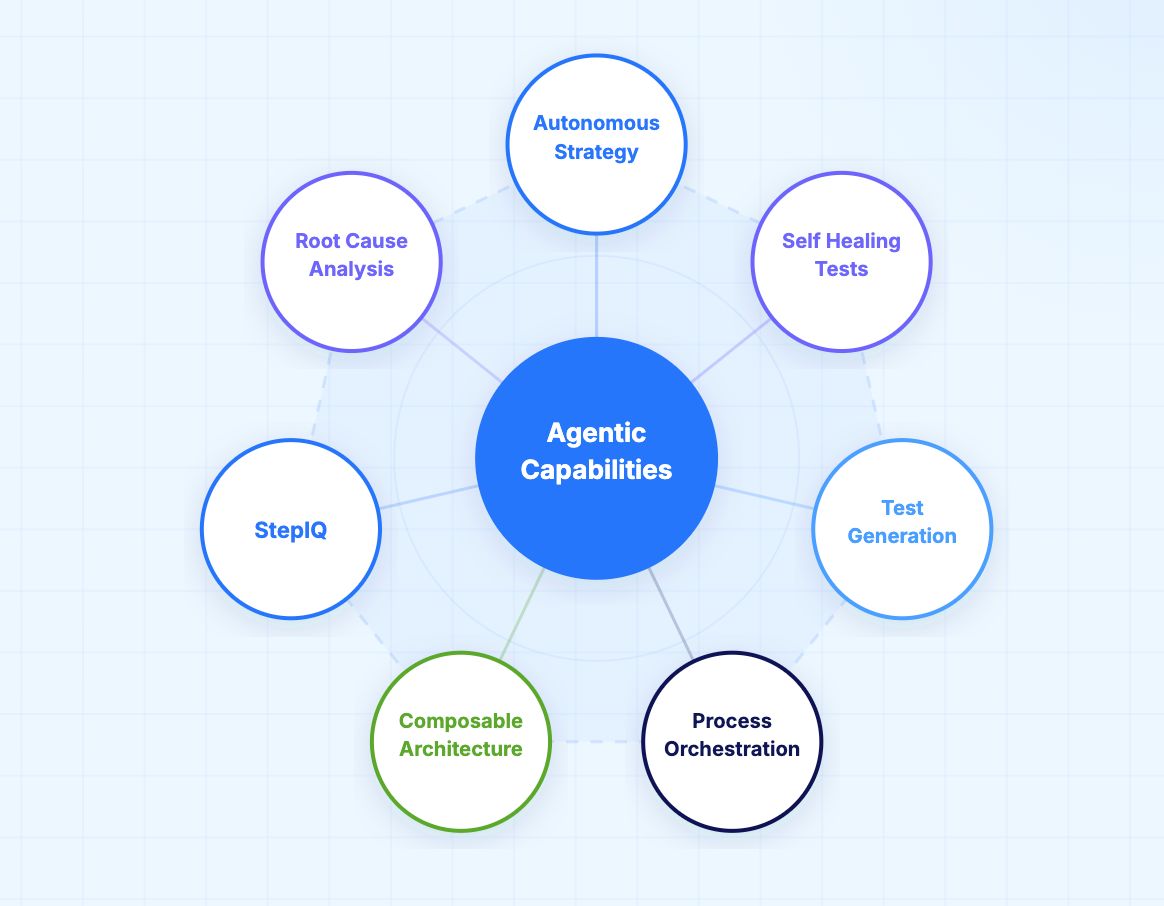
Autonomous Test Strategy
Virtuoso QA doesn't wait for test plans; it creates them. Analyzing application changes, user patterns, and risk factors, it independently determines what needs testing, how thoroughly, and when.
Self-Healing Tests
When applications change, Virtuoso QA doesn't just report broken tests; it fixes them. Using AI-augmented object identification and ML-powered adaptation, it maintains test suites automatically, reducing maintenance effort by 95%.
Intelligent Test Generation
Using natural language processing and the GENerator capability, Virtuoso QA creates comprehensive test scenarios from business requirements. It understands intent, not just syntax, generating tests that validate business outcomes, not just technical functions.
Business Process Orchestration
Through its Business Process Orchestration feature, Virtuoso QA manages entire quality workflows. It coordinates testing across systems, environments, and teams, ensuring comprehensive validation of end-to-end processes.
Composable Test Architecture
The platform's Composable testing approach enables modular test construction. Common patterns become reusable components that combine intelligently for complex scenarios.
StepIQ Intelligence
StepIQ provides semantic understanding of test steps, enabling tests to adapt to application changes while maintaining intent. This goes beyond simple object recognition to true comprehension.
Root Cause Analysis
When tests fail, Virtuoso QA doesn't just report failure; it analyzes causes. AI-powered root cause analysis identifies patterns, suggests fixes, and prevents future occurrences.
The Agentic Difference
What makes Virtuoso QA agentic rather than merely automated is its ownership of outcomes. It doesn't execute test scripts; it ensures software quality. This fundamental shift from task to outcome, from tool to partner, exemplifies why understanding the distinction between AI agents and agentic AI is crucial for digital transformation.

Frequently Asked Questions
Can AI agents evolve into agentic AI?
How does Virtuoso QA leverage agentic AI?
What are the risks of implementing agentic AI?
How can organizations prepare for an agentic AI future?