Blog
5 Best RSAT Alternatives for Dynamics 365 in 2026

Rishabh Kumar
Published on

Table of contents
Lorem ipsum
Lorem ipsum
Lorem ipsum
Lorem ipsum
Lorem ipsum
Microsoft has been unusually clear. At a recent TechTalk, the message to the Dynamics 365 community was that RSAT is feature complete, with no new capabilities and no roadmap, and that support ends after 15 May 2027. The tool will still run after that date, but without fixes, updates or help from Microsoft.
The official guidance is plain: start evaluating an alternative testing solution now. What Microsoft has not done is name a single replacement, which leaves every Dynamics 365 team facing the same question and very little neutral guidance on how to answer it.
The point of this piece is to supply that guidance, the categories worth knowing and the criteria that should actually decide the choice.
Summary
RSAT alternatives fall into four broad categories, namely coded automation frameworks, low-code visual platforms, legacy and model-based platforms, and AI-native test automation platforms. None of them is a free, drop-in replacement, and the right answer depends far more on the environment than on the brand.
The criteria that matter most for Dynamics 365 specifically are resilience to the One Version update cadence, the ability to test processes end to end across systems, an authoring model functional teams can own, and a migration path that preserves existing work.
Start With What Changed, Not With a Tool
The instinct after a deprecation notice is to find the closest like-for-like replacement and start rebuilding, and for Dynamics 365 that instinct is usually a mistake, because the thing that broke is not just a tool. It is the assumption the tool was built on.
RSAT was designed to replay a recorded sequence of clicks inside finance and operations, which means it does not understand what a process is meant to achieve, it only knows which buttons were pressed and in what order. That design was perfectly adequate when an application changed slowly and lived alone, but it struggles now, because Dynamics 365 changes on a fixed cadence, processes routinely cross into other systems, and AI is accelerating change everywhere around the platform.
Choosing well therefore means buying for the new requirement rather than the old one. The question is no longer which tool replays recordings most like RSAT, but which tool verifies that customer-critical processes still work, across systems, as the platform keeps moving.
The Categories of RSAT Alternatives
Teams evaluating in 2026 are mostly choosing between four architectural categories, and each one solves part of the problem while carrying an honest trade-off that is worth understanding before any demo.
1. Coded Automation Frameworks
Frameworks built on open standards such as Selenium, paired with C# or Java and a BDD layer, give developers complete control, so complex cross-module logic, conditional flows, and pipeline integration are all achievable.
The cost is the one most teams underestimate, because a multi-step Dynamics 365 scenario can take the better part of a day to script and debug, and the Unified Interface generates element identifiers that shift across sessions and updates, so coded tests break often.
Within a couple of update cycles, maintenance and the dependency on scarce coding skills tend to dominate, and the test logic stays locked away from the functional users who actually understand the business.
2. Low-Code and Visual Platforms
Visual, drag-and-drop platforms lower the barrier that RSAT and coded frameworks raise, making test creation accessible to a wider audience and often importing existing RSAT recordings to ease the move.
The trade-off here is architectural, because most of them still operate at the user-interface layer, which means they break on the same kinds of change that break RSAT, only with less effort to repair afterwards.
For a team that wants something more approachable without rethinking its whole strategy, low-code is a reasonable step up rather than a genuine step change.
3. Legacy and Model-Based Platforms
Established enterprise platforms in the legacy and model-based category bring broad capability, model-driven test design, and large feature sets accumulated over many years.
For Dynamics 365 specifically, the questions to weigh are how well the model adapts to the Unified Interface, how heavy the configuration and licensing overhead becomes, and whether the platform was built for AI-shaped change or has simply had AI added on top of an older core.
Breadth is real, but breadth is not the same thing as resilience.
4. AI-Native Test Automation Platforms
AI-native test platforms are built from the ground up with machine learning, natural language processing, and intelligent automation as core capabilities, rather than as features bolted onto an older architecture.
The distinction that matters for Dynamics 365 is intent, because an AI-native platform aims to understand what a process is meant to accomplish, so it can self-heal when the interface moves and validate outcomes rather than replay clicks.
The trade-off is that, like any platform, it still requires a deliberate evaluation and a measured migration, since there is no option anywhere that costs nothing, needs no change management, and covers everything on day one.

Best RSAT Alternatives in Each Category
Categories are easier to weigh against named examples, so the tools below illustrate each of the four. The list is representative rather than exhaustive, and the aim is to show what each architectural choice looks like in practice rather than to rank products, because every team's right answer still depends on its own environment and the criteria set out in the next section.
1. Virtuoso QA, an AI-Native Platform
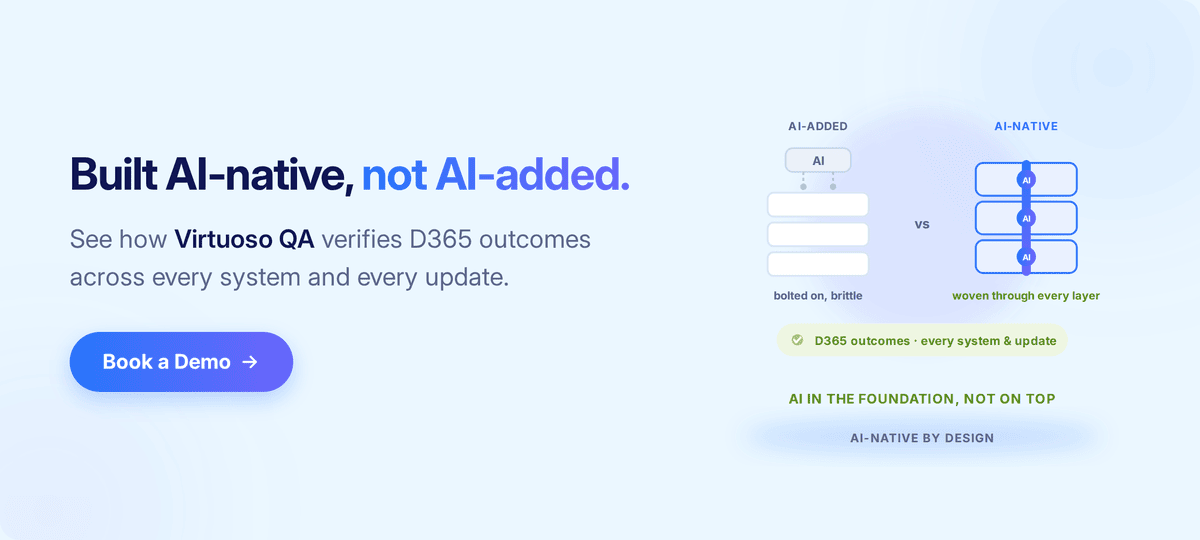
Virtuoso QA is built AI-native rather than AI-added, with natural language authoring, AI-augmented object identification, and self-healing as core capabilities rather than later additions.
Instead of replaying recorded clicks, it aims to verify that a process reaches its intended outcome, healing automatically when the interface moves and validating results across Dynamics 365 and the systems around it.
Virtuoso QA's composable automation for Microsoft Dynamics 365 lets teams configure standard D365 processes rather than rebuild them, which is what makes the migration off RSAT an upgrade rather than a restart.
The trade-off, common to any serious platform, is that it rewards a deliberate evaluation and a measured migration rather than promising a zero-effort switch, and the criteria in the next section are written to help run exactly that evaluation, against Virtuoso and against everything else on your shortlist.
2. Selenium, a Coded Automation Framework
Selenium is the open-source, code-based standard for automating web applications, and it can certainly drive parts of Dynamics 365 such as validating a login to the web client or creating a record.
It demands real development capability in a language such as C# or Java, and because the Unified Interface generates element identifiers that shift between sessions and updates, the maintenance burden tends to grow with the suite rather than shrink.
It suits teams with strong in-house automation engineering who want complete control and accept the upkeep that comes with it.
3. Executive Automats, a Low-Code D365-Focused Platform
Executive Automats is a no-code and low-code platform focused on the Dynamics 365 Finance and Operations module, with a recorder for building straightforward web-based test cases.
It lowers the barrier that coded frameworks raise and is aimed specifically at the D365 environment, though, as with most tools in this category, complex scenarios can still call for developer support, and coverage centres on the web layer.
4. Leapwork, a Low-Code Cross-Application Platform
Leapwork takes a visual, building-block approach to no-code automation, with cross-application support that extends across D365 modules and out to external systems such as SAP or Salesforce.
The visual model is designed so that business users and QA staff can build and maintain tests without writing code, which keeps test creation accessible beyond the development team.
5. Tricentis, a Legacy and Model-Based Platform
Tricentis is an established enterprise platform in the model-based category, bringing broad capability and a large accumulated feature set across many application types, including Dynamics 365.
For D365 specifically, the questions worth weighing are how well the model adapts to the Unified Interface, how much configuration and licensing overhead it carries, and whether its intelligence is built in or layered onto an older core.
The Criteria That Should Decide the Choice
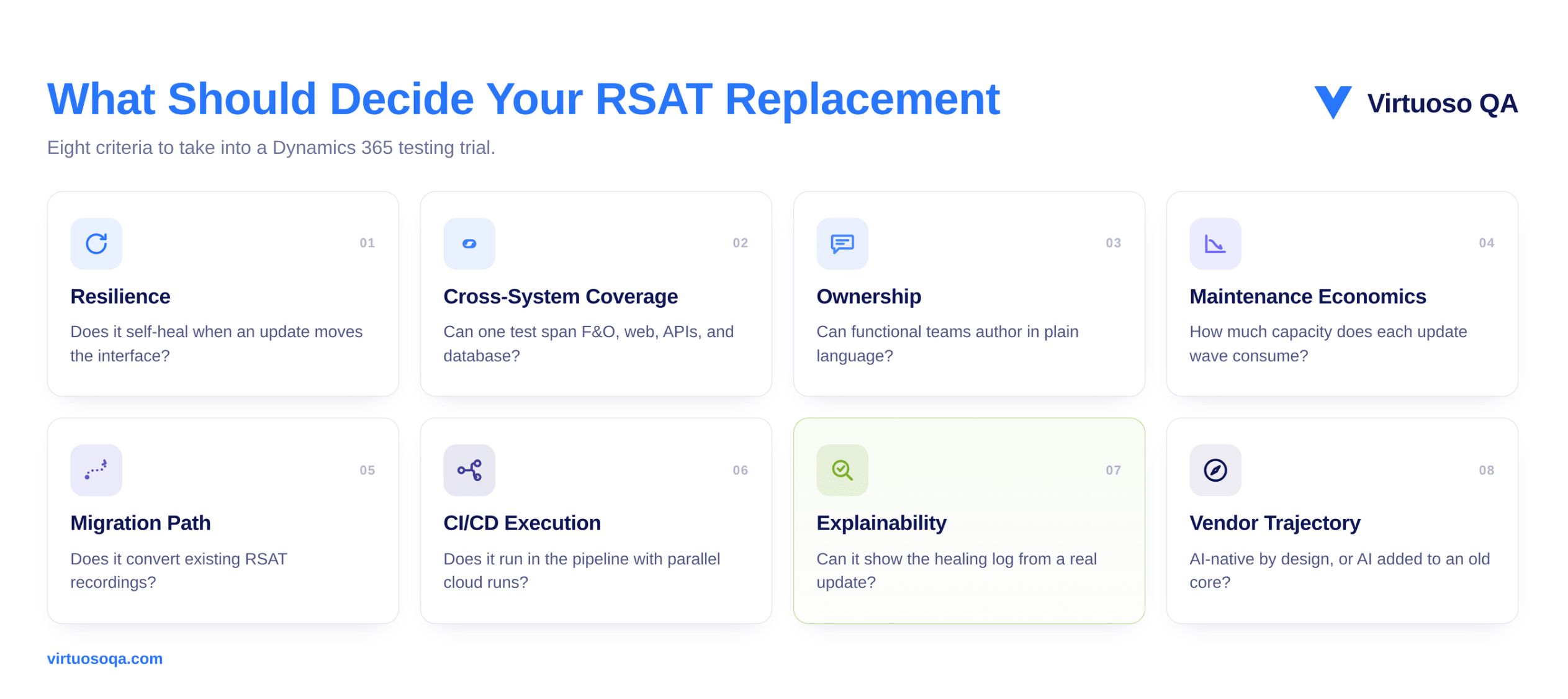
Tool categories narrow the field, but criteria pick the winner, and the eight below are the ones that separate a confident Dynamics 365 choice from an expensive second migration in three years.
1. Resilience to the One Version Cadence
The single most important property is what happens when an update changes the interface, so ask how the platform handles Dynamics 365's dynamic element identifiers and whether tests recover on their own.
A platform that self-heals, adapting automatically when controls or fields move, removes the re-recording cycle that defines RSAT and coded frameworks, whereas a platform that merely retries fixed locators inherits the same fragility under a different name.
2. Process-Level, Cross-System Coverage
Most Dynamics 365 alternatives, like RSAT itself, test one module at a time, but the real value lies in following a transaction across its whole path.
Verify whether a single test can span finance and operations, the web front ends around it, the APIs, and the database state, validating the outcome at both ends of a process such as procure-to-pay or period close.
Coverage that stops at the ERP boundary leaves the most expensive failures, the breaks between systems, untested.
3. An Authoring Model the Team Can Own
The people who built RSAT recordings were functional power users rather than developers, so a replacement that demands coding shifts the work to a different, scarcer team and locks the test logic away from the business.
Natural language authoring keeps that ownership where it belongs, because tests read as plain business steps, so consultants and analysts build and maintain coverage directly, and the knowledge stays readable across QA, development, and product.
4. Maintenance Economics
The headline metric is rarely creation speed. It is the share of effort lost to keeping existing tests alive after each update wave.
Model the real total cost of ownership here, looking at how maintenance scales with suite size and how much of the team's capacity an update consumes, because a platform that cuts maintenance through self-healing fundamentally changes the economics of how much coverage a team can sustainably hold.
5. A Migration Path That Preserves the Asset
Years of RSAT recordings encode genuine institutional knowledge, including process flows, edge cases, and the specific steps that prevented past go-live failures, so a good alternative carries that forward rather than discarding it.
Confirm whether the platform can convert existing recordings and scripts into its own executable tests, because migration tooling that reuses recorded logic turns the deprecation window into an upgrade rather than a rebuild from zero.
6. CI/CD and Continuous Execution
Regression for a continuously updated platform cannot be a twice-yearly scramble, because it has to run as part of the pipeline.
Check for native integration with Azure DevOps and other CI tools, for triggered execution, and for parallel cloud runs that scale without provisioning more machines, since continuous execution is what turns testing from a release gate into a constant signal of quality.
7. Explainability and Auditability
When something heals or fails, the team needs to know why, and explainability is also the cleanest way to tell genuine intelligence from a slightly more patient replay. A practical test cuts through most sales claims, which is to ask to see the healing log from a real update.
A platform that truly adapts can show what changed, how it re-routed, and what it then validated, whereas a platform that only retries locators can show a pass or a fail and nothing more.
The difference tells you whether you are buying understanding or repetition.
8. Vendor Trajectory
The last criterion is the one that prevents a repeat of the current situation, because RSAT is being retired partly because it was built before AI-shaped change became the norm.
Weigh whether a platform is AI-native by design or has had AI added onto an older core, and whether its direction matches where Dynamics 365 itself is heading, namely continuous, AI-enabled, and cross-system.
Choosing a tool aligned with that trajectory is how a team avoids migrating all over again the next time the ground moves.
Where Virtuoso QA Fits
Virtuoso QA is the trust layer for Dynamics 365 and the systems around it, so as code velocity rises and updates keep coming, it provides continuous verification that customer-critical workflows still work, whatever changed underneath. Mapped to the criteria above, the picture is as follows.
On resilience, self-healing adapts tests automatically when the interface shifts, holding to around 95 percent user acceptance, supported by AI-augmented object identification that handles dynamic identifiers reliably.
On process-level coverage, a single journey validates Dynamics 365 alongside web front ends, APIs, and databases, testing a process end to end rather than module by module.
On ownership, natural language authoring keeps tests readable and maintainable by functional teams rather than only developers.
On migration, GENerator converts legacy recordings and scripts into executable natural language tests, and composable D365 libraries mean teams configure standard processes rather than rebuild them.
On continuous and explainable execution, tests run inside Azure DevOps and other pipelines with parallel cloud execution, and AI Root Cause Analysis explains what happened when a test heals or fails.
How to Run the Evaluation
The strongest evaluations are run on real processes rather than on slide decks, and a short, structured trial removes most of the guesswork.
Pick three to five of the highest-risk Dynamics 365 processes, meaning the cross-module workflows whose failure would actually hurt, such as order-to-cash, procure-to-pay, and period close. Build them in each shortlisted platform, then run them through a real update wave and watch what happens, measuring how much broke, how much healed on its own, how much could be tested end to end, and how readable the result was to a non-developer.
It also pays to sort the existing RSAT library before migrating anything, because some recordings are genuine regression tests while others are really process documentation.
Carrying the regression tests forward and leaving the documentation behind keeps the new suite lean from the very start.
Where This is Heading
The retirement of RSAT is a signal rather than just an event, because Dynamics 365 testing is moving toward something continuous, intelligent, and cross-system, where verification travels with change rather than waiting for a release gate.
In that model, impacted tests run automatically when something is altered, failures arrive with repro steps and a suspected cause already attached, and the suite stays aligned with the live behaviour of the application.
The teams that treat the window before May 2027 as time to adopt that model, rather than as time to find the nearest RSAT lookalike, will be the ones testing with confidence on the other side of the deadline.
Related Reads
Frequently Asked Questions
Has Microsoft Named an Official RSAT Replacement?
Can Teams Keep Using RSAT After May 2027?
What Should Teams Look For in a Dynamics 365 Test Automation Tool?
How Can a Buyer Evaluate Whether a Platform Really Self-Heals?
Can Existing RSAT Recordings Be Reused in a New Tool?
How Long Does Migrating Off RSAT Take?