Insurance
Insurance Document Testing: Schedules, Certificates, Renewal Notices and Wordings

Adwitiya Pandey
Published On






Table of contents
Lorem ipsum
Lorem ipsum
Lorem ipsum
Lorem ipsum
Lorem ipsum
Insurance document testing proves that every policy event produces the right document, from the right template version, with the right values and mandatory disclosures, and that it actually reaches the customer or broker. Documents carry the contract and many regulatory disclosures, so a document defect is a legal and conduct problem, not just a technical one.
Yet documents are often the least tested part of an insurance release. They’re generated by a separate composition platform, change on their own schedule, and are usually checked by someone opening a PDF during UAT. This guide sets out a more systematic approach.
Which Insurance Documents Carry the Most Risk?
The documents that define cover, state the price and carry regulatory disclosures carry the most risk. An error in any of them can change what the customer is covered for, what they believe they’re paying, or what they’re told about their rights.
Document | Why It Matters | Typical Defects |
|---|---|---|
Policy schedule | States cover, limits, excesses, premium and effective dates | Values out of step with the policy after a change |
Certificate of insurance | Legal evidence of cover, for example for motor | Wrong vehicle, driver or period |
Policy wording and endorsements | Define the contract | An old wording version attached after a change |
Product information documents | Summarise cover before purchase | Out of date after a product change |
Renewal notice | Shows renewal terms and required disclosures | Missing or wrong values, such as last year’s premium on UK renewal notices |
Mid-term adjustment and cancellation documents | Confirm changes and refunds | Wrong amounts or effective dates |
Claims letters | Communicate decisions, payments and reasons | Decline letters without reasons, or wrong settlement amounts |
Why Do Insurance Document Defects Slip Through?
Because document generation sits between systems. The policy platform decides which document to request and what data to send; the composition platform chooses the template and lays out the values; and the delivery channel sends it.
Each has its own release cycle, and a change in any one can break a document that nobody tests until a customer reads it.
The usual causes:
Template versioning: A wording or template update is not linked to the products and dates it applies to.
Data mapping: A new or renamed field in the policy platform is not passed to the template, so a value is blank or wrong.
Event triggers: A policy event no longer requests the document it should, or requests the wrong one.
Conditional content: Clauses that should appear only for certain covers, jurisdictions or customers appear for the wrong ones.
Delivery: The document is generated but never reaches the portal, email or post.
What Should an Insurance Document Test Check?
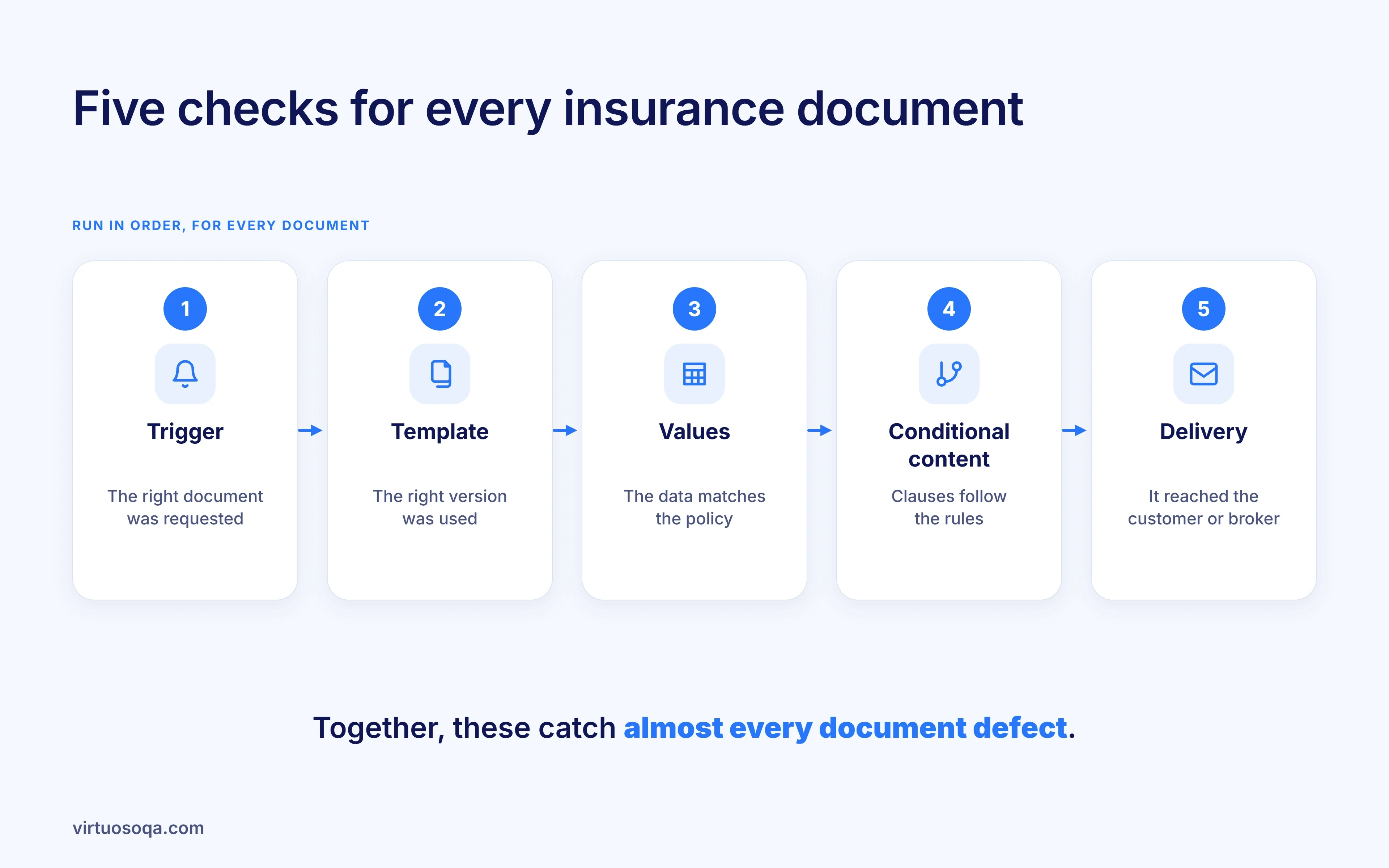
Check five things for every policy event: the right document was requested, the right template version was used, the values passed to it match the policy, conditional content follows the rules, and the document reached the customer or broker. Together they cover almost every document defect insurers see.
Trigger: The policy event requests the expected documents, and no others.
Template: The template and wording versions match the product, jurisdiction and effective date.
Values: Names, covers, limits, excesses, premiums, taxes, dates and identifiers passed to the template match the policy.
Conditional content: Clauses and disclosures appear exactly when the rules say they should.
Delivery: The document is available in the portal, sent by email or queued for print, as the customer's preferences require.
How Should Regulatory Disclosures in Documents Be Tested?
Treat each required disclosure as a requirement drawn from the rule that mandates it, and test it on every release that touches the document or the data behind it.
In UK home and motor, for example, renewal transparency rules require renewal notices to show the previous year's premium alongside the renewal price.
The Consumer Duty's consumer understanding outcome adds a broader expectation: communications should equip customers to make decisions.
Testing cannot judge clarity, but it can make sure the right information is present, correct and delivered. See Consumer Duty and Software Testing.
How Do You Test Documents Produced by Composition Platforms?
Test at the boundaries. Confirm what the policy platform sends to the composition platform for each event, confirm which template version was used, and confirm the document is available to the customer.
Composition platforms such as Smart Communications, Quadient Inspire and OpenText Exstream have their own testing for layout; insurers need to test that their data and rules produce the right document.
Where a composition platform exposes document content through an API or a portal view, checks can extend to key values in the output. Where it does not, testing the request data and template version still catches most defects, because most document errors start upstream.
How Does Virtuoso QA Touchstone Test Insurance Documents?
Touchstone tests documents as part of the policy journeys that produce them. Each journey checks the document request, the template version, the values passed to composition and availability in the portal, with requirements drawn from wordings, templates and disclosure rules.
The Analyst reads wording and template schedules, disclosure rules and product specifications, and proposes requirements for each event, each citing its source.
The Architect builds journeys that perform each policy event and check the resulting document request, template version, values and delivery.
The Autopilot runs those journeys on a deterministic engine whenever a template, wording, product or integration changes.
API and data checks compare the values sent to composition with the policy, and confirm the document is available in customer and broker portals.
Change tracing links a wording or template update to every product, event and journey it affects.
Illustrative Scenario: The Renewal Notice Field That Went Blank
This scenario is illustrative and does not describe a specific firm.
A UK home insurer renames a premium field in its policy platform as part of a billing change. The composition platform's renewal notice template still references the old field name.
Touchstone's renewal journeys check the data passed to the renewal notice for each policy. The previous year's premium arrives empty for every renewal. The mapping is corrected before the next invitation batch, and the evidence shows the disclosure requirement, the failed value check and the passing re-run, a fault that would otherwise have reached every renewing customer that month.
Insurance Document Testing FAQs
How do you test insurance documents?
Why are insurance documents a compliance risk?
Can automated tests check PDF content?
How often should document tests run?
Who owns insurance document testing?
" height="10.182000000000016px" id="C361dJxCp" width="11.692999999999984px"/></svg>)