Blog
Test Automation for Pet Insurance Platforms: What Makes This Sector Different

Rishabh Kumar
Published on






Table of contents
Lorem ipsum
Lorem ipsum
Lorem ipsum
Lorem ipsum
Lorem ipsum
Pet insurance is one of the fastest-digitising corners of the insurance market, and the software behind it is harder to test than most people expect. Breed-based pricing, medically complex claims decisions, lifetime policy flows and a crowd of distribution channels combine into a testing problem that generic test automation was never shaped to handle.
The piece below sets out what makes the sector different, why standard approaches struggle, and what a testing programme built for a pet insurance platform actually needs to do.
Why Pet Insurance Software Is Its Own Testing Problem
Most software testing guidance assumes a stable set of rules and an occasional feature change. A pet insurance platform breaks that assumption from day one. The rules move constantly, the calculations are dense, and a defect does not surface as a cosmetic bug but as a wrong premium or a rejected claim on a sick animal.
The sector is also growing and modernising at speed. The UK and the Nordic markets carry the highest pet insurance penetration in Europe, veterinary costs have been rising faster than general inflation for years, and a wave of digital-first carriers has pushed claims automation and online distribution to the front of the product. Each of those trends adds change, and change is what a testing programme has to keep pace with.
Four characteristics set pet insurance apart from a testing standpoint. Taken together, they explain why a team can automate a simple retail checkout with ease and still struggle to get a pet pricing engine under reliable test.
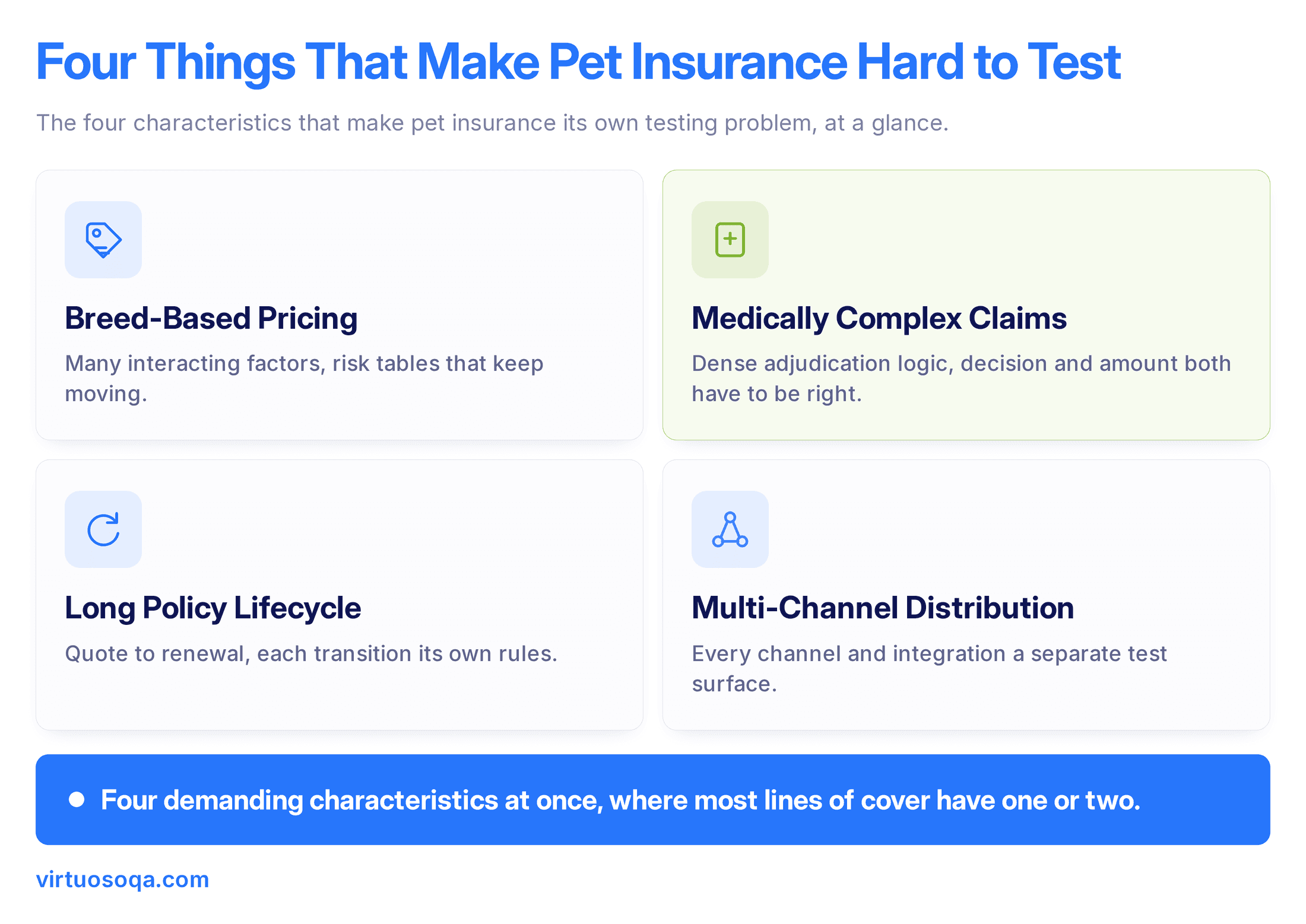
Characteristic One: Breed-Based Pricing is Unusually Hard
A pricing engine turns risk factors into a premium, and pet insurance carries more of them, interacting in more ways, than most lines of cover. Getting the premium right across every combination is where the difficulty starts.
A motor rating structure is large but fairly stable once built. A pet pricing engine has to reason about species, breed, crossbreed, age band, pre-existing conditions, cover level and excess, and it does so against risk tables that shift as veterinary cost data updates.
Country-specific rules add another layer: the sector has no single European regulator and sits under national insurance law, so the same insurer can face different requirements in different markets. Some markets require cover for hereditary conditions in dogs while others permit their exclusion, which means the rating logic itself changes by country.
The testing consequence is a combinatorial one. Change a single breed risk factor and every quote path that touches that factor needs re-verification, not just the rule that was edited. Re-checking that by hand across breeds, age bands, cover levels and jurisdictions does not scale, which is why pricing changes so often sit in a queue waiting for a manual test cycle to catch up.
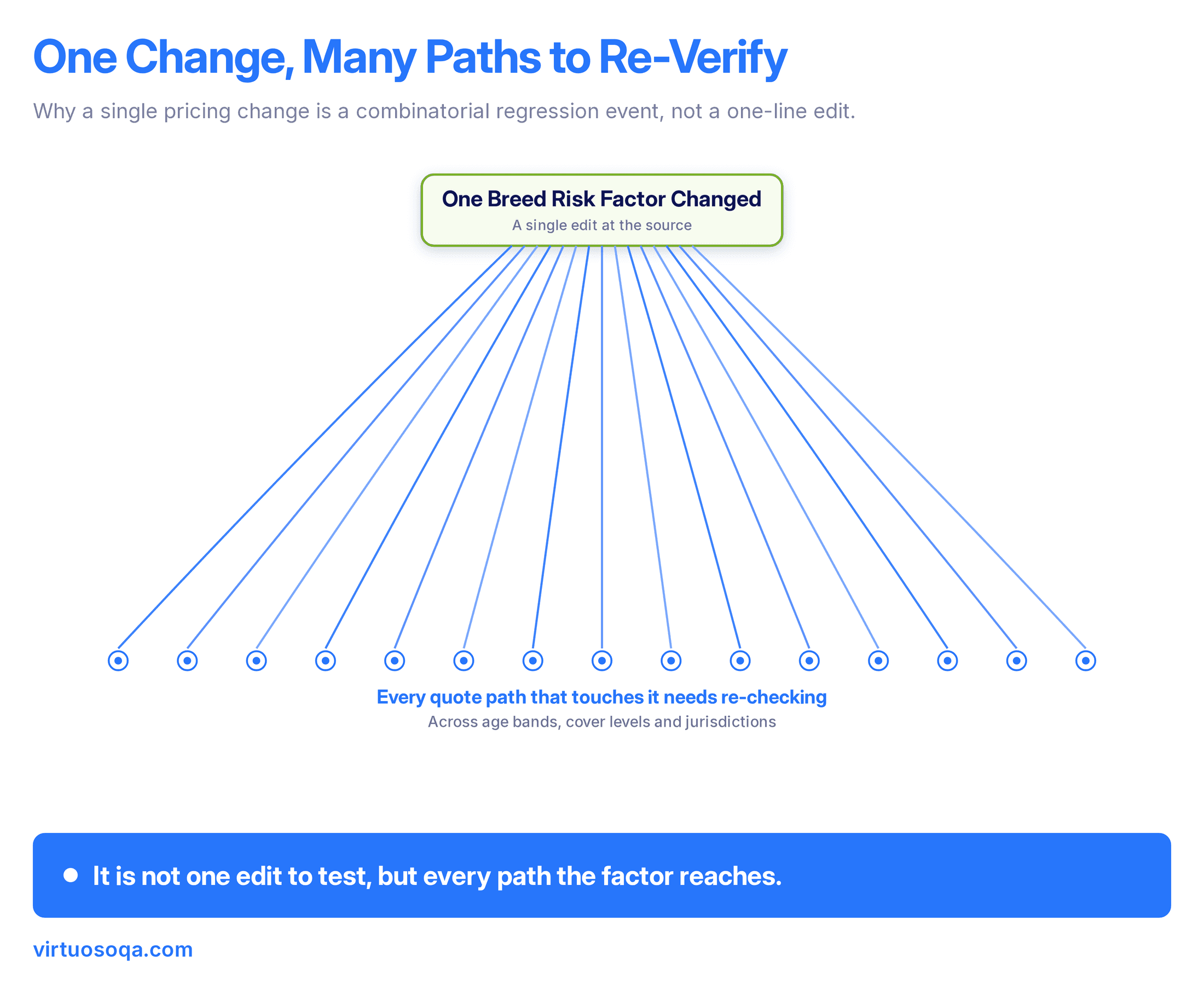
Characteristic Two: Claims Logic is Medically and Financially Complex
Claims adjudication on a pet policy is a dense piece of business logic. It has to read the policy wording as executable rules, apply them to a real veterinary event, and arrive at a decision and an amount that both stand up to scrutiny.
A single claim decision may depend on whether the policy was in force at the date of treatment, whether a waiting period has passed, whether the condition is covered or falls under a pre-existing exclusion, and how annual limits, per-condition limits and excesses deplete across the policy year.
The move to straight-through claims processing, increasingly powered by large language models and document reading, raises the stakes further. Automated adjudication rules get tuned frequently, and every adjustment is a regression event across the full set of possible outcomes.
Testing that logic means proving the decision, the amount and the reason codes are correct across pay, partial pay, decline and refer, including the awkward cases: a claim that straddles a renewal, a lapsed policy, or several claims eating into the same limit.
A defect here is not a minor bug. A wrongly declined claim reaches an owner with a sick animal, and a wrongly paid one is quiet leakage the business carries.
Characteristic Three: The Policy Lifecycle is Long and Full of Transitions
Pet policies, particularly lifetime products, are long-lived and change hands through many states. Each transition carries its own rules and data transformations, and a change at one stage can surface as a defect three steps later.
Lifetime cover renews year after year, with re-rating that has to reflect current pricing rules and the pet's changing age and history. Mid-term adjustments, such as adding a pet or changing cover level, have to recalculate premium on a pro-rata basis and carry the change through to billing and documents. Cancellation and reinstatement each have their own logic. Because these stages share data, testing any one of them in isolation misses the point: a pet insurance platform has to be tested as a lifecycle, from quote to renewal, not as a set of separate screens.
Characteristic Four: Distribution is Multi-Channel, and Every Channel is a Test Surface
Pet insurance rarely reaches the customer through one route. Direct websites, price comparison aggregators, bancassurance tie-ups and embedded points of sale such as veterinary practices all sell the same product, and each is a separate surface that has to work.
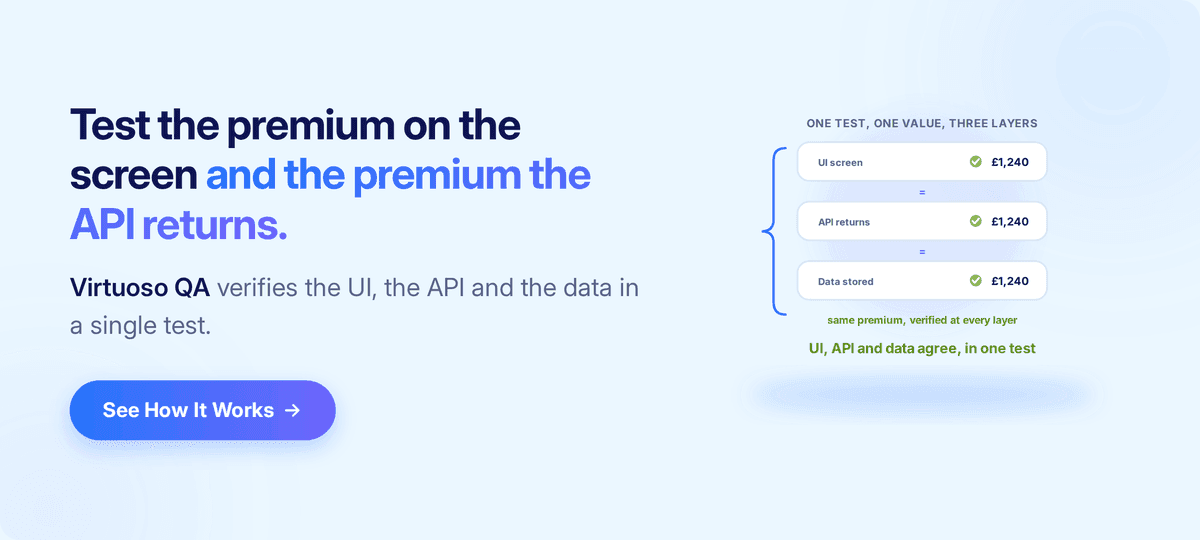
Aggregator integrations matter most for testing, because a comparison site sends a quote request through an API and expects a correct, consistent premium back. A pricing change that looks right on the direct site can return a different number through the aggregator if the integration is not re-tested. Each new channel, each API contract change and each new partner adds a regression surface, and the premium has to stay consistent across all of them. A testing programme that covers the web application journeys and the APIs behind them catches these breaks where they happen, rather than waiting for a mispriced quote to appear on a comparison site.
Why Generic Test Automation Struggles Here
Standard automation frameworks were built for applications where the interface is stable and the rules change slowly. A pet insurance platform is the opposite, and three problems tend to appear in quick succession.
The first is the combinatorial explosion already described: too many interacting factors to script and re-script by hand.
The second is maintenance. Traditional framework-based suites break whenever the interface or the rules change, and on a platform that changes weekly, teams end up spending the bulk of their time repairing tests rather than extending coverage.
The third is knowledge. The people who understand breed edge cases and adjudication rules are usually senior testers and domain specialists, not automation engineers, so the knowledge that should drive the tests sits one step removed from the tooling that writes them.
The result is familiar to anyone who has run QA in a fast-moving insurance product. Coverage stays thin, the test cycle becomes the release ceiling, and the business ships pricing and claims changes faster than the team can verify them.
What Good Testing Looks Like for a Pet Insurance Platform
A testing programme fit for this sector has to do four things well, each answering one of the characteristics above. None of them is exotic, but together they are demanding enough that most generic setups fall short.
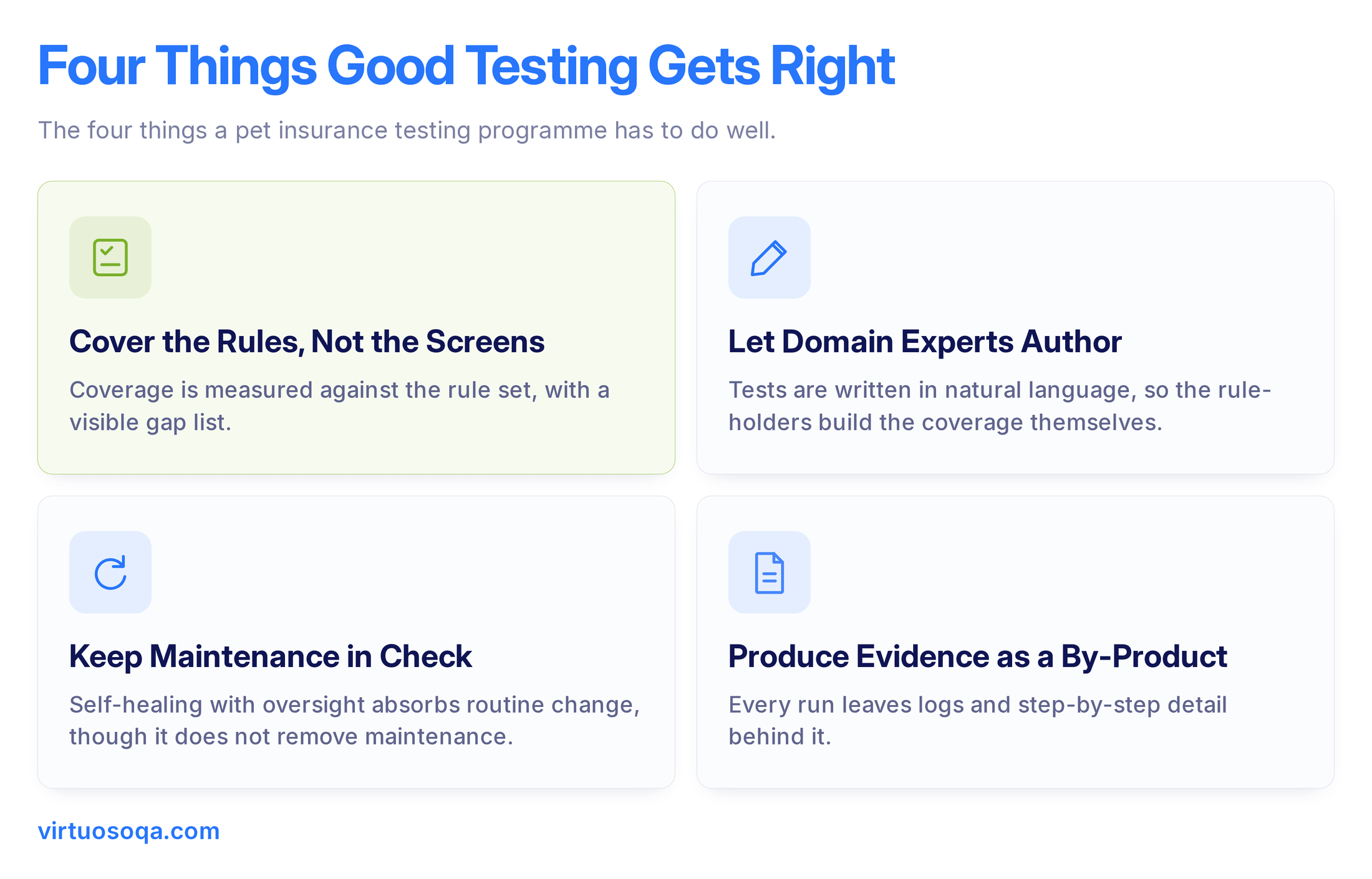
Cover the rules, not just the screens: Coverage should be measured against the pricing and adjudication rule set, with a visible gap list, so the team knows which rules are protected and which are not.
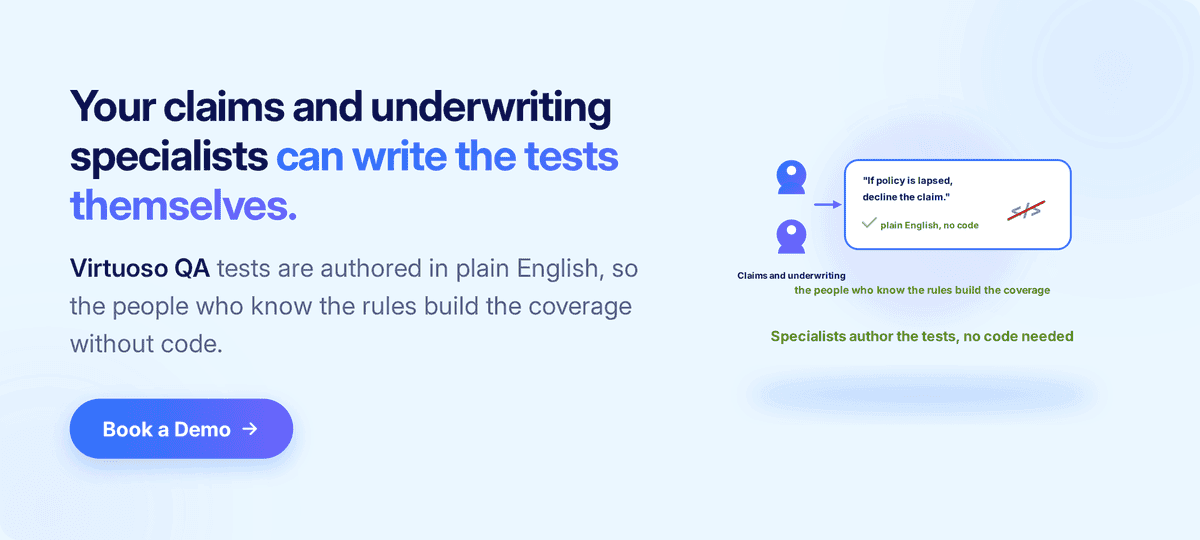
Let domain experts author the tests: When tests are written in natural language rather than code, the underwriters and claims specialists who hold the edge-case knowledge can build the coverage directly, and that knowledge stays in the suite when people move on.
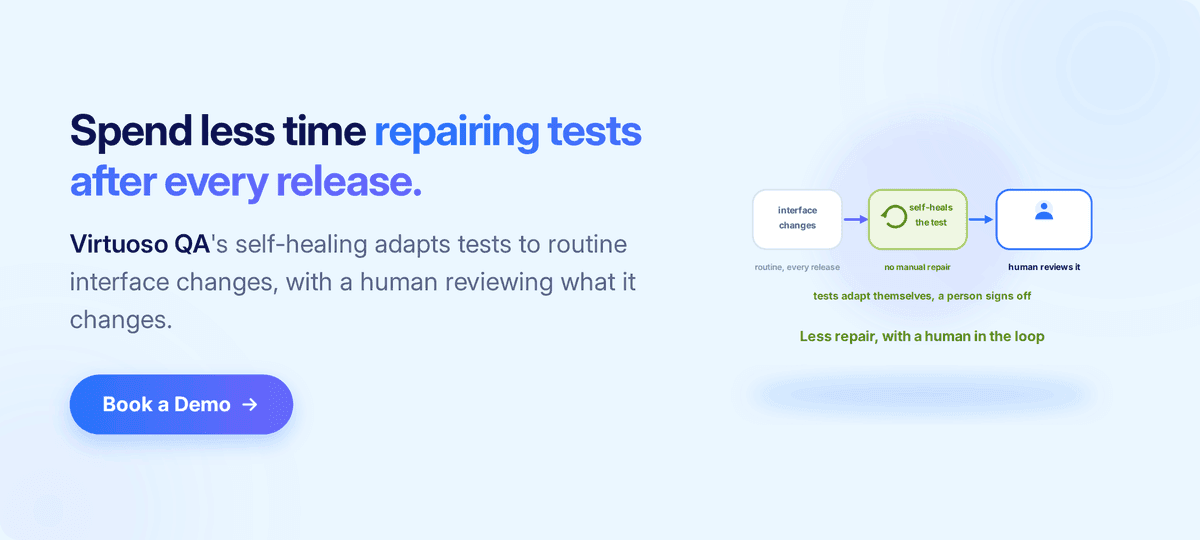
Keep maintenance from eating the gains: Self-healing with human oversight absorbs routine interface changes so the team is not rebuilding tests every sprint. Worth stating plainly, self-healing reduces maintenance, it does not remove it, and no responsible programme promises zero maintenance.
Produce evidence as a by-product: Every run should leave logs, pass and fail history and step-by-step detail behind it, so the record of what was tested exists without a separate documentation exercise.
Underneath all four sits the question regulated buyers now ask first: can the testing be trusted?
Insurance procurement teams have started writing AI governance into their requirements as mandatory criteria, including human approval before AI-generated tests execute, no training on customer data, data held in the UK or EU, and a full audit trail of every run. A pet insurance testing programme has to satisfy those before it satisfies anything else.
Where Virtuoso QA Fits
Virtuoso QA is the trust layer for pet insurance platforms: automated regression across pricing engines, claims adjudication logic, policy lifecycle flows and the APIs behind them, with the evidence a documented testing programme is expected to produce.
Tests are authored in natural language, so the people who understand breed-specific edge cases and adjudication rules build the coverage without writing code, and that expertise is encoded before it walks out the door.
The mechanic is governed autonomy. AI reasons about the tests, a deterministic engine executes them, a person approves what matters before they run, and every decision is recorded. Speed comes from the AI and the reuse; accountability comes from the deterministic execution and the human gate. Self-healing with human oversight keeps the suite steady as the product changes, and every run generates the logs and step-by-step evidence a carrier can hand to an auditor without translation.
London Market Group shows the pattern at insurance scale. Before Virtuoso QA, more than 100 SDETs on Selenium and Karate could not keep pace with testing demand. After moving to AI-native automation, the group reached 85 per cent faster test creation, 81 per cent less maintenance effort and over 95 per cent functional coverage with a team half the size. A North American pet health insurer runs regression across its pricing and claims platform on the same model. The pattern transfers directly to a pet insurance product.
Check our page on AI-Native Test Automation for Insurance to know how Virtuoso QA transforms insurance application testing
Frequently Asked Questions
What Is Pet Insurance Test Automation?
Why Is Testing a Pet Insurance Platform Different From Other Insurance Software?
How Do You Test Pet Insurance Claims Logic?
Why Is Breed-Based Pricing Hard to Test?
How Does AI-Driven Claims Automation Affect Testing?
How Do Pet Insurers Measure Test Coverage?