Enterprise Test Authoring Built for Scale and Consistency
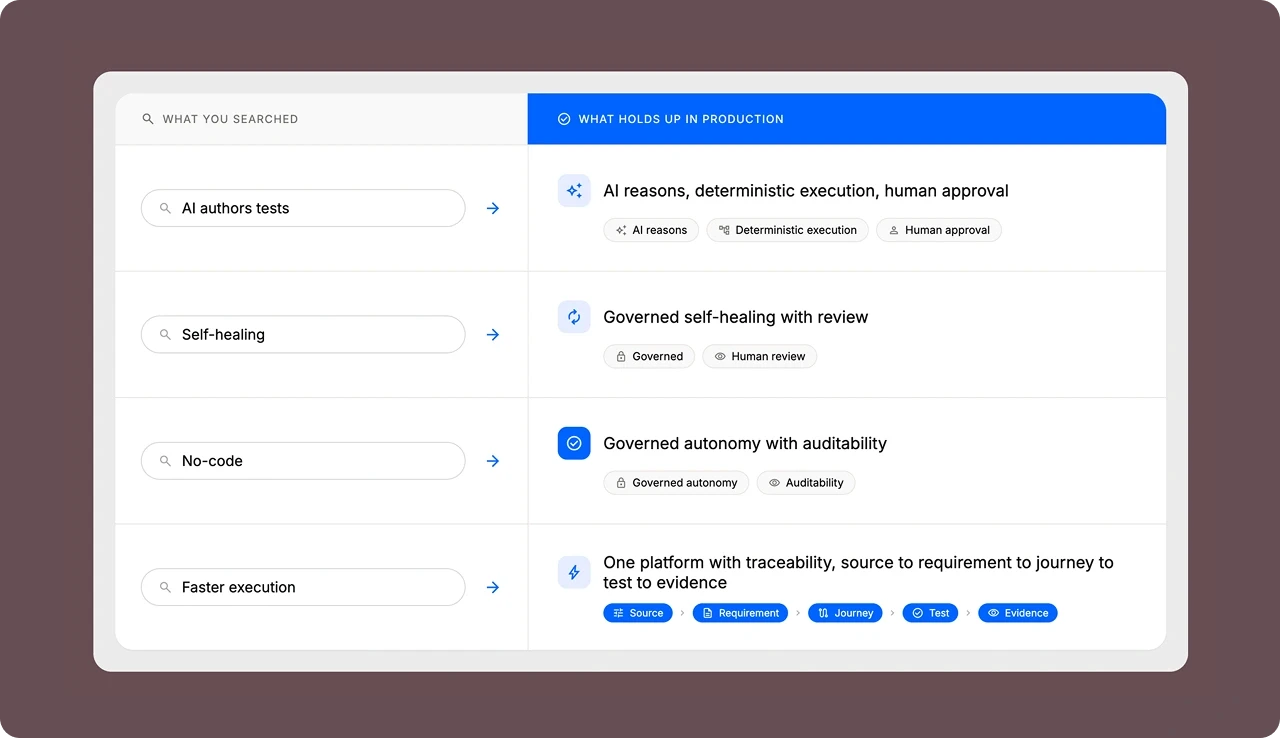
In enterprise environments, test coverage is authored across teams, delivery partners, regions and levels of experience. Virtuoso QA keeps that work consistent through plain-English journeys, organisation-specific conventions applied by Touchstone at the point of generation, and a clear record of the requirement version behind every journey.
Enterprise Test Authoring Built for Scale and Consistency
In enterprise environments, test coverage is authored across teams, delivery partners, regions and levels of experience. Virtuoso QA keeps that work consistent through plain-English journeys, organisation-specific conventions applied by Touchstone at the point of generation, and a clear record of the requirement version behind every journey.
Trusted where releases carry consequences











Trusted where releases carry consequences
Trusted where releases carry consequences
Trusted where releases carry consequences
The Structural Impact of Uncontrolled Test Authoring
For smaller teams, authoring is a productivity metric. At enterprise scale, authoring becomes an governance challenge where unmanaged variance introduces significant downstream overhead.
Inconsistent Execution Across Teams
Documented standards are only effective when consistently applied. Without automated enforcement, distributed teams, vendors, and regional units inevitably structure, name, and validate the same core processes differently. These discrepancies remain hidden until cross-estate reporting fails to consolidate accurately.

Knowledge Loss and Key-Person Dependency
When contractors roll off or teams reorganize, critical context leaves with them. Unstructured suites force incoming engineers to reverse-engineer test logic directly from code to determine original scope and intent.

Compounding Onboarding Overhead
Every new team, partner, or engineer must learn proprietary framework architecture before delivering value. In environments with normal turnover, this ramp-up period creates a permanent, recurring drain on engineering capacity.

The Structural Impact of Uncontrolled Test Authoring
For smaller teams, authoring is a productivity metric. At enterprise scale, authoring becomes an governance challenge where unmanaged variance introduces significant downstream overhead.
Inconsistent Execution Across Teams
Documented standards are only effective when consistently applied. Without automated enforcement, distributed teams, vendors, and regional units inevitably structure, name, and validate the same core processes differently. These discrepancies remain hidden until cross-estate reporting fails to consolidate accurately.
Knowledge Loss and Key-Person Dependency
When contractors roll off or teams reorganize, critical context leaves with them. Unstructured suites force incoming engineers to reverse-engineer test logic directly from code to determine original scope and intent.
Compounding Onboarding Overhead
Every new team, partner, or engineer must learn proprietary framework architecture before delivering value. In environments with normal turnover, this ramp-up period creates a permanent, recurring drain on engineering capacity.
Author Tests From the Knowledge You Own
Virtuoso QA turns your existing requirements, specifications, stories and process documentation into proposed test coverage. Touchstone and its specialised agents analyse the sources you select, identify what needs testing and create structured requirements with citations back to the document behind each one.

Write Tests for People, Not Frameworks
Plain English journeys are readable across QA, product and delivery teams. Steps describe intent rather than selectors, and data is referenced by column name, so a test stays maintainable when ownership moves between teams or suppliers.

Standardise Authoring at the Point of Creation
Your naming conventions, instructions and output templates are applied during generation, at organisation or project scope. Enterprise standards stay consistent across teams while projects add their own requirements where needed.

Author From the Requirements Behind the Test
Specifications, stories, policies, process documents, diagrams and API definitions go into the project Knowledge Base, and Touchstone proposes requirements with risk levels, tags, structured descriptions and citations to their source.

Turn Approved Requirements Into Executable Tests
The Analyst interprets what needs covering, the Architect turns it into a test design with checkpoints, data and environments, and the Autopilot builds the journey, presenting its plan before authoring and pausing when input is needed.

Build Traceability Into Every Test
Each test stays connected to the requirement and source it came from. Proposals are versioned, approvals are recorded, and journeys retain the requirement version behind them, so the history of what changed and why stays intact.

Author Once and Reuse Across the Suite
Checkpoints, data tables and environments become library assets available to every journey after them. Proposed coverage references what exists before creating anything new, so a shared step is maintained in one place.
Author Tests From the Knowledge You Own
Virtuoso QA turns your existing requirements, specifications, stories and process documentation into proposed test coverage. Touchstone and its specialised agents analyse the sources you select, identify what needs testing and create structured requirements with citations back to the document behind each one.
Write Tests for People, Not Frameworks
Plain English journeys are readable across QA, product and delivery teams. Steps describe intent rather than selectors, and data is referenced by column name, so a test stays maintainable when ownership moves between teams or suppliers.
Standardise Authoring at the Point of Creation
Your naming conventions, instructions and output templates are applied during generation, at organisation or project scope. Enterprise standards stay consistent across teams while projects add their own requirements where needed.
Author From the Requirements Behind the Test
Specifications, stories, policies, process documents, diagrams and API definitions go into the project Knowledge Base, and Touchstone proposes requirements with risk levels, tags, structured descriptions and citations to their source.
Turn Approved Requirements Into Executable Tests
The Analyst interprets what needs covering, the Architect turns it into a test design with checkpoints, data and environments, and the Autopilot builds the journey, presenting its plan before authoring and pausing when input is needed.
Build Traceability Into Every Test
Each test stays connected to the requirement and source it came from. Proposals are versioned, approvals are recorded, and journeys retain the requirement version behind them, so the history of what changed and why stays intact.
Author Once and Reuse Across the Suite
Checkpoints, data tables and environments become library assets available to every journey after them. Proposed coverage references what exists before creating anything new, so a shared step is maintained in one place.
Make Test Authoring an Enterprise Capability

Expand Coverage Without Framework Bottlenecks
Author tests from business behaviour without requiring framework expertise for every contribution. Teams can expand coverage while reducing dependency on specialist automation skills.
Build Test Suites That Outlast Team Turnover
Plain-English journeys linked to requirements preserve the context behind every test. When teams or vendors change, the knowledge remains readable, maintainable and transferable.

Prove Coverage, Not Just Test Counts
Requirement-linked tests show what was tested, what the test is intended to prove and where the requirement originated. Coverage becomes something teams can understand in business terms, not just a number of executions.
Reduce the Cost of Every New Contributor
People can understand and contribute to tests without first learning a framework, coding language or team-specific automation conventions. Test authoring becomes accessible to everyone who understands the product.
Make Test Authoring an Enterprise Capability
Expand Coverage Without Framework Bottlenecks
Author tests from business behaviour without requiring framework expertise for every contribution. Teams can expand coverage while reducing dependency on specialist automation skills.
Build Test Suites That Outlast Team Turnover
Plain-English journeys linked to requirements preserve the context behind every test. When teams or vendors change, the knowledge remains readable, maintainable and transferable.
Prove Coverage, Not Just Test Counts
Requirement-linked tests show what was tested, what the test is intended to prove and where the requirement originated. Coverage becomes something teams can understand in business terms, not just a number of executions.
Reduce the Cost of Every New Contributor
People can understand and contribute to tests without first learning a framework, coding language or team-specific automation conventions. Test authoring becomes accessible to everyone who understands the product.
Scripted Frameworks vs. AI-Assisted Test Generation vs. Virtuoso QA
Virtuoso QA authors from approved requirements rather than from code or a prompt, applies your standards during generation, and keeps a person in the loop at each stage. What separates the three approaches is where the intent comes from and what the organisation is left holding afterwards.
How tests are authored
Scripted frameworks require teams to write and maintain test code. AI-assisted generation creates tests from prompts or inputs, but still depends on the underlying framework. Virtuoso QA uses agents to turn approved requirements into structured, executable journeys.

Where test intent comes from
Scripted frameworks rely on someone translating requirements into automation. AI-assisted generation depends on the context provided to the model. Virtuoso QA’s Analyst works from requirements and source documentation to establish what needs to be tested.

How standards are applied
Scripted frameworks rely on teams following conventions. AI-assisted generation follows instructions provided to the model. Virtuoso QA applies Agentic Directives during generation, embedding organisation and project standards into authoring.

How changes are authored
Scripted tests require developers to modify affected code. AI-assisted generation can suggest changes, but teams still need to assess them. Virtuoso QA’s Analyst identifies requirement changes, Architect structures the impact and Autopilot authors the approved journey changes.
How authoring is governed
Scripted frameworks rely on code review. AI-assisted generation adds another review step for generated output. Virtuoso QA keeps human approval in the loop, recording proposals, versions, sources and acceptance.
What the organisation inherits
Scripted frameworks leave behind code and framework knowledge. AI-assisted generation reduces coding effort but retains that technical model. Virtuoso QA creates readable, requirement-linked journeys that preserve the intent behind each test.
Scripted Frameworks vs. AI-Assisted Test Generation vs. Virtuoso QA
Virtuoso QA authors from approved requirements rather than from code or a prompt, applies your standards during generation, and keeps a person in the loop at each stage. What separates the three approaches is where the intent comes from and what the organisation is left holding afterwards.
How tests are authored
Scripted frameworks require teams to write and maintain test code. AI-assisted generation creates tests from prompts or inputs, but still depends on the underlying framework. Virtuoso QA uses agents to turn approved requirements into structured, executable journeys.
Where test intent comes from
Scripted frameworks rely on someone translating requirements into automation. AI-assisted generation depends on the context provided to the model. Virtuoso QA’s Analyst works from requirements and source documentation to establish what needs to be tested.
How standards are applied
Scripted frameworks rely on teams following conventions. AI-assisted generation follows instructions provided to the model. Virtuoso QA applies Agentic Directives during generation, embedding organisation and project standards into authoring.
How changes are authored
Scripted tests require developers to modify affected code. AI-assisted generation can suggest changes, but teams still need to assess them. Virtuoso QA’s Analyst identifies requirement changes, Architect structures the impact and Autopilot authors the approved journey changes.
How authoring is governed
Scripted frameworks rely on code review. AI-assisted generation adds another review step for generated output. Virtuoso QA keeps human approval in the loop, recording proposals, versions, sources and acceptance.
What the organisation inherits
Scripted frameworks leave behind code and framework knowledge. AI-assisted generation reduces coding effort but retains that technical model. Virtuoso QA creates readable, requirement-linked journeys that preserve the intent behind each test.
Explore Related Virtuoso QA Capabilities
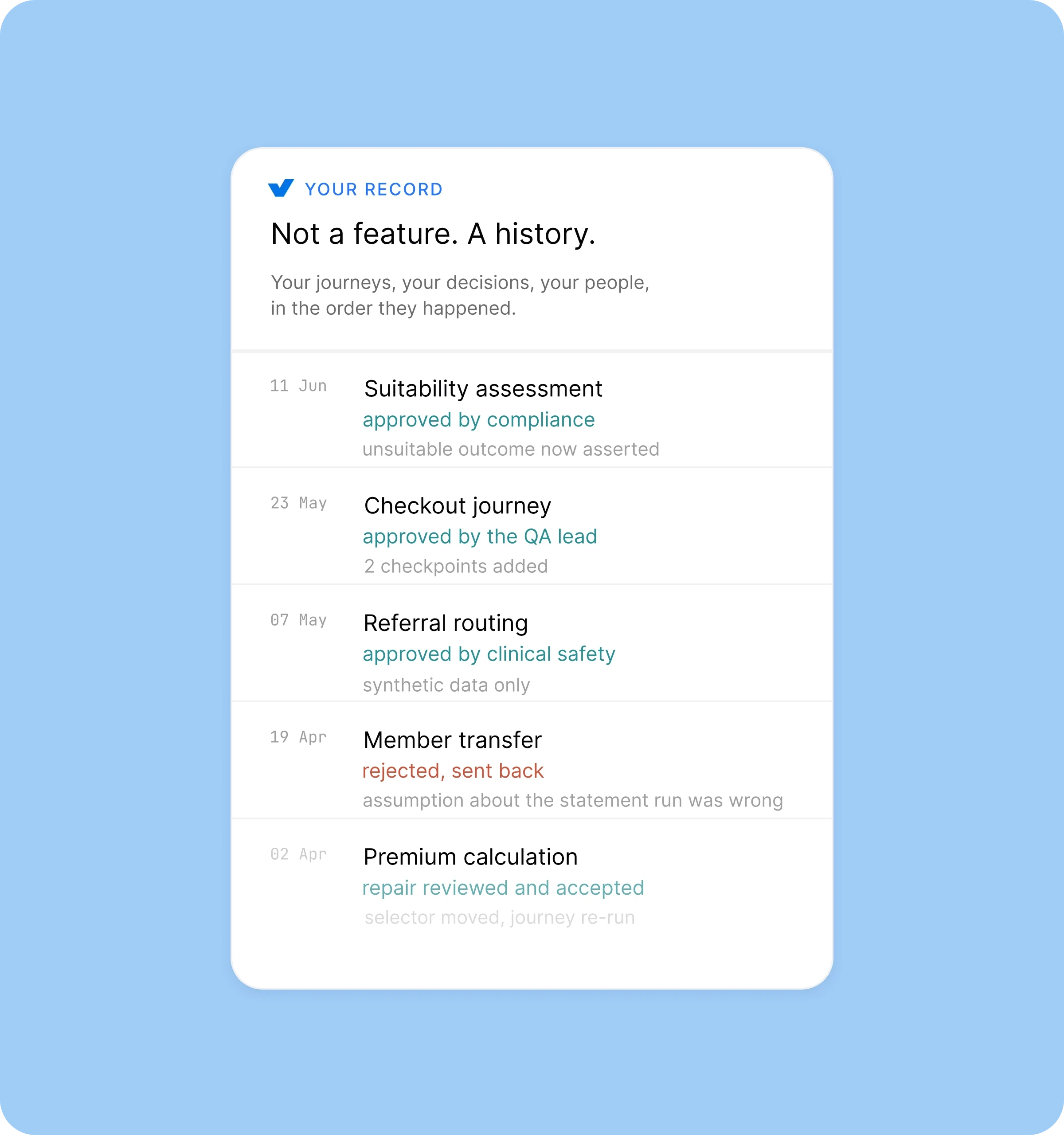
Read the record a change leaves
Version history, execution history and the chain from source to requirement to run.
Run approved journeys at scale
Deterministic execution across browsers, environments and datasets, on demand or from your pipeline.
Explore Related Virtuoso QA Capabilities
Read the record a change leaves
Version history, execution history and the chain from source to requirement to run.
Run approved journeys at scale
Deterministic execution across browsers, environments and datasets, on demand or from your pipeline.
Explore Related Virtuoso QA Capabilities
Read the record a change leaves
Version history, execution history and the chain from source to requirement to run.
Run approved journeys at scale
Deterministic execution across browsers, environments and datasets, on demand or from your pipeline.
AI-native, proven in production.
10x
Faster execution
9x
Faster authoring
85%
Less maintenance
50%
Lower QA cost
AI-native, proven in production.
10x
Faster execution
9x
Faster authoring
85%
Less maintenance
50%
Lower QA cost
AI-native, proven in production.
10x
Faster execution
9x
Faster authoring
85%
Less maintenance
50%
Lower QA cost
Proven where quality and accountability matter
Recognised by independent analysts, trusted by enterprise teams, and built with the security controls required for critical software.

WAVE STRONG PERFORMER
Proven where quality and accountability matter
Recognised by independent analysts, trusted by enterprise teams, and built with the security controls required for critical software.
WAVE STRONG PERFORMER
Proven where quality and accountability matter
Recognised by independent analysts, trusted by enterprise teams, and built with the security controls required for critical software.
WAVE STRONG PERFORMER
Frequently Asked Questions
How authoring works in Virtuoso QA, from where a journey can start to what your team approves before anything runs.
" height="10.182000000000016px" id="C361dJxCp" width="11.692999999999984px"/></svg>)
Do we have to use document generation, or can we just write steps?
Who on the team can author a journey?
What does a generated requirement actually contain?
Will it duplicate requirements we already have?
Will the same prompt produce the same output twice?
Frequently Asked Questions
How authoring works in Virtuoso QA, from where a journey can start to what your team approves before anything runs.
Do we have to use document generation, or can we just write steps?
Who on the team can author a journey?
What does a generated requirement actually contain?
Will it duplicate requirements we already have?
Will the same prompt produce the same output twice?

See what your next release looks like with Virtuoso
Book a walkthrough on your applications and your workflows. Bring a requirement, a user journey, or a brittle Selenium script, and watch the loop run on something you recognise.
See what your next release looks like with Virtuoso
Book a walkthrough on your applications and your workflows. Bring a requirement, a user journey, or a brittle Selenium script, and watch the loop run on something you recognise.
See what your next release looks like with Virtuoso
Book a walkthrough on your applications and your workflows. Bring a requirement, a user journey, or a brittle Selenium script, and watch the loop run on something you recognise.

Trust Center
AICPA
SOC

WAVE STRONG PERFORMER


@ Copyright 2026 SpotQA, Creators of Virtuoso QA
Trust Center
AICPA
SOC
WAVE STRONG PERFORMER
@ Copyright 2026 SpotQA, Creators of Virtuoso QA
Trust Center
AICPA
SOC
WAVE STRONG PERFORMER
@ Copyright 2026 SpotQA, Creators of Virtuoso QA