Blog
Insurance Regression Testing: A Practical Guide for Pricing and Claims Platforms

Rishabh Kumar
Published on






Table of contents
Lorem ipsum
Lorem ipsum
Lorem ipsum
Lorem ipsum
Lorem ipsum
Every release of an insurance platform is a regression event across systems where a small error carries a real cost: a wrong premium, or a customer with a genuine claim that gets rejected by mistake. Regression testing is the discipline that keeps pricing, claims and policy logic correct as the code underneath them changes.
This guide sets out what regression means for each of those systems, what to automate first, how to measure whether coverage is real, and what evidence a testing programme should keep behind it.
What Regression Testing Means on an Insurance Platform
Regression testing checks that a change to one part of a system has not broken behaviour somewhere else. On most software, the stakes are a bug and a fix. On an insurance platform, the same broken behaviour can price a policy wrong or decline a valid claim before anyone notices.
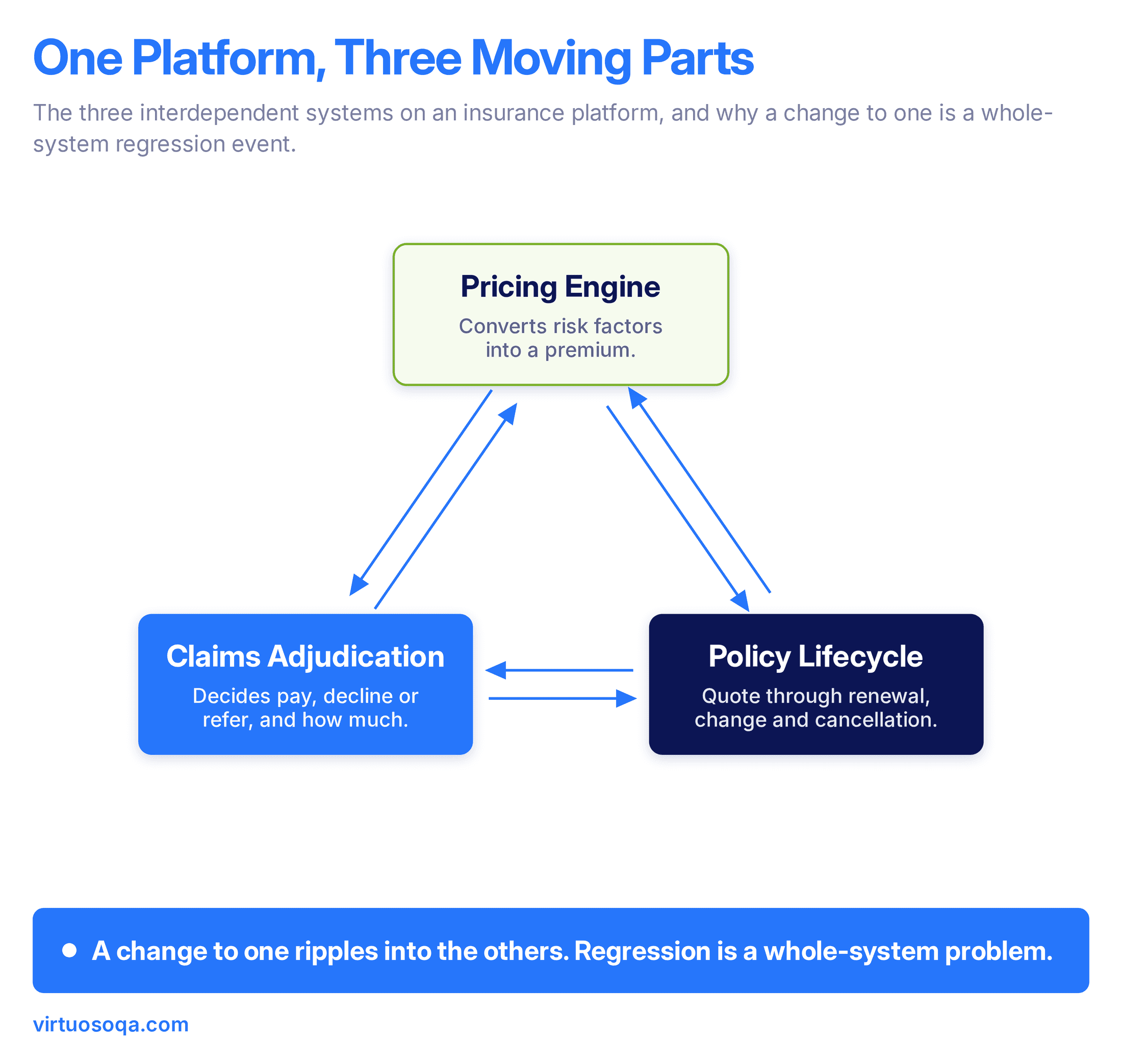
Insurance software sits on three moving parts that rarely stay still for long.
The pricing or rating engine converts risk factors into a premium.
The claims adjudication logic decides whether a claim is paid, declined or referred, and for how much.
The policy lifecycle carries a customer from quote through renewal, mid-term change and cancellation.
A change to any one of them can ripple into the others, which is why regression on an insurance platform is a whole-system problem rather than a per-feature check.
The release cadence has also changed. Pricing rules move as risk data updates, claims automation gets refined, new digital channels and aggregator integrations arrive, and each of those lands as a change that has to be verified before it ships.
When verification is manual, the speed of the test cycle sets the ceiling on how often a carrier can safely release.
Regression Testing a Pricing Engine
A pricing engine turns a set of inputs into a number, and the number has to be right every time. Regression here means re-checking that premium calculations still return the correct result after any change to the rating logic, the risk tables or the rules that sit around them.
The difficulty is combinatorial. A motor rating structure is large but fairly stable. A pet insurance pricing engine has to reason about species, breed, crossbreed, age band, pre-existing conditions, cover level, excess and country-specific rules, and the underlying risk tables shift as veterinary cost data updates. Change a single breed risk factor and every quote path that touches that factor needs re-verification, not just the one you edited.
A pricing regression suite should hold the calculation to account across the combinations that matter:
Premium correctness for representative and boundary cases across each rating factor, including the edges of every age band and risk tier.
Correct application of loadings, discounts and the order in which they stack.
Minimum and maximum premium rules, rounding behaviour and tax or levy application.
Referral and decline triggers where a risk falls outside appetite.
Consistency across channels, so a direct quote and an aggregator quote for the same risk return the same premium.
Re-running that set by hand for every rating change does not scale, which is the practical reason pricing changes so often wait in a queue behind the test cycle.
Regression Testing Claims Adjudication Logic
Claims adjudication applies the policy wording as executable rules. Regression testing it means proving that the decision and the amount stay correct after any change to those rules or to the automation that runs them.
The rule set is dense. Adjudication has to check that the policy was in force at the date of loss, that any waiting period has passed, that the condition is covered rather than excluded, that pre-existing condition rules are applied, and that annual limits, per-condition limits, excesses and co-insurance are deducted in the right order. AI-assisted claims automation raises the stakes further, because straight-through processing rules get tuned frequently and each adjustment is a fresh regression event across every possible outcome.
A claims regression suite needs to verify more than a headline pay-or-decline result:
The correct decision across pay, partial pay, decline and refer, for both typical and edge cases.
The correct settlement amount, with limits, excesses and co-insurance applied accurately.
Correct reason codes on every declined or referred claim, since those drive customer communications and audit records.
Correct depletion of annual and per-condition limits across multiple claims in a policy year.
Behaviour on awkward states such as a lapsed policy, a mid-term cover change, or a claim that straddles a renewal.
A claims defect is not only a QA problem. A wrongly rejected claim reaches a customer at the worst possible moment, and a wrongly paid one is leakage the business absorbs quietly.
Regression Testing the Policy Lifecycle
A policy is not a single transaction. It moves through quote, purchase, mid-term adjustment, renewal, cancellation and sometimes reinstatement, and each transition carries its own rules and data transformations.
Regression across the lifecycle checks that a change at one stage does not corrupt another. Renewal re-rating has to reflect the current pricing rules and any no-claims logic. A mid-term adjustment, such as adding a pet or changing cover, has to recalculate premium on a pro-rata basis and carry the change through to billing and documents.
Cancellation has to unwind cleanly and stop future collections. When those stages share data and rules, a change to the quote path can surface as a defect three steps later at renewal, which is exactly the kind of break a lifecycle regression suite is meant to catch.
Do Not Forget the API Layer
Pricing and claims logic rarely lives alone. It talks to aggregators, payment providers, document generation, and data feeds, and every one of those integrations is a regression surface in its own right.
An API contract change, a new aggregator field or an altered response format can break a flow that the user interface tests never touch. A regression programme that covers web application journeys and the APIs behind them catches the failure at the layer where it happens, rather than waiting for it to appear as a mispriced quote on a customer's screen.
Suggested Read: What is API Contract Testing? Types, Setup and Best Practice
What to Automate First
The instinct to automate everything at once is the fastest way to build a suite nobody trusts. A better approach ranks the work by risk, so the coverage that matters most exists first.
Three questions decide the order.
How often does this logic change?
How wide is the blast radius when it breaks?
What is the consequence to a customer or a regulator if it ships wrong?
The areas that score high on all three sit at the top, and for most carriers that means the core quote paths in the pricing engine and the decision rules in claims adjudication.
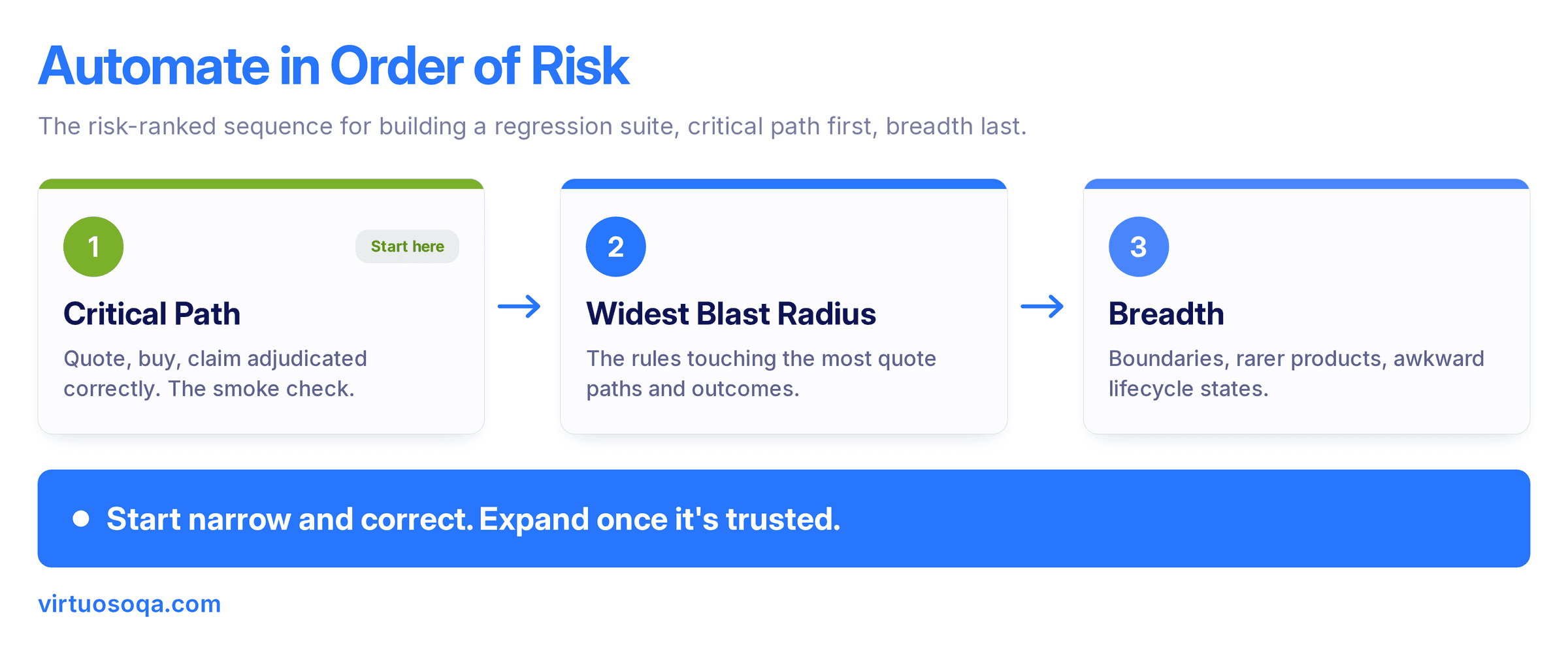
A workable sequence looks like this:
The critical path first: a small set of tests that prove a customer can get a quote, buy a policy and have a claim adjudicated correctly. That set becomes the smoke check that runs on every build.
The widest blast radius next: the rating factors and adjudication rules that touch the most quote paths or claim outcomes, since a break there affects the most customers.
Breadth after depth: boundary cases, less common breeds or products, and the awkward lifecycle states, layered in once the high-exposure logic is locked down.
Starting narrow and correct beats starting broad and brittle. A short suite that runs reliably on every release earns trust, and trust is what lets a team expand coverage without the business losing confidence in the pipeline.
How to Measure Coverage That Means Something
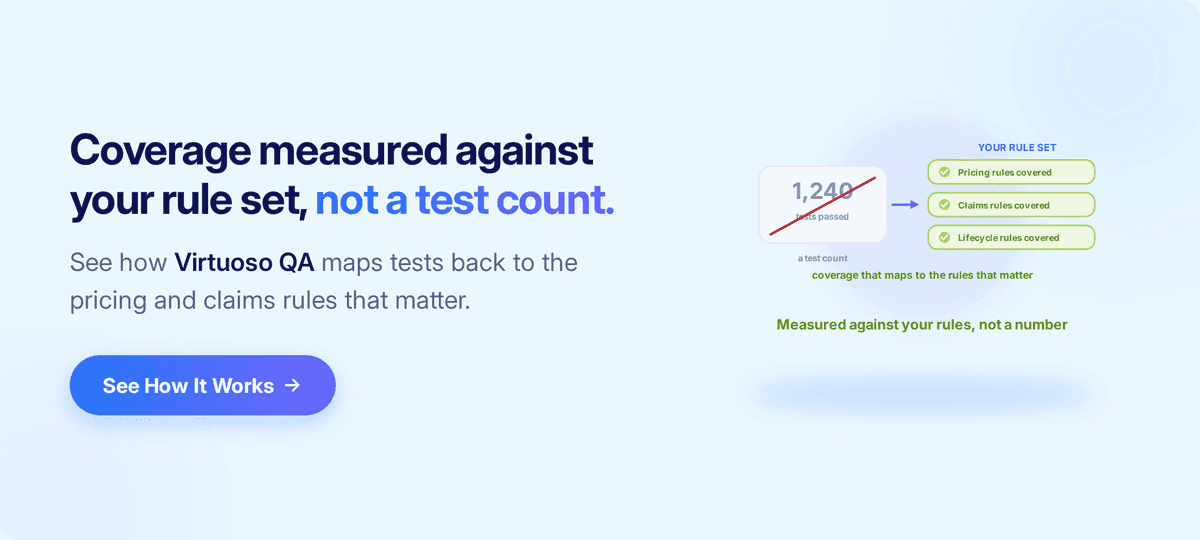
Coverage is easy to report and easy to fake. A count of test cases tells you very little about whether the logic that matters is actually verified, so insurance regression coverage should be measured against the rule set, not the test list.
Three views give an honest picture:
Rule coverage: What proportion of pricing rules and adjudication rules has at least one automated check behind it? A visible gap list is worth more than a single headline percentage.
Outcome coverage: Are all the decision outcomes exercised, including the declines and referrals, not just the happy-path acceptances?
Boundary coverage: Do tests hit the edges of each rating band and limit, where calculation errors tend to hide, rather than only the comfortable middle?
Code coverage still has a place as a supporting signal, but on an insurance platform the question a regression suite has to answer is behavioural: does the system still price and adjudicate correctly across the cases the business cares about? Coverage reporting that maps tests back to business rules answers that question and gives the team a defensible view of what is protected and what is not.
What Evidence to Keep
The output of a regression run is not only a pass or a fail. It is a record of what was tested, against which build, with what result, and who signed off on the tests that ran. On a regulated insurance platform, that record has value well beyond the QA team.
A testing programme worth trusting keeps evidence as a by-product of the run rather than as a separate documentation chore:
Timestamped run logs and a full pass and fail history, tied to the specific build or release under test.
Version-controlled tests with change history and named users, so it is clear who changed what and when, with the ability to roll back.
A record of human approval for any AI-generated test before it executes, which keeps a person accountable for what the suite checks.
Step-by-step execution evidence, including screenshots and root cause detail on failures, exportable in formats an auditor or reviewer can actually read.
Worth stating plainly: Producing this evidence is not the same as being compliant with any particular regulation. A test automation platform generates the evidence that a documented, repeatable testing programme is expected to show. Whether that evidence satisfies a given obligation is a matter for the carrier and its auditors. The value is that the evidence already exists, rather than being reconstructed from spreadsheets and memory when someone asks.
Manual Versus Automated Regression: The Honest Comparison
Neither approach wins on every axis, and a guide that pretends otherwise is not much use to a buyer. The table below sets out where each earns its place on an insurance platform.
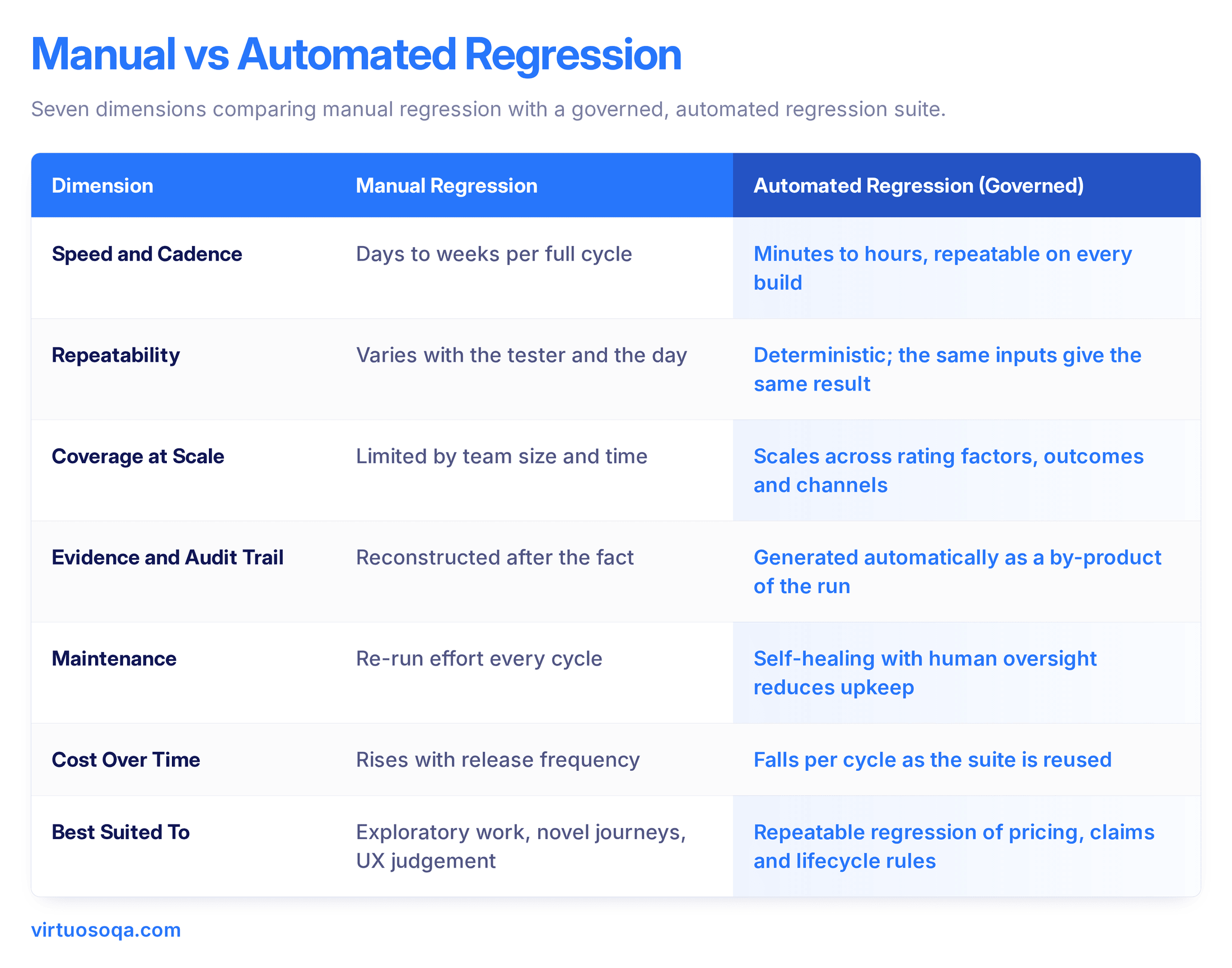
The point is not that manual testing has no role. Exploratory testing, first-look review of a new journey and the human judgement that spots something that feels wrong all remain valuable, and no automated suite replaces them. The point is that re-running the same regression by hand on every release, at a cadence the business now demands, is where manual effort stops being rigour and starts being the release ceiling.
If pricing logic changes weekly and a manual regression cycle takes two weeks, the arithmetic does not resolve. Verification, not engineering, becomes the constraint on how fast a carrier can ship.
How AI Changes the Regression Problem, and How to Keep It Accountable
AI is now on both sides of the equation. It writes more of the code that goes into a pricing or claims platform, and it increasingly runs inside the claims process itself. Both effects push change frequency up, which means more regression events, not fewer.
The temptation is to answer speed with speed: let AI generate the tests and let them run. On an insurance platform that trades one risk for another, because an ungoverned suite can approve its own logic and no one can say afterwards why a test existed or what it checked. Insurance procurement teams have noticed, and AI governance now appears as mandatory criteria in test automation RFPs: human approval before AI-generated tests execute, no training on customer data, data held in the UK or EU, and a full audit trail of every run.
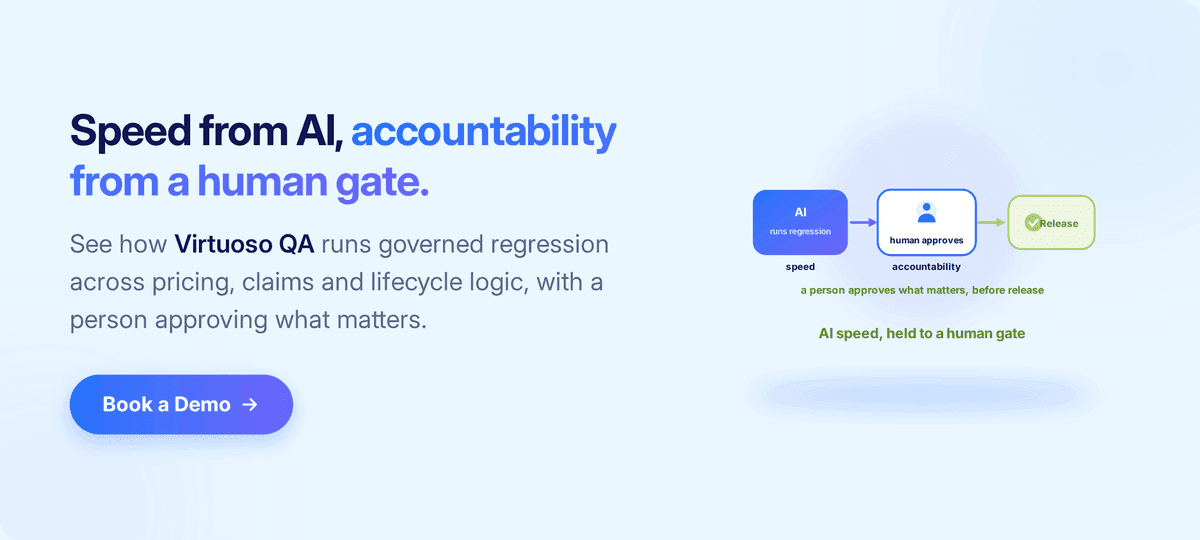
The model that satisfies those criteria is governed autonomy. AI reasons, a deterministic engine executes, a person approves what matters, and every decision is recorded. Speed comes from the AI and the reuse; accountability comes from the deterministic execution and the human gate. An insurer gets faster releases and keeps an answer to the question an auditor or a claims customer might eventually ask.
Where Virtuoso QA Fits
Virtuoso QA is the trust layer for insurance platforms: automated regression across pricing engines, claims adjudication logic, policy lifecycle flows and the APIs behind them, with the evidence a documented testing programme is expected to produce.
Tests are authored in natural language, so the people who hold the domain knowledge, the underwriters and claims specialists who understand the rules, build the coverage without writing code.
Execution is deterministic, which makes results repeatable rather than probabilistic. Self-healing with human oversight keeps maintenance from eating the gains, and every run leaves logs, pass and fail history and step-by-step evidence behind it. AI-generated tests are approved by a person before they execute, and version control records who changed what.
Check our page on AI-Native Test Automation for Insurance to know how Virtuoso QA transforms insurance application testing
London Market Group makes the pattern concrete. Before Virtuoso QA, more than 100 SDETs on Selenium and Karate could not keep pace with the testing demand. After moving to AI-native automation, the group reached 85 per cent faster test creation, 81 per cent less maintenance effort and over 95 per cent functional coverage with a team half the size.
A North American pet health insurer runs regression across its pricing and claims platform on the same model. The tooling was never the constraint; the approach was.
Where Insurance Regression Testing Is Heading
Release frequency will keep rising, and the pressure will keep coming from both directions: more code, generated faster, and more automation inside claims that has to be tuned and re-verified. The carriers shipping fastest are the ones that encoded their regression once and now run it on every release. The ones shipping slowest are still re-running it by hand and calling the delay caution.
Governance is becoming a buying criterion rather than a preference, and evidence is turning into an expectation rather than an afterthought. The insurers that treat regression as a continuous, recorded, human-governed activity will be the ones that can ship pricing and claims changes at market speed and still answer for every one of them. Governed autonomy, not blind autonomy, is the version of this that holds up when someone asks how a decision was reached.
Frequently Asked Questions
What is Insurance Regression Testing?
How Often Should Insurance Platforms Run Regression Tests?
What Should You Automate First in Insurance Regression Testing?
How Do You Measure Regression Test Coverage for Insurance Software?
Can Insurance Regression Testing Be Automated Without Writing Code?
How Does Automated Regression Testing Support Audit Requirements?