Blog
AI Test Automation Platform Guide: Complete 2025 Buyer's Handbook

Rishabh Kumar
Published on

Table of contents
Lorem ipsum
Lorem ipsum
Lorem ipsum
Lorem ipsum
Lorem ipsum
The Revolution Is Here. Are You Ready?
Your competition just deployed AI agents that write tests in plain English. You're still debugging XPath selectors.
While you're burning midnight oil fixing broken Selenium scripts, AI-native platforms are eliminating maintenance cycles entirely. While your team waits for SDET availability, competitors democratize testing across entire organizations. While you measure success in test coverage percentages, they measure success in revenue velocity.
The brutal reality: Only 19.3% of organizations automate more than half their tests according to the DORA State of DevOps Report. The rest are stuck in manual testing quicksand, watching market leaders accelerate past them.
The AI test automation market exploded 300% year-over-year according to Gartner. This isn't incremental improvement—it's category disruption. And like every technology revolution, there will be winners and losers.
The stakes:
66% of global organizations are at “significant risk” of software outages due to insufficient testing—and 72% still delay releases because of low confidence in test coverage (ITpro research)
72% of teams exploring AI-driven workflows but most choosing wrong platforms (State of Testing Report 2024)
10x speed advantage for organizations choosing AI-native architecture
95% maintenance reduction with intelligent test hyperautomation
According to the PMI Cost of Delay concept, each day of postponed release represents ongoing lost revenue potential based on the value of the delayed feature.
This guide exposes the technical truth about AI test automation platforms. No marketing fluff. Just the engineering insights you need to choose wisely.
Why Selenium Is Yesterday's Technology
The Maintenance Disaster
Selenium promised to automate testing. Instead, it automated suffering.
The hard numbers:
Teams spend 80% of time maintaining tests instead of creating value
Only 19.3% of organizations automate over 50% of tests (DevOps Research)
$150K+ annual cost per SDET just to babysit brittle scripts
6-month average to see any ROI (if you ever do)
Why Traditional Frameworks Fail
Technical debt by design:
XPath selectors break with every UI change
Hard-coded waits create flaky, unreliable tests
No intelligent element recognition across browsers
Zero self-healing capabilities for dynamic applications
Manual test data management becomes organizational bottleneck
Architecture limitations:
Selenium WebDriver architecture designed for 2004 web applications
No built-in support for modern frameworks (React, Angular, Vue)
Cannot handle iFrames, Shadow DOM, or dynamic content intelligently
Requires separate tools for API testing, visual validation, accessibility checks
AI-Native vs. AI-Washing: The Technical Reality
True AI-Native Architecture
Built from silicon up with artificial intelligence as the foundation:
Deep Learning Integration:
Computer vision models trained on millions of UI patterns
Natural Language Processing for business-readable test creation
Machine learning algorithms that improve with every test execution
Behavioral pattern recognition across application interactions
Technical capabilities:
Intelligent Object Identification using multiple selectors and visual recognition
Predictive Element Discovery that anticipates UI changes
Autonomous Test Healing that fixes broken tests before they fail
Cross-Browser Intelligence that adapts selectors per browser engine
AI-Washing: Legacy Tools with Lipstick
Traditional frameworks with basic AI features bolted on:
Surface-level improvements:
Simple element healing using backup selectors
Basic pattern matching for common scenarios
Reactive failure detection after tests break
Limited learning from historical data
Fundamental limitations:
Still requires coding for test creation
Maintenance overhead remains 60-80% of effort
No natural language programming capabilities
Cannot handle complex business workflows intelligently
The technical verdict: AI-washing delivers 10-20% improvement. AI-native delivers 10x transformation.
Platform Comparison: David vs. Goliaths
Virtuoso: The AI-Native Revolution
Virtuoso didn't retrofit AI onto legacy architecture. They reimagined testing from the ground up with artificial intelligence as the core foundation.
Breakthrough Technologies:
1. Live Authoring Engine
What it is: Real-time test creation and validation using dedicated cloud browsers
Why it matters: Eliminates the write-test-debug-repeat cycle that wastes 70% of automation effort
Technical advantage: Immediate feedback loops with integrated DevTools for deep inspection
Competitor reality: Selenium, Cypress, Playwright still require blind scripting and separate debugging
2. GENerator AI Test Intelligence
What it is: Advanced natural language processing that converts business requirements into executable tests
Technical depth:
Multi-model AI architecture combining NLP, computer vision, and behavioral learning
Understands business context, not just technical selectors
Generates robust test logic from plain English descriptions
Competitive gap: TestComplete, Katalon, and others require technical scripting knowledge
3. StepIQ Intelligent Action Framework
What it is: AI-powered step execution that adapts to application behavior dynamically
Technical innovation:
Context-aware action optimization based on application state
Intelligent wait strategies that eliminate flaky test timing issues
Dynamic parameter injection for data-driven scenarios
Traditional limitations: Selenium requires manual explicit waits and hard-coded parameters
4. Composable Test Architecture
What it is: Build-once, use-everywhere test asset creation with intelligent reusability
Business impact:
94% reduction in test creation time for subsequent projects
Master libraries of pre-built test components for enterprise applications
Automatic adaptation of composable assets to different environments
Competitive weakness: Cypress and Playwright create single-use, project-specific tests
5. Test Hyperautomation Platform
What it is: End-to-end automation combining UI, API, visual, accessibility, and security testing
Technical architecture:
Unified test execution engine handling multiple testing types
Intelligent correlation between UI actions and backend API calls
Automated cross-browser and cross-device validation
Built-in visual regression detection with pixel-perfect accuracy
Enterprise customers trust Virtuoso:
Marsh McLennan (Fortune 500 insurance and consulting)
DXC Technology (Global IT Services)
IBM (Technology and consulting services)
Dedalus (Healthcare technology)
Nutanix (Enterprise cloud computing)
Selenium: The Legacy Burden
What Selenium does well:
Large open-source community with extensive documentation
Wide browser support across different vendors
Established ecosystem of plugins and extensions
Free licensing for budget-conscious organizations
Where Selenium fails:
No AI capabilities beyond basic element waiting
Requires expert-level programming in Java, Python, or C#
80% maintenance overhead according to industry studies
No self-healing when application elements change
Separate tools required for API testing, visual validation, reporting
Flaky test syndrome due to timing and synchronization issues
Technical debt reality: Organizations spend $200K+ annually just maintaining Selenium test suites
Cypress: Developer-Focused, Enterprise-Limited
Cypress strengths:
Modern JavaScript architecture with time-travel debugging
Fast test execution with automatic waiting
Excellent developer experience for JavaScript-heavy applications
Built-in screenshot and video recording
Critical limitations:
Single browser limitation (Chromium-based only until recently)
No cross-browser testing for Internet Explorer or Safari
JavaScript-only test creation requiring development skills
Limited enterprise scalability for large test suites
No AI or self-healing capabilities
Cannot test mobile applications natively
Enterprise reality: Cypress works for small development teams but breaks down at enterprise scale
Playwright: Microsoft's Catch-Up Attempt
Playwright advantages:
Multi-browser support (Chrome, Firefox, Safari)
Faster execution than Selenium with modern architecture
Auto-waiting capabilities reduce timing issues
Modern API design with TypeScript support
Fundamental gaps:
Still requires coding expertise for test creation
No AI or machine learning capabilities
Limited self-healing beyond basic retry mechanisms
New ecosystem with fewer plugins and integrations
Manual maintenance required for element changes
Market position: Better than Selenium, nowhere near AI-native capabilities
TestComplete: SmartBear's Aging Platform
TestComplete features:
Visual test creation with record-and-playbook functionality
Support for desktop, web, and mobile applications
Object identification with multiple selection methods
Integration with SmartBear's testing ecosystem
Technical limitations:
Windows-heavy architecture limiting cross-platform testing
Expensive licensing with limited scalability
Basic AI features that don't eliminate maintenance overhead
Object repository maintenance becomes bottleneck at scale
Slow execution speed compared to modern platforms
Cost reality: TestComplete licensing can exceed $50K annually for enterprise teams
Katalon: All-in-One Mediocrity
Katalon positioning:
Unified platform for web, API, mobile, and desktop testing
Low-code test creation with record-and-playbook
Built-in test management and reporting capabilities
Freemium model for small teams
Technical shortcomings:
Selenium-based engine inherits all WebDriver limitations
Limited AI capabilities beyond basic element healing
Vendor lock-in with proprietary test formats
Performance issues with large test suites
Minimal self-healing compared to truly AI-native platforms
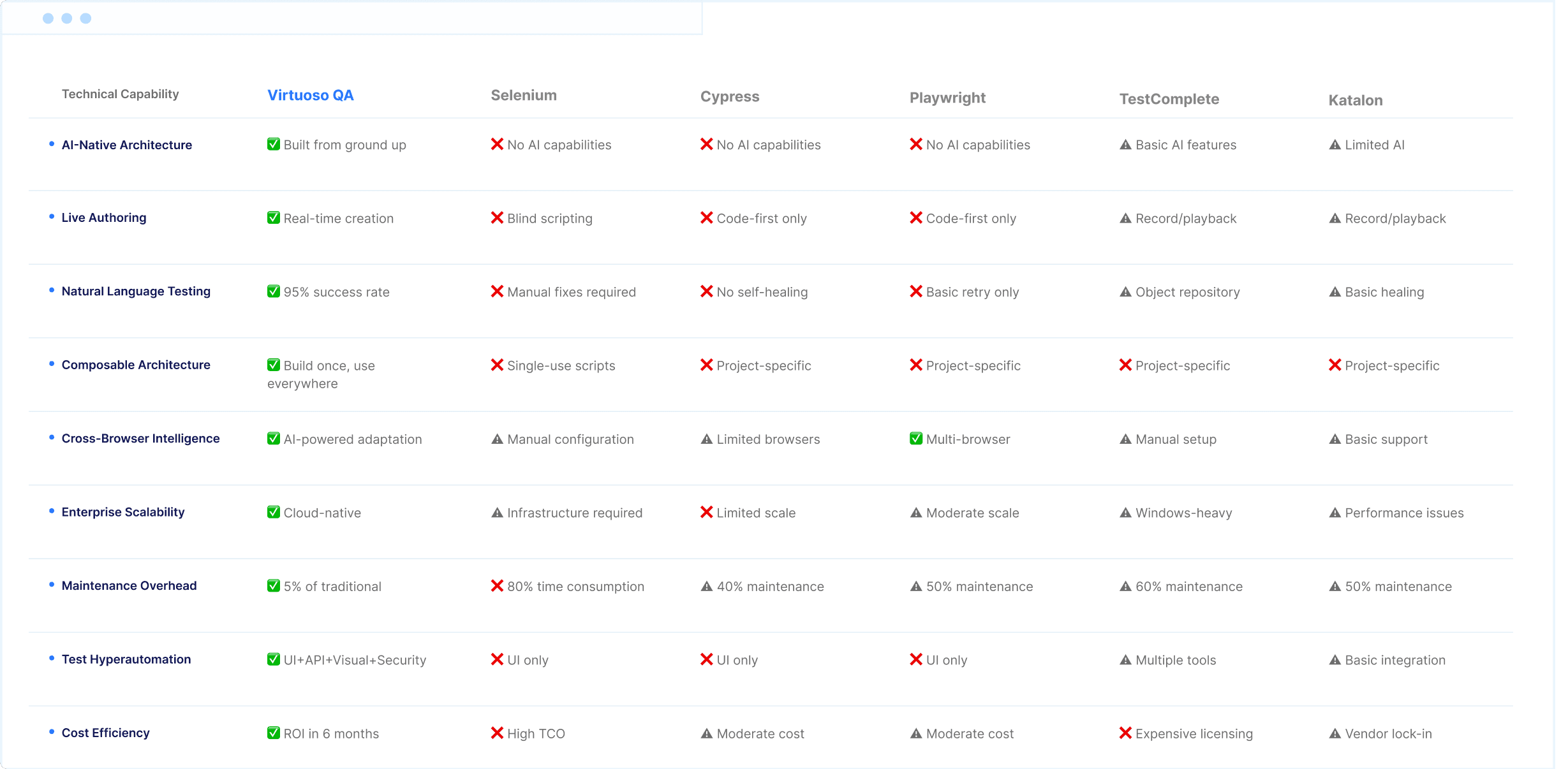
The Technical Verdict
Technical Deep Dive: Virtuoso's Architecture
AI-Powered Object Identification Engine
Traditional approach (Selenium):
Problem: Breaks when CSS classes change, DOM structure evolves, or dynamic IDs are introduced
Virtuoso's intelligent approach:
AI engine combines:
Visual pattern recognition of input field appearance
Context understanding (near "Password" field and "Login" button)
Semantic analysis of labels, placeholders, and aria-labels
Behavioral patterns from user interaction data
Multiple fallback selectors automatically generated
StepIQ: Context-Aware Test Execution
Intelligent action optimization:
Dynamic wait strategies based on application loading patterns
Context-aware parameter injection for data-driven scenarios
Adaptive timing that learns from application behavior
Error prediction and prevention before test failures occur
Traditional limitations:
Virtuoso's intelligence:
Composable Test Architecture: Technical Implementation
Asset creation:
Master Library Development: Pre-built test components for common business processes
Intelligent Parameterization: Automatic identification of configurable elements
Cross-Environment Adaptation: Assets automatically adapt to different environments
Dependency Management: Smart handling of test prerequisites and data setup
Reusability metrics:
94% reduction in test creation time for subsequent projects
60% faster environment setup through automated configuration
80% reduction in maintenance effort through centralized asset updates
GENerator AI: Natural Language Processing Engine
Multi-model AI architecture:
Intent Recognition: Understanding what the user wants to test
Context Mapping: Relating business requirements to technical implementation
Action Generation: Converting natural language to executable test steps
Validation Logic: Automatically generating appropriate assertions
Business language processing:
Generated test logic:
Navigate to product catalog
Add premium product over $100 to cart
Proceed to checkout as premium customer
Verify shipping cost is $0
Validate premium customer badge display
Confirm order total calculation accuracy
Cloud-Native Execution Infrastructure
Technical architecture:
Auto-scaling test execution across global cloud infrastructure
Parallel test orchestration with intelligent load balancing
Real-time result aggregation and failure analysis
Automatic environment provisioning for test execution
Enterprise security:
SOC 2 Type II certification with comprehensive security controls
TLS encryption for all data transmission
AES-256 encryption for data at rest
Role-based access controls with SSO integration
Regular penetration testing and vulnerability assessments
ROI Analysis: The Numbers Don't Lie
Virtuoso Customer Results
Global Insurance Leader:
85% faster UI test creation compared to Selenium
81% reduction in maintenance time
75% faster defect resolution through automated root cause analysis
$2.1M annual cost savings in first 18 months
Technology Fortune 500:
93% faster API test development
88% reduction in maintenance effort
83% acceleration in regression testing
ROI achieved in 4 months
Traditional Platform TCO Reality
Selenium hidden costs:
$150K+ annual SDET salaries × team size
$50K+ annual infrastructure and tooling costs
$100K+ annual maintenance effort for test suite upkeep
$200K+ annual opportunity cost from delayed releases
TestComplete licensing:
$6K+ per user annually for full feature access
$30K+ setup and training costs
$80K+ annual maintenance for enterprise deployments
Limited scalability requiring additional tool purchases
Katalon enterprise costs:
$200+ per user monthly for enterprise features
Vendor lock-in risks with proprietary test formats
Integration complexity requiring additional development effort
Performance limitations at enterprise scale
Virtuoso Value Proposition
Immediate benefits:
60-80% cost reduction compared to traditional approaches
10x faster test creation through AI-powered authoring
95% maintenance reduction via intelligent self-healing
6-month average ROI across enterprise customers
Strategic advantages:
Democratized testing enabling business users to create automation
Future-proof architecture with continuous AI improvements
Composable assets that scale across projects and teams
Enterprise security meeting strictest compliance requirements
Implementation Strategy: Technical Deployment
Phase 1: Foundation (Weeks 1-2)
Technical setup:
SOC 2 compliant cloud environment provisioning
SSO integration with enterprise authentication systems
CI/CD pipeline integration (Jenkins, Azure DevOps, GitLab)
Initial team training on Live Authoring and GENerator AI
Success metrics:
Team creating first tests within 2 days
80% team adoption of natural language test creation
Integration with existing development workflows
Phase 2: Pilot Validation (Weeks 3-6)
Scope selection:
2-3 business-critical applications for validation
High-value test scenarios with clear success criteria
Comparison benchmarks against existing automation approaches
Composable asset development:
Master library creation for common business processes
Reusable component identification and parameterization
Cross-environment configuration and validation
Phase 3: Scale and Optimize (Weeks 7-12)
Enterprise deployment:
Rollout across all applications and business units
Advanced training on StepIQ and test hyperautomation
Performance optimization and parallel execution setup
Comprehensive reporting and analytics implementation
Integration Architecture
CI/CD pipeline integration:
API integration capabilities:
RESTful APIs for test execution and result retrieval
Webhook support for real-time notifications
GraphQL interface for advanced query capabilities
SDK availability for custom integrations
Security and Compliance: Enterprise Grade
Information Security Architecture
SOC 2 Type II compliance:
Comprehensive security controls across availability, security, confidentiality
Regular third-party security audits and penetration testing
Continuous monitoring and vulnerability assessment
Incident response procedures and disaster recovery plans
Data protection:
End-to-end encryption using TLS 1.3 for data in transit
AES-256 encryption for data at rest
Zero-knowledge architecture ensuring customer data privacy
Regional data residency options for GDPR compliance
Enterprise Integration Security
Authentication and authorization:
SAML/SSO integration with enterprise identity providers
Multi-factor authentication support
Role-based access controls with granular permissions
API key management and rotation capabilities
Network security:
Cloudflare protection against DDoS and web attacks
AWS infrastructure with enterprise-grade security controls
VPC isolation for customer environments
IP whitelisting and network access controls
Compliance Frameworks Supported
Regulatory compliance:
GDPR for European data protection requirements
SOX for financial reporting and audit trails
HIPAA for healthcare data protection
PCI DSS for payment card industry security
ISO 27001 for information security management
The Technical Truth: Why Virtuoso Wins
Engineering Excellence
AI-native from day one:
No legacy WebDriver limitations to overcome
Built for modern web applications and frameworks
Designed for cloud-scale enterprise deployment
Optimized for developer and business user productivity
Technical differentiation:
Live Authoring: Industry's only real-time test creation platform
GENerator AI: Most advanced natural language test programming
StepIQ: Intelligent test execution with context awareness
Composable Architecture: Build-once, use-everywhere efficiency
Test Hyperautomation: Unified platform for all testing types
Market Leadership
Customer validation:
Fortune 500 enterprise customers across industries
95% customer satisfaction with platform capabilities
Industry-leading ROI with 6-month average payback
Technical innovation awards from industry analysts
Competitive moats:
3-year technical lead in AI-native capabilities
Patent portfolio protecting core innovations
Enterprise-grade security meeting strictest requirements
Continuous innovation with quarterly platform updates
Your Next Move
The choice is binary. Continue struggling with maintenance-heavy traditional tools that consume your best engineers, or embrace the AI-native future with Virtuoso.
Traditional platforms make promises. Virtuoso delivers results.
Legacy tools require experts. Virtuoso empowers everyone.
Competitors offer features. Virtuoso provides transformation.
Take Action: Experience the Revolution
Immediate Next Steps
See Live Authoring in action: Request technical demonstration
Explore AI capabilities: Learn about AI-powered test automation
Understand agentic AI: Discover autonomous testing agents
Review enterprise features: Explore business system testing
Technical Resources
Platform documentation: Comprehensive technical guides
Feature specifications: Detailed product capabilities
Customer success stories: Enterprise case studies
Implementation resources: Technical documentation library
Frequently Asked Questions
Q: How does Virtuoso's AI actually work technically?
A: Virtuoso combines computer vision, natural language processing, and machine learning in a unified AI engine. Our models are trained on millions of UI patterns and user interactions, enabling intelligent object identification, predictive element discovery, and autonomous test healing. Unlike competitors who bolt basic AI onto legacy architectures, our platform is AI-native from the foundation up.
Q: What's the real difference between Live Authoring and traditional test creation?
A: Traditional tools require writing code blindly, then running tests to see if they work—creating debug cycles. Live Authoring shows you test execution in real-time as you build, using dedicated cloud browsers. You see exactly what your test does, immediately. This eliminates 70% of the debug-and-fix cycles that waste time in traditional approaches.
Q: How do composable test assets actually work in practice?
A: Composable testing means building intelligent test libraries once, then reusing them across projects with automatic adaptation. For example, a "login workflow" asset automatically adapts to different login forms, environments, and authentication methods. We've seen 94% reduction in test creation time for subsequent projects using this approach.
Q: Can Virtuoso really handle enterprise-scale testing requirements?
A: Absolutely. Our cloud-native architecture scales automatically to handle thousands of parallel test executions. Enterprise customers like Marsh McLennan and IBM run comprehensive test suites across global infrastructure with SOC 2 compliance. Our platform is built for Fortune 500 scale from day one.
Q: What about integration with our existing CI/CD pipelines?
A: Virtuoso provides native integrations with Jenkins, Azure DevOps, GitLab, GitHub Actions, and other major platforms. Our RESTful APIs enable custom integrations, and we support webhook notifications for real-time feedback. Most enterprises have us integrated within their first week.
The Future Is Now
The AI test automation revolution isn't coming—it's here. Organizations choosing AI-native platforms are already pulling ahead with 10x speed advantages and 95% maintenance reduction.
The question isn't whether AI will transform testing. The question is whether you'll lead or follow.
Traditional tools are yesterday's technology. Virtuoso is tomorrow's platform, available today.
Start your transformation now and join the Fortune 500 companies already experiencing the future of testing with our AI testing tool.