Blog
Automated End to End Testing: What You Need to Know

Adwitiya Pandey
Published on

Table of contents
Lorem ipsum
Lorem ipsum
Lorem ipsum
Lorem ipsum
Lorem ipsum
complex ecosystems of microservices, APIs, third-party integrations, and multi-platform interfaces that must work together seamlessly. Manual testing simply cannot keep pace with this complexity while meeting today's demands for rapid, frequent releases.
This is where automated end-to-end testing becomes indispensable. In this comprehensive guide, you'll discover what automated E2E testing is, why it's essential for modern software delivery, how it works, and how to implement it effectively using cutting-edge platforms like Virtuoso QA.
What is End-to-End Testing?
End-to-end testing validates an application's workflow from start to finish, simulating real user scenarios across all integrated components. Unlike unit tests that examine individual functions or integration tests that check connections between modules, E2E testing validates complete user journeys through your entire application stack.
Core Purpose: E2E testing ensures that your application works correctly as a complete system, from the user interface down through APIs, databases, and external integrations.
When a user logs into your banking app, transfers money, and receives a confirmation, E2E testing validates that entire workflow functions correctly across your authentication service, transaction processor, database, notification system, and user interface.
What is Automated End-to-End Testing and Why Does it Matter in Modern QA?
Automated end-to-end testing uses software tools to execute complete user workflows without human intervention, validating that all integrated components function correctly together.
Cloud-native, microservices-based applications cannot be tested effectively through manual approaches alone. Modern applications involve:
Dozens or hundreds of microservices communicating via APIs
Multiple databases and caching layers
Third-party integrations for payments, authentication, and analytics
Responsive interfaces across web, mobile, and desktop
Real-time data synchronization across distributed systems
Manually testing every possible interaction across these components for each release is impossible. Automated E2E testing makes comprehensive validation practical and sustainable.
Explore our article on Business Process End-to-End Testing to learn why validating complete workflows is more effective than isolated testing.
Why Automate End-to-End Testing?
Automation transforms E2E testing from a bottleneck into an accelerator of software delivery. Here's why automation is essential rather than optional for modern E2E testing.

Handle Complexity at Scale
Distributed systems and microservices architectures create exponential testing complexity. A single user action might trigger interactions across a dozen services, each with its own logic and failure modes.
Automated E2E testing handles this complexity by:
Executing tests across multiple integrated components simultaneously
Validating API contracts between services
Checking data consistency across distributed databases
Verifying that asynchronous processes complete correctly
Testing fallback behaviors when dependencies fail
Manual testing cannot maintain this level of comprehensive coverage across complex architectures.
Reduce Human Error
Manual testing suffers from inevitable human inconsistencies:
Testers accidentally skip steps in long workflows
Different testers interpret test cases differently
Fatigue leads to overlooked defects during repetitive testing
Manual data entry introduces variability and errors
Automated tests execute identically every time, eliminating these inconsistencies. When an automated E2E test passes, you know precisely what was validated and can trust the results completely.
Accelerate Regression Cycles
Every code change carries risk of breaking existing functionality. Comprehensive regression testing protects against these regressions but becomes increasingly time-consuming as applications grow.
Automated E2E testing accelerates regression cycles by:
Running complete test suites in hours instead of weeks
Executing tests immediately after code changes
Providing fast feedback that enables rapid iteration
Catching regressions before they reach later testing stages
Supporting multiple daily releases through fast validation
Organizations practicing continuous delivery typically run automated E2E regression suites multiple times daily.
Enable CI/CD & Agile Delivery
Continuous integration and deployment pipelines depend on automated testing to function safely. Without automation, you cannot:
Test every code commit before merging
Deploy multiple times per day with confidence
Maintain quality while increasing release velocity
Provide developers immediate feedback on changes
Automated E2E tests integrate directly into CI/CD pipelines, automatically validating that new code maintains system integrity before reaching production.
Ensure Multi-Platform Consistency
Users access applications across diverse browsers, operating systems, and devices. Manual testing across all combinations is impractical.
Automated E2E testing ensures consistency by:
Running identical tests across Chrome, Firefox, Safari, and Edge simultaneously
Validating responsive designs on various screen sizes
Testing on different operating systems in parallel
Catching platform-specific defects reliably
Maintaining comprehensive cross-platform coverage sustainably
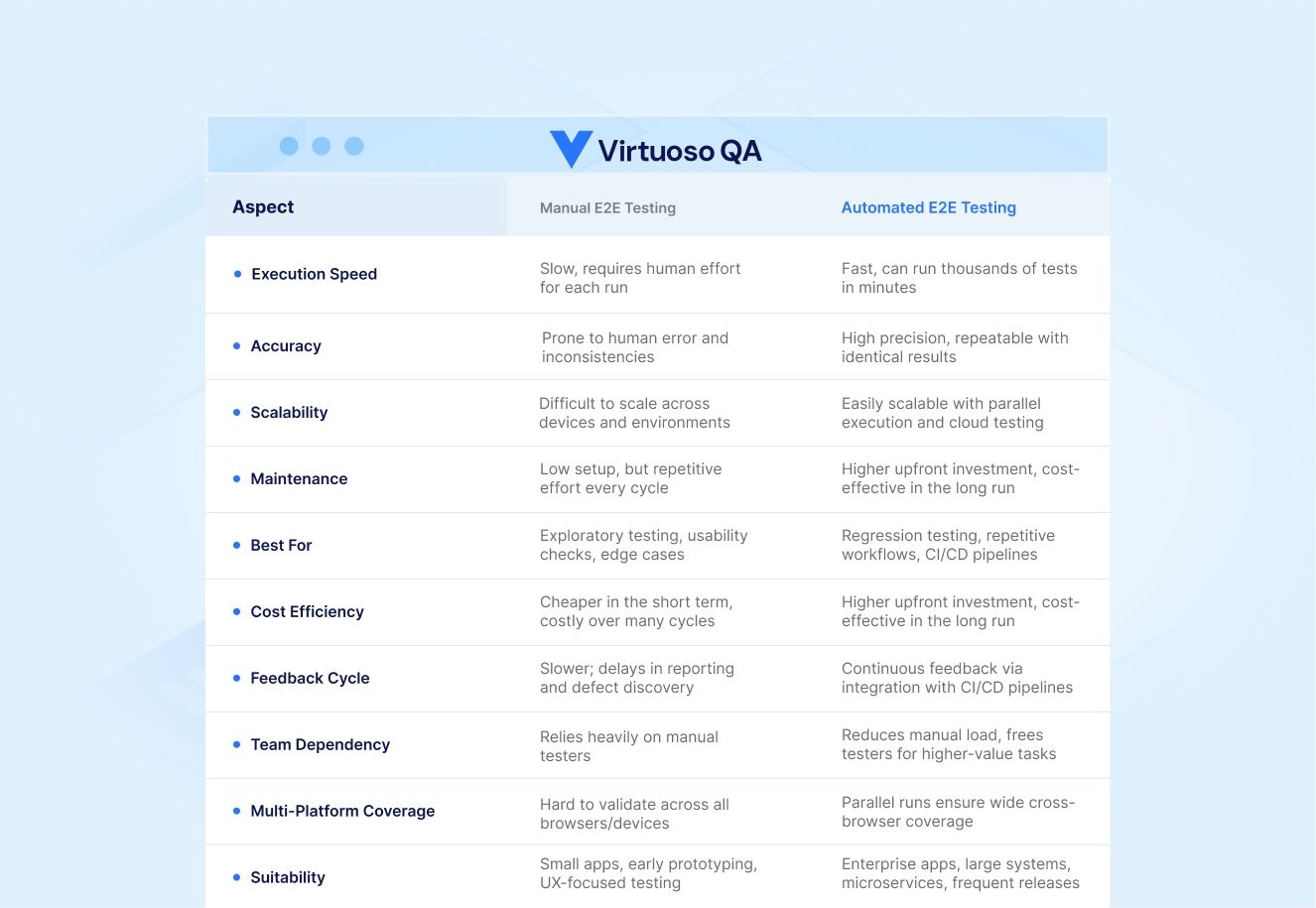
Manual vs Automated E2E Testing: Major Differences
Understanding the fundamental differences between manual and automated approaches helps organizations invest testing resources optimally.
Core Benefits of Automated E2E Testing
Automated E2E testing delivers value across the entire organization, from engineers to executives to end users.
For QA Engineers
Automation transforms the QA engineer's role from repetitive test execution to strategic quality engineering:
Execute comprehensive test suites with a single click
Focus on exploratory testing and complex scenarios
Design and maintain automated frameworks
Analyze test results and identify patterns
Collaborate more closely with development teams
For Developers
Developers gain confidence and speed from automated E2E testing:
Receive immediate feedback on whether changes break user workflows
Refactor code safely with comprehensive test coverage
Catch integration issues before code review
Deploy features with confidence in system stability
Reduce time spent investigating production incidents
For Managers
Engineering managers use automated E2E testing for visibility and planning:
Access real-time quality dashboards showing release readiness
Make data-driven go/no-go decisions for releases
Demonstrate quality improvements to stakeholders
Optimize resource allocation based on testing metrics
Reduce costs associated with production defects
For Users
End users benefit from automated E2E testing through:
Fewer bugs reaching production that disrupt workflows
More reliable and consistent application behavior
Faster delivery of new features with maintained stability
Better overall user experience and satisfaction
Reduced downtime from defect-related outages
How Automated E2E Testing Works
Automated E2E testing follows a systematic process that transforms user workflows into repeatable, reliable automated validations.
Step 1: Define Critical Workflows
Not all workflows carry equal business value. Begin by identifying which user journeys matter most:
Revenue-generating processes like checkout and payment
User onboarding and account management flows
Business-critical operations unique to your domain
Frequently-used features that affect many users
Workflows involving complex integrations
Regulatory compliance requirements
Risk-based prioritization ensures you automate tests that provide maximum value first.
Step 2: Automate Test Case Design
Transform identified workflows into automated test cases using frameworks or no-code platforms:
Define step-by-step actions users take through workflows
Specify inputs, expected outputs, and validation points
Handle test data requirements and dependencies
Account for wait times and asynchronous operations
Design tests to be maintainable and readable
Modern no-code platforms like Virtuoso QA accelerate this phase dramatically by allowing test creation in natural language without programming.
Step 3: Test Execution Across Layers
Automated E2E tests validate workflows across your entire application stack:
User Interface Layer: Automated tools interact with your UI just as users would, clicking buttons, filling forms, and navigating pages while validating displayed content.
API & Service Layer: Tests call backend APIs, validate responses, check status codes, and verify data contracts between services, ensuring microservices communicate correctly.
Database & Storage Layer: Validation extends to data persistence, checking that transactions write correctly, queries return expected results, and data integrity is maintained.
Integrations: Tests validate external service integrations like payment gateways, CRM systems, and analytics platforms work correctly within workflows.
Step 4: Continuous Integration & Deployment
Automated E2E tests integrate into CI/CD pipelines, automatically executing when:
Developers push code to version control
Pull requests are created for code review
Builds are deployed to testing environments
Scheduled times like nightly for comprehensive suites
Manual triggers for ad-hoc validation needs
Failed tests automatically block code from advancing through deployment stages, preventing broken functionality from reaching production.
Step 5: Reporting & Analytics
Modern automated testing platforms provide comprehensive reporting:
Real-time dashboards showing test execution status
Detailed logs and screenshots for failed tests
AI-generated insights into failure root causes
Historical trend analysis for quality metrics
Integration with issue tracking for defect management
Step 6: Test Maintenance & Self-Healing
Applications evolve constantly, requiring tests to evolve with them. Traditional automated tests break when:
UI elements move or change appearance
Workflows add or remove steps
Data formats or validation rules change
Third-party integrations modify APIs
Self-healing automation, powered by AI, automatically adapts tests to these changes. Virtuoso QA's self-healing capabilities detect when elements change and automatically update test references, reducing maintenance burden by up to 85%.
Key Activities in Automated E2E Testing
Successful automated E2E testing requires orchestrating several interconnected activities.
Test Planning & Environment Setup
Proper planning and environment configuration are foundational:
Provision test environments that mirror production
Set up test data management systems
Configure service mocks and stubs for external dependencies
Establish network and security configurations
Create isolated test sandboxes to prevent interference
Automation Scripting or No-Code Test Creation
Create automated tests using your chosen approach:
Traditional Scripting: Write test scripts using frameworks like Selenium, Cypress, or Playwright. Requires programming expertise but offers maximum flexibility.
No-Code Platforms: Use visual test builders or natural language interfaces to create tests without programming. Dramatically faster test creation and broader team participation.
Parallel & Cross-Browser Execution
Execute tests efficiently through parallelization:
Run tests simultaneously across multiple browsers
Execute different test suites in parallel
Distribute tests across cloud-based execution grids
Optimize execution time through strategic parallelization
Scale execution capacity based on testing needs
Defect Logging & Traceability
When tests fail, systematic defect management ensures resolution:
Automatically create defect tickets with failure details
Link defects to specific test cases and requirements
Attach screenshots, logs, and reproduction steps
Track defects through resolution and verification
Maintain traceability for audit and analysis
Metrics for Automated E2E Testing
Measuring automated E2E testing effectiveness requires tracking relevant testing metrics that drive improvement.
Automation Coverage Percentage
What proportion of your critical E2E workflows are automated?
Track coverage growth over time
Set coverage targets based on workflow criticality
Identify high-value manual tests for automation
Monitor coverage across different workflow types
Balance comprehensive coverage with maintenance burden
Pass/Fail Rate
What percentage of automated tests pass successfully?
Monitor trends to identify quality improvements or regressions
Investigate sudden changes in pass rates
Track separately for different test types and environments
Use as a release readiness indicator
Set quality gates based on pass rate thresholds
Flaky Test Rate
How many tests fail inconsistently due to test issues rather than actual defects?
Identify and eliminate flaky tests that erode confidence
Track flakiness trends to measure improvement
Investigate root causes of test instability
Target near-zero flakiness for reliable automation
Leverage self-healing automation to reduce flakiness
Execution Time & Parallel Runs
How quickly can you validate complete E2E workflows?
Monitor total suite execution time
Identify slow tests for optimization
Increase parallelization to reduce duration
Balance comprehensiveness with timely feedback
Set execution time targets for CI/CD pipelines
Defect Detection Rate
How effectively do automated E2E tests find real defects?
Compare defects found by automation vs. manual testing
Track defect severity distributions
Measure defect detection before vs. after automation
Calculate ROI based on defects caught before production
Identify workflow areas needing additional test coverage
ROI of Automation
What return are you getting on your automation investment?
Calculate time saved through automated execution
Measure reduced costs from fewer production defects
Quantify faster time-to-market enabled by automation
Factor in maintenance costs and tooling expenses
Compare against baseline manual testing costs
Challenges in Automated E2E Testing
While highly valuable, automated E2E testing presents challenges that organizations must address proactively.
High Setup & Maintenance
Creating and maintaining automated E2E tests requires significant investment:
Initial test creation takes time and expertise
Tests require updates when applications change
Framework maintenance adds ongoing effort
Test data management increases complexity
Tool and infrastructure costs accumulate
Solution: Modern no-code platforms with AI-powered self-healing dramatically reduce these burdens. Virtuoso QA's natural language test creation accelerates initial setup while self-healing automation slashes maintenance by up to 85%.
Complex Environments
E2E testing requires realistic environments with proper configuration:
Multiple interconnected services must run together
Test data must be seeded across databases
External service dependencies need mocking or sandboxes
Network configurations must mirror production
Environment synchronization becomes challenging
Solution: Containerization, infrastructure-as-code, and cloud-based test environments simplify environment management significantly.
Execution Time for Large Suites
Comprehensive E2E test suites can take hours to execute:
Testing all workflows across browsers takes time
Sequential execution limits throughput
Slow tests delay feedback to developers
Long execution times discourage frequent testing
Solution: Parallel execution across cloud-based grids, test prioritization for faster feedback, and continuous optimization of slow tests reduce execution time dramatically.
Flakiness & False Positives
E2E tests can fail inconsistently due to test instability:
Network timing issues cause intermittent failures
Asynchronous operations complete unpredictably
Third-party services respond inconsistently
Environment state affects test results
Minor UI changes break fragile selectors
Solution: Robust wait strategies, proper test isolation, stable element identification, and AI-powered self-healing minimize flakiness.
Skill Gap
Traditional E2E automation requires specialized programming skills:
Writing and maintaining test scripts needs expertise
Setting up frameworks requires technical knowledge
Debugging failures demands coding ability
Limited team members can participate in automation
Solution: No-code automation platforms democratize E2E testing, enabling non-technical team members to create and maintain automated tests effectively.
Best Practices for Automated E2E Testing
Following established best practices maximizes automated E2E testing effectiveness while minimizing common pitfalls.
Prioritize Business-Critical Journeys
Focus automation effort on workflows that matter most:
Start with revenue-critical paths like checkout and payment
Automate user onboarding and authentication flows
Cover core value-delivery features users depend on
Include regulatory compliance workflows
Test integration points with external systems
Balance Test Pyramid
Avoid over-reliance on E2E tests by maintaining a balanced test pyramid:
Many fast unit tests at the foundation
Moderate integration tests in the middle
Fewer but comprehensive E2E tests at the top
Each layer complements rather than duplicates coverage
Optimize test distribution for speed and reliability
Use Realistic Test Data
Test quality depends heavily on data quality:
Mirror production data characteristics and volumes
Include edge cases and boundary values
Refresh test data regularly to avoid staleness
Protect sensitive data through masking or synthetic generation
Version control test data for reproducibility
Leverage CI/CD Integration
Integrate automated E2E tests deeply into delivery pipelines:
Trigger tests automatically on code commits
Gate deployment progression on test results
Provide fast feedback to developers
Run comprehensive suites nightly
Enable manual triggers for ad-hoc validation
Monitor & Maintain Tests
Automated tests require ongoing care to remain effective:
Regularly review and remove obsolete tests
Update tests when requirements change
Refactor tests to improve maintainability
Monitor and eliminate flaky tests
Leverage self-healing to reduce manual maintenance
Adopt Self-Healing AI Tools
Modern AI-powered testing platforms dramatically reduce maintenance:
Self-healing tests adapt automatically to UI changes
AI identifies and updates changed element locators
Natural language test creation accelerates development
Intelligent failure analysis speeds debugging
Reduced maintenance frees teams for strategic work
Future of Automated End-to-End Testing
Automated E2E testing continues evolving rapidly, with several transformative trends emerging.
AI-Driven Test Generation
Artificial intelligence is beginning to generate tests automatically:
AI analyzes application behavior to suggest test scenarios
Machine learning identifies high-risk areas needing coverage
Generative AI creates test cases from requirements documentation
Intelligent test creation accelerates automation dramatically
AI-assisted testing makes comprehensive coverage more achievable
Self-Healing Automation
Self-healing capabilities are becoming standard rather than exceptional:
Tests automatically adapt when applications change
AI-powered element identification remains stable across updates
Maintenance burden decreases by 70-85%
Flaky tests are eliminated through intelligent stability
Teams focus on creating value rather than maintaining tests
Agentic Testing
Autonomous AI agents are emerging to orchestrate testing intelligently:
AI agents determine what and when to test autonomously
Intelligent prioritization focuses effort on highest-risk areas
Agents learn from past failures to improve test coverage
Automated test creation, execution, and analysis with minimal human intervention
Testing becomes increasingly autonomous and intelligent
Cloud-First, Scalable Testing Grids
Testing infrastructure is moving entirely to the cloud:
Massive parallelization across distributed execution grids
Global testing from diverse geographic locations
Elastic scaling based on testing demand
Zero infrastructure management overhead
Instant access to all browser and device combinations
Conclusion: Automated E2E Testing for Modern Businesses
Automated end-to-end testing has evolved from a nice-to-have luxury to an absolute necessity for organizations delivering modern software. The complexity of cloud-native architectures, the pace of continuous delivery, and the expectations of today's users make comprehensive automated E2E testing indispensable.
The benefits are clear: faster releases, higher quality, reduced costs, and happier users. The challenges, while real, have solutions in modern AI-powered testing platforms that dramatically reduce the traditional burdens of test creation and maintenance.
Virtuoso QA represents the future of automated E2E testing. As a no-code test automation solution, Virtuoso QA simplifies end-to-end testing with AI-driven, self-healing scripts that eliminate flaky tests, accelerate test execution by 10x, and provide real-time reporting with AI-generated insights. This empowers teams to release faster with confidence, achieving comprehensive E2E coverage without the traditional automation overhead.
Key advantages of Virtuoso QA for automated E2E testing:
Natural Language Test Creation: Write tests in plain English without programming
Self-Healing Automation: Tests adapt automatically to application changes, reducing maintenance by 85%
Live Authoring: Real-time validation ensures tests work correctly before execution
Cross-Browser Testing: Execute tests across all browsers and devices simultaneously
AI Root Cause Analysis: Automatically identifies why tests fail, accelerating debugging
CI/CD Integration: Seamlessly integrates into modern deployment pipelines
Business Process Orchestration: Validates complex multi-step workflows reliably
Want to see Virtuoso QA in action? Watch our demo on Virtuoso’s AI-powered end-to-end testing platform:
Organizations that embrace modern automated E2E testing gain competitive advantages through faster delivery, higher quality, and superior user experiences. The question is no longer whether to automate E2E testing, but rather how quickly you can implement intelligent, self-healing automation that scales with your business.
Frequently Asked Questions About Automated End-to-End Testing
Why should we automate E2E testing instead of testing manually?
When should we start automating E2E tests?
What tools are best for automated E2E testing?
How long does it take to set up automated E2E testing?
What percentage of E2E tests should be automated?
How does AI improve automated E2E testing?