Blog
Automated vs Manual Testing: Pros, Cons, and the AI Shift

Virtuoso QA
Published on

Table of contents
Lorem ipsum
Lorem ipsum
Lorem ipsum
Lorem ipsum
Lorem ipsum
With AI making testing faster, easier, and more cost-effective, software testing is becoming increasingly automated. Being an AI-powered software testing platform, we know all too well the benefits of automated testing and how it can transform businesses.
So as more and more companies integrate automation into their software development and quality assurance processes, we thought we would take a closer look at automated vs. manual testing. Here, we explore what is both gained and lost with test automation and what these mean for the future of testing. So, let's dive in.
Understanding Manual Testing
What Manual Testing Involves
Manual testing is the process of validating software through direct human interaction. A tester executes test cases by performing actions on the application, observing results, and comparing outcomes against expected behavior.
The process typically involves:
Test Planning: Understanding requirements, identifying scenarios, designing test cases
Test Execution: Interacting with the application, inputting data, navigating flows
Observation: Watching application behavior, noting responses, identifying anomalies
Verification: Comparing actual results against expected outcomes
Documentation: Recording results, logging defects, updating test evidence
Strengths of Manual Testing
Manual testing brings capabilities that automation cannot easily replicate.
1. Human Judgment and Intuition
Experienced testers notice things that fall outside predefined test cases. They recognize when something "feels wrong" even if it technically passes defined criteria. This intuition comes from domain knowledge, user empathy, and pattern recognition that machines do not possess.
2. Exploratory Discovery
Skilled testers can explore applications in unscripted ways, following hunches, varying inputs, and probing boundaries. This exploratory approach discovers defects that would never be caught by predefined automated tests because nobody anticipated those specific scenarios.
3. Usability Assessment
Evaluating user experience requires human perspective. Is the interface intuitive? Are error messages helpful? Does the flow feel natural? These subjective assessments require human judgment that automation cannot provide.
4. Immediate Adaptability
When applications change, human testers adapt immediately. They recognize new elements, understand changed flows, and continue testing without any update to test scripts or automation code.
5. Low Initial Investment
Manual testing can begin immediately with minimal setup. No automation framework, no test scripts, no infrastructure configuration required. For new projects or one time testing needs, manual testing starts faster.
Limitations of Manual Testing
Manual testing faces fundamental constraints that limit its scalability.
1. Speed and Throughput
Humans can only work so fast. A manual tester might complete 50 test cases in a day. Complex applications with thousands of test cases cannot be fully tested manually within typical release windows.
2. Consistency and Repeatability
Human testers vary in thoroughness, attention, and execution. The same test case executed by different testers may produce different results. Fatigue, distraction, and bias affect quality.
3. Cost at Scale
Manual testing costs scale linearly with effort. Testing twice as much requires twice as many testers or twice as much time. Large scale testing becomes prohibitively expensive.
4. Regression Testing Burden
Every release requires re testing previously validated functionality. Regression testing is repetitive, tedious, and grows with each new feature. Manual regression testing consumes ever increasing resources without adding proportional value.
5. Documentation Overhead
Thorough manual testing requires detailed documentation of steps taken, observations made, and results recorded. This documentation burden adds significant overhead to test execution.

Understanding Automated Testing
What Automated Testing Involves
Automated testing uses software tools to execute predefined tests, compare results against expected outcomes, and report findings without human intervention during execution.
The process typically involves:
Test Creation: Building automated test scripts or configurations that define test steps
Test Execution: Running tests automatically, often scheduled or triggered by events
Result Comparison: Automatically verifying actual outcomes against expected results
Reporting: Generating test results, logs, and analytics without manual compilation
Maintenance: Updating tests when applications change
Strengths of Automated Testing
Automation provides capabilities manual testing cannot match.
1. Speed and Scale
Automated tests execute in seconds or minutes what manual testing takes hours or days. A regression suite that would require 11.6 days of manual effort can complete in 1.43 hours with 100 parallel automated executions, representing 64x speed improvement.
2. Consistency and Reliability
Automated tests execute exactly the same way every time. No variation in thoroughness, no fatigue effects, no human error in execution. Results are reproducible and comparable across runs.
3. Continuous Execution
Automation enables testing at any time without human availability constraints. Tests can run overnight, on weekends, or continuously as part of CI/CD pipelines. Every code commit can trigger immediate validation.
4. Cost Efficiency at Scale
Once automated tests are created, execution cost approaches zero. Running a test suite 1,000 times costs essentially the same as running it once. This inverts the economics of testing for repetitive scenarios.
5. Comprehensive Coverage
Automation makes exhaustive testing practical. Every browser combination, every data permutation, every edge case can be covered when execution cost is negligible.
6. Objective Measurement
Automated tests produce quantifiable metrics: pass rates, execution times, coverage percentages. This data enables trend analysis, quality measurement, and objective decision making.
Limitations of Traditional Automated Testing
Conventional automation approaches face significant challenges.
1. High Initial Investment
Creating automated tests requires substantial upfront effort. Writing scripts, building frameworks, configuring infrastructure all demand time and expertise before any test executes.
2. Maintenance Burden
The most significant challenge with traditional automation is ongoing maintenance. Research shows Selenium users spend 80% of their time maintaining existing tests and only 10% creating new ones. This ratio undermines the economic case for automation.
3. Technical Skill Requirements
Traditional automation frameworks require programming expertise. Java, Python, JavaScript, or other languages create a barrier that excludes non technical team members from contributing.
4. Brittleness
Automated tests break when applications change. Element locators become invalid, timing changes cause failures, and workflow modifications require script updates. This brittleness creates constant maintenance work.
5. Limited Discovery
Automated tests only find defects in scenarios that were anticipated and encoded. They cannot discover issues outside their predefined scope. No amount of automation replaces the discovery capability of skilled exploratory testing.
6. False Confidence Risk
Passing automated tests can create false confidence if the test suite has gaps, if tests are poorly designed, or if validation criteria are incomplete. Automation validates what it checks but says nothing about what it does not check.

The Real Comparison: When to Use Each Approach
1. Ideal Scenarios for Automation
Certain testing activities are natural fits for automation.
Regression Testing
Previously validated functionality must be re tested with every release. This repetitive, unchanging validation is perfect for automation. The tests are stable, the expected outcomes are known, and the value increases with each execution.
Data Driven Testing
Scenarios that must be tested with multiple data combinations benefit enormously from automation. Testing a form with 100 different input combinations takes minutes automatically versus hours manually.
Cross Browser and Cross Device Testing
Verifying functionality across multiple browsers, operating systems, and devices creates a combinatorial explosion that manual testing cannot address. Automation makes comprehensive compatibility testing practical.
Smoke and Sanity Testing
Quick validation that core functionality works should happen frequently, ideally with every build. Automated smoke tests provide immediate feedback without consuming manual tester time.
Performance Baseline Monitoring
Tracking application performance over time requires consistent measurement. Automated tests can monitor response times, throughput, and resource utilization continuously.
Integration Verification
API contracts, data flows between systems, and integration points benefit from automated validation. These technical verifications are well suited to automated checking.
CI/CD Pipeline Validation
Continuous deployment requires continuous testing. Automated tests integrated into pipelines provide the rapid feedback necessary for deployment confidence.
Ideal Scenarios for Manual Testing
Some testing activities remain better suited to human execution.
Exploratory Testing
Skilled testers probing applications with creativity, intuition, and domain knowledge discover defects that no predefined test would catch. This high value, discovery oriented testing should remain manual.
Usability Evaluation
Assessing user experience, interface intuitiveness, and interaction quality requires human perspective. Automated tests cannot evaluate whether an application feels right to use.
Ad Hoc and Unscripted Testing
Quick verification, informal checking, and investigative testing benefit from human flexibility. When you just need to check something quickly, manual testing is often faster than creating automation.
New Feature Initial Testing
Features under active development change rapidly. Creating automation for unstable functionality wastes effort. Initial validation often makes sense manually until features stabilize.
Edge Case Investigation
When exploratory testing discovers unexpected behavior, manual investigation determines whether it is a defect, expected behavior, or something to monitor. This judgment requires human analysis.
Low Frequency Scenarios
Features used rarely and unlikely to change may not justify automation investment. If a test will only run occasionally, manual execution may be more efficient overall.
The Economics of Testing Approaches
1. Total Cost of Ownership Analysis
Understanding true costs requires looking beyond surface metrics.
Manual Testing Costs
Direct costs: Tester salaries, benefits, facilities
Time costs: Hours required for test execution
Opportunity costs: Testers executing routine tests cannot do exploratory testing
Scale costs: Costs increase linearly with testing volume
Quality costs: Defects missed due to limited coverage or human error
Traditional Automation Costs
Setup costs: Framework development, infrastructure configuration, initial test creation
Maintenance costs: Ongoing updates as applications change (80% of effort for traditional frameworks)
Skill costs: SDETs cost 80% more than manual testers
Infrastructure costs: Execution environments, cloud resources, tool licenses
Failure costs: Flaky tests causing false positives and wasted investigation time
AI Native Automation Costs
Platform costs: Subscription for AI native testing platform
Reduced authoring costs: Natural language test creation eliminates programming requirement
Minimal maintenance costs: Self healing reduces maintenance by 80% or more
Reduced skill costs: Non technical team members can create and maintain tests
Lower infrastructure costs: Cloud execution included in platform
2. ROI Calculation Framework
Evaluate automation investment based on actual returns.
Value Metrics:
Time saved: Hours of manual effort replaced by automation
Coverage gained: Additional scenarios tested that would not be tested manually
Speed achieved: Faster feedback cycles enabling faster delivery
Quality improved: Defects caught earlier and more consistently
Cost Metrics:
Creation effort: Time to create automated tests
Maintenance effort: Ongoing time to keep tests functional
Tool and infrastructure: Platform and execution costs
Training and adoption: Time for team to become productive
ROI Timeline:
Traditional automation: Often 12 to 18 months before positive ROI due to high maintenance
AI native automation: Typically positive ROI within weeks due to rapid creation and minimal maintenance
To know more, refer - Test Automation ROI Calculator: Manual vs Traditional vs AI-Native

What You Can Lose with Automation
It's no secret that manual testing can be costly, time-consuming, and very tedious, especially for the likes of regression or stress testing. But it still has its merits.
So, to start with, here are a few factors to consider when it comes to automated vs. manual testing and what can potentially be lost when moving to automated testing.
Human Intuition
When automating your testing, you inevitably lose some of that human touch. For example, a test script might check if a button works, but it won’t realize if it is awkwardly placed or confusing for users. Manual testers can spot these issues because they think like real users and can identify problems that automation might miss.
While automated testing is amazing at checking if your software works technically, it doesn't provide feedback on how the app feels to use in the same way manual testing does. Testers can share insights about what’s working and what’s not and feedback to developers to make the app better for the end users.
Adaptability
Automated tests follow strict instructions, so if your app or software changes, say if you add a new feature, design tweak, or backend update, the tests can fail or stop working.
You’ll then need to spend time fixing or rewriting the scripts which can take time to put right. Manual testers can explore the new changes and test them immediately without the need to rewrite a test script. Plus, they can begin testing straight away without the need to create an automated test.
Hard Coding Skills
As automation becomes more accessible with low-code/no-code testing tools like ours, the need for teams to have advanced coding skills is decreasing. This shift makes testing more efficient and user-friendly. However, it's important to remember that not all types of testing can be automated.
For example, exploratory tests require critical thinking, adaptability, and on-the-spot decision-making, which cannot be automated. This limitation can become an issue if your team lacks the technical expertise needed to manage tests that still require this type of manual intervention.
Read our blog on the pros and cons of manual testing to find out more.
What You Gain with Automation
Apart from the obvious of time, money, (and the sanity of your testing team), there is a lot to be gained from automating your testing.
Faster Feedback
Automation allows tests to run continuously, providing immediate feedback whenever new code is introduced. This is particularly valuable in agile development, where teams need to identify and fix issues quickly. Unlike manual testing, automated testing can run 24/7. This means that you can get continuous feedback and ensure bugs are caught early in the development cycle.
Better Test Coverage and Scalability
Automation enables teams to test more, faster. It can handle large datasets, simulate multiple users, and run tests across various environments simultaneously.
This means broader test coverage and the ability to scale testing efforts as projects grow, ensuring no feature goes untested. So, you can be sure that your software is both robust and reliable in record time.
For instance, automated testing can simulate thousands of users interacting with an app to test performance under load - something manual testers simply can’t achieve.
Fewer Mistakes
While human testers are great when it comes to minimizing mistakes and ensuring accuracy, machines come out on top. By their very nature, machines are not prone to human error. This is why automated testing delivers far greater consistency and accuracy compared to manual testing.
More Innovation
Manual testing takes time, and by freeing up repetitive tasks, it allows your team to focus on the more strategic side of their work. This drives innovation in both the testing process and the overall development lifecycle.
Instead of manually running the same test cases over and over, teams can spend time brainstorming new ways to improve the user experience, creating exploratory tests, or addressing complex issues within the software. Automation also opens the door for more innovative ways to test software, like shift-left testing, where testing begins earlier in the development cycle.
The Third Option: AI Native Test Automation
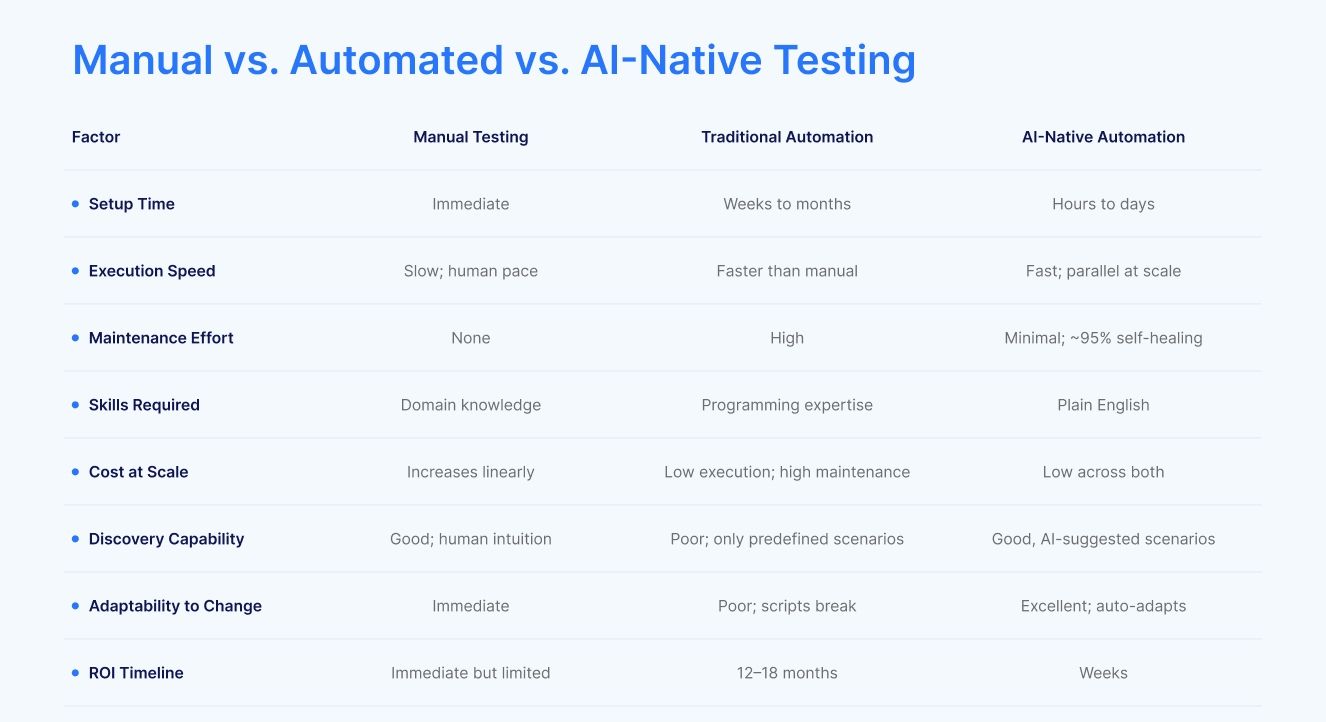
1. Beyond the Traditional Debate
The automated versus manual debate assumes traditional automation with its high maintenance burden. AI native platforms change the equation fundamentally.
Natural Language Test Creation
Tests written in plain English eliminate the programming barrier. Manual testers can create automated tests without learning to code. The skill gap between manual and automation roles disappears.
"Navigate to login page, enter valid credentials, verify dashboard displays account balance"
This is actual test authoring, not a simplified example. Non technical team members create comprehensive automated tests immediately.
Self Healing Maintenance
When applications change, AI native platforms adapt automatically. Self healing technology achieves approximately 95% accuracy in updating tests without human intervention. The 80% maintenance burden of traditional automation drops to near zero.
Autonomous Test Generation
AI can analyze applications and generate tests automatically. StepIQ technology examines interfaces, understands context, and creates test steps based on application behavior. Test creation accelerates from days to minutes.
From Manual Tester to Automation Contributor
AI native platforms enable a transformation: manual testers become automation contributors within a single sprint. Their domain expertise directly creates automated coverage without intermediate translation to code.
Organizations report:
87% reduction in test building time
90% reduction in maintenance effort
Over 90% reduction in effort compared to manual testing
2. The New Testing Model
AI native automation enables a hybrid model that leverages the best of both approaches.
Automate the Routine
Regression testing, smoke testing, integration validation, and repetitive verification all automate easily with AI native platforms. These activities that consumed manual tester time now execute automatically.
Elevate Manual Testing
With routine testing automated, manual testers focus exclusively on high value activities: exploratory testing, usability evaluation, and creative investigation. Their skills apply where human judgment matters most.
Enable Everyone to Contribute
Business analysts, product owners, and domain experts can all create automated tests using natural language. Testing coverage expands because more people can contribute.
Achieve Continuous Testing
Tests integrated into CI/CD pipelines run with every code change. Quality feedback is immediate and continuous rather than batched at release milestones.
Building Your Testing Strategy
1. Assessment Framework
Evaluate your current state to determine optimal approach.
Current Manual Effort Analysis
What percentage of testing is manual?
How much time goes to regression testing?
Are testers able to do exploratory testing?
What is the defect escape rate to production?
Automation Effectiveness Review
What percentage of tests are automated?
How much time goes to automation maintenance?
What is the ratio of test creation to maintenance?
Are automated tests trusted or frequently ignored?
Opportunity Identification
Which manual testing activities are repetitive?
Where would faster feedback enable faster delivery?
What coverage gaps exist due to time constraints?
Which team members could contribute to automation with appropriate tools?
2. Strategic Recommendations by Maturity Level
Organizations with Minimal Automation (Less than 20% automated)
Priority: Automate regression testing for stable, critical functionality
Approach: Start with AI native platform to avoid traditional automation pitfalls
Goal: Free manual testers from repetitive regression to focus on exploratory testing
Timeline: Expect positive ROI within first quarter
Organizations with Moderate Automation (20% to 50% automated)
Priority: Reduce maintenance burden on existing automation while expanding coverage
Approach: Migrate high maintenance tests to self healing platform
Goal: Shift effort ratio from maintenance to new test creation
Timeline: Measure maintenance reduction within first month
Organizations with Extensive but Struggling Automation (More than 50% automated but high maintenance)
Priority: Transform automation economics through platform modernization
Approach: Use GENerator to convert legacy tests to AI native format
Goal: Reclaim automation investment while eliminating maintenance burden
Timeline: Legacy migration in weeks, not months
Organizations with Mature Automation (More than 50% automated with healthy maintenance)
Priority: Extend automation to remaining manual activities and enable broader contribution
Approach: Add AI native capabilities for natural language authoring and autonomous generation
Goal: Democratize test creation while accelerating coverage expansion
Timeline: Continuous improvement and expansion
3. Implementation Roadmap
Phase 1: Foundation (Weeks 1 to 4)
Select pilot scope with clear success criteria
Deploy AI native platform
Create initial automated tests for highest value scenarios
Establish baseline metrics for comparison
Phase 2: Expansion (Weeks 5 to 12)
Extend automation to full regression suite
Enable manual testers to create automated tests
Integrate with CI/CD pipelines
Measure and report ROI metrics
Phase 3: Optimization (Ongoing)
Continuously expand coverage with AI assisted generation
Reallocate manual testing effort to exploratory activities
Refine test suite based on analytics and outcomes
Scale across additional applications and teams
Looking Ahead
So now you know more about the pros and cons when it comes to automated vs. manual testing, the question now becomes - what's next?
Well, the move to intelligent AI-powered test automation of course. At Virtuoso QA, we’re not about automating testing but revolutionizing it. Our intelligent test automation powered by Generative AI redefines how teams approach software testing by breaking free from the limitations of traditional automation.
Our platform integrates advanced AI with intuitive, user-friendly features to empower teams and supercharge efficiency.
Tired of tedious test maintenance? With Virtuoso QA’s self-healing capabilities, minor software changes no longer derail your testing process. Our AI automatically detects errors and updates test scripts in real-time, ensuring seamless, uninterrupted testing cycles. Say goodbye to hours wasted rewriting broken tests.
And it gets even better. Thanks to our Natural Language Programming (NLP), you can write tests in plain English. Test authoring becomes faster, simpler, and more accessible for everyone on your team.
Ready to scale or simplify your testing like never before? Book a demo today and discover how Virtuoso QA can transform your testing process.
Related Reads
Frequently Asked Questions
What percentage of testing should be automated?
Why do many test automation projects fail?
How much does automated testing cost compared to manual testing?
What is AI native test automation?
Should we replace all manual testing with automation?
How does self healing test automation work?