Blog
11 Best Generative AI Testing Tools in 2026

Adwitiya Pandey
Published on

Table of contents
Lorem ipsum
Lorem ipsum
Lorem ipsum
Lorem ipsum
Lorem ipsum
Generative AI is fundamentally transforming software testing by enabling machines to autonomously create, maintain, and optimize test suites through large language models and advanced machine learning. Where traditional test automation requires humans to write every test manually, generative AI testing tools analyze applications, understand requirements, and generate comprehensive test coverage automatically.
This comprehensive analysis examines how generative AI revolutionizes testing through autonomous test generation, intelligent test data creation, natural language test authoring, self-healing maintenance, and AI-powered root cause analysis, delivering verified outcomes like 9x faster test creation and 88% maintenance reduction that redefine testing economics at enterprise scale.
11 Best Generative AI Testing Tools in 2026
The tools below span three architectures, namely AI-native platforms built around generative AI, AI-augmented tools that layer AI onto an existing framework, and ML-based platforms that improve stability without full generative capability. Each entry notes which it is, because the architecture matters more than the marketing label when you are choosing.
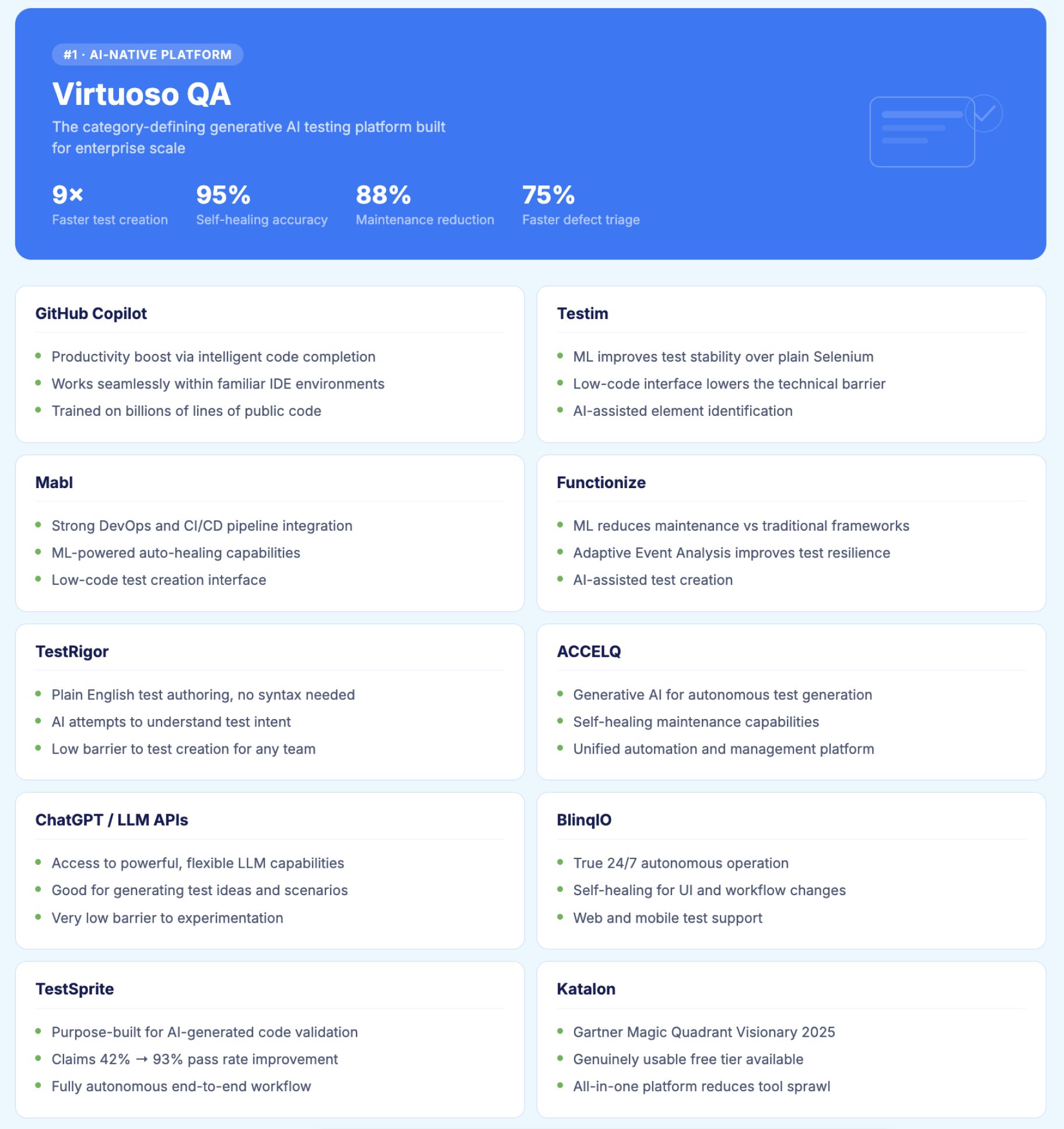
1. Virtuoso QA - Best AI-Native Generative AI Testing Platform
What Virtuoso QA Does
Virtuoso QA represents the category-defining AI-native platform architected entirely around generative AI and LLM capabilities. Unlike tools that add AI features to legacy frameworks, Virtuoso QA was built from inception to deliver autonomous testing at enterprise scale.
Key Features
GENerator: Autonomous test generation from requirements, wireframes, legacy suites, manual test cases, Jira stories, or Figma designs
Natural Language Programming: Create tests by describing user actions in plain English with LLM-powered intelligent autocomplete
StepIQ: AI analyzes application structure and generates test steps, assertions, and edge case scenarios automatically
AI Test Data Generation: Describe data needs in natural language and AI produces contextually appropriate data instantly
95% Self-Healing: ML and generative AI autonomously maintain tests as applications change
AI Root Cause Analysis: Automatically diagnoses failures, analyzes logs and API responses, generates remediation recommendations
Best Suited For
Enterprises seeking transformational testing outcomes: 9x faster test creation, 88% maintenance reduction, and 75% faster defect triage.
Pros
True autonomous test generation from multiple sources (84% first-run success)
95% self-healing accuracy
88-90% maintenance reduction
Non-technical users create tests in plain English
AI root cause analysis reduces triage time
Intelligent test data generation respects business context and compliance
Cons
Enterprise-focused, may be more than smaller teams need
Custom pricing (not publicly listed)
2. GitHub Copilot for Testing
What GitHub Copilot Does
GitHub Copilot applies LLM capabilities to assist developers in writing test code, positioning as an AI pair programmer for test automation. It suggests test code as developers type, leveraging training on billions of lines of public code.
Key Features
LLM-Assisted Code Generation: Suggests test code based on function signatures
Assertion Generation: Creates assertions from expected behavior descriptions
Test Data Setup: Generates boilerplate for test data preparation
IDE Integration: Works within familiar development environments
Pattern Recognition: Provides templates for common testing patterns
Best Suited For
Developers who want AI assistance while writing test code in their existing IDEs.
Pros
Productivity boost through intelligent code completion
Works in familiar development environments
Trained on billions of lines of code
Reduces boilerplate writing time
Cons
Assists but does not replace test creation, developers still write tests line by line
Tests still break when applications change, no self-healing
Requires coding expertise, does not democratize testing
No autonomous test generation from requirements
Incremental improvement, not transformational change
3. ACCELQ with Autopilot
What ACCELQ Autopilot Does
ACCELQ provides codeless test automation with ACCELQ Autopilot positioning as a generative AI engine for autonomous testing, combining test automation and management in a unified platform.
Key Features
GenAI-Driven Automation: Generative AI for autonomous test generation
Self-Healing Maintenance: AI-powered test maintenance
Intelligent Recommendations: AI suggests test improvements
Unified Platform: Combines test automation and test management
Best Suited For
Enterprises seeking codeless automation with generative AI capabilities in a unified platform.
Pros
Generative AI for test generation
Self-healing maintenance capabilities
Unified automation + management platform
Codeless test creation
Cons
The codeless model has a real learning curve for complex reusable-component architecture.
Full AI capability sits behind custom enterprise pricing, so upfront cost clarity needs a sales conversation.
Generation quality depends heavily on the quality of the input requirements.
4. Testim: AI-Augmented Test Automation
What Testim Does
Testim provides test automation with machine learning for element identification and test maintenance, positioning as an AI-powered platform for faster test creation and more stable execution.
Key Features
ML-Powered Element Identification: Attempts to recognize components even when attributes change
Test Stability: Machine learning makes tests more resilient to UI changes
Low-Code Test Creation: Visual interface with AI assistance
Smart Locators: AI-driven element selection
Best Suited For
Teams seeking more stable test automation than traditional Selenium with AI-augmented maintenance.
Pros
ML improves test stability vs pure Selenium
Low-code interface lowers technical barrier
AI-assisted element identification
Cons
Now part of Tricentis, so its standalone roadmap and long-term positioning are uncertain, worth confirming before purchase.
The ML stability advantage is lost if tests are migrated to another platform.
Coverage is strongest for Salesforce and standard web, thinner on niche stacks.
5. Mabl
What Mabl Does
Mabl positions as an AI-native testing platform with machine learning for test maintenance and intelligent insights, targeting developer and DevOps personas with deep integration into modern development stacks.
Key Features
ML-Driven Maintenance: Machine learning for element identification and auto-healing
Low-Code Creation: Visual test builder with AI assistance
DevOps Integration: Deep integration with modern CI/CD pipelines
Intelligent Insights: AI-powered analysis and recommendations
Best Suited For
Developer-led teams practicing continuous delivery who want AI-assisted testing within DevOps workflows.
Pros
Strong DevOps and CI/CD integration
ML-powered auto-healing capabilities
Low-code test creation
Developer-friendly workflow
Cons
Developer-centric positioning fits enterprises with separate QA organisations less well.
The AI is ML-based rather than LLM/generative-native.
Backend and database coverage needs external tooling.
6. Functionize
What Functionize Does
Functionize positions as an AI-powered testing platform using machine learning for test creation, maintenance, and analysis through its Adaptive Event Analysis technology.
Key Features
Adaptive Event Analysis: ML attempts to understand user intent for resilient tests
ML Element Identification: Makes tests resilient to UI changes
Test Recording: Create tests through recording or manual authoring
AI Assistance: ML supports test creation and maintenance
Best Suited For
Teams seeking ML-powered automation that's more resilient than traditional Selenium frameworks.
Pros
ML reduces maintenance vs traditional frameworks
Adaptive Event Analysis improves test resilience
AI-assisted test creation
Cons
ML-based rather than LLM/generative-native.
Custom-only pricing slows procurement for teams needing upfront clarity.
Requires an application-analysis phase before it produces executable output.
7. TestRigor
What TestRigor Does
TestRigor enables test creation in plain English, claiming AI-powered capabilities for understanding test intent and generating appropriate automation.
Key Features
Plain English Tests: Write tests using everyday language
AI Intent Understanding: Attempts to understand test intent from natural language
Automation Generation: Converts plain English to executable tests
Self-Healing Claims: AI element identification for maintenance
Best Suited For
Teams wanting to create tests in natural language without learning test automation syntax.
Pros
Plain English test authoring
AI attempts to understand intent
Lower barrier to test creation
Claims self-healing capabilities
Cons
Natural-language understanding has limits with complex branching logic and deeply data-dependent scenarios.
Vision AI can struggle with highly custom or game-like UI rendering.
Smaller public review base than the longest-established platforms, so independent evaluation matters.
8. ChatGPT and LLM APIs for Test Generation
What Direct LLM Use Does
Organizations experiment with using ChatGPT, GPT-4, Claude, and other LLM APIs directly for test generation tasks through prompt engineering.
Key Features
Prompt-Based Generation: Ask LLMs to generate test cases from requirements
Code Generation: Paste code and request test automation
Scenario Creation: Describe applications and request test scenarios
Iterative Refinement: Iterate on outputs to refine tests
Best Suited For
Teams experimenting with LLM capabilities or generating test ideas before manual implementation.
Pros
Access to powerful LLM capabilities
Flexible, use for various test generation tasks
Good for generating test ideas and scenarios
Low barrier to experimentation
Cons
Lacks context about applications under test
Requires manual conversion to executable automation
No integration with test execution infrastructure
No self-healing or maintenance capabilities
Not suitable for enterprise testing at scale
To know more, Read - ChatGPT for Test Automation: Prompts, Use Cases, and Limitations
9. BlinqIO
What BlinqIO Does
BlinqIO positions as the "first AI Test Engineer", an autonomous platform that generates, executes, and maintains test automation code 24/7.
Key Features
Autonomous Code Generation: AI interprets test scenarios and generates automation code
24/7 Operation: Virtual testers work around the clock without human intervention
Self-Healing: Automatically updates scripts when UI changes
Cucumber/BDD Native: Built for behavior-driven development workflows
Multilingual: Supports 50+ languages
Best Suited For
BDD/Cucumber teams wanting autonomous test generation without building an internal automation team.
Pros
True 24/7 autonomous operation
Self-healing for UI and workflow changes
Web and mobile support
Cons
Newer platform, limited enterprise proof points
Per-scenario pricing
Complex scenarios may need manual oversight
10. TestSprite
What TestSprite Does
TestSprite is built specifically for validating AI-generated code. Its MCP Server creates a closed loop between AI coding tools (Copilot, Claude, GPT) and automated testing - planning, executing, debugging, and re-validating changes autonomously.
Key Features
MCP Server: Connects AI coding agents to testing agents
Autonomous Planning: AI drafts test plans from documentation
Instant Code Generation: Creates test code in seconds after approval
AI Debugging: Identifies root causes from test outcomes
Cloud Execution: Runs tests automatically on cloud infrastructure
Best Suited For
Teams using AI coding assistants (Copilot, Cursor, Claude) who need automated validation of generated code.
Pros
Purpose-built for AI-generated code era
Claims 42% → 93% pass rate improvement
Fully autonomous end-to-end workflow
No testing engineers needed for validation
Cons
Newer entrant, limited enterprise references
Narrow focus on AI-code validation
Less proven for complex enterprise apps
11. Katalon
What Katalon Does
Katalon is a comprehensive test automation platform supporting web, mobile, API, and desktop testing. Named a Gartner Magic Quadrant Visionary in 2025, it offers GenAI capabilities for test generation while maintaining accessibility for teams with mixed technical skills.
Key Features
GenAI Test Generation: AI-assisted test case creation
Multi-Platform: Web, mobile, API, desktop in one tool
Low-Code + Code: Visual interface with scripting option
Self-Healing: AI-powered locator recovery
TestOps: Built-in analytics and CI/CD orchestration
Best Suited For
Teams wanting one platform that handles everything reasonably well, with a usable free tier.
Pros
Gartner Magic Quadrant Visionary 2025
Genuinely usable free tier
All-in-one platform reduces tool sprawl
Works for mixed technical skill levels
Large community and documentation
Cons
AI-augmented, not AI-native
Performance issues with very large test suites
Proprietary format creates vendor lock-in

Critical Generative AI Capabilities for Testing Tools
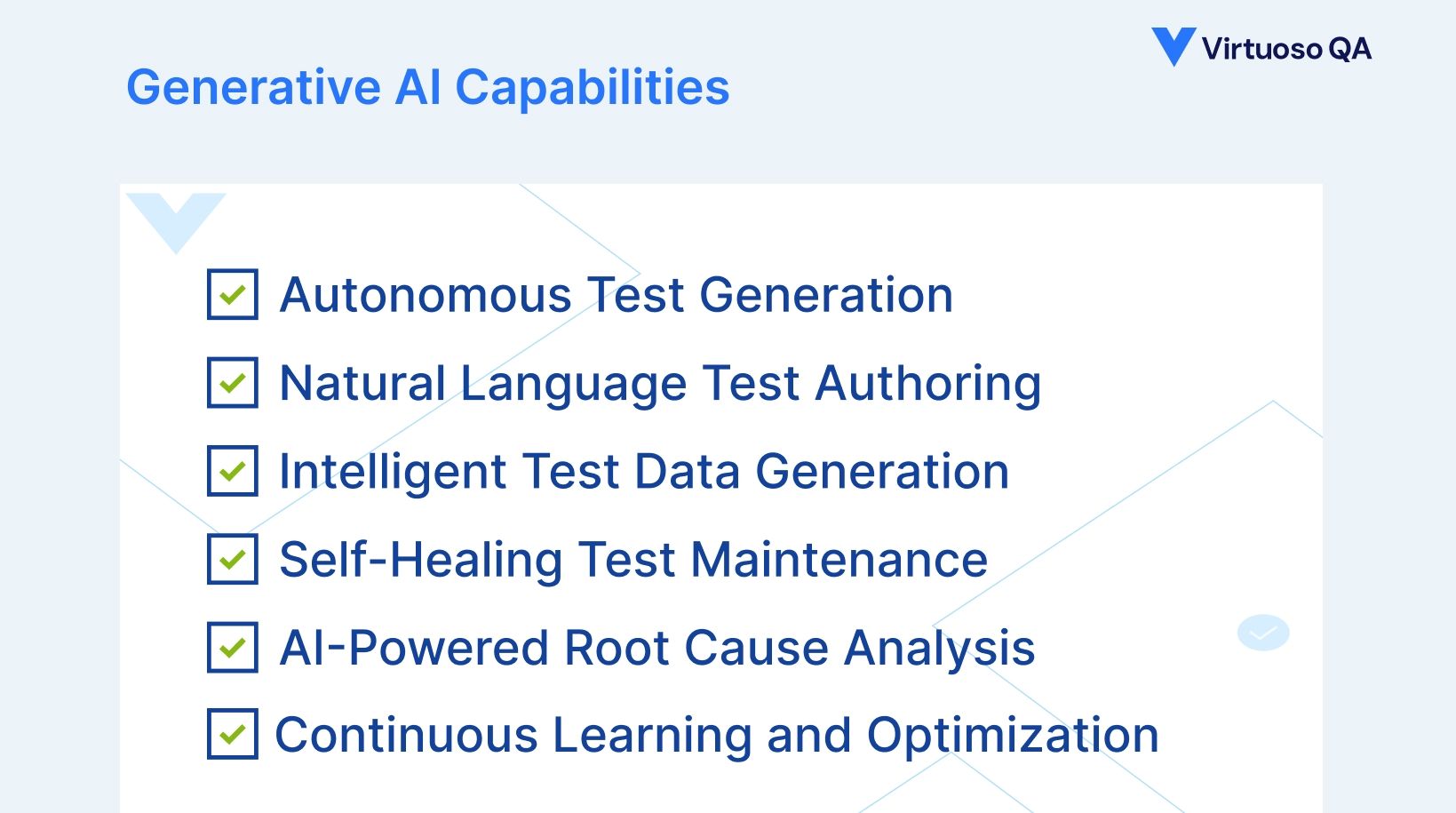
1. Autonomous Test Generation from Requirements
The most transformative generative AI capability: analyzing requirements, specifications, user stories, or wireframes and automatically generating comprehensive test suites validating stated criteria. Organizations achieve 9x faster test creation as AI produces in hours what manual test authoring requires weeks to build.
Advanced platforms analyze business requirements documents, extract testable criteria, generate test scenarios including positive tests, negative tests, boundary conditions, and edge cases, create executable automation in natural language or code, and provide traceability linking generated tests to source requirements.
2. Natural Language Test Authoring with LLM Assistance
Generative AI enables test creation through conversational natural language where testers describe expected behaviors and LLMs translate descriptions into executable automation. This democratizes test creation to business analysts, manual testers, and domain experts without coding expertise.
Platforms provide intelligent autocomplete suggesting next test steps, context-aware recommendations based on application under test, automatic assertion generation inferring expected outcomes, and real-time validation ensuring test logic is correct as testers author.
3.Intelligent Test Data Generation
Generative AI creates realistic test data on demand through understanding data schemas, business rules, and context. Rather than manually creating customer records, order histories, or product catalogs, AI generates appropriate data instantly.
Advanced capabilities include contextually appropriate data matching business domain (healthcare data for Epic, financial data for banking), edge case generation creating boundary values and unusual scenarios, relationship preservation ensuring data integrity across related entities, and compliance awareness generating data respecting regulatory requirements.
4. Self-Healing Test Maintenance
Generative AI enables tests to heal themselves when applications change. When UI elements move, change attributes, or get renamed, AI-powered self-healing identifies elements through visual and contextual understanding, updates test automation automatically, and validates fixes ensuring tests still validate correctly.
Organizations achieving 95% self-healing accuracy reduce maintenance from 80% of effort to 12%, fundamentally changing testing economics by redirecting effort from maintenance to coverage expansion.
5. AI-Powered Root Cause Analysis
When tests fail, generative AI automatically diagnoses root causes by comparing expected versus actual behavior, analyzing error logs and stack traces, examining network requests and API responses, reviewing database states, and generating remediation recommendations.
This reduces defect triage time by 75% as teams receive instant analysis rather than manually investigating failures across complex application stacks.
6. Continuous Learning and Optimization
Advanced generative AI testing tools learn from execution patterns, test results, and application changes to continuously optimize test suites. AI recommends removing redundant tests, identifies gaps in coverage, suggests test scenario improvements, optimizes execution ordering for faster feedback, and predicts high-risk areas requiring additional testing.
The Generative AI Testing Evaluation Framework
1. Autonomous Test Generation Depth
Evaluate how platforms generate tests from diverse sources: requirements documents, user stories, UI wireframes, legacy test suites, manual test cases, and application analysis. Measure generation speed (hours versus weeks for equivalent coverage), comprehensiveness (positive tests, negative tests, edge cases, boundary conditions), and accuracy (percentage of generated tests executing successfully).
Virtuoso QA's GENerator creating tests from requirements, wireframes, or legacy suites with 84% first-run success demonstrates true autonomous generation versus platforms requiring significant manual refinement.
2. Natural Language Authoring Intelligence
Can non-technical users create sophisticated tests through natural language, or does the platform require technical expertise despite natural language interfaces? Test with business analysts and manual testers attempting complex scenario creation. Measure time-to-productivity and success rates.
3. Self-Healing Effectiveness
When applications change, what percentage of test updates occur autonomously versus requiring manual intervention? Test with realistic UI changes (element moves, attribute changes, layout redesigns) measuring self-healing accuracy and maintenance burden reduction.
Platforms claiming AI self-healing should demonstrate specific metrics like Virtuoso QA's 95% accuracy and verified 88% to 90% maintenance reduction through customer outcomes.
4. AI-Powered Analysis Depth
How effectively does the platform use AI for root cause analysis, test optimization, coverage gap identification, and intelligent recommendations? Measure reduction in defect triage time and value of AI-generated insights.
Virtuoso QA's 75% reduction in defect triage time through AI Root Cause Analysis demonstrates analysis depth versus platforms providing basic failure reporting.
5. Test Data Generation Intelligence
Does the platform generate contextually appropriate, realistic test data across scenarios, or require manual data preparation? Evaluate data quality, relationship preservation, edge case coverage, and compliance awareness.
6. True AI Native Architecture
Is the platform architected from inception around generative AI and LLMs, or are AI features added to legacy architecture? AI native platforms deliver superior integration, autonomous capabilities, and continuous learning versus bolt-on AI features.
Begin Your Generative AI Testing Journey
Request a personalized demonstration showing how Virtuoso QA's generative AI capabilities deliver autonomous test generation through GENerator, natural language authoring with LLM intelligence, 95% self-healing accuracy, AI-powered root cause analysis, and intelligent test data generation for your specific applications and requirements.
The future of testing is generative AI native, autonomous, and intelligent. The future creates comprehensive test coverage through LLMs at machine speed. The future is inevitable.

Frequently Asked Questions on Generative AI Testing
How do large language models improve test automation?
What is autonomous test generation and how does it work?
Can generative AI completely replace manual test creation?
How does generative AI create test data?
How do you evaluate generative AI testing tools?