Blog
Autonomous Test Generation: What it is and How it Works

Rishabh Kumar
Published on

Table of contents
Lorem ipsum
Lorem ipsum
Lorem ipsum
Lorem ipsum
Lorem ipsum
For decades, writing tests was work a person did. An engineer read a requirement, opened the application, and turned that understanding into a script. That arrangement worked fine when software shipped on a quarterly cycle. It breaks down when software ships daily.
Autonomous test generation is the response. It is software that reads requirements, watches how users behave in production, detects code changes, and produces executable tests without a person scripting each step. Done well, it does not just save time on authoring. It decides whether a release can still be trusted at the pace AI now produces the code underneath it.
The Problem That Made Autonomous Generation Necessary
Writing tests used to be the main cost of testing. Most QA budgets paid for the time it took engineers to turn requirements into scripts. Keeping those scripts working was a quieter cost underneath, but both were manageable when development moved at a human pace.
Three things changed that at once.
AI coding assistants moved into the engineering mainstream. Pull request frequency in teams using AI tools now runs at multiples of what it was before 2024. Teams that shipped twenty features a quarter now ship sixty, with each change touching more of the codebase than before. The bottleneck shifted. Authoring is no longer where the time goes. Verification is.
The second shift made the first worse. AI-written code drifts. Patterns vary across pull requests. Edge-case handling is inconsistent. Refactors arrive without warning. Tests that worked yesterday break today not because the feature changed but because the implementation underneath it did.
The third shift is structural. The teams writing the most AI-assisted code are also the ones furthest from their QA function. Development accelerates. The QA backlog grows. Confidence in releases falls. Teams either slow down or ship with less test coverage than they should.
Autonomous test generation exists because no human team can write tests fast enough to keep up with code that writes itself.
What is Autonomous Test Generation?
The phrase gets applied loosely. Vendors use it for everything from a record-and-replay tool with a few AI suggestions to genuine systems that read product documentation and produce running tests. The distinction matters because each version produces very different outcomes in practice.
A working definition: Autonomous test generation is the production of executable tests by AI systems working from source material other than human-authored test scripts. The sources can be requirements, design files, user analytics, support tickets, defect history, or code changes. The outputs are tests that run real user journeys end to end. The human role moves from author to reviewer and editor.
The word autonomous does the real work here. A tool that suggests the next step in a script is assisted authoring. A tool that records a user session is recorded authoring. Autonomous generation begins where the system produces tests on its own initiative from material outside the test suite itself.
Autonomous vs Assisted vs Recorded Test Creation
These three approaches are often grouped together. The differences are sharper than most suggests.
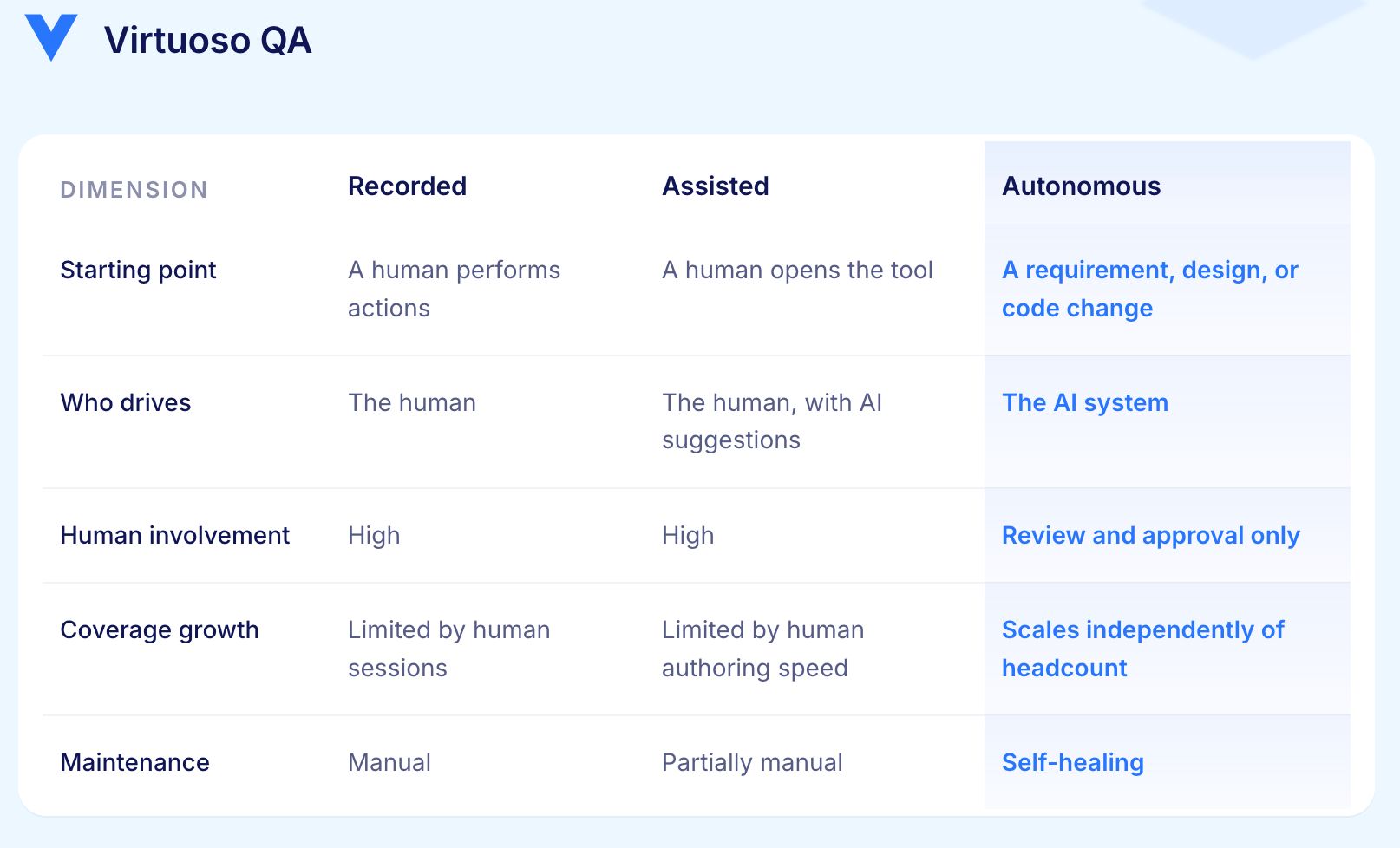
The key difference is whether the platform can generate tests without a human starting point. Most platforms that do the third also do the first two. The distinction is whether generation is the default or the exception.
Where Autonomous Systems Generate Tests From
Generation is only as reliable as the source material behind it. Five source types carry most of the value in enterprise environments.
1. Requirements and Acceptance Criteria
The platform reads a user story or acceptance criterion, identifies the actors, actions, and expected outcomes, maps them to the live application, and produces a test journey. A criterion like "a customer applies for a quote, receives a price within fifteen seconds, and accepts it" becomes a sequence of navigable steps with explicit assertions on timing and state.
The output is written in plain English rather than code, so a business analyst can review it without needing to understand the automation framework underneath.
2. Existing Test Suites
Most enterprise teams carry years of test scripts written in Selenium, UFT, TestComplete, Karate, or internal frameworks. Autonomous generation reads those scripts, extracts the underlying journeys they were trying to cover, and rewrites them as modern, self-healing tests.
This is not a straight translation. A flaky Selenium script with hard-coded waits and brittle locators is not what the original author intended to write. The platform produces what the author was trying to express, freed from the technical limitations of the framework they had available at the time.
3. User Analytics
Analytics show what users actually do in the product, which often differs significantly from what the QA team assumes. The platform reads session data, identifies the highest-traffic and highest-revenue flows, and generates tests for journeys the team may never have written explicitly.
A pattern that appears consistently: a team believes their regression suite covers the product comprehensively. Analytics shows two flows accounting for sixty percent of user sessions, and one of them has no test coverage at all.
4. Defect and Support History
Support tickets and defect records point at the journeys most likely to break. Generating tests from this data closes the gap between where the product has historically failed and where the test suite currently looks.
5. Code and Design Changes
When a Figma design file changes, the platform can read the change, identify which journeys are affected, and update or generate tests accordingly. When code changes, the same logic applies to the underlying implementation. The test suite does not wait for the QA team to be told something has moved.
How Autonomous Test Generation Works
Most explanations stop at "the AI reads your requirements and produces tests." That is accurate but not useful for anyone deciding whether to trust the output in a production pipeline. Here is what actually happens.
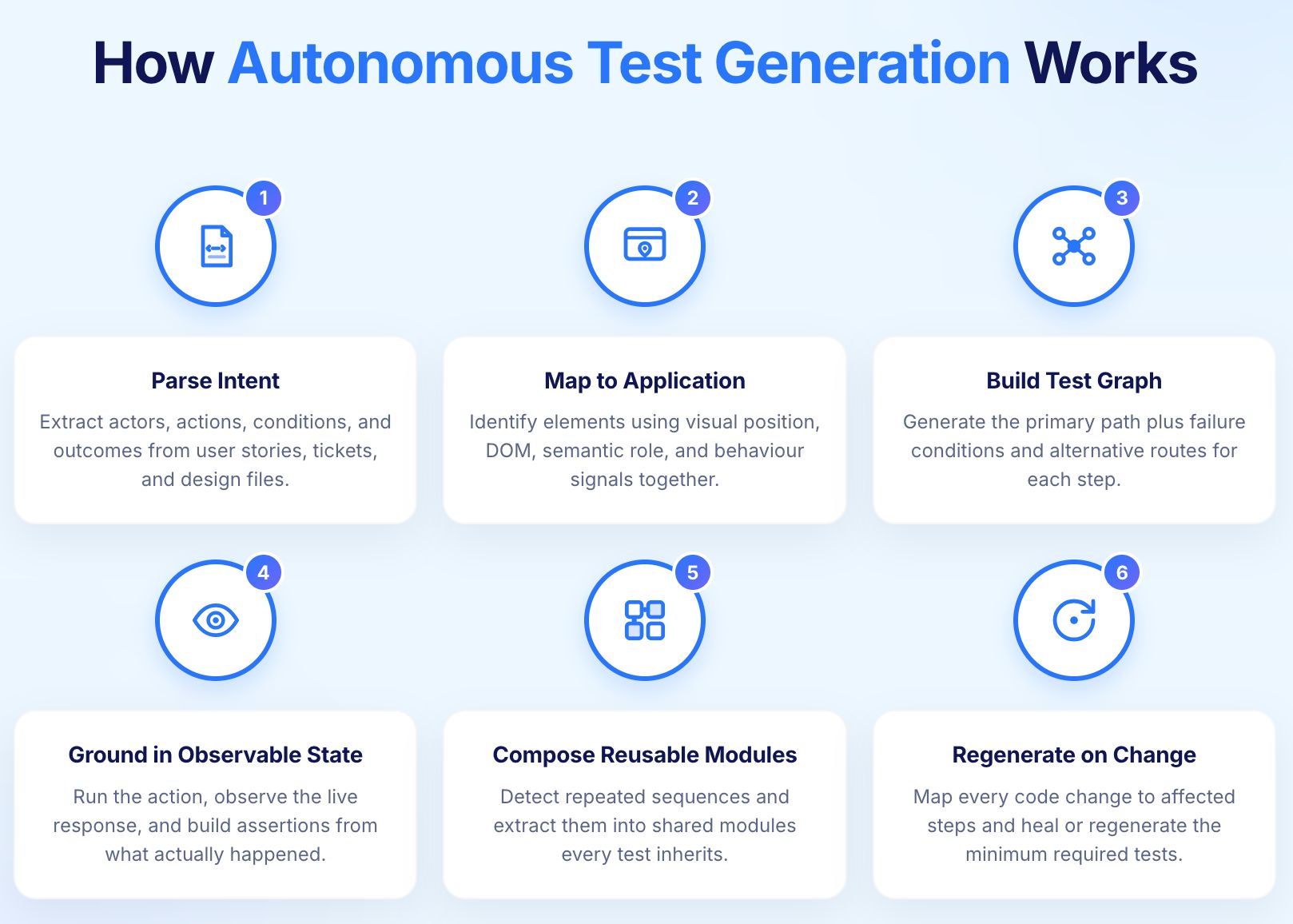
Step 1: Parsing Intent from Source Material
The platform reads the input, whether that is a user story, a Jira ticket, a Figma annotation, or a plain English description, and extracts structured, testable information from it. Natural language processing and large language models identify the actor, the action sequence, the conditions that apply, and the expected outcome.
Every generated test step links back to the source statement that produced it. A human reviewer can verify the interpretation is correct before the test enters the suite.
Step 2: Mapping Intent to the Live Application
Knowing what to test is different from knowing how to test it on a specific application. The platform locates the actual elements and flows by building an identification profile for each element using multiple signals simultaneously: visual position, DOM structure, semantic role, surrounding context, and historical behaviour across previous test runs.
A test built on a single CSS selector breaks when that selector changes. A test built on five correlated signals absorbs significant UI changes without breaking.
Step 3: Generating the Full Test Graph
A test is not a list of actions. The platform generates the primary execution path and extends it with failure conditions and edge cases the source material implies. Each step includes the action to perform, the element to interact with, the assertion to evaluate, and the alternative path to follow if the assertion fails.
Step 4: Grounding Assertions in Observable State
Rather than inferring what the application should do, the platform navigates to the live application, performs the action, and observes what actually happens. Assertions are built from what was observed, linked to the specific DOM state, network response, or visual output recorded during generation.
This grounding step is what separates generated tests that can be trusted from generated tests that merely read correctly.
Step 5: Composing Reusable Modules
Naive generation produces monolithic tests where every test contains every step from scratch. A login sequence appearing in 300 tests gets generated 300 times. Composable generation identifies repeated sequences and extracts them into shared modules. When the login flow changes, one module updates and all 300 tests inherit the change automatically.
Step 6: Continuous Regeneration from Change Signals
When a code change lands, the platform maps it to the affected test steps and either heals them automatically or regenerates only the minimum set required to maintain accuracy. Analytics updates, new defects, and UI changes all feed the same loop. The suite stays current without a human reviewing every change manually.

Can Generated Tests Actually Be Trusted?
A test is only useful if its result can be believed. Autonomous generation creates a verification problem inside the verification system itself. This is the question most vendors avoid and the one that matters most at enterprise scale.
The Hallucination Problem
AI language models generate text that reads correctly whether or not it is accurate. Apply that to test cases and the failure mode is a test that passes against the wrong assertion, or a test that checks behaviour the product never promised.
The platforms that solve this do not rely on language models alone. Generation is grounded in the actual application: element identification through DOM structure, visual analysis, and contextual signals; assertions tied to observable state rather than assumed state; explicit links back to the source requirement so every test is reviewable. The model proposes. The runtime confirms.
Why Self-Healing Matters More Than Generation
A generated test that breaks the first time the UI changes is a problem rather than a solution. The maintenance cost it creates exceeds the authoring cost it saved.
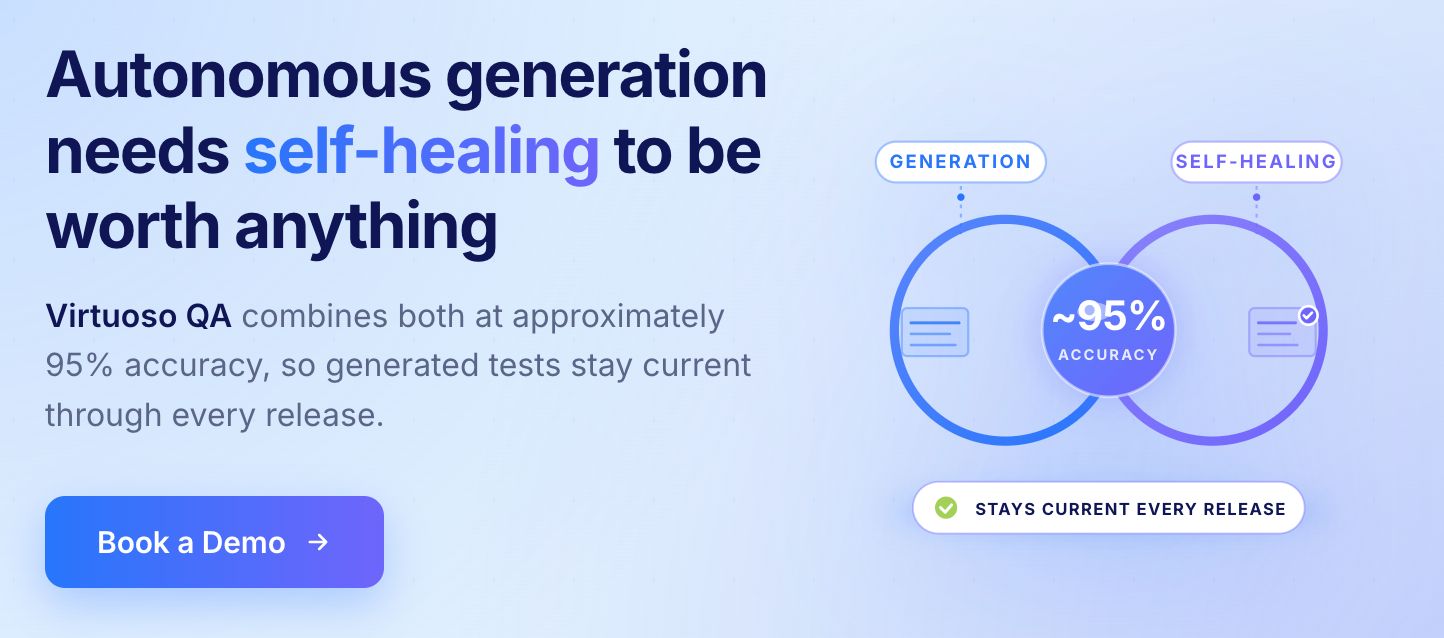
Autonomous generation only pays off when it is paired with self-healing. The platform must identify elements through multiple signals so that when a locator changes, the test still runs against the same element. Self-healing accuracy of approximately 95% is roughly the threshold at which generation shifts from an interesting capability to a reliable operating model.
Without that foundation, every generation cycle creates a maintenance cycle. With it, the test suite grows without the QA team growing alongside it.
Explainability as a Requirement
When a test fails, the platform must explain what it expected, what it observed, and which part of the application caused the difference. A failure without that explanation is noise rather than a signal the team can act on.
Explainability is much harder to add later than to build in from the start. Generation systems that produce tests in plain language, link each step to its source, and surface root cause analysis at failure are the ones that earn genuine trust over time.
What Autonomous Generation Cannot Do
Saying what a system cannot do builds more trust than overstating what it can.
1. It Cannot Invent Business Intent
If the requirement is ambiguous, the test will be too. The human role is not to script but to clarify intent and review the output. Ambiguity in the input produces ambiguity in the coverage.
2. It Cannot Replace Exploratory Testing
Curiosity, intuition, and the ability to notice something unexpected are still human capabilities. Autonomous generation scales the predictable and the documented. Exploratory testers find what nobody thought to ask for.
3. It Cannot Fix a Poorly Designed Product
A comprehensive test suite that passes against a feature that should not work as designed is a confidence vehicle pointed in the wrong direction. Generation surfaces problems. It does not make design decisions.
4. It Cannot Eliminate the Release Judgement
The platform can score confidence, prioritise risk, and produce evidence. The decision about whether to release still belongs to the people who own the outcome.
The honest framing strengthens the position. Generation handles the volume that no team could author manually. People handle the judgement that no model can be trusted with yet.
How Virtuoso QA Delivers Autonomous Test Generation
Virtuoso QA is built around the assumption that authoring would stop being the bottleneck. Four capabilities work together to make autonomous generation the default rather than the experiment.
GENerator is the agentic test generation engine. It produces executable Virtuoso QA journeys from requirements, Figma designs, Jira tickets, and legacy test suites from Selenium, Tosca, and TestComplete. The output is written in plain English. A QA engineer can review it, edit it inline, and add it to the suite in the same view.
StepIQ reads the live application and generates contextually accurate test steps by examining the screens, fields, and flows of the application under test. Coverage is not limited by what a human thought to record. StepIQ accelerates test authoring by up to nine times compared to manual scripting.
Natural Language Programming means generated tests are readable and editable by anyone on the team, not just automation engineers. Business analysts, product owners, and QA engineers without a scripting background can all review and modify the output. Complex technical logic can be wrapped in a single plain-English step that the rest of the team uses without seeing what is underneath.
Self-healing AI keeps generated tests current as the application changes. Element identification combines visual analysis, DOM structure, and contextual signals, and adapts at approximately 95% accuracy when elements move, are renamed, or are restructured. Tests that would have broken and required manual fixes continue running without intervention.
The four capabilities work individually. Together they produce what the platform calls the Trust Layer: tests that generate themselves, run themselves, heal themselves, and explain themselves when they fail.
Autonomous Generation in the CI/CD Pipeline
Generated tests are only valuable if they enter the delivery pipeline without friction. A test suite that lives outside the pipeline is a test suite that gets bypassed when schedule pressure arrives.
Virtuoso QA integrates natively with Jenkins, Azure DevOps, GitHub Actions, GitLab, and CircleCI. Generated tests execute on a cloud grid across more than 2,000 browser, OS, and device configurations. Failures surface as tracked issues with reproduction steps, screenshots, video recordings, and AI Root Cause Analysis pointing at the suspected cause.
The pipeline does not just run tests faster. It stops shipping code the suite is not confident in.
Where Autonomous Generation is Heading
The next development is not better generation. It is generation that never stops.
A continuously generating test suite behaves differently from a generation tool. Tests are produced from product signals as those signals change. Analytics feed in. Defects feed in. Code changes feed in. The suite reorganises itself around what currently matters. Pull requests open and the affected tests run automatically. Confidence scores attach to each release. Evidence files into the project management tool before a human asks for it.
The role of the QA team changes at the same time. Writing and fixing scripts moves out. Deciding what to trust, what to ship, and what to investigate moves up. The team governs the quality programme rather than operating the tools.
The destination is a test suite that scales as fast as the code does. Autonomous generation is the first part of that. Self-healing, root cause analysis, and change-based test selection are the rest. Together they form the operating model for QA at the pace AI-coded software now demands.
Related Reads
Frequently Asked Questions
How is autonomous test generation different from record-and-replay?
Can autonomous generation replace manual test writing entirely?
How reliable are AI-generated tests?
What is self-healing and why does it matter for generated tests?
How long does it take to generate a meaningful test suite?
What happens when the application changes after tests have been generated?