Blog
Business Acceptance Testing: Objectives, Steps, and Modern Approaches

Rishabh Kumar
Published on






Table of contents
Lorem ipsum
Lorem ipsum
Lorem ipsum
Lorem ipsum
Lorem ipsum
Business acceptance testing determines whether software delivers business value stakeholders expect. Traditional UAT approaches create bottlenecks delaying releases, requiring weeks of manual validation effort, and failing to catch requirement mismatches until late stages. Organizations implementing AI-native business acceptance testing achieve 87% faster test creation, 90% maintenance reduction, and highly reusable tests across system integration, regression, and user acceptance testing. Natural Language Programming enables business users to create and validate tests without technical expertise, while composable testing provides pre-built acceptance criteria for enterprise systems. True business acceptance testing requires tools business stakeholders actually use, tests that document requirements as executable validation, and automation that accelerates rather than delays project delivery.
Understanding Business Acceptance Testing
What is Business Acceptance Testing?
Business acceptance testing validates software delivers business value stakeholders expect, meets defined business requirements, enables intended business processes, provides usable experiences for business users, and justifies investment through realized benefits. BAT differs from technical testing focusing on correct implementation by emphasizing business utility and value delivery.
Requirements Validation
Tests verify features implement exactly what business requirements specified, not technical teams' interpretation of requirements. When requirements state "system must prevent duplicate orders," testing validates actual duplicate prevention using business scenarios, not just technical validation that duplicate checking code exists.
Business Process Enablement
Testing validates complete business workflows spanning systems, departments, and roles. Enterprise software supports processes like order-to-cash, procure-to-pay, or hire-to-retire involving multiple systems and handoffs. Business acceptance testing validates end-to-end processes work correctly, not just individual system functions.
Usability Validation
Business users with actual job roles determine whether systems provide intuitive, efficient experiences enabling productive work. Technical usability testing evaluates general interface principles. Business acceptance testing validates whether purchasing agents, claims processors, or account managers can efficiently complete actual work.
Value Realization
Ultimate business acceptance criterion: does software deliver expected business value justifying investment? Testing validates performance improvements, cost reductions, capability enhancements, or competitive advantages that motivated the project.
Where Business Acceptance Testing Fits in the Acceptance Testing Lifecycle
With the broader acceptance testing ecosystem, business acceptance testing forms a critical layer. Acceptance testing generally validates whether a solution is ready for real-world use while business acceptance testing ensures the software delivers the business value, outcomes, and process alignment stakeholders expect. What makes business acceptance testing distinct is its focus on value realization. Where UAT checks if the system works for users, BAT checks if the system works for the business, thereby ensuring every requirement, workflow, and rule supports strategic goals, revenue processes, and operational continuity.
Who is Involved in Business Acceptance Testing?
Business acceptance testing involves diverse stakeholders with different perspectives and requirements:
1. Business Sponsors
Executive leaders funding projects expect validation that investments deliver promised returns, strategic objectives get achieved, and business capabilities improve measurably. Sponsors require confidence before approving production release.
2. Business Process Owners
Managers responsible for processes like sales, procurement, or claims processing validate that new systems support improved process execution, maintain business continuity during transitions, and enable process changes the project intended.
3. End Users
People actually using systems daily determine whether interfaces make sense, workflows match actual work patterns, performance proves acceptable, and training adequacy enables productivity. End user acceptance ultimately determines project success regardless of technical quality.
4. Compliance and Risk
Depending on industry, regulatory compliance officers validate systems meet legal requirements, internal audit validates controls and segregation of duties, and risk management validates business continuity and disaster recovery capabilities.
Effective business acceptance testing provides evidence each stakeholder group needs to confidently approve production release.
Objectives of Business Acceptance Testing
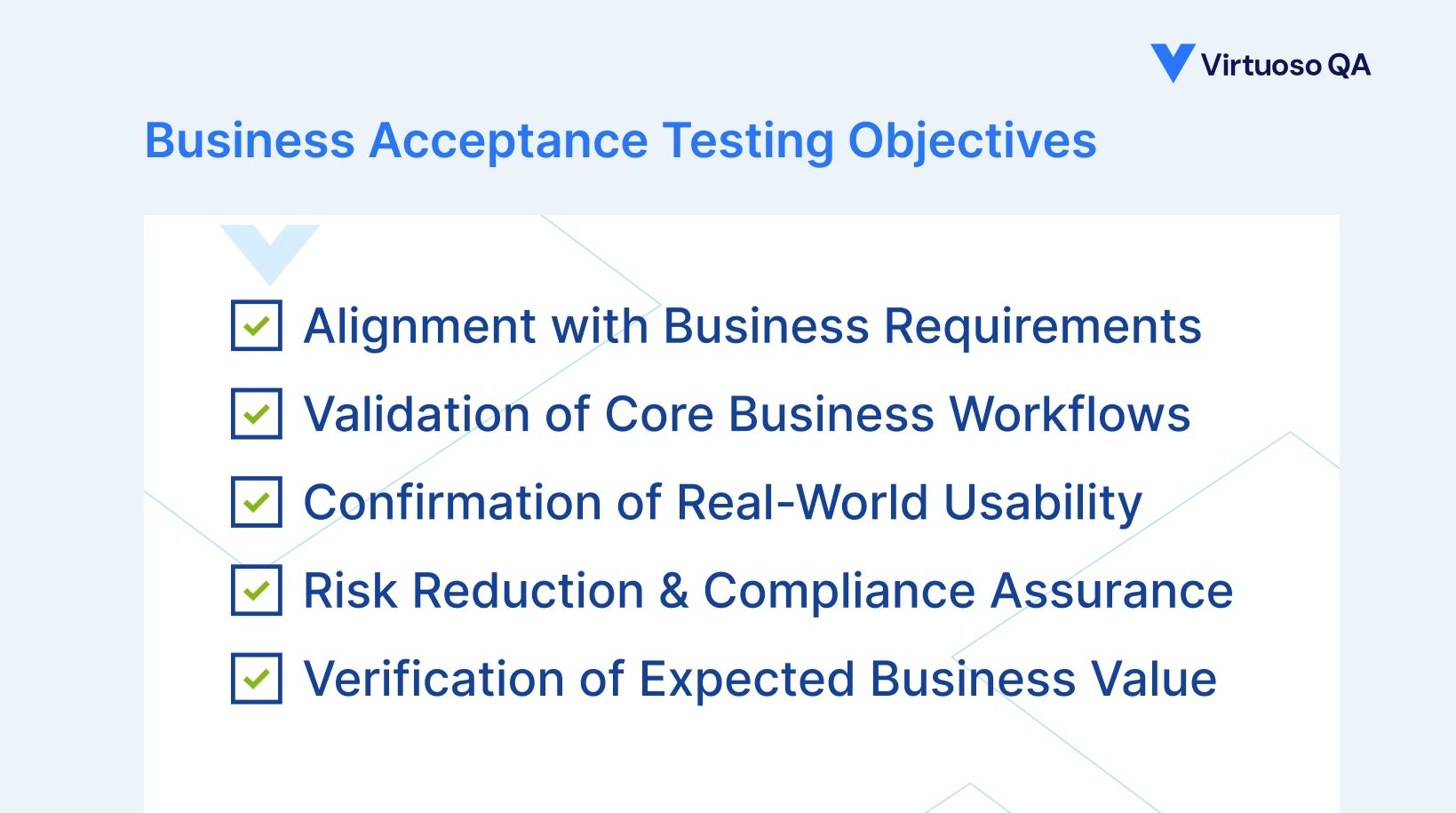
Primary objective of business acceptance testing is to confirm whether the software truly fulfills business expectations and not just that it functions technically. BAT ensure:
1. Alignment With Business Requirements
Every requirement must be implemented exactly as intended, not interpreted through technical assumptions.
2. Validation of Core Business Workflows
Processes such as order-to-cash, hire-to-retire, and claim-to-settlement must work end-to-end across systems, teams, and integrations.
3. Confirmation of Real-World Usability
Business users verify that workflows match how work is actually performed and not how technical teams think it’s performed.
4. Risk Reduction & Compliance Assurance
BAT ensures the system supports audit rules, industry regulations, and business continuity requirements.
5. Verification of Expected Business Value
The software must deliver measurable business outcomes, including efficiency improvements, cost reductions, better customer experiences, and stronger operational performance.
Steps Involved in Business Acceptance Testing
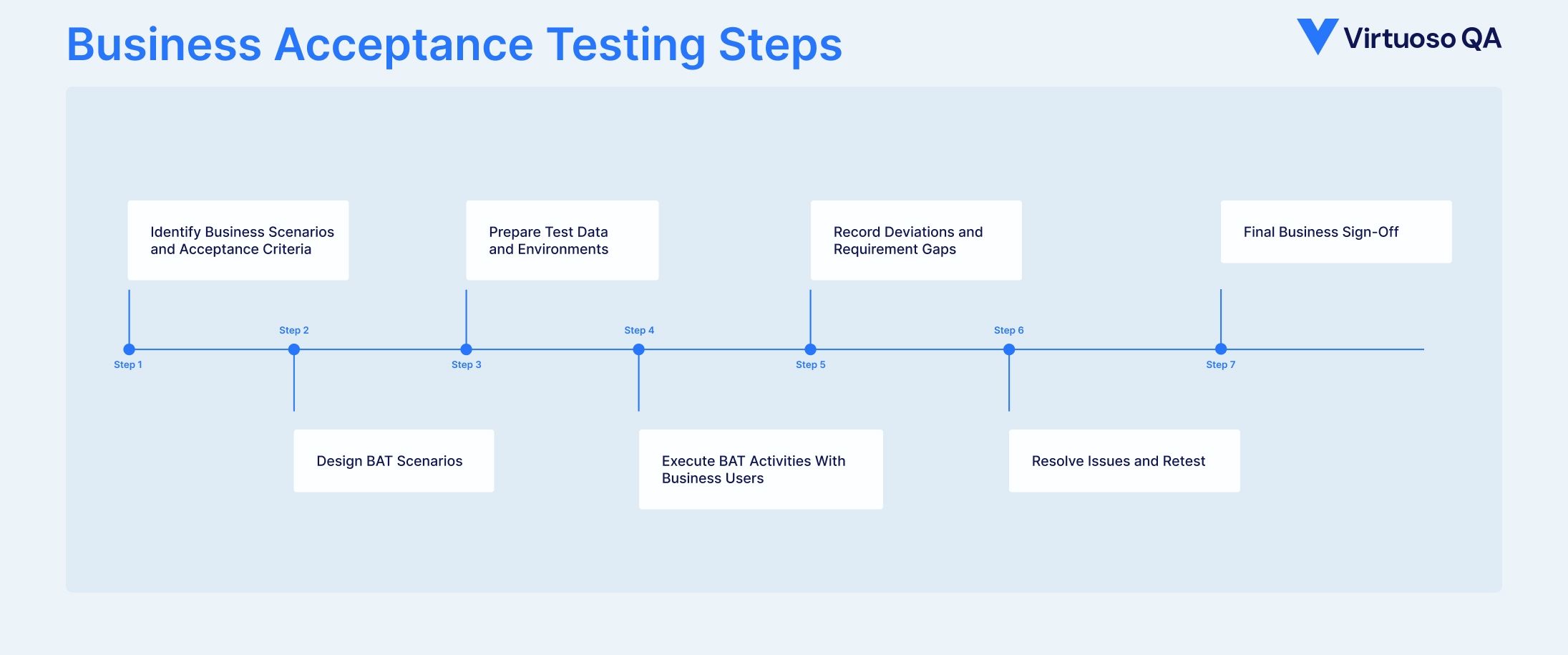
Effective Business Acceptance Testing follows a structured and collaborative workflow. The following steps provide a clear, repeatable process:
1. Identify Business Scenarios and Acceptance Criteria
Engage business stakeholders to document the exact workflows, rules, and outcomes that must be validated.
2. Design BAT Scenarios
Using natural language or business-readable tests, define scenarios that reflect real business use cases and not technical scripts.
3. Prepare Test Data and Environments
Create realistic, business-specific datasets and ensure test environments support cross-system workflows.
4. Execute BAT Activities With Business Users
Business stakeholders execute or review automated tests, validating that workflows behave exactly as expected.
5. Record Deviations and Requirement Gaps
Any mismatch between expected and actual behavior triggers discussion and refinement of requirements or implementation.
6. Resolve Issues and Retest
Technical teams fix defects, automation updates automatically (if AI-enabled), and BAT re-validates business outcomes.
7. Final Business Sign-Off
Stakeholders provide approval once they have full confidence the system supports real-world processes and business goals.
Benefits of Business Acceptance Testing
Organizations adopting structured BAT gain significant improvements in delivery timelines, quality, and business confidence. Key benefits include:
1. Earlier Detection of Requirement Gaps
BAT validates business logic early, thereby reducing costly late-stage rework.
2. Faster and More Confident Releases
Continuous business validation ensures that by the time UAT starts, most issues are already resolved.
3. Increased Stakeholder Alignment
Business users, analysts, and technical teams share the same business-readable tests, eliminating interpretation errors.
4. Improved Business Process Quality
End-to-end workflows across systems behave consistently and reliably.
5. Higher User Adoption
BAT ensures workflows match real user expectations and reduce training friction.
6. Reduced Implementation Risk
Validation across compliance, operational continuity, and business constraints ensures smoother go-lives.
7. Reusability Across Testing Phases
Well-written BAT tests become reusable assets for SIT, regression, UAT, and post-production assurance.
Challenges in Traditional Business Acceptance Testing
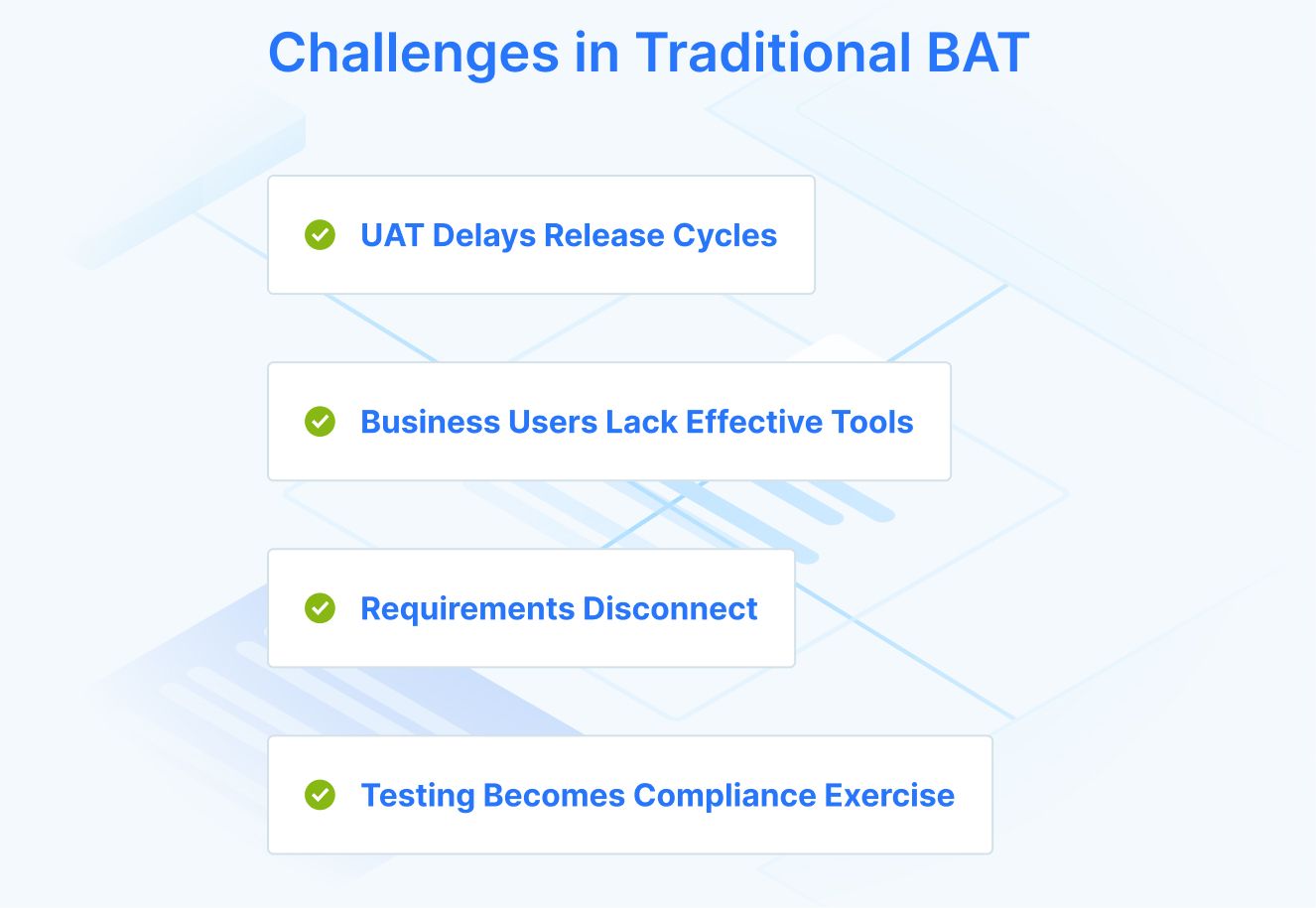
Business acceptance testing exists to validate software meets business requirements and delivers intended value before production release. In practice, UAT represents the most problematic phase of enterprise software delivery, creating delays, requiring extensive manual effort, and frequently failing to catch critical requirement gaps.
1. UAT Delays Release Cycles
Traditional business acceptance testing occurs late in development after technical teams complete features. Business users receive unfamiliar systems requiring extensive learning, execute time-consuming manual testing procedures, and discover requirement mismatches only when fixing them proves expensive. UAT phases extend weeks or months, delaying business value realization and frustrating stakeholders expecting faster delivery.
2. Business Users Lack Effective Tools
Technical teams build automation using Selenium, Cucumber, or commercial tools requiring programming expertise. Business users cannot create, modify, or understand these tests. During UAT, business teams resort to manual testing using Excel spreadsheets, Word documents, and email coordination because automation remains inaccessible. The testing approach intended to validate business requirements excludes business participation.
3. Requirements Disconnect
Business requirements expressed in documents, user stories, or verbal discussions rarely translate accurately to technical implementations. Traditional development approaches build features based on technical interpretations of requirements, validate against technical specifications, then present completed systems to business users for acceptance. Requirement mismatches discovered during UAT require expensive rework because developers have moved to new features and system architecture choices limit modification options.
4. Testing Becomes Compliance Exercise
When UAT requires weeks of manual effort validating hundreds of scenarios, teams optimize for appearance of thoroughness rather than actual validation effectiveness. Checkbox testing replaces meaningful acceptance validation. Business users execute perfunctory tests to meet compliance requirements without genuine confidence software delivers expected value.
True business acceptance testing requires fundamentally different approaches enabling business participation from project start, automating validation without technical barriers, and ensuring continuous alignment between requirements and implementation.
Natural Language Testing: Enabling Business Participation
The Technical Barrier Problem
Traditional test automation requires programming knowledge using languages like Java, Python, or JavaScript, understanding of testing frameworks like Selenium or Cucumber with technical syntax, and familiarity with development tools, version control, and continuous integration. These technical requirements exclude business users from creating or modifying automated tests despite business users understanding requirements better than technical teams.
The disconnect creates problems throughout project lifecycles. Business users describe requirements using business terminology. Technical teams interpret requirements into technical specifications. Developers implement based on their understanding. Testers validate against technical specifications. Only during UAT do business users finally see results, discovering interpretations diverged from intentions. Late discovery of requirement gaps causes expensive rework.
Natural Language Programming for Business Testing
Natural Language Programming eliminates technical barriers by enabling business users to describe test scenarios using plain English that AI systems translate into executable automation. Instead of programming test steps in technical syntax, business users write descriptions like: "Validate that premium customers placing orders above $10,000 receive automatic approval while standard customers require manager authorization."
AI interprets business intent, identifies relevant system interactions, generates test steps validating described behavior, and executes comprehensive validation without requiring technical implementation knowledge from business users. The business user never sees technical code, element locators, or programming constructs. Testing remains in business language throughout creation, execution, and reporting.
Business-Readable Test Journeys
Tests created using Natural Language Programming remain readable by business users who created them and other business stakeholders validating requirements. Traditional automation produces technical code incomprehensible to business users. Natural Language tests document requirements as executable validation that business teams review, modify, and trust.
This readability transforms testing from technical activity into business collaboration. Business analysts write acceptance criteria as Natural Language tests during requirements definition. Business users review test scenarios confirming they match intended behavior. When questions arise about system behavior, teams reference business-readable tests showing exactly what system does rather than interpreting technical specifications or code.
Composable Acceptance Testing: Pre-Built Business Validation
The Rebuild Problem
Traditional projects rebuild test automation from scratch for common business processes despite processes remaining fundamentally similar across implementations. Every ERP implementation tests order-to-cash, procure-to-pay, record-to-report. Every CRM implementation tests lead-to-opportunity, opportunity-to-quote, quote-to-cash. Every HCM implementation tests hire-to-retire, time-to-pay, learn-to-perform.
Organizations spend 1,000+ hours building basic process automation that hundreds of other organizations already built for identical processes. This rebuild approach wastes resources, delays projects, and creates inconsistent validation quality. Most critically, automation doesn't exist during early project phases when business acceptance testing provides maximum value identifying requirement gaps before expensive implementation work.
Pre-Built Process Automation
Composable testing provides pre-built, proven automation for common enterprise business processes. Organizations implementing SAP, Oracle, Dynamics 365, Workday, ServiceNow, or Salesforce import comprehensive test libraries covering standard processes, configure for specific implementations with 30% customization effort, and deploy complete business acceptance testing from project start rather than months later after building automation.
Business acceptance testing begins immediately during requirements and design phases rather than waiting for custom automation development.
Reusable Across Testing Phases
Composable tests serve multiple purposes throughout project lifecycles: Requirements validation during design phase ensuring business processes match intended workflows. System integration testing validating technical implementations before business involvement. Regression testing ensuring changes don't break previously validated functionality. User acceptance testing providing business users automated validation they configure and execute. Operational assurance post-release confirming production systems maintain validated behavior.
Single test investment delivers value across all testing phases and continues providing value post-implementation through ongoing regression and operational validation.
Accelerating UAT Through Shift-Left Testing
Traditional Late-Stage UAT Problems
Traditional approaches defer business acceptance testing until technical teams complete development. Business users receive finished systems months after requirements definition, discover requirement mismatches when fixing them proves expensive, execute time-consuming manual testing learning unfamiliar systems, and provide feedback causing rework and delays.
This sequential approach creates adversarial dynamics. Technical teams view UAT as business users finding problems with perfectly good implementations. Business users view UAT as discovering technical teams built wrong things. Projects enter UAT phases with business stakeholders skeptical and technical teams defensive. Requirement mismatches discovered late create finger-pointing about whether requirements were clear or implementations were correct.
Continuous Business Validation
Shift-left business acceptance testing begins during requirements definition, continues throughout development, and ensures continuous alignment between business expectations and technical implementations. Business users create Natural Language acceptance tests from requirements before code exists. Developers reference business-readable tests understanding exactly what behavior business expects. Tests execute immediately when features ship validating alignment with business requirements.
This continuous validation approach prevents requirement mismatches rather than discovering them late. When business expectations diverge from implementations, teams identify gaps immediately while context remains fresh and corrections prove inexpensive. Business users maintain continuous visibility into what's being built through business-readable tests executing regularly. Final UAT becomes confirmation rather than discovery because continuous validation already established business acceptance throughout development.
Organizations implementing shift-left business acceptance testing accelerate UAT and project delivery by identifying requirement gaps early, reducing late-stage rework, maintaining business stakeholder confidence, and enabling faster production releases.
Enterprise System Acceptance Testing
ERP Implementation Challenges
Enterprise resource planning implementations represent massive business acceptance testing challenges. Systems like SAP S/4HANA, Oracle Cloud, or Microsoft Dynamics 365 require validating thousands of business processes across finance, procurement, inventory, manufacturing, sales, and human resources. Traditional approaches require years to build comprehensive test automation, delaying implementation value and creating ongoing maintenance burdens.
ERP implementations using composable testing import comprehensive pre-built test libraries covering standard processes like financial period close, purchase requisition to payment, sales order to cash, manufacturing order to delivery, inventory management and transfers, and asset acquisition to retirement. Organizations customize for specific business rules, integrate with legacy systems, and validate industry-specific extensions while leveraging proven automation for core processes.
SaaS and Cloud Platform Validation
Software-as-a-Service and cloud platform implementations present unique business acceptance challenges. Systems receive frequent updates from vendors that potentially change functionality, break customizations, or alter business processes. Traditional approaches rebuild test automation for each implementation then face ongoing maintenance as vendors release updates.
Composable testing for SaaS platforms provides vendor-maintained test libraries covering standard platform functionality that vendors update when platforms change. Organizations add customization testing and integration validation while leveraging vendor-maintained automation for core features. Testing stays current with platform evolution without manual test maintenance.
Organizations implementing Salesforce, ServiceNow, Workday, or other cloud platforms using composable testing achieve Day 1 comprehensive coverage impossible when building custom automation, maintain test currency through platform updates automatically, and focus testing resources on business-specific customizations rather than rebuilding standard functionality validation.
Implementing Business Acceptance Testing Strategy
1. Requirements-Based Test Design
Effective business acceptance testing begins with requirements. Business analysts, product owners, and business stakeholders define acceptance criteria using business language. Using Natural Language Programming, acceptance criteria become executable tests immediately. Requirements stating "System must prevent duplicate orders using customer account and order date" become tests validating exactly that behavior using business scenarios.
This requirements-to-test translation eliminates interpretation gaps. Business stakeholders reviewing test scenarios immediately identify whether tests match intentions. Requirement gaps surface during requirements phase rather than UAT phase. When requirements prove ambiguous, attempting to create executable tests forces clarification before development begins.
Virtuoso QA's GENerator capability accelerates this process by converting requirements documents, BDD specifications, Visio diagrams, or user stories into drafted test journeys automatically. Business teams review AI-generated tests, refine as needed, and establish executable acceptance criteria before technical implementation begins.
2. Stakeholder Involvement Strategy
Business acceptance testing requires active participation from diverse stakeholders, not passive recipients of finished systems. Product owners define acceptance criteria as Natural Language tests during requirements. Business process owners validate test scenarios match actual business workflows. End users execute tests in their own language confirming systems support real work. Compliance officers create regulatory requirement validation using business terminology.
This broad participation requires tools business users actually use. Technical automation platforms requiring programming knowledge exclude business participation regardless of stated intentions. Natural Language Programming enables genuine business involvement because tests remain in business language throughout creation, execution, and analysis.
Organizations achieve effective stakeholder involvement by training business users on Natural Language test creation requiring 8-10 hours rather than weeks for programming, establishing clear ownership where business teams create and maintain acceptance tests, integrating testing with requirements and design processes rather than treating as separate phase, and celebrating business contributions to testing as valuable project participation.
3. Continuous vs Phase-Gate Testing
Traditional projects use phase-gate approaches where business acceptance testing occurs after development completion. Modern approaches use continuous business validation where tests execute throughout development providing ongoing feedback. Continuous approaches prove superior by identifying issues early when corrections prove inexpensive, maintaining business stakeholder confidence through visibility, reducing late-stage surprises and rework, and accelerating overall project delivery.
Implementing continuous business acceptance testing requires automated test execution in development and test environments, business-readable reporting enabling stakeholders to understand results without technical interpretation, notification mechanisms alerting business users to test failures requiring attention, and cultural changes treating business acceptance testing as ongoing collaboration rather than phase-gate approval.
The Business Acceptance Testing Imperative
Business acceptance testing determines whether software investments deliver expected value. Traditional approaches defer validation until late stages, require extensive manual effort, and frequently discover requirement mismatches when corrections prove expensive. Organizations implementing AI-native business acceptance testing using Natural Language Programming achieve 87% faster test creation enabling business users to participate directly, 90% maintenance reduction sustaining automation without technical burden, and highly reusable tests serving multiple purposes across project lifecycles.
More importantly, modern BAT approaches prevent requirement mismatches rather than discovering them late, accelerate project delivery through continuous validation, and provide business stakeholders confidence software delivers intended value before production release.
The gap between organizations enabling genuine business participation in testing and those maintaining technical-only automation widens daily. Business users cannot participate in traditional automation regardless of intentions. Manual UAT cannot provide comprehensive validation. Late-stage testing cannot prevent expensive rework.
True business acceptance testing requires tools business stakeholders actually use, automation beginning from requirements rather than after development, and intelligent systems eliminating maintenance preventing sustainable automation. The question is whether your organization will lead or follow this transformation.
Experience AI-Native Business Acceptance Testing
Virtuoso QA enables genuine business acceptance testing through Natural Language Programming, composable test libraries, and intelligent automation eliminating technical barriers. Our customers achieve 87% faster test creation with business users creating validation without coding expertise, 90% maintenance reduction through AI self-healing, and highly reusable tests across system integration, regression, and user acceptance phases.
Ready to transform business acceptance testing?
Request a demo to see how Natural Language Programming enables business users to create automated validation, composable testing accelerates enterprise system implementations, and AI-native testing delivers comprehensive business acceptance impossible with traditional approaches.
Explore composable testing to understand how pre-built test libraries for SAP, Dynamics 365, Salesforce, and other enterprise systems enable Day 1 comprehensive coverage reducing implementation timelines from months to weeks.

Frequently Asked Questions About Business Acceptance Testing
How does business acceptance testing differ from UAT?
Who participates in business acceptance testing?
When should business acceptance testing begin?
What are composable tests in BAT?
How do you measure BAT effectiveness?