Blog
5 Software Testing Life Cycle Phases Explained - Modern STLC & Shift-Left Guide

Rishabh Kumar
Published on

Table of contents
Lorem ipsum
Lorem ipsum
Lorem ipsum
Lorem ipsum
Lorem ipsum
Software testing lifecycle phases define when quality validation takes place throughout the Software Development Lifecycle (SDLC). Traditional approaches isolated testing at the end of development creating bottlenecks, delayed feedback, and expensive defect remediation. Organizations waiting until system testing or UAT to begin validation discover defects costing 15x more to fix than issues identified during requirements.
Modern testing strategies integrate validation throughout every SDLC phase using shift-left methodologies and continuous testing. Organizations testing from requirements before code exists achieve 84% first-run success rates and accelerate UAT delivery. AI-native test platforms enable truly in-sprint automation where tests creation happens simultaneously with development rather than lagging behind.
This comprehensive guide explains traditional testing phases, modern shift-left approaches, and AI-native methodologies transforming how organizations integrate testing throughout development. You will learn when each testing phase executes, what validation occurs at each stage, and how intelligent automation accelerates quality validation enabling continuous deployment.
Understanding the Software Testing Life Cycle (STLC) Phases in SDLC
Software Development Lifecycle testing encompasses all quality validation activities from requirements through production deployment. Effective SDLC testing embeds quality verification at every stage rather than treating testing as isolated phase after development completes.
Traditional Waterfall Testing Phases
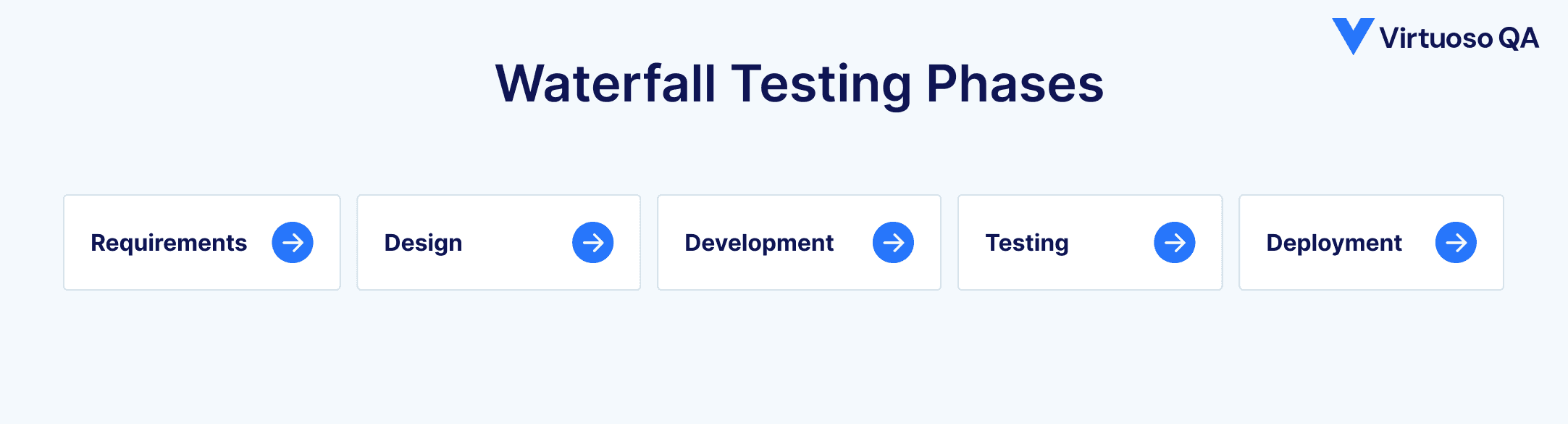
Waterfall methodology follows sequential phases where testing occurs after development finishes:
Requirements → Design → Development → Testing → Deployment
This approach created fundamental problems:
Late Feedback: Developers learn about defects weeks after writing code, losing context
Expensive Remediation: Defects discovered late cost 15x more fixing than early detection
Testing Bottleneck: All validation compressed into single phase delaying releases
Limited Coverage: Time constraints force incomplete testing before deadlines
Testing Phase Concentration: Waterfall concentrated all testing into a dedicated phase following development. QA teams received complete applications then spent weeks executing test cases discovering defects requiring extensive rework.
Modern Agile and DevOps Testing Integration
Agile testing methodologies integrate testing throughout two-week sprints. Rather than isolated testing phases, validation occurs continuously as features develop.
Sprint Pattern:
Week 1: Requirements definition, design, development begins, test design starts
Week 2: Development completes, automated tests execute, defects fixed, features deployed
DevOps extends Agile with continuous integration and continuous deployment (CI/CD). Automated testing executes with every code commit providing sub-hour feedback enabling multiple daily releases.
Continuous Testing Characteristics:
Automated validation triggers on code changes
Parallel test execution provides rapid feedback
In-sprint automation keeps testing synchronized with development
Production monitoring validates real user experiences
Organizations adopting continuous testing reduce release cycles from months to days while improving quality through immediate defect detection and correction.
The Five Core Software Testing Life Cycle Phases
Modern software testing organizes into five distinct phases, each validating different aspects of application quality. Understanding when and how each phase executes enables comprehensive validation without duplication or gaps.

Phase 1: Unit Testing (Component Level)
Unit testing validates individual code units (functions, methods, classes) in isolation. Developers write unit tests alongside production code verifying logic correctness before integration.
What Unit Testing Validates:
Individual function inputs produce expected outputs
Edge cases handle boundary conditions correctly
Error conditions raise appropriate exceptions
Logic branches execute through all code paths
Who Performs Unit Testing
Developers write and execute unit tests as part of coding workflow. Unit tests run automatically before committing code changes.
When Unit Testing Occurs
Continuously during development. Developers execute unit tests locally before pushing code. CI pipelines run complete unit test suites on every commit.
Coverage Targets
Organizations target 70-90% code coverage for business logic. Higher coverage provides diminishing returns while requiring exponential effort.
Unit Testing Limitations
Unit tests validate isolated components but cannot detect integration issues, UI problems, or end-to-end workflow failures. Additional testing phases remain essential.
Phase 2: Integration Testing (System Integration)
Integration testing validates that separately developed components communicate correctly when combined. This phase identifies interface mismatches, data format incompatibilities, and interaction failures.
What Integration Testing Validates:
Components exchange data correctly through defined interfaces
API contracts remain stable between services
Database interactions execute proper transactions
External system integrations handle expected and error scenarios
Integration Testing Levels:
Component Integration: Validates groups of related components working together (authentication module, payment processing, reporting services)
System Integration: Validates complete application connecting with external systems (payment gateways, third-party APIs, databases, messaging systems)
Enterprise Integration: Validates multiple applications interacting within enterprise ecosystem (ERP connecting with CRM, supply chain systems, financial applications)
Who Performs Integration Testing
QA engineers, automation engineers, and sometimes developers for lower-level component integration.
When Integration Testing Occurs
After unit testing passes and components integrate into larger subsystems. Continuous in Agile environments as features complete throughout sprints.
Virtuoso QA Advantage
Business Process Orchestration unifies UI actions, API validations, and database checks within single test journeys. Organizations validate complete integration workflows without maintaining separate toolchains: "Submit order via UI, verify API creates transaction, confirm database inventory updates, validate notification sent."
Phase 3: System Testing (End-to-End Validation)
System testing validates complete applications against requirements ensuring all functionality works correctly together. This comprehensive phase tests entire systems as users will experience them.
What System Testing Validates:
All functional requirements implemented correctly
Non-functional requirements met (performance, security, usability)
Complete user workflows execute end to end
Application behavior matches specifications under various conditions
System Testing Types:
Functional Testing: Validates features work according to specifications
Performance Testing: Confirms application handles expected load and response times
Security Testing: Verifies protection against vulnerabilities and unauthorized access
Usability Testing: Ensures interfaces provide intuitive, efficient user experiences
Compatibility Testing: Validates operation across browsers, devices, operating systems
Who Performs System Testing
QA teams execute system testing using detailed test cases and automated test suites. Business analysts may participate validating business logic.
When System Testing Occurs
After integration testing confirms components interact correctly. In Agile environments, system testing occurs within sprints as features complete.
Testing Environment
Dedicated testing or staging environments mirroring production configurations without affecting live users.
System Testing Duration
Traditional approaches required 2-4 weeks for comprehensive system testing. Modern AI-native automation reduces this to 2-4 days through parallel execution and intelligent validation.
Virtuoso QA Impact
Organizations automate 6,000 journeys reducing system testing from 475 person days to 4.5 days. Natural Language Programming enables business analysts participating in system test creation without coding expertise.
Phase 4: User Acceptance Testing (Business Validation)
User Acceptance Testing (UAT) validates applications meet business needs and user expectations. Business stakeholders execute realistic scenarios confirming systems deliver intended business value before production release.
What UAT Validates:
Business processes execute correctly supporting operational workflows
System delivers specified business value solving identified problems
Users can accomplish tasks efficiently without extensive training
Application integrates appropriately with existing business operations
UAT Participants:
Business users who will operate systems daily
Business analysts representing user perspectives
Subject matter experts validating domain-specific logic
Key stakeholders approving production release
UAT Scenarios
Real-world business workflows users execute regularly rather than technical test cases. Examples: processing customer orders, generating financial reports, managing employee records, handling customer service requests.
UAT Duration
Traditional UAT consumed 2-6 weeks as business users learned systems while validating functionality. Limited business user availability extended timelines further.
Accelerating UAT
Business-readable automation created during system testing enables UAT reuse. Rather than manual re-execution, business users review automated test results confirming scenarios represent actual workflows. Organizations accelerate UAT from weeks to days through intelligent reuse.
Virtuoso QA Advantage
Natural Language Programming creates business-readable test journeys business users understand without technical translation. Codeless tests enable business analysts authoring UAT scenarios directly. Organizations leverage Composable Testing libraries for UAT and operational assurance post-release.
Phase 5: Regression Testing (Ongoing Validation)
Regression testing validates existing functionality continues working after code changes. Every new feature, bug fix, or refactoring risks breaking previously working capabilities. Comprehensive regression suites provide safety nets enabling confident frequent releases.
What Regression Testing Validates:
New changes do not introduce defects in existing functionality
Bug fixes resolve issues without creating new problems
Refactoring maintains identical external behavior
Application stability remains consistent through continuous changes
When Regression Testing Occurs:
After every code change in continuous integration environments
Before every release in traditional methodologies
Nightly automated execution validating daily development
On-demand when significant changes require validation
Regression Testing Challenges:
Test Suite Growth: Regression suites expand continuously as applications evolve, eventually requiring days for complete execution
Maintenance Burden: Traditional automation breaks with every UI change, forcing teams into perpetual test repair consuming 80% of capacity
Execution Time: Comprehensive regression testing 2,000 manual test cases requires 11.6 days with single testers, creating unacceptable bottlenecks
AI-Native Solutions
Virtuoso QA transforms regression economics through 95% self-healing accuracy and parallel cloud execution. Organizations reduce regression cycles from 475 person days to 4.5 days. Insurance enterprises execute 100,000 annual regression tests via CI/CD without human intervention. Tests automatically adapt to application changes maintaining comprehensive coverage without maintenance burden.
Shift-Left Testing: Moving Quality Earlier in SDLC
Shift-left testing moves quality validation progressively earlier in development lifecycles. Rather than waiting until system testing or UAT to discover defects, organizations identify issues during requirements, design, and development when fixes cost exponentially less.
The Economic Case for Shift-Left
Defect remediation costs increase exponentially as defects progress through SDLC phases:
Requirements Phase: $100 per defect (simple specification corrections)
Design Phase: $500 per defect (design modifications before implementation)
Development Phase: $1,500 per defect (code changes within development context)
Testing Phase: $5,000 per defect (code changes after context lost plus retesting)
Production Phase: $15,000 per defect (emergency fixes plus customer impact plus reputation damage)
Organizations discovering 100 defects in production spend $1.5M on remediation. The same 100 defects found during requirements cost $10K fixing. Shift-left testing delivers 150x ROI through early detection.
Testing from Requirements (Shift-Leftmost)
The ultimate shift-left approach validates requirements before code exists. Organizations create test automation from specifications, wireframes, or user stories then execute tests as development progresses.
Design-Led QA: Start testing from Figma designs, Jira requirements, or visual diagrams. AI-native platforms analyze design artifacts generating test scenarios validating specified behaviors before implementation completes.
Requirements Validation Benefits:
Identifies ambiguous or contradictory specifications immediately
Provides executable acceptance criteria developers implement against
Creates test automation ready for execution when code completes
Eliminates wait time between development completion and test readiness
Virtuoso QA GENerator: Delivers instant test authoring from requirements with no scripting. Analyzes requirements, user stories, or design documents generating comprehensive test scenarios using Natural Language Programming. Organizations shift testing fully left before development begins.
In-Sprint Automation (True Agile Testing)
In-sprint automation creates automated tests within the same sprint developing features. This approach eliminates automation lag where development races ahead while test automation struggles catching up.
Traditional Problem: Development completes sprint 5. Test automation finally catches up validating sprint 3 features. Defects discovered now cost exponentially more than immediate detection.
In-Sprint Solution: Automated tests created simultaneously with feature development provide immediate validation. Defects discovered within sprint context enable instant correction before developers lose context.
Enabling In-Sprint Automation:
Natural Language Programming eliminates coding bottlenecks enabling rapid test creation
Autonomous test generation analyzes applications creating scenarios automatically
Self-healing eliminates maintenance allowing focus on new automation
Codeless approaches empower business analysts and manual testers expanding automation capacity
Virtuoso QA Results: 10x speed gain drives shift-left with truly in-sprint automation. Organizations create tests 85-93% faster enabling test creation keeping pace with development velocity.
Continuous Testing in CI/CD Pipelines
Continuous testing integrates automated validation executing with every code commit. CI/CD pipelines trigger test execution automatically providing sub-hour feedback enabling multiple daily releases.
CI/CD Testing Stages:
Commit Stage (5-10 minutes): Unit tests and smoke tests validating basic functionality before code merges
Acceptance Stage (20-40 minutes): Comprehensive functional testing validating features work correctly
Deployment Verification (10-20 minutes): Post-deployment validation confirming production releases succeeded
Continuous Testing Benefits:
Immediate feedback on code quality before context loss
Automated quality gates preventing defective code reaching production
Confidence enabling frequent releases without quality compromise
Parallel execution across hundreds of configurations validating compatibility
Virtuoso QA Integration: Direct connections with Jenkins, Azure DevOps, GitHub Actions, GitLab, CircleCI, Bamboo enable seamless CI/CD integration. Organizations execute 100,000+ annual tests via automated pipelines. Failures generate detailed AI Root Cause Analysis with screenshots, logs, and remediation suggestions accelerating issue resolution.
Modern Testing Phase Integration Strategies
Contemporary organizations blend traditional testing phases with shift-left approaches creating comprehensive validation strategies optimizing quality, speed, and cost.
1. Parallel Testing Phase Execution
Rather than sequential phase execution where integration waits for unit testing completion, modern approaches execute phases in parallel when practical.
Parallel Execution Patterns:
Unit + Integration: Developers execute unit tests locally while CI pipelines run integration test suites against recent builds
System + UAT Preparation: QA teams execute system testing while business analysts prepare UAT scenarios reviewing test coverage
Regression + Feature Testing: Nightly regression suites validate existing functionality while sprint testing validates new features
Benefits: Parallel execution reduces overall testing time from weeks to days. Organizations complete validation faster without compromising coverage or quality.
2. Risk-Based Testing Phase Prioritization
Not all functionality requires identical validation depth. Risk-based strategies allocate testing effort proportional to business impact and technical complexity.
Risk Assessment Criteria:
Business Criticality: Revenue impact, regulatory requirements, customer satisfaction
Technical Complexity: Integration points, algorithm sophistication, technology novelty
Change Frequency: Stable features require lighter regression than rapidly evolving capabilities
Historical Defects: Components with defect history warrant additional validation
Phase Prioritization:
High Risk Features: Comprehensive validation through all phases with manual exploratory testing
Medium Risk Features: Standard phase validation with automated coverage
Low Risk Features: Targeted validation focusing on critical workflows with sampling
Organizations implementing risk-based prioritization achieve better quality outcomes with lower testing costs compared to uniform validation approaches.
3. Test Automation Throughout SDLC Phases
Automation accelerates validation across all testing phases, not just regression testing. Strategic automation investment throughout SDLC multiplies testing efficiency.
Unit Testing Automation: Already standard practice with xUnit frameworks
Integration Testing Automation: API testing tools (Postman, REST Assured) or unified platforms like Virtuoso QA combining UI, API, and database validation
System Testing Automation: Comprehensive UI automation with intelligent self-healing eliminating maintenance burden
UAT Automation Support: Business-readable tests enable UAT reuse and operational assurance
Regression Testing Automation: Complete coverage executing continuously through CI/CD pipelines
Virtuoso QA Unified Approach: Single platform automates across all testing phases eliminating tool fragmentation. Organizations reduce effort 94% through composable reusability applying automation from system testing through UAT and operational assurance.
AI-Native Testing Phase Transformation
Artificial intelligence fundamentally transforms how testing integrates throughout SDLC phases. AI-native methodologies achieve comprehensive validation impossible through manual or traditional automated approaches.
1. Autonomous Test Generation from Requirements
AI platforms analyze requirements, wireframes, or design documents automatically generating comprehensive test scenarios validating specifications before implementation.
Generation Capabilities:
Interpret user stories and acceptance criteria creating validat validation scenarios
Analyze Figma designs or mockups generating UI test automation
Process business process diagrams creating end-to-end workflow tests
Generate edge cases and negative scenarios from requirement analysis
Virtuoso QA GENerator: Delivers instant test authoring, legacy conversion (lifting old scripts to Virtuoso), intent-based test flows mapping to real user behavior, and design-led QA starting testing from Figma or Jira before code exists.
2. Intelligent Self-Healing Across Phases
Self-healing automation adapts tests automatically through application changes eliminating maintenance burden across all testing phases.
Traditional Maintenance Problem: Application changes break tests across unit, integration, system, UAT, and regression phases. Teams spend 80% capacity repairing tests rather than expanding coverage or validating new functionality.
AI-Native Solution: 95% self-healing accuracy automatically updates tests adapting to UI changes, API modifications, and workflow evolutions. Maintenance burden drops 88% freeing capacity for strategic validation.
Phase-Specific Self-Healing:
Integration Testing: Automatically adapts to API contract changes maintaining validation coverage
System Testing: Updates UI interactions through interface changes without manual intervention
UAT Testing: Maintains business-readable scenarios through application evolution
Regression Testing: Keeps comprehensive suites current without perpetual maintenance
3. Continuous Quality Intelligence
AI platforms analyze test execution patterns providing intelligent insights optimizing testing strategies across SDLC phases.
Intelligence Capabilities:
Defect Pattern Recognition: Identify code areas prone to defects warranting additional validation
Test Optimization: Suggest test consolidation opportunities and redundancy elimination
Coverage Analysis: Highlight validation gaps requiring additional test scenarios
Execution Optimization: Prioritize test execution based on change analysis and failure probability
AI Root Cause Analysis: Automatically diagnoses test failures with comprehensive evidence (screenshots, network logs, DOM snapshots, performance metrics) and actionable remediation suggestions. Organizations reduce debugging time 75% through intelligent failure analysis.
Transform Your Testing Phase Integration with Virtuoso QA
Testing phase strategy determines whether quality validation accelerates or bottlenecks development. Organizations integrating testing throughout SDLC through shift-left methodologies, in-sprint automation, and continuous validation achieve 10x speed improvements while improving quality through early defect detection.
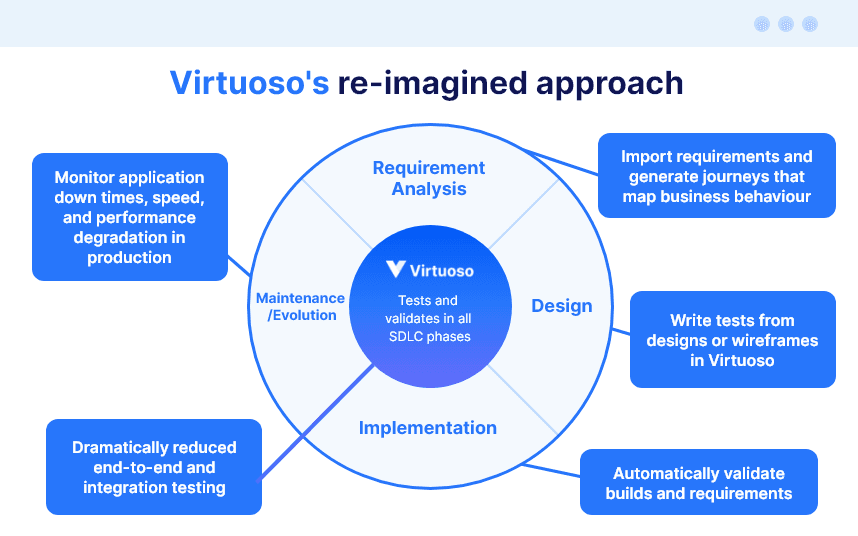
Virtuoso QA enables truly shift-left testing through autonomous generation from requirements, Natural Language Programming accelerating test creation 85-93%, and 95% self-healing eliminating maintenance burden. Organizations test from wireframes achieving 84% first-run success rates, reduce comprehensive validation from 475 days to 4.5 days, and execute 100,000+ annual regression tests via CI/CD without human intervention.
Related Reads
Frequently Asked Questions
How does testing work in Agile sprints?
What is continuous testing in DevOps?
What is in-sprint automation and how is it achieved?
How does AI enable testing from requirements?
What is Natural Language Programming for testing?
How does Live Authoring accelerate test creation?