Blog
What is Agentic AI and Why is Everybody Talking About It?

Virtuoso QA
Published on

Table of contents
Lorem ipsum
Lorem ipsum
Lorem ipsum
Lorem ipsum
Lorem ipsum
The third wave of AI is here. While Generative AI (GenAI) and machine learning were all anyone could talk about a few years ago, there’s a new kid on the block: Agentic AI. Forbes has called it a ‘breakthrough for business and tech,’ while IBM describes it as ‘the next big thing in AI research.’ This new technology is undoubtedly causing a stir.
But what is Agentic AI, and why is it creating such a buzz in the tech world? Let’s dive in.
What is Agentic AI?
While every new tech advancement generates its fair share of hype, Agentic AI is being hailed as the third wave of AI technology. By now, we are all very well-acquainted with AI; it’s part of our everyday interactions with technology.
From ChatGPT helping draft emails in offices around the world to businesses leveraging AI tech to increase efficiency, we have all witnessed an AI revolution that now seems second nature.
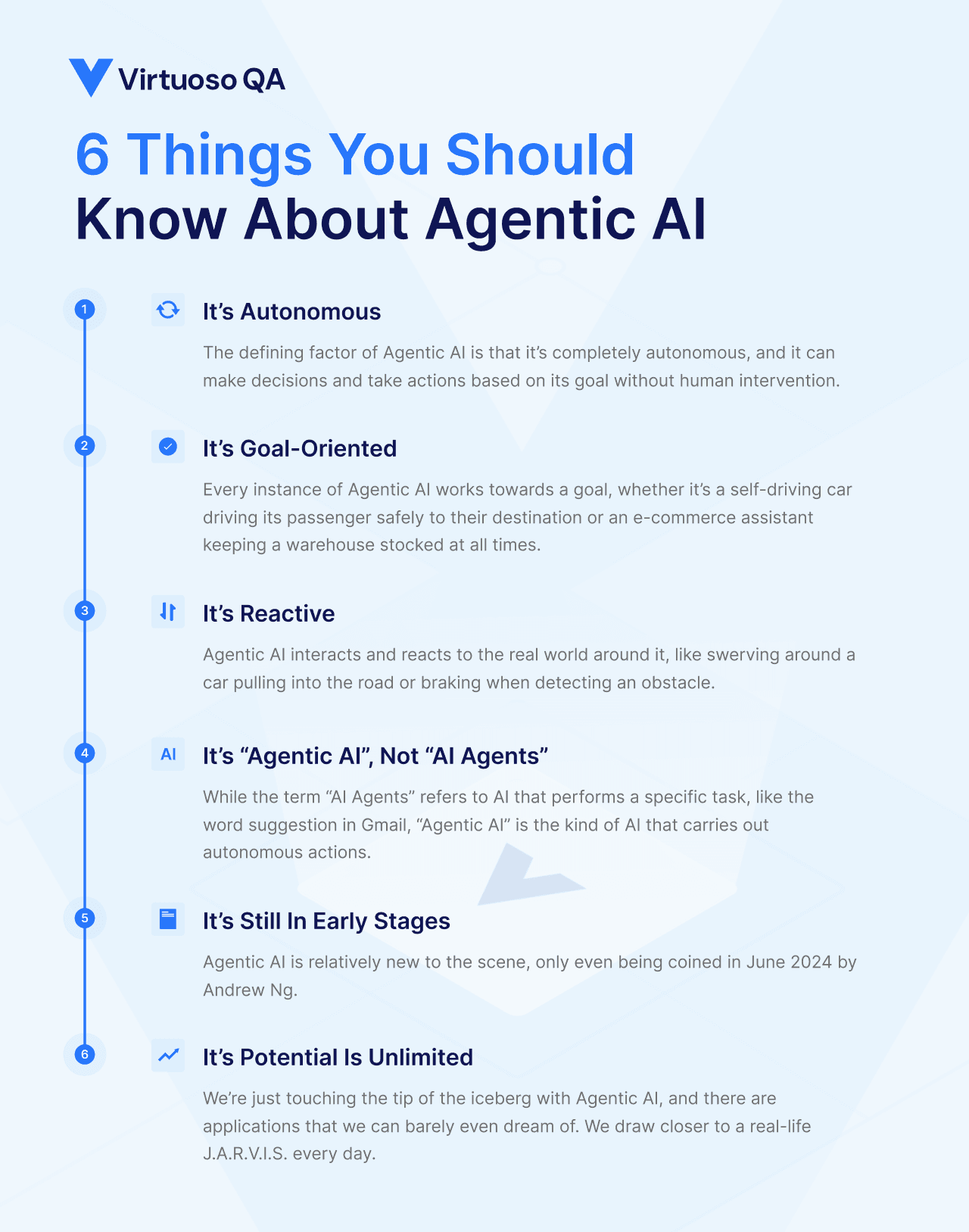
Agentic AI can execute complex tasks and workflows unlike any AI before it. It uses AI agents and harnesses the power of other AI technologies, such as generative AI and Machine Learning, to execute intricate tasks. These agents can complete complex tasks autonomously and adapt their behavior over time, continuously learning and solving problems independently.
What Makes Agentic AI Different?
Unlike its predecessors, this type of AI can act autonomously with very little human input. It can “‘think’ for itself,” so to speak.
This third wave of artificial intelligence can adapt, learn, and optimize its processes in real time without needing explicit instructions at every step. It will enable humans to interact with AI to execute incredibly complex tasks through ever simpler user interfaces and natural language instructions.
But doesn’t AI already do this? Not quite. Agentic AI is different because it has, well, agency. This ability to adapt to new tasks and make complex decisions based on real-time reasoning allows it to act almost like a human employee.
Machine learning and generative AI rely on pre-programmed data to identify patterns, complete tasks, or draw conclusions. Agentic AI’s autonomy is what sets it apart and makes it so exciting. Agentic AI can perform tasks using GenAI and ML as tools, just like a person, and deploy them to help it perform tasks that require continuous adjustments and reasoning.
To put that into context, GenAI is able to suggest places for your next getaway based on your preferences. But an Agentic AI agent goes a step further. It can plan your trip and then book it, making decisions on your behalf. This is the essential difference.
So now you know the answer to what agentic AI is, why has it got everybody talking?
Why is Everyone Talking About It?
Agentic AI’s human-like autonomy represents a paradigm shift for artificial intelligence, one that will impact just about every industry worldwide. The rapid evolution of AI has captivated the world.
Bill Gates has already predicted that in the future, we will all have an AI agent to help us work, and completely reimagine the way we live our lives. While the old debate about AI replacing humans resurfaces with each advancement, Agentic AI is likely to spark new discussions on the ethics of human intelligence versus machines as it becomes ever smarter, more autonomous, and more widely used.
But don’t run for the hills just yet.
Agentic AI integration is poised to improve efficiency, reduce costs, and make work life a lot easier with more time spent on creativity and innovation. At Virtuoso QA, we are particularly excited about how Agentic AI will further transform software testing.
AI has already made software testing faster, easier, and able to run tests at unprecedented scale. Now with its decision-making capabilities, Agentic AI can automate testing processes more efficiently than ever before, reducing errors and speeding up development cycles.
What Lies Ahead
Agentic AI will make processes faster, smarter, and more efficient, with the power to unlock industry potential almost overnight. As AI adoption continues to grow, this new era is accelerating the pace of innovation.
The future of AI will likely involve even deeper integration with human intelligence, enabling collaborative workflows where humans and AI work side by side. Far from being the stuff of science fiction, this type of autonomous, intuitive AI is now a firm reality, and its impact is only just beginning.
Take exploratory testing, for example - a software testing task that, until now, couldn’t be executed by AI, because there are no defined rules to script. It takes curiosity and adaptability to investigate a system for weaknesses nobody thought to specify. Agentic AI agents can now plan that investigation, drive a real browser, and surface what they find, and they earn trust when their work arrives as reviewable proposals, with a person approving what matters.
At Virtuoso QA, agentic AI is no longer on the roadmap. Virtuoso QA Touchstone turns your specs and tickets into runnable tests, with AI proposing, a deterministic engine executing, and a human approving every change. Take the time, stress, and cost out of software testing with Virtuoso QA's agentic software testing platform, built for faster time to market and proven ROI.
Suggested Reads
Frequently Asked Questions
How is Agentic AI different from generative AI?
How is Agentic AI different from AI agents?
What can Agentic AI do that earlier AI could not?
Will Agentic AI replace human jobs?
How does Agentic AI apply to software testing?