Blog
Salesforce Testing: From Reliable Automation to Assurance

Andrew Doughty
Published on






Table of contents
Lorem ipsum
Lorem ipsum
Lorem ipsum
Lorem ipsum
Lorem ipsum
Salesforce has always been a challenging application to automate reliably. We've seen this firsthand, having been invited into numerous competitive proof-of-value exercises where the limitations of existing automation had become a significant enough problem for customers to seek a better solution.
We've consistently demonstrated that Virtuoso QA can solve those challenges, often where other approaches have struggled.
Its dynamic interface, complex object relationships, configurable workflows, permissions, validation rules and frequent platform updates create challenges that traditional test automation tools often struggle with.
We’ve broken down where those problems come from, and how teams work around them, in our look at the most common Salesforce testing challenges.
And every Salesforce implementation is different.
Two organisations might use the same Salesforce products, but have completely different configurations, integrations, business processes and controls.
This creates two distinct challenges.
First, can you reliably automate Salesforce?
Second, do you actually know what needs to be tested to prove that Salesforce is working as intended?
We've spent years solving the first problem. With Touchstone, we're tackling the second.
We Have Already Proven the Foundation
Virtuoso QA has been automating Salesforce for years.
Some of the world's leading organisations across financial services, insurance, government, UK Critical National Infrastructure, healthcare and retail have chosen Virtuoso QA to test their enterprise applications.
Importantly, many are now in their fourth, fifth or sixth year with us.
I think that matters.
It's one thing to demonstrate that a testing tool works in a proof of concept. It's quite another to support complex enterprise applications reliably, year after year, as those applications evolve.
Virtuoso QA was built to handle the dynamic nature of modern web applications, including Salesforce. Our natural-language automation, intelligent element identification and self-maintenance capabilities help customers build and run tests without constantly rebuilding automation as the interface changes.
That robustness is the foundation on which we've built Touchstone.
But Reliable Automation Doesn't Guarantee Effective Testing
This is where I believe the industry needs to move forward.
You can have hundreds or thousands of automated Salesforce tests.
They can execute reliably.
They can all pass.
But are they testing the right things?
Do they reflect the business requirements?
Do they understand the Salesforce configuration?
Are they checking the important risks and controls?
Are the assertions sufficient to prove the expected business outcome?
And when Salesforce changes, do you know which tests need to change with it?
These are fundamentally different questions from whether a test can successfully click a button or complete a workflow.
Automation proves that a journey can run. Assurance needs to prove that the right outcome occurred.
Touchstone Understands Salesforce
Within Touchstone, we are building knowledge of Salesforce's conventions, behaviours, rules, standards and quirks.
That includes how Salesforce objects relate to one another, how permissions and sharing rules affect behaviour, how workflows and validation rules operate, and the patterns that make Salesforce implementations different from conventional web applications.
But Salesforce knowledge alone isn't enough.
Touchstone can combine that knowledge with the customer's own implementation context:
Configuration, custom objects, fields and validation rules
Flows, approval processes and business logic
User roles, permissions and security controls
Integrations with other enterprise applications
Requirements, process documentation and operating procedures
Business objectives, risk and compliance obligations
The result is something much more intelligent than an automation engine.
Touchstone brings together knowledge of how Salesforce should work, how your Salesforce implementation has been configured and what your business needs it to achieve.
That becomes the intelligence behind the testing.

Consider a Financial Services Onboarding Process
A traditional automated test might:
Create an opportunity, progress it through the sales stages, generate an approval request and confirm the record has been updated.
That's useful.
But what does it actually prove?
The business objective might be:
Only appropriately authorised customer accounts should be activated, following completion of the required checks and approvals, with accurate records maintained across connected systems.
Now we need to understand much more.
Can a user bypass a mandatory approval?
Are the correct permissions applied?
What happens when required customer information is missing?
Can an account be activated before the necessary checks are complete?
Are approval limits enforced?
Does an integration failure leave the customer in an incorrect state?
Are the right records created in downstream systems?
Is there an audit trail demonstrating what happened?
Those are the tests that matter.
And importantly, we need to test not only what should happen, but what must not happen.
Touchstone uses application knowledge, customer context and testing expertise to help determine those scenarios, design the appropriate tests and assertions, and build executable automation through its agents.
From Requirements to Evidence
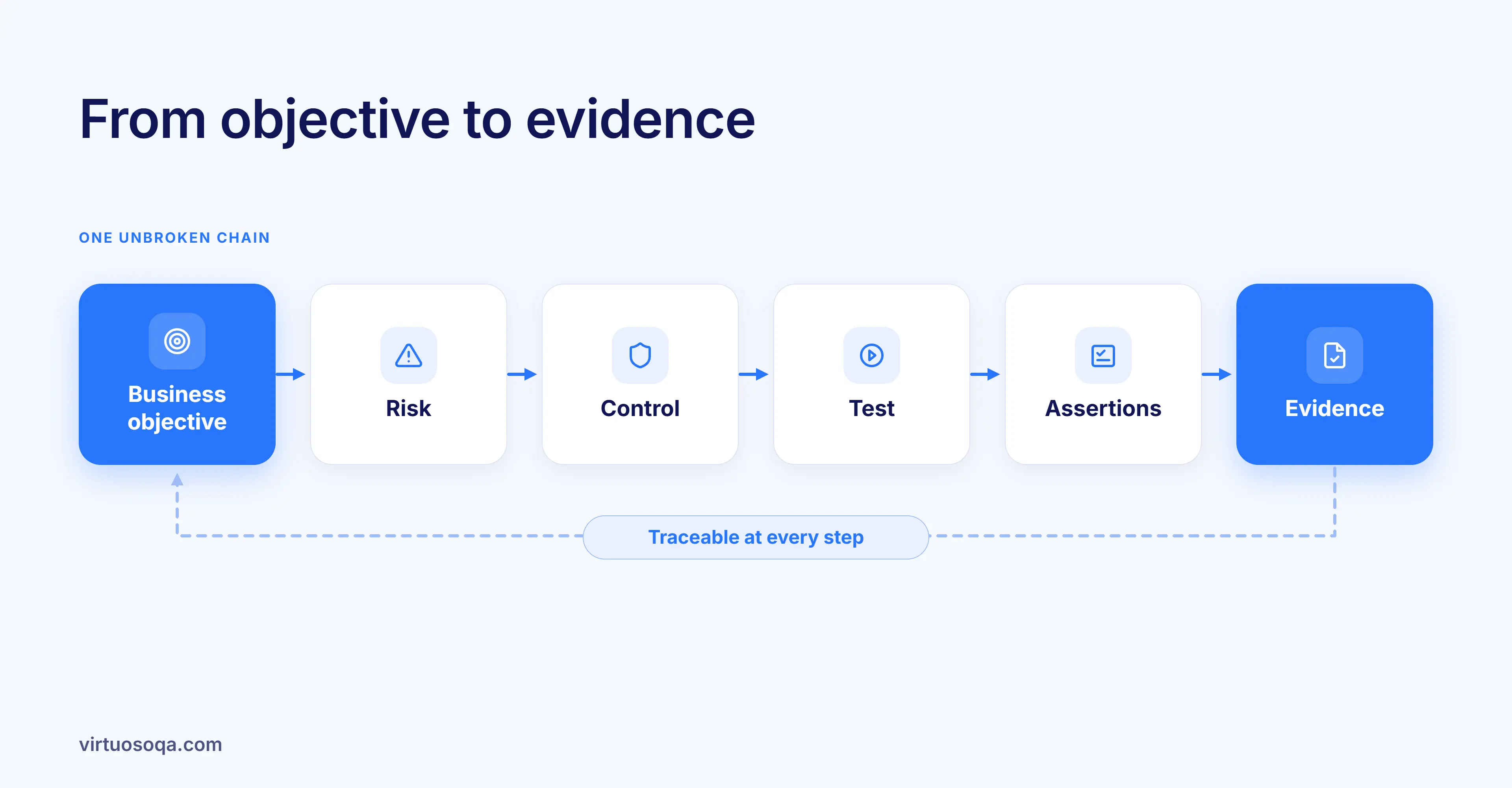
The model behind Touchstone is straightforward:
Business objective → Risk → Control → Test → Assertions → Evidence
Touchstone's agents understand the available knowledge, analyse requirements, design the testing and build the automated journeys.
Virtuoso QA provides the proven execution capability underneath.
And the results are traceable back to the original requirements, tests and assertions, providing evidence of what was verified and what happened.
As requirements and configurations change, Touchstone can help identify the implications and update the relevant testing.
That is particularly important in Salesforce, where a seemingly small change to a Flow, permission, validation rule or integration can affect multiple business processes.
Instead of relying entirely on people to work out what has changed, what might break and which tests need maintaining, we can use the knowledge and context already held within Touchstone.
The aim is to make assurance continuous, rather than rebuilding confidence after every change.
The Human Role Becomes More Important, Not Less
This is central to our thinking.
We don't believe the best use of experienced Salesforce testers and business SMEs is spending their time manually translating requirements into test scripts, fixing automation and repeating regression cycles.
Their knowledge and judgement are far more valuable than that.
People should be defining objectives, identifying risk, challenging assumptions, reviewing evidence and making decisions.
The agents should carry the repetitive work at scale.
AI proposes. Humans govern.
That is how we believe organisations can improve both the economics and the effectiveness of Salesforce testing.
Teams that want a practical checklist for putting that division of work into place will find one in our Salesforce testing best practices.
Proven Automation. Now With Intelligence.
For years, Virtuoso QA has helped enterprises solve the challenge of reliable Salesforce automation.
Touchstone builds on that foundation.
It brings together Salesforce knowledge, customer-specific context, testing expertise and agentic AI to determine what needs to be tested, build and maintain the automation, and provide traceable evidence of the outcomes.
The opportunity isn’t simply to create more automated tests or execute them faster.
It is to improve test quality, increase coverage, reduce the human effort required and provide greater confidence that critical business processes work as intended.
Salesforce knows how Salesforce should work.
Your implementation partner knows how it was configured.
You know how your business needs it to work.
Touchstone brings that knowledge together and turns it into continuously verified tests, assertions and evidence.
Related Reads
Guide on Salesforce Lightning Web Components Testing
Salesforce Test Automation - Approach and Best Practices
How to Perform Regression Testing in Salesforce
Salesforce Financial Services Cloud Testing: Automation Guide for Banking CRMs
A Guide to Salesforce UAT (User Acceptance Testing)
How to Handle Complex Element Selection in Salesforce for Effective Test Automation
" height="10.182000000000016px" id="C361dJxCp" width="11.692999999999984px"/></svg>)