Blog
Software Testing Strategies - Models, Components, Types

Rishabh Kumar
Published on

Table of contents
Lorem ipsum
Lorem ipsum
Lorem ipsum
Lorem ipsum
Lorem ipsum
Every enterprise QA team has a test strategy. Very few have one that actually works.
Plenty of automation programmes stall within a year or two, and it's rarely for lack of effort. The usual cause is a flawed test strategy that collapses under the weight of maintenance, skills gaps, and tooling that was never designed for the pace of modern software delivery.
This guide sets out what a test strategy should look like now that AI and large language models are reshaping every layer of quality engineering, from test creation and execution to maintenance and reporting.
What is a Test Strategy?
A test strategy is a high-level document that defines the overall approach, principles, scope and objectives for software testing across a project or organisation. It gives QA teams a structured framework for what to test, how to test it, and why certain approaches are chosen over others.
A test plan details the specific test cases and schedules for a given release. The test strategy sits above that. It sets the guiding approach that shapes every downstream decision, from tool selection and environment setup to risk mitigation and team structure.
A well-crafted test strategy answers four fundamental questions:
Which testing levels and types will be used?
What criteria decide when testing starts and when it ends?
How will effort be split between manual and automated testing?
How will the strategy adapt as the application and business requirements change?
Benefits of a Test Strategy
Predictable quality
Every release passes through the same verification gates. Quality stops being subjective and becomes measurable.
Efficient resource allocation
Testing effort concentrates on high-risk areas instead of spreading evenly across everything. Teams do less work but catch more defects.
Faster feedback loops
Developers learn about issues earlier in the cycle when fixes are cheap. A defect caught during development costs a fraction of one found in production.
Measurable outcomes
Coverage, defect escape rates, and cycle times give leadership visibility into whether the strategy is working or needs adjustment.
Team alignment
Developers, testers, product managers, and business stakeholders share a common understanding of what "done" means from a quality perspective.
Risk reduction
Critical business workflows receive the deepest coverage. The strategy ensures that if testing is cut short, the most important areas have already been validated.
Why Test Strategy Matters More Than Ever
The traditional test strategy was designed for a world of quarterly releases and siloed QA teams. That world no longer exists. Enterprise engineering organizations now ship code daily, sometimes hourly, across complex architectures spanning microservices, APIs, and dynamic front end frameworks.
In this environment, a static test strategy document that sits in a shared drive becomes a liability. The organizations that outperform their peers treat test strategy as a living system, one that is continuously refined based on real time data from test execution, defect analysis, and production feedback.
The stakes are high. Bugs found in production cost far more to fix than those caught during development, because by then they've reached customers, other systems and other teams' work. And teams that spend most of their QA time repairing existing tests rather than creating new ones are running on a treadmill that never reaches the finish line.
A modern test strategy addresses these realities head on.
Core Components of a Test Strategy Document
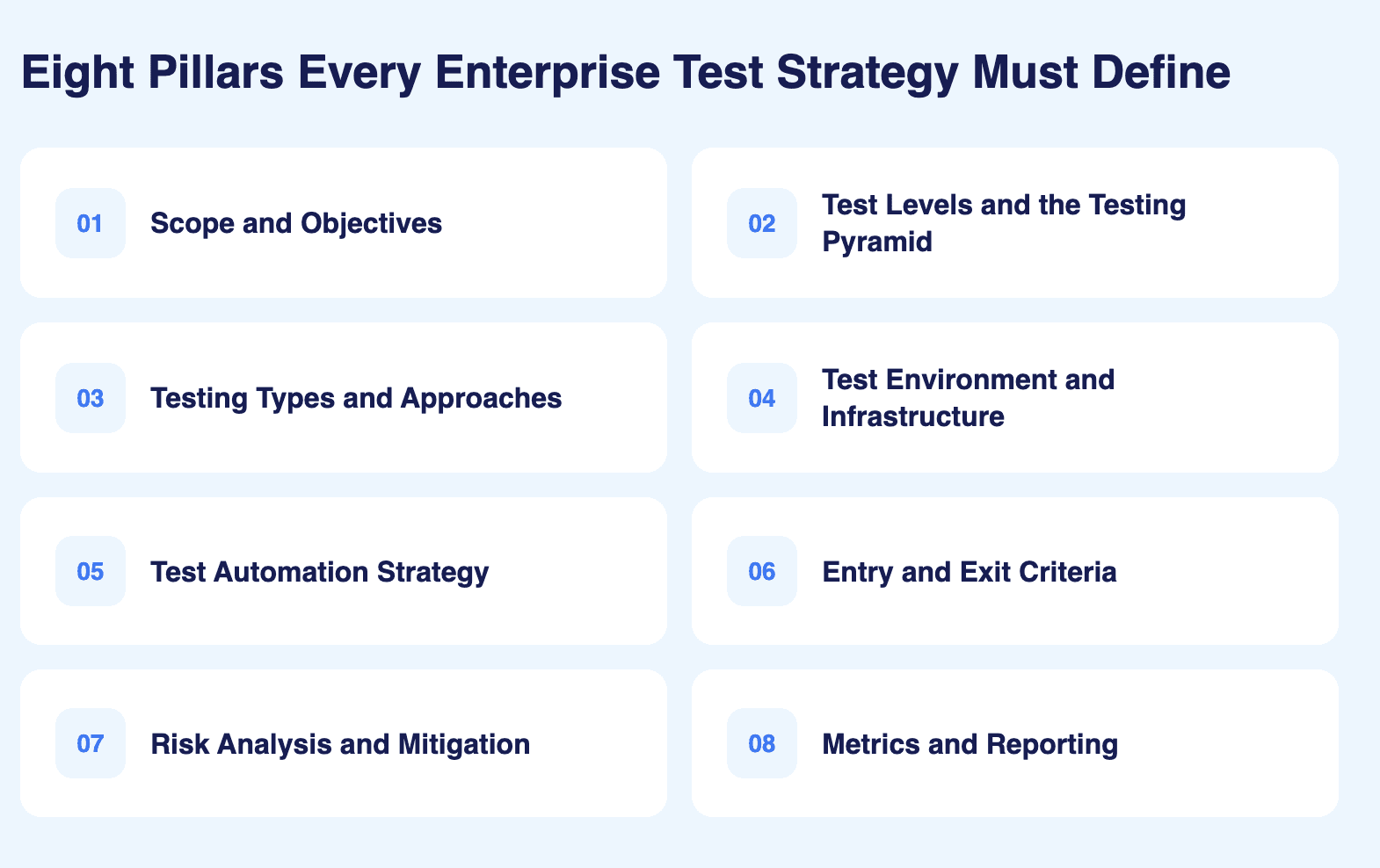
Scope and Objectives
The strategy must clearly articulate what is in scope and what is not. This includes the features, modules, and integration points that will be tested, as well as explicit exclusions. Scope definition prevents the two most common failures in enterprise QA: scope creep that dilutes coverage, and blind spots in critical functionality that go untested.
Objectives should be measurable. Vague goals like "improve quality" offer no accountability. Effective objectives specify targets such as achieving 90% automation coverage on regression suites, reducing defect leakage to production below 2%, or cutting regression cycle time by 50%.
Test Levels and the Testing Pyramid

A robust strategy defines the distribution of effort across test levels, following the testing pyramid model. Unit tests form the base, providing fast, isolated validation of individual components with the highest coverage density, typically 70% to 80% of all tests. Integration tests occupy the middle layer, verifying data flow and interactions between components. End to end tests sit at the top, validating complete user workflows across the full system stack.
The pyramid is not decorative. Enterprise teams that invert it, relying heavily on slow, brittle end to end tests while neglecting unit and integration layers, consistently struggle with long feedback cycles, flaky test suites, and unsustainable maintenance burdens.
Testing Types and Approaches
The strategy should specify which testing types apply to the project: functional testing, regression testing, integration testing, API testing, cross browser testing, accessibility testing, and exploratory testing among them. Each type serves a distinct purpose, and the strategy should explain why each is included and how it maps to project risks.
Equally important is the testing approach. Modern enterprise teams overwhelmingly operate in Agile or DevOps models, where testing is embedded throughout the development lifecycle rather than sequenced at the end. This shift left approach means test strategy must account for continuous testing within CI/CD pipelines, parallel execution across environments, and rapid feedback loops that keep pace with sprint cadences.
Test Environment and Infrastructure
Test environments should mirror production as closely as possible. The strategy must document hardware configurations, operating systems, browsers, databases, and network conditions that testing will cover.
One of the biggest challenges in modern software testing is recreating production-like environments. As applications become increasingly distributed, staging environments often drift from production, leading to tests that pass in CI but fail after deployment. This has made API and Integration testing increasingly dependent on realistic infrastructure simulation rather than isolated endpoint validation.
Newer approaches, such as production traffic replay popularized by open-source projects like Keploy, allow engineering teams to validate interactions across APIs, databases, message queues, and third-party services without manually rebuilding the entire production environment.
For enterprises testing web applications across diverse user bases, cross browser and cross device coverage is essential. Modern cloud based platforms eliminate the need to maintain physical device labs, offering scalable access to thousands of OS, browser, and device combinations on demand.
Test Automation Strategy
This is where most test strategies either succeed or collapse. The automation strategy must address three critical dimensions: what to automate (prioritizing high frequency regression scenarios and critical business workflows), how to automate (tool selection, framework architecture, and coding requirements), and how to maintain automated tests as the application evolves.
The maintenance dimension is where most automation programmes fail. Traditional script based automation, particularly with frameworks like Selenium, creates a compounding maintenance burden. Every UI change, every redesign, every new feature can break dozens or hundreds of tests. Teams then spend more time fixing tests than writing them, and the automation initiative collapses under its own weight.
This is precisely the problem that AI-native test automation was designed to solve.
Entry and Exit Criteria
Entry criteria define the conditions that must be met before testing begins: code complete status, unit tests passing, test environment configured, test data prepared. Exit criteria define when testing is complete: all test cases executed, critical defects resolved, coverage thresholds met, and test reports reviewed by stakeholders.
These criteria function as quality gates that prevent premature releases and ensure testing efforts are both thorough and efficient.
Risk Analysis and Mitigation
Every test strategy must identify risks that could derail testing efforts and define mitigation plans for each. Common risks include tight timelines with insufficient resources, technical skill gaps on the team, test environment instability, and third party dependency failures.
Risk based testing takes this further by prioritizing test coverage based on the probability and business impact of potential defects. High risk areas, such as payment processing, user authentication, and critical business workflows, receive the deepest coverage, while lower risk areas receive proportionally less attention.
Metrics and Reporting
The strategy should define the key performance indicators that will measure testing effectiveness. Essential testing metrics include test coverage (percentage of requirements or code covered by tests), defect density (defects per thousand lines of code), defect leakage (defects escaping to production), mean time to failure, and test automation ROI.
For regulated industries, add one more: requirement traceability. What share of your tests link back to a documented requirement and a named approver? When an auditor or incident review asks what was tested before a release, this is the metric that decides whether you can answer in minutes or weeks.
These metrics are not administrative overhead. They are the feedback mechanism that tells the team whether the strategy is working, and where it needs to evolve.
Testing Strategies Across the Software Development Lifecycle
Testing is not a phase that happens after development. The most effective strategies embed testing throughout the entire SDLC.
Requirements Analysis
Static testing begins here. Requirement reviews, walkthroughs, and inspections catch ambiguities and contradictions before any code is written. Defects found at this stage cost almost nothing to fix.
Design
Design reviews and prototype testing validate that the architecture supports functional and non-functional requirements. Scalability, security, and performance questions get answered at the whiteboard, not in production.
Development
Unit testing, code reviews, and test-driven development catch defects at the source. Static analysis tools flag code quality issues automatically on every commit.
Testing
Integration testing, system testing, and user acceptance testing validate the assembled system. By this point, the strategy has already been working for weeks.
Deployment
Smoke testing and targeted regression confirm the release candidate is stable. Automated pipeline gates prevent broken builds from reaching production.
Maintenance
Exploratory testing and production monitoring catch issues that scripted tests miss. Performance monitoring tracks degradation over time.
No single phase can carry the full testing burden. Strategies that overweight testing at the end create bottlenecks. Strategies that distribute testing across the SDLC produce faster, more reliable releases.
Test Strategy vs Test Plan: Understanding the Distinction
These two documents serve fundamentally different purposes, and conflating them is a common source of confusion in enterprise QA.
The test strategy is a high level, organization wide document that remains relatively stable throughout the project lifecycle. It defines the overall testing philosophy, approach, and standards. It is typically authored by the QA lead in collaboration with project managers, business analysts, and development leads.
The test plan is a detailed, project specific or sprint specific document that derives from the strategy. It specifies individual test cases, execution schedules, assigned resources, and expected results. Test plans evolve continuously throughout the testing process as new information emerges.
Think of the test strategy as the constitution and the test plan as the legislation. The strategy sets the principles. The plan operationalizes them.
Aspect | Test Strategy | Test Plan |
|---|---|---|
Level | High-level and organisation-wide | Detailed and specific to a project or sprint |
Purpose | Sets the overall approach, principles and standards for testing | Puts the strategy into practice for a specific release |
Contents | Scope, test levels, testing types, tools, environments, risks and metrics | Test cases, schedules, assigned people and expected results |
How often it changes | Stays fairly stable through the project | Changes continuously as new information comes in |
Who writes it | The QA lead, with project managers, business analysts and development leads | QA engineers and test leads working on the release |
Relationship | Comes first and guides every test plan | Is based on the strategy |
To understand the difference between a test plan and a test strategy in detail, refer - Test Plan vs Test Strategy: Key Differences, Scope, and When to Use Each
Test Strategy Models: How Organisations Structure Their Testing Approach
Analytical Strategy
Test conditions are derived from systematic analysis of requirements or risks. Requirements based testing maps test coverage directly to documented requirements. Risk based testing prioritizes coverage based on the probability and impact of potential failures.
Model Based Strategy
Testing is guided by models that represent expected system behavior, data flows, or user interactions. This approach is particularly effective for complex systems where testing all possible states manually would be impractical.
Methodical Strategy
Teams follow established standards, quality checklists, or industry specific compliance frameworks. Organizations in regulated industries such as healthcare, financial services, and insurance frequently adopt this approach to ensure consistent adherence to regulatory requirements.
Reactive Strategy
Tests are designed and executed in response to actual system behavior rather than predefined specifications. Exploratory testing is the most common expression of this strategy, where testers use their domain expertise and intuition to discover defects that structured testing might miss.
Consultative Strategy
Testing scope and priorities are driven by stakeholder input and business context rather than purely technical considerations. This approach works well when business stakeholders have deep domain knowledge about which functionality is most critical to end users.
Software Testing Strategy Types by Approach
Static Testing
Examines code, requirements, and documents without executing software. Includes peer reviews, static analysis, and linting.
Designs test cases based on internal code structure, exercising specific paths, branches, and conditions.
Validates software behaviour from the user's perspective. Techniques include equivalence partitioning, boundary value analysis, and decision table testing.
Validates that software performs intended operations correctly across features, business logic, and user workflows.
Verifies previously working features still function after code changes. Requires risk-based prioritisation and automation for stable tests.
Validates interactions between components, services, and external systems. Critical for microservices architectures.
Validates service-layer contracts, data transformations, and error handling. Executes faster than UI tests and catches backend regressions.
Validates rendering and functionality across browsers, operating systems, and devices.
Validates usability for people with disabilities. Covers screen reader compatibility, keyboard navigation, and colour contrast.
Prioritises effort based on likelihood and impact of failure. Concentrates resources on high-risk areas first.
Moves testing earlier in the development process. Includes TDD, automated checks on every commit, and tester involvement in design reviews.
Combines test design and execution in a single activity. Uses charters and time-boxes to discover defects that scripted tests miss.
Manual vs Automated Testing: When to Use Each
The decision is never "automate everything" or "keep it all manual." Context determines the right balance.
When to Automate
Regression tests that run on every build. Data-driven tests executing the same logic across hundreds of inputs. Smoke tests verifying critical paths after deployment. API tests validating service contracts. Performance tests simulating concurrent users.
When to Test Manually
Exploratory testing requiring creativity and intuition. Usability testing where human perception matters. New features still evolving with frequent changes. One-off investigations for reported bugs. Accessibility testing evaluating actual user experience.
The Hybrid Approach
Mature teams automate stable, repetitive checks in CI/CD pipelines, freeing human testers for exploratory testing, usability evaluation, and complex scenarios expensive to automate. The key metric is not percentage automated. It is whether your strategy catches the bugs that matter before users find them.
How to Build a Test Strategy Step by Step

Step 1: Define Scope and Objectives
Identify features, modules, and systems in scope. Establish measurable quality goals (90% regression pass rate, defect leakage below 2%). Identify constraints: timeline, budget, team size.
Step 2: Assess Risks and Priorities
Identify which areas carry the highest risk. Which features do users rely on most? Where has code changed recently? Which components have a defect history? Use risk assessment to guide effort allocation.
Step 3: Choose Testing Types
Based on risk assessment, select which types apply: unit testing for business logic, integration testing for service boundaries, end-to-end testing for critical journeys, performance testing for high-traffic features, security testing for authentication and payments.
Step 4: Allocate Resources and Tools
Decide which tests will be automated versus manual. Select test management, CI/CD, and automation tools. Define test data management and refresh processes. Assign roles and responsibilities.
Step 5: Create Your Test Plan
Translate the strategy into a concrete plan. Map test cases to requirements. Define entry and exit criteria. Document environment and data requirements. Set schedule and milestones.
Step 6: Execute and Track
Run tests and track results systematically. Record pass/fail with evidence. Link defects to test cases and requirements. Monitor coverage metrics and identify gaps.
Step 7: Review and Iterate
After each release, retrospect. Which defects escaped? Were any efforts wasted on low-risk areas? Did the team have the right tools? What changes for the next cycle? A test strategy is never finished. It evolves with every release.
How AI and LLMs Are Transforming Test Strategy
Traditional automation creates a maintenance spiral: more tests mean more repairs, which eat the time meant for new coverage. AI-native test platforms like Virtuoso QA break this cycle with self-healing.
Instead of relying on one brittle locator, they identify each element through several signals and update the test when the UI changes. Every repair is logged, so your team can review what changed and accept or reject it. The time that used to go on firefighting broken scripts goes back into expanding coverage.
From Script Maintenance to Self-Healing Intelligence
Traditional test automation creates a death spiral: more tests generate more maintenance, which consumes the time that should be spent on new test creation. AI-native platform like Virtuoso QA break this cycle through self-healing technology that automatically adapts tests when the application's UI changes. Instead of relying on brittle element locators that break on every redesign, AI-native systems understand test intent and dynamically update tests to match the current state of the application.
Enterprise organizations that have adopted this approach report reduction in test maintenance effort, freeing QA teams to focus on coverage expansion and strategic testing rather than firefighting broken scripts.
From Coded Scripts to Natural Language Authoring
The skills gap in test automation has historically been one of the biggest barriers to scaling QA. Traditional frameworks require programming expertise that many QA professionals and business analysts do not possess. Natural language test authoring eliminates this barrier entirely, allowing team members to write and understand tests in plain English.
This democratization of test creation means more team members can contribute to automation, coverage scales faster, and the testing knowledge embedded in test suites becomes accessible to the entire organization rather than locked inside code that only developers can read.
From Manual Test Generation to Autonomous AI
AI agents can now draft tests straight from the requirements your team has already written. Virtuoso QA's Touchstone agents read your specs, Jira stories and documents, draft requirements and tests from them, and cite the source for each one.
A named person approves every requirement before anything is built. Coverage grows far faster than manual authoring allows, and it grows from real requirements, with a person in control of what counts.
From Isolated Reporting to AI Root Cause Analysis
When tests fail, the traditional approach requires manual investigation to determine whether the failure indicates a genuine defect, a test environment issue, or a test maintenance problem. AI powered root cause analysis automates this triage, analyzing failure patterns, screenshots, DOM snapshots, and network logs to identify the actual cause and recommend remediation steps.
From Pass Rates to Release Evidence
A green pipeline tells you tests passed. It doesn't tell you what they proved. AI-native platforms can now record, for every run, which requirement each test covers, what happened at every step, and who approved it.
That turns the test strategy's exit criteria into evidence that release boards, auditors and incident reviews can actually use.
Building a Test Strategy for AI-Native Testing
For organizations ready to modernize their test strategy, the framework looks fundamentally different from legacy approaches.
The foundation is an AI-native testing platform that integrates self-healing, natural language authoring, autonomous test generation, and intelligent analytics into a single unified system. This is not about bolting AI onto existing tools. It is about adopting a platform that was architecturally designed with AI at its core.
The strategy should define how AI capabilities will be leveraged at each stage of the testing lifecycle: using AI generation from requirements, with human approval, to build initial coverage quickly; natural language authoring to bring the whole team into test creation; reviewable self-healing to keep maintenance under control; composable test libraries to reuse work across projects and teams; AI root cause analysis to speed up defect resolution; and release evidence to show what each release was tested against.
Test Strategy Best Practices
Start testing early
Involve QA at the requirements stage, not the night before release. Shift-left applies to every project.
Prioritise ruthlessly
You will never have time to test everything. Use risk-based testing to focus on what matters most.
Automate the right things
Target stable, repetitive, high-value tests. Do not automate tests that change every sprint or require human judgement.
Maintain your test suite
Dead tests, flaky tests, and duplicates erode confidence in results. Regularly prune and refactor.
Use traceability
Link test cases to requirements, and record who approved them. This makes coverage gaps visible, makes impact assessment straightforward when requirements change, and gives you a clear answer when someone asks what a release was tested against.
Invest in test environments
Unstable environments produce unreliable results. Treat test infrastructure as a first-class concern.
Measure and improve
Track defect escape rates, coverage, cycle time, and automation ROI. Use data to drive strategy improvements, not gut feeling.
For a fuller, section-by-section version of these practices built for AI-accelerated delivery, see our testing best practices checklist.
Build a Test Strategy That Scales with Virtuoso QA
Most test strategies fail because the tooling underneath cannot sustain them. Maintenance consumes the automation investment. Skills gaps limit who can contribute. Coverage stalls while the application keeps growing.
Virtuoso QA is built to sustain a strategy, not just start one. Every run produces release evidence showing which requirement each test covers, what happened at each step, and who approved it.
Touchstone agents draft tests from your existing requirements, with a named person signing each one off. Self-healing logs every repair for review, plain English authoring lets the whole team contribute, and AI root cause analysis points straight to why a test failed.
Frequently Asked Questions
What should be included in a test strategy document?
How does AI change test strategy?
What are the types of test strategies?
Why do most test automation strategies fail?
What is the role of CI/CD in test strategy?
How do you build a test strategy for Agile teams?