Blog
7 Best Codeless Automation Testing Tools in 2026

Rishabh Kumar
Published on

Table of contents
Lorem ipsum
Lorem ipsum
Lorem ipsum
Lorem ipsum
Lorem ipsum
Most tools that call themselves codeless still require code somewhere. A recorder-generated script breaks and someone opens a terminal. A visual flow works until an API call needs custom logic and a developer is pulled in. A no-code interface hides the script rather than eliminating it.
True codeless test automation is different. It means writing tests in natural language or through visual interaction, having the platform handle everything beneath that layer, and never needing a developer to keep the suite running. This page covers seven platforms that genuinely deliver on that standard, what each one does well, where each one has limits, and how to choose between them.
What Makes Test Automation Truly Codeless
Before comparing tools, it helps to define the term precisely. Many platforms market themselves as codeless or low-code while still requiring scripting for anything beyond simple scenarios. True codeless automation meets all four of these criteria:
Test creation requires no programming language: Natural language, plain English, or visual interaction is sufficient for any test scenario, including complex ones involving APIs, iFrames, and dynamic elements.
Maintenance does not require scripting: When the application changes, the platform adapts automatically rather than requiring a developer to update locators or rewrite steps.
Edge cases and data-driven scenarios are handled without code: Parameterisation, conditional logic, and external data sources are configurable through the platform interface.
CI/CD integration does not require custom scripting: Pipeline triggers, execution schedules, and result routing are configured through the platform, not through custom shell scripts or YAML engineering.
Tools that fail any of these criteria are low-code, not truly codeless. The distinction matters because the maintenance burden of low-code test tools at scale approaches that of fully scripted frameworks.
The 7 Best True Codeless Automation Testing Tools in 2026
1. Virtuoso QA
Best for: Enterprise teams needing AI-native test automation with self-healing and natural language authoring
Virtuoso QA is built from the ground up as an AI-native platform, meaning intelligence is the architecture rather than a feature layer added on top. Tests are authored in plain English through the StepIQ engine. A QA analyst writes "Add product to cart, proceed to checkout, and complete payment with saved card" and the platform converts that into an executable, self-healing automated test without any scripting.
What separates Virtuoso QA from other codeless tools is what happens after the test is written. Virtuoso QA's self-healing engine achieves approximately 95% accuracy in automatically adapting tests when the application's UI changes. When a button moves, a class name changes, or a page is restructured, the test updates itself. Teams that previously spent the majority of their automation time repairing broken scripts report the opposite experience with Virtuoso QA.
The Virtuoso QA's GENerator capability converts legacy test assets including Selenium scripts, Tosca test cases, BDD Gherkin scenarios, and manual spreadsheets directly into executable natural language tests, removing the most common barrier to adopting a new platform without rebuilding from scratch.
Key capabilities:
Natural language test authoring via StepIQ, accessible to QA engineers, business analysts, and Salesforce admins without coding
Approximately 95% self-healing accuracy that adapts tests automatically when UI changes across releases
GENerator for converting legacy Selenium, Tosca, and manual test assets into Virtuoso journeys
Parallel execution across 2,000+ OS, browser, and device configurations with no infrastructure setup
AI Root Cause Analysis examining DOM snapshots, console logs, network traffic, and execution history to diagnose failures instantly
Composable test libraries where common workflows are authored once and reused across hundreds of scenarios
Native CI/CD integrations with Jenkins, Azure DevOps, GitHub Actions, GitLab, CircleCI, TestRail, Xray, and Jira
Consideration:
Virtuoso QA focuses on web-based applications. Teams with significant native mobile testing requirements outside of mobile web may need to complement it for those specific scenarios.
Pricing:
Contact sales for enterprise pricing. Consumption and capacity-based subscription models available.
2. testRigor
Best for: Teams that want plain English test creation with broad coverage including mobile and email validation
testRigor allows testers to write tests in plain English and execute them without managing any underlying scripting. Its approach is genuinely codeless: tests are written as natural language instructions, and the platform handles element identification, synchronisation, and execution without exposing any technical layer to the test author.
testRigor's coverage breadth is a notable differentiator in this category. Beyond standard web UI testing, it handles two-factor authentication flows, email and SMS validation, PDF and file download verification, and mobile testing on physical devices. This makes it practical for teams that need to validate complete user journeys that cross multiple channels rather than staying within the browser boundary.
Key capabilities:
Plain English test authoring with no scripting required at any stage
AI-powered test generation that reflects real end-user behaviour patterns
Support for 2FA via email, SMS, and Google Authenticator within test flows
Email functionality testing including rendering, links, and content validation
Mobile testing on physical devices and hybrid applications
OCR-based text recognition and ML-based image classification for handling dynamic visual elements
Consideration:
testRigor's pricing model, which charges for infrastructure rather than users or executions, can make cost estimation less predictable at scale compared to capacity-based models.
3. Leapwork
Best for: Enterprise teams testing across diverse technology stacks including legacy systems
Leapwork uses a visual, flow-based approach to test creation where testers build test scenarios by connecting blocks in a diagram interface rather than writing code or scripts. This visual model makes Leapwork accessible to non-technical users while supporting testing across a wide range of technologies including web, desktop, SAP, Citrix, and mainframe applications.
For enterprises with heterogeneous technology landscapes where a single platform must cover both modern web applications and legacy enterprise systems, Leapwork's technology breadth is a practical advantage over tools that focus exclusively on web.
Key capabilities:
Visual flow-based test creation requiring no coding or scripting
Support for web, desktop, SAP, Citrix, and mainframe application testing
Native Salesforce support with cross-browser and cross-platform execution
Reusable test components and scalable architecture for large test suites
CI/CD integration for continuous testing within DevOps pipelines
Built-in analytics with PowerBI and Tableau integration for test reporting
Consideration:
The visual flow interface, while accessible, can become complex to manage at scale when hundreds of flows are interconnected. Teams transitioning from natural language platforms sometimes find the visual model more rigid than they expected.
4. ACCELQ
Best for: Teams needing unified codeless coverage across web, API, mobile, and desktop in a single platform
ACCELQ is a codeless automation platform that covers the full quality lifecycle from test design through execution without requiring programming expertise at any stage. Its design-first approach builds modularity into test architecture from the start, which reduces the accumulation of fragile, hard-to-maintain test assets over time.
A practical differentiator is ACCELQ's automated test case generation, which analyses Salesforce data models, API schemas, and application structures to suggest and generate test cases without manual specification. For teams maintaining large test portfolios, this reduces the effort of keeping coverage aligned with application evolution.
Key capabilities:
Codeless test creation covering web, API, mobile, and desktop within a unified platform
Automated test case generation using application data models and API schemas
Self-healing automation that automatically corrects tests when element attributes change
Support for Salesforce Lightning and Classic, ServiceNow, and other enterprise applications
Enterprise-ready CI/CD integration, scalability, and SOC 2 security compliance
Design-first architecture with built-in modularity that avoids the need for custom frameworks
Consideration:
Integrating ACCELQ with highly customised legacy systems or non-standard enterprise architectures may require additional configuration effort. Teams whose testing scope extends to very complex mainframe or desktop environments may find coverage limits.
5. Tricentis Tosca
Best for: Large enterprises with regulated industry requirements and complex multi-application testing
Tricentis Tosca uses a model-based test automation approach that creates a dynamic representation of application elements rather than relying on static scripts. The model adapts when applications change, providing resilience that scripted frameworks cannot match. Tosca is particularly strong in regulated industries such as financial services, healthcare, and insurance, where compliance documentation, audit trails, and formal test governance are mandatory.
Tosca's technology breadth is its clearest competitive advantage. It covers SAP, Salesforce, Oracle, web, mobile, API, and mainframe applications within a single platform, making it one of the few tools capable of serving genuinely complex enterprise landscapes where a single test suite must span fundamentally different technology layers.
Key capabilities:
Model-based test automation that reduces maintenance when applications change
Broad technology coverage spanning SAP, Salesforce, web, mobile, API, and mainframe
Risk-based test prioritisation that focuses execution on the highest-impact scenarios
Salesforce Lightning and Classic support within a single model
Enterprise compliance features including formal approval workflows and audit trails
Integration with enterprise ALM, DevOps, and test management platforms
Consideration:
Tosca carries significant implementation investment in time, cost, and training. Teams without prior experience with model-based testing typically face a meaningful learning curve before achieving productive output, and licensing costs position it at the upper end of the market.
6. Testsigma
Best for: Teams wanting cloud-native codeless automation with rapid test creation across web, mobile, and API
Testsigma is a cloud-native test automation platform that enables test creation in plain English or through recording user actions. Its focus on speed of test creation, claim of being up to five times faster than traditional approaches, and support for 3,000+ real browsers and devices on the cloud make it a practical option for teams that need to scale coverage quickly without infrastructure overhead.
Testsigma's auto-healing capability detects element attribute changes and remaps tests with alternative locators automatically, reducing the maintenance effort that consumes QA capacity in script-based programmes.
Key capabilities:
Plain English test authoring or action recording for test creation without coding
Execution across 3,000+ real browsers and devices on a managed cloud grid
Auto-healing that detects element changes and remaps locators automatically
Parameterised data-driven testing with support for multiple external data sources
CI/CD integration with Jenkins, GitHub, Azure DevOps, Bamboo, and Jira
Scheduled and parallel test execution across multiple devices simultaneously
Consideration:
Testsigma's self-healing capability, while effective for common element changes, may require manual intervention for more complex structural changes to the application. Teams with very high release velocity should validate healing accuracy in their specific environment before full adoption.
7. Rainforest QA
Best for: Product and QA teams that want fast, reliable end-to-end testing without building or maintaining automation scripts
Rainforest QA takes a distinct approach to codeless testing: tests are written in plain English, and the platform executes them using a combination of AI-powered automation and, where needed, crowd-sourced human testers. This hybrid model means that even edge cases and visually complex scenarios that pure automation struggles with can be validated reliably.
For teams that have previously experienced the trust erosion that comes from flaky automated test suites, Rainforest's approach offers a practically zero-flakiness guarantee by routing genuinely ambiguous scenarios to human validation rather than producing unreliable automated results.
Key capabilities:
Plain English test case authoring requiring no technical expertise
AI-powered automated execution with human-in-the-loop validation for complex scenarios
Near-zero flakiness through hybrid execution model that routes ambiguous results appropriately
No test maintenance required as the platform handles application changes
Browser-based execution across major browsers without infrastructure setup
Suitable for teams that want comprehensive QA coverage without a dedicated automation engineering resource
Consideration:
The hybrid human-AI execution model, while reliable, means test execution time is longer than fully automated platforms and pricing scales with execution volume rather than users. Teams requiring very rapid feedback cycles within CI/CD pipelines should evaluate response times against their release cadence.
How to Choose the Right Codeless Tool
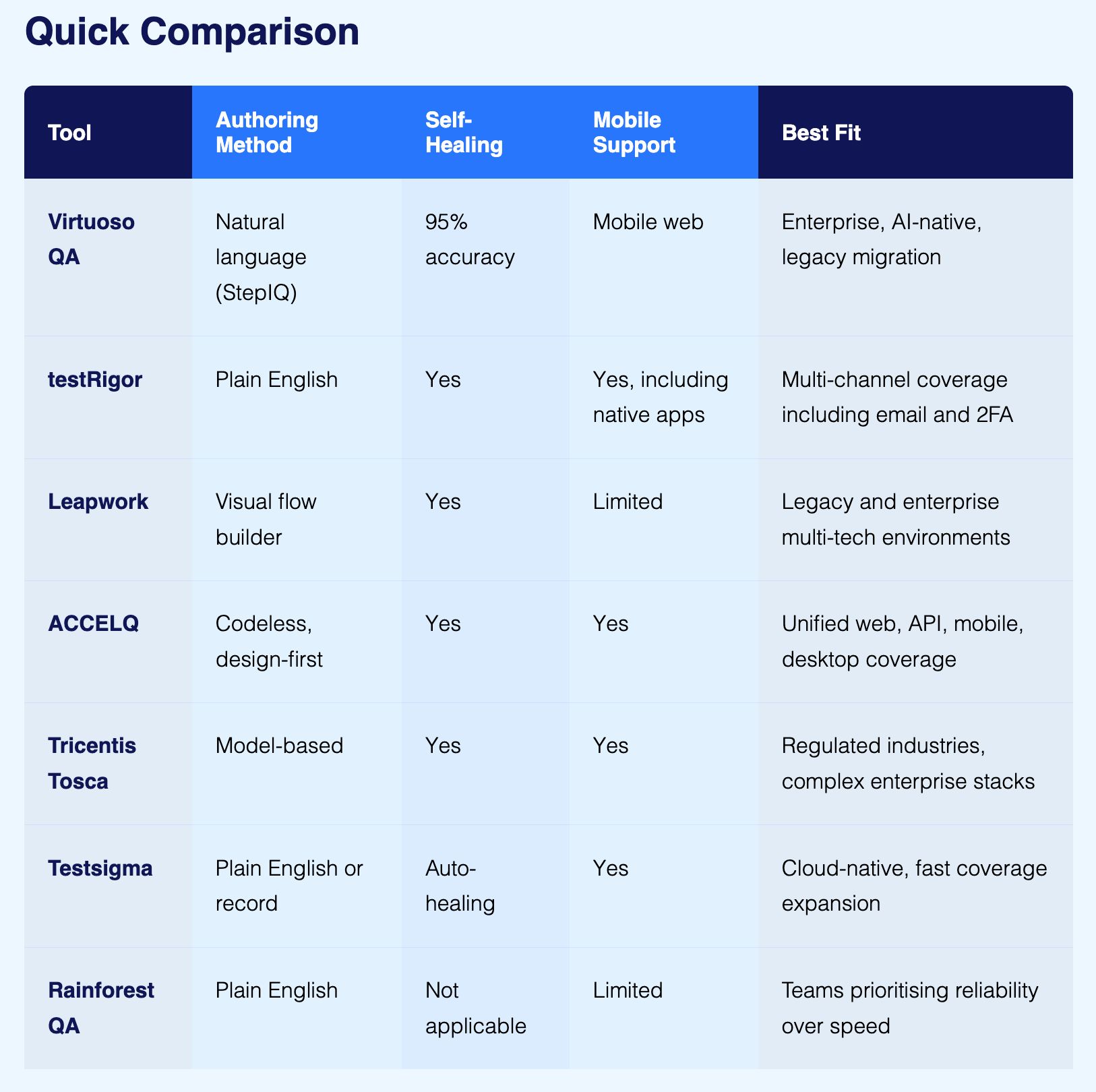
If maintenance overhead is your primary problem, prioritise self-healing accuracy. Virtuoso QA at approximately 95% and Tricentis Tosca's model-based approach are the strongest options. Both eliminate the repair cycle that consumes QA capacity in script-based programmes.
If your team includes non-technical contributors, prioritise natural language authoring. Virtuoso QA, testRigor, and Testsigma all allow business analysts, product managers, and QA engineers without coding backgrounds to author and own tests independently.
If your testing scope extends beyond the browser, evaluate technology coverage carefully. testRigor covers email and mobile natively. Leapwork and Tricentis Tosca cover SAP, Citrix, and mainframe. ACCELQ covers web, API, mobile, and desktop in a unified platform.
If you are migrating from legacy automation, Virtuoso QA's GENerator capability provides the clearest migration path by converting existing Selenium, Tosca, and manual assets into natural language tests without requiring a rebuild.
If reliability is more important than execution speed, Rainforest QA's hybrid model produces near-zero flakiness by routing complex scenarios to human validation rather than producing unreliable automated results.

Frequently Asked Questions
Is codeless test automation suitable for enterprise applications?
What is the difference between codeless and low-code test automation?
What is self-healing in codeless test automation?
How do I migrate from Selenium to a codeless platform?