Blog
14 Best Low Code Test Automation Tools in 2026

Rishabh Kumar
Published on

Table of contents
Lorem ipsum
Lorem ipsum
Lorem ipsum
Lorem ipsum
Lorem ipsum
Low code test automation promises to democratise testing by enabling team members without programming expertise to create automated tests. Yet most platforms claiming "low code" still require technical knowledge, configuration management, and constant maintenance when applications change.
In 2026, the market divides sharply between traditional low-code platforms that reduce but do not eliminate coding requirements, and AI-native platforms that achieve true codeless automation through natural language understanding and autonomous maintenance.
This analysis examines 12 leading low-code solutions and reveals why enterprises are migrating to AI-native platforms that deliver 10x speed gains and 88% maintenance reduction.
Best Low Code Test Automation Tools in 2026
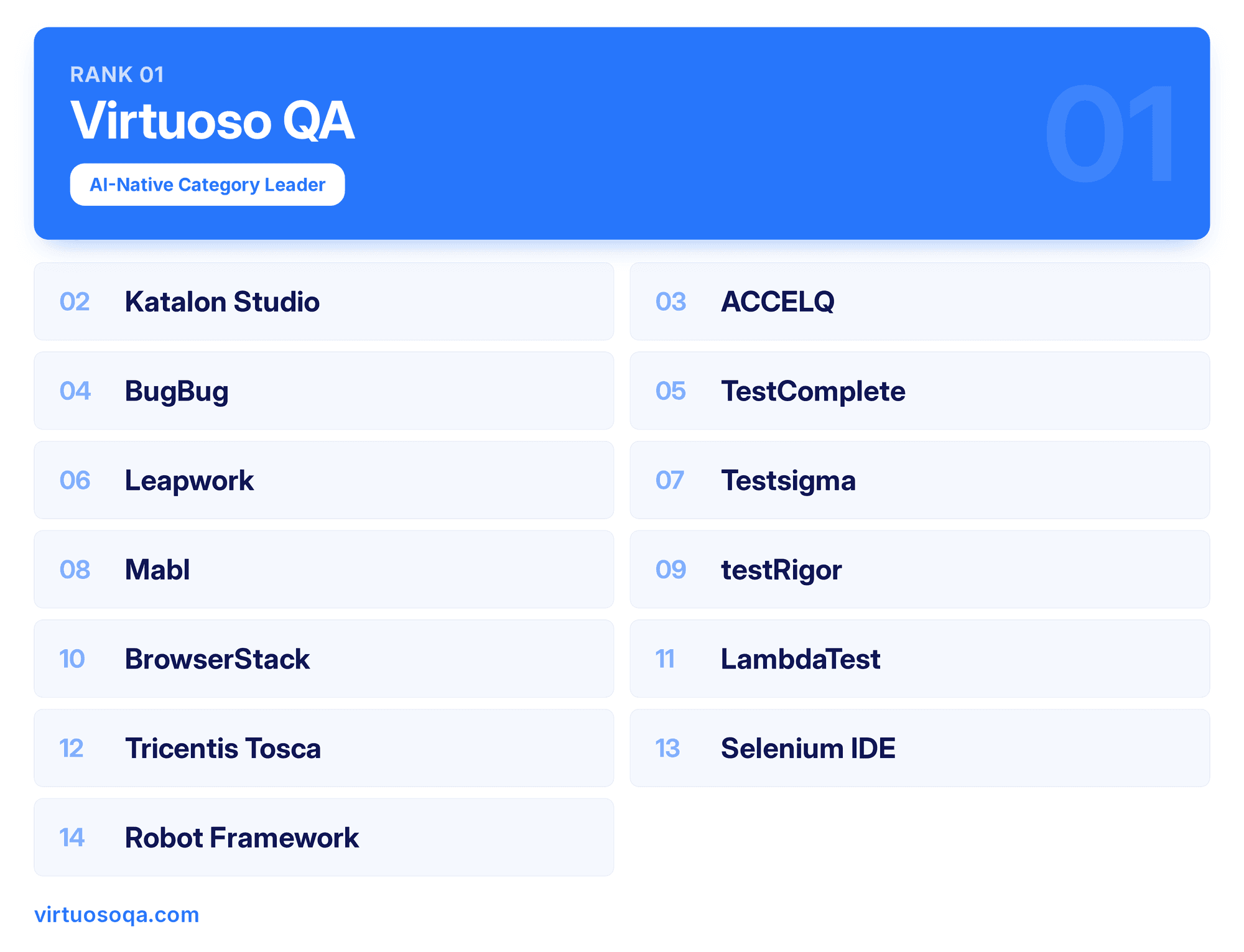
1. Virtuoso QA - AI-Native Category Leader
Virtuoso QA represents the evolution past low code into AI-native test automation that achieves what traditional low-code platforms could not deliver.
Natural Language Programming
Write tests in conversational English with no drag-and-drop builders, no keyword libraries, no proprietary syntax
Business analysts, manual testers, and domain experts author tests from day one
StepIQ - Autonomous Test Generation
StepIQ autonomously generates comprehensive test suites by analyzing applications, understanding workflows, and creating test scenarios that validate functionality.
Identifies critical paths, edge cases, data variations, and integration scenarios
Delivers 9x faster test creation compared to manual test building in low-code platforms
95% Self-Healing - Eliminating Maintenance
Tests automatically adapt when buttons move, IDs change, or layouts redesign
AI-powered element identification uses visual analysis, contextual understanding, and semantic recognition
Requires human intervention for only 5% of changes vs 100% with traditional platforms
Live Authoring
Executes test steps in real time against the actual application as testers author them
Immediate visual feedback eliminates the write, run, debug, repeat cycle
Errors are caught at the moment of creation, not after the full suite is built
Unified UI and API Testing
Validates complete workflows across the UI and backend within a single natural language test scenario
Removes the need for separate tools for API validation and eliminates manual correlation of results across tools
Composable Testing
Allows teams to build intelligent test assets once and reuse them across all client implementations with minimal configuration
Enables system integrators to achieve 94% effort reduction at project level by maintaining master libraries rather than rebuilding per client
Ensures that when a shared workflow changes, it is updated once and every test that uses it inherits the change automatically
GENerator - Legacy Migration
Converts legacy test suites from Selenium, Katalon, TestComplete, Tosca, and other frameworks into fully executable Virtuoso QA journeys
Ensures migrated tests arrive in Virtuoso already self-healing and composable from day one
2. Katalon Studio
Katalon balances low-code accessibility with scripting flexibility for complex scenarios. Katalon significantly expanded its AI capabilities with the launch of TrueTest and StudioAssist.
What It Does
Provides visual test creation with record and playback, object repository management, and keyword-driven design for non-developers
Offers a script editor for Groovy and Java when scenario complexity demands it
Supports web, API, mobile, and desktop testing within a single platform
Includes StudioAssist, an AI chat assistant embedded inside the IDE for code generation and test guidance
Launched TrueTest, an AI-native testing system that learns from real user behaviour in production and automatically generates tests for uncovered journeys
Provides Test Gap Analysis that compares production user journeys against existing test suites to surface coverage gaps
Added MCP Server integration, enabling LLM-driven test management directly from the IDE
Where It Falls Short
Still occupies the middle ground between scripted and truly codeless, easier than pure frameworks but not a genuine no-code experience
Tests remain locator-dependent and break when UIs change, requiring manual repair
Complex scenarios require Groovy scripting knowledge that many QA practitioners do not have
Object repository management demands technical understanding that limits self-service adoption
Teams still need technical specialists for anything beyond standard workflows, limiting true democratisation
3. ACCELQ
ACCELQ positions as a codeless platform with AI augmentation, directly competing with AI-native platforms for enterprise buyers.
What It Does
Enables test creation through visual interfaces without requiring teams to write code
Combines web, mobile, API, and desktop testing with test management in a single unified platform
Offers Autopilot, a generative AI engine for autonomous test generation from requirements
Includes self-healing capabilities that aim to reduce maintenance when applications change
Targets large enterprises with complex application portfolios requiring comprehensive coverage without specialised coding skills
What to Validate Before Buying
Verify self-healing effectiveness through proof of concepts using realistic application changes, not just demos
Compare maintenance burden directly against AI-native test platforms like Virtuoso QA before committing
Assess ease of complex test creation for genuinely non-technical users, not just power users
Request measurable team productivity gains from existing customers through references
Calculate total cost of ownership including licensing, training time, and ongoing maintenance effort
Note that user feedback suggests interface complexity requires significant training investment
4. BugBug
BugBug is a lightweight low-code platform for automating end-to-end and regression tests for web applications. Its Chrome-based recorder and visual editor use AI-assisted capabilities to make browser test creation faster and reduce common selector, timing, and dynamic UI issues.
What It Does
Records real browser interactions and converts them into editable test steps without requiring users to write code
Uses Adaptive Locators, Smart Waiting, and Smart Click & Scroll to select stable elements, handle asynchronous pages, and reproduce realistic user interactions
Runs tests locally in the browser or in the cloud, with scheduling, notifications, and parallel execution for continuous regression testing
Provides reusable components, variables, built-in email testing, and Edit & Rewind for faster test maintenance and debugging
Integrates tests into CI/CD workflows through its CLI, public API, webhooks, and integrations with common development tools
Supports custom JavaScript actions when teams need to automate scenarios beyond the recorder’s standard capabilities
Where It Falls Short
Focuses on Chromium-based web applications and does not provide native mobile, desktop, or broad cross-browser testing
AI assists with recording and test stability but does not generate complete test suites from prompts or automatically repair failed tests after application changes
Advanced logic and highly customised workflows may still require JavaScript or technical configuration
Best suited to SaaS and web-first product teams rather than enterprises requiring automation across SAP, Citrix, mainframe, or packaged desktop applications
5. TestComplete
Two decades in market, TestComplete remains fundamentally code-dependent despite its low-code marketing.
What It Does
Supports JavaScript, Python, and VBScript with visual interfaces that attempt to reduce how much code testers must write
Provides object recognition to identify UI elements reliably across test runs
Enables distributed testing for parallel execution across environments
Integrates with the broader SmartBear ecosystem for teams already using their tools
Where It Falls Short
Tests are ultimately scripts that require programming knowledge regardless of how the visual wrapper simplifies entry
Element identification relies on properties that break when applications change, triggering manual maintenance
Complex scenarios demand advanced scripting skills that most QA teams do not have in-house
Maintenance burden grows steadily with application scale, consuming QA capacity that should go toward coverage
Represents the older generation of low code that cannot compete with AI-native self-healing in maintenance cost
6. Leapwork
Leapwork uses flowchart-based visual test creation to make automation accessible for non-technical users. The 3.0 release introduced the New Elegance design for a more intuitive building experience.
What It Does
Uses flowchart-based building blocks representing test steps, requiring no coding or text-based authoring
Supports complex technology stacks including legacy systems, Citrix, mainframe, and SAP
Provides a cross-technology smart recorder that converts user actions into visual automated flows
Integrates with DevOps and CI/CD tools for automated pipeline execution
Tracks test failures using video logs, data insights, and activity logs for faster diagnosis
Visual vs Natural Language
Visual flowcharts appeal to users who think graphically and prefer to see logic represented spatially
Natural language scales more effectively for large test suites, naturally supports version control, and enables faster authoring without building visual flows
Industry trends increasingly favour natural language for enterprise-scale automation programmes
Visual approaches retain genuine niche value for specific legacy, desktop, and Citrix scenarios
7. Testsigma
Testsigma provides cloud-based scriptless test automation through plain English test creation executed on cloud infrastructure.
What It Does
Enables test creation using simple English statements across web, mobile, and API testing
Provides a cloud execution grid for broad browser and device coverage without local infrastructure
Includes AI-driven self-healing that detects element changes and remaps locators automatically
Integrates with CI/CD pipelines for automated testing workflows triggered by code changes
Orchestrates functional, API, and visual tests within unified end-to-end flows
What to Validate Before Buying
Validate self-healing effectiveness in comparison to AI-native architectures through a realistic proof of concept
Test ease of complex scenario creation for genuinely non-technical users across varied workflows
Verify enterprise scalability through customer references in similar environments to your own
Measure maintenance burden under continuous development pressure, not just in stable environments
8. Mabl
Mabl targets developer and DevOps personas with low-code interfaces and machine learning for test maintenance. Mabl also expanded into desktop application testing.
What It Does
Provides low-code test creation via browser interaction recording that captures user flows automatically
Includes AI-powered auto-healing that adjusts test scripts when UI elements shift, new features release, or layouts change
Combines UI, API, performance, and accessibility testing in a single platform
Supports reusable JavaScript and Appium snippets for teams that need to handle advanced scenarios
Accepts natural language input for generating database queries and complex test logic
Expanded into desktop testing with self-healing capabilities that adapt when desktop DOM or structure changes
Integrates deeply with modern CI/CD stacks, targeting organisations where developers own quality
Where It Falls Short
Developer-centric positioning creates real adoption friction for enterprises with large, separate QA organisations
Low-code approach still requires more technical knowledge than truly codeless platforms, limiting non-technical adoption
Works best in organisations where developers and testers share quality ownership rather than those with dedicated manual testing teams
9. testRigor
testRigor enables test creation in plain English and has significantly expanded its human emulator capability to span multiple channels in a single test.
What It Does
Allows testers to write tests using everyday language describing user actions, with no CSS selectors or XPath required
Provides a human emulator capability that automates end-to-end business processes spanning web, mobile, desktop, APIs, email, SMS, and 2FA within a single plain English test script
Uses machine learning to identify elements by visible text and user-facing labels rather than technical identifiers
Generates test cases and data automatically from simple descriptions to cover edge cases without manual data preparation
Covers functional, regression, sanity, API, UI, and system tests across a wide range of application types
Where It Falls Short
Desktop automation requires manual setup including Windows VM and RDP configuration, making it significantly less mature than web and mobile coverage
Automated teardown and cleanup are not built-in for desktop test scenarios, requiring manual handling
Enterprise scalability at large volumes should be verified through customer references before committing
Self-healing effectiveness should be compared directly against established AI-native platforms through proof of concept
10. BrowserStack Low Code Automation
BrowserStack Low Code Automation tackles the execution bottleneck by combining AI-augmented test authoring with instant access to its massive real device infrastructure, making it a strong contender for teams seeking both modern authoring and enterprise-grade execution.
What It Does
Enables test authoring through a combination of an interactive visual recorder and natural language prompts, converting manual actions into readable, editable English steps
Includes AI-driven self-healing that automatically detects UI changes and remaps locators on the fly to prevent brittle script breakage
Executes tests instantly on BrowserStack’s cloud of over 30,000 real mobile devices and desktop browsers without requiring any local infrastructure setup or maintenance
Supports advanced automation practices directly in the UI, including reusable modular components, data-driven execution, and API validations alongside UI steps
Integrates natively into standard CI/CD pipelines, functioning as a seamless deployment gate with built-in video logs, screenshots, and rich debugging
What to Validate Before Buying
Verify AI self-healing effectiveness against your specific application architecture through a proof of concept, particularly for heavily obfuscated or highly dynamic enterprise platforms.
Confirm how pricing scales with high-frequency execution volumes, since the platform is tightly integrated into BrowserStack's broader cloud testing tiers.
Test the natural language generation on complex, conditional business logic to ensure non-technical testers are not forced to rely entirely on the manual step recorder for edge cases.
Assess whether your organisation requires strict on-premises execution for compliance reasons, since the low-code offering relies on routing tests through the cloud.
11. LambdaTest
LambdaTest is primarily a cloud execution platform rather than a complete test creation and maintenance solution.
What It Does
Provides cloud-based infrastructure for browser and device testing at scale
Offers KaneAI, an AI-powered assistant for test generation and intelligent test guidance
Includes HyperExecute, a parallel execution engine designed for fast pipeline integration
Integrates with CI/CD tools for automated test triggering across cloud environments
Delivers broad cross-browser and real-device matrix coverage without maintaining physical infrastructure
Important Distinction
Solves the test execution infrastructure problem but does not address test creation or maintenance challenges
Teams still need separate tools or frameworks to author and maintain their tests before executing on LambdaTest
Most valuable as a cloud execution layer that complements a dedicated test authoring platform rather than replacing one
Should not be evaluated as a substitute for end-to-end test automation platforms that cover the full testing lifecycle
12. Tricentis Tosca
Tosca provides model-based test automation with deep enterprise application support and is recognised in the Gartner Magic Quadrant.
What It Does
Enables test creation without coding through model-based automation and visual interfaces
Covers test automation, test data management, service virtualisation, and ALM integration in a comprehensive platform
Provides deep native support for SAP, Oracle, Salesforce, and other enterprise applications
Includes Vision AI for testing unscannable legacy environments such as Citrix, SAP interfaces, and custom Java applets
Where It Falls Short
Implementation requires significant professional services investment spanning months before teams see value
Learning curve demands weeks of formal training before QA teams reach productive automation speed
Total cost of ownership is high, including licensing, ongoing professional services, and specialised personnel costs
Modern AI-native platforms offer faster implementation timelines and lower TCO for organisations that do not have an existing Tricentis investment to protect
13. Selenium IDE
Selenium IDE lowers the barrier to Selenium through record and playback functionality. It remains the entry-level option for teams already in the Selenium ecosystem.
What It Does
Records user actions directly in the browser and replays them as automated tests
Reduces initial test creation effort compared to scripting Selenium WebDriver tests manually from scratch
Offers a free, open source option that is familiar to teams already working with Selenium
Where It Falls Short
Produces brittle tests that break frequently whenever application UI changes, generating high maintenance overhead
Recorded tests require significant manual cleanup and enhancement before they are reliable at scale
Complex scenarios still require full Selenium WebDriver scripting, defeating the purpose of the low-code recorder
Carries the highest maintenance burden of any approach on this list due to its complete dependency on fragile element locators
Represents the oldest generation of low code automation with no intelligence, just recorded actions that break on first change
14. Robot Framework
Robot Framework uses tabular, keyword-driven syntax that appears readable but still requires real coding for enterprise-scale automation.
What It Does
Provides keyword-driven test automation in tabular plain-text format that reads more naturally than pure scripting
Offers an extensive library ecosystem covering web automation, APIs, databases, and other testing needs
Has served niche enterprise environments for two decades as an early attempt at readable automation
Benefits from an active open source community with extensive documentation and pre-built libraries
Where It Falls Short
Real automation at scale requires creating and maintaining custom keyword libraries, typically written in Python, so teams are still effectively coding
Teams often discover they are just coding wrapped in keyword abstraction rather than avoiding coding altogether
Complex scenarios require complex keyword logic that is difficult to maintain as applications evolve
Maintenance burden persists across every application change just as it does in raw scripted frameworks
Represents the pre-AI generation of low code that attempted readability through keywords before AI made genuinely codeless automation achievable

Understanding Low Code Test Automation
Low code test automation emerged to address a fundamental challenge: traditional framework-based automation requires specialised programming skills that most QA organisations lack.
The Low Code Promise
Low code platforms aim to bridge the gap between manual testing and scripted automation through:
Visual interfaces and drag-and-drop test creation
Keyword-driven approaches and simplified scripting
Accessibility for testers with limited coding knowledge
Faster test creation than pure coding frameworks
The vision: manual testers who understand workflows create automated tests. Business analysts translate requirements into validation. QA teams scale without hiring armies of automation engineers.
The Low Code Reality
The challenge is that "low code" describes a wide spectrum. Teams evaluating these platforms consistently discover:
Simple scenarios work well through visual interfaces
Complex scenarios still require scripting or technical configuration
Element locators break when UIs change, requiring manual maintenance
CI/CD integration often requires technical knowledge
Test data management remains a technical challenge
Technical specialists are still needed for anything beyond basic workflows
Low Code vs AI-Native - The Critical Evaluation Framework
Ease of Test Creation
Traditional low-code platforms require:
Learning platform-specific visual interfaces, drag-and-drop builders, or keyword libraries before creating anything useful
Memorising proprietary approaches that differ across tools and do not transfer to other platforms
Technical knowledge for complex scenarios, meaning specialists remain essential
Restricting test authoring to users who have completed platform training
AI-native platforms enable:
Test creation by describing actions in natural language with no platform-specific learning required
Anyone familiar with the application to author tests without learning any special syntax
AI to handle scenario complexity rather than pushing it onto the user through configuration
The entire QA organisation to contribute to automation, not just trained specialists
Measured outcome: Traditional low-code platforms require days or weeks of training before new users produce useful tests. AI-native platforms like Virtuoso QA get new users to productivity within hours because natural language requires no platform-specific learning curve.
Maintenance Burden
Traditional low-code platforms:
Still cause tests to break when UIs change, despite offering visual interfaces for creation
Require manual element identification updates that only technical staff can perform
Need technical knowledge to diagnose and fix failures, creating specialist dependency
Consume 60 to 80% of QA time on maintenance rather than building new coverage
AI-native platforms:
Autonomously adapt to UI changes through self-healing, removing human intervention from the process
Recognise elements through visual and contextual AI rather than relying on brittle locators that break on change
Maintain tests automatically across sprints and platform updates without manual effort
Reduce maintenance effort compared to traditional approaches, freeing QA to build new coverage
True Democratisation
Traditional low-code platforms:
Enable moderately technical users to create tests faster than raw frameworks, but not non-technical users
Still require technical specialists for complex scenarios, maintaining the same bottleneck in a different form
Limit testing capacity to team members with technical aptitude, leaving domain experts unable to contribute
Fail to expand automation beyond the handful of engineers who can handle edge cases and maintenance
AI-native platforms:
Enable anyone who can describe a user workflow to create a fully executable automated test
Require no coding or technical skills for any level of scenario complexity
Democratise automation to business analysts, manual testers, and domain experts who understand business logic
Expand testing capacity across the entire organisation rather than concentrating it in a specialist team
Enterprise Scalability
Traditional low-code platforms:
Struggle with large test suites because maintenance overhead grows proportionally with suite size
Face performance challenges when managing thousands of tests simultaneously
Require growing technical teams as automation expands to maintain the increasing maintenance burden
AI-native platforms:
Scale to tens of thousands of tests with consistent performance through cloud infrastructure
Enable small teams to manage large automation programmes by offloading maintenance to AI
Grow seamlessly as testing needs expand without requiring proportional headcount increases
Measured outcome: Organisations execute more than 100,000 annual tests through Virtuoso QA's cloud infrastructure with minimal human maintenance intervention, at scales that are not achievable with traditional low-code platforms.
Total Cost of Ownership
Traditional low-code platforms:
May appear cost-effective at the licensing level but carry significant hidden personnel costs
Require ongoing investment in technical staff to build, maintain, and extend the automation suite
Direct most QA effort toward maintenance rather than creating new coverage that adds value
AI-native platforms:
Carry higher licensing costs than open-source options but dramatically reduce personnel requirements through AI
Direct QA effort toward expanding coverage and strategic quality work rather than maintenance repair
Typically deliver positive ROI within 6 to 12 months through maintenance reduction and headcount savings
Measured outcome: Traditional low-code platforms with 10 technical staff maintaining tests cost $1.5M to $2M annually in personnel alone. AI-native platforms that enable 1 to 2 staff to manage equivalent automation cost $150K to $300K annually, delivering positive ROI despite higher licensing costs.

Frequently Asked Questions
What is low code test automation and how does it differ from traditional automation?
What is the difference between low code and no code test automation?
Can non-technical testers really use low code automation platforms effectively?
How do low code platforms handle test maintenance when applications change?
How does AI improve low code test automation?