Blog
What is Business Process Testing? How to Automate Complete End to End User Journeys

Rishabh Kumar
Published on

Table of contents
Lorem ipsum
Lorem ipsum
Lorem ipsum
Lorem ipsum
Lorem ipsum
Enterprise applications do not operate in isolation. When a customer places an order, that single action triggers workflows across inventory management, payment processing, fulfillment systems, CRM updates, and customer communications. When an insurance company processes a claim, the workflow spans policy administration, adjudication engines, payment systems, and compliance reporting. When a financial institution onboards a new client, the journey crosses KYC verification, account provisioning, risk assessment, and regulatory documentation.
Yet the vast majority of enterprise testing strategies still validate these systems individually. Components pass their isolated tests while the orchestrated business processes that define actual customer experience break in production. Industry research indicates that business process failures at integration points cost enterprises an average of $4.5 million annually, with the overwhelming majority of these failures occurring at the boundaries between systems that isolated testing cannot detect.
Business process testing solves this critical gap. It validates complete user journeys across multiple systems, ensuring that complex enterprise workflows function seamlessly from start to finish. This guide explains what business process testing is, why traditional approaches fail, and how AI powered automation transforms business process validation from a manual bottleneck into a strategic advantage.
What is Business Process Testing?
Business process testing is the practice of validating complete, end to end business workflows as they are experienced by real users, rather than testing individual application components in isolation. It ensures that every step in a multi system business process, from initiation through completion, functions correctly and delivers the expected business outcome.
A business process test for an Order to Cash workflow, for example, would validate the entire sequence: a customer browsing products, adding items to cart, completing checkout, processing payment through the payment gateway, updating inventory in the ERP system, generating a shipping notification, updating the CRM record, and sending the customer a confirmation email. Each step depends on the previous one. Each involves different systems. The business process test validates all of them as a single, cohesive journey.
This approach stands in contrast to traditional component testing, where each system is validated independently. The payment gateway passes its tests. The inventory system passes its tests. The CRM passes its tests. But when a payment confirmation triggers an inventory update that triggers a shipping notification, the entire chain may fail at integration points that no individual test ever examined.
Business Process Testing vs. Component Testing
Component testing validates that individual modules or systems function correctly within their own boundaries. Business process testing validates that the orchestration of multiple components delivers the correct business outcome. Both are necessary. Neither is sufficient alone.
The distinction matters because enterprise defects increasingly occur at integration boundaries rather than within individual systems. Payment processing works, but the handoff to fulfillment fails. User registration completes, but the downstream provisioning of permissions across connected systems breaks. These cross system failures are invisible to component testing and only surface through business process validation.
Business Process Testing vs. Integration Testing
Integration testing validates the technical interfaces between systems: APIs return correct responses, data formats are consistent, authentication works across service boundaries. Business process testing operates at a higher level of abstraction. It validates that the complete business transaction achieves the correct outcome from the perspective of the user and the business, combining UI interactions, API calls, database validations, and cross system data flows into a single, unified test journey.
Integration testing asks: "Do these systems communicate correctly?"
Business process testing asks: "Does the customer get what they ordered, on time, with the correct invoice?"
Why Business Process Testing Matters Now
Three converging forces make business process testing essential for modern enterprises.
1. Enterprise Applications Are More Interconnected Than Ever
The average enterprise now operates dozens of cloud based applications, from ERP systems like SAP S/4HANA and Oracle Cloud to CRM platforms like Salesforce and Microsoft Dynamics 365, policy administration systems like Guidewire, HR platforms like Workday, procurement systems like Coupa, and custom web applications. These systems are connected through APIs, middleware, event buses, and shared databases. A single business process may traverse five or more systems before completing.
This interconnection creates exponential complexity. Every new integration multiplies the number of potential failure points. Every vendor update across any connected system can disrupt workflows that span multiple platforms. Testing each system in isolation provides a false sense of security because the real risk lives at the boundaries.
2. Release Velocity Has Outpaced Testing Capacity
Enterprise SaaS vendors now release updates on continuous cycles. Salesforce delivers three major releases per year plus continuous minor updates. Oracle and SAP push regular cloud updates. Custom applications release weekly or even daily through CI/CD pipelines. Each release can alter UI elements, API behaviors, data structures, and business logic across the connected ecosystem.
Manual business process testing cannot keep pace with this velocity. A comprehensive end to end regression test of a complex business process might take a manual tester an entire day to execute once. With dozens of critical business processes and continuous releases across multiple connected systems, the math simply does not work. Organizations either slow down releases to accommodate testing or accept the risk of untested business processes reaching production.
3. The Cost of Business Process Failures Is Escalating
When a business process fails in production, the impact extends far beyond a single user encountering an error. Failed order fulfillment workflows affect revenue. Broken claims processing delays customer settlements. Disrupted financial reporting workflows create compliance exposure. Failed customer onboarding journeys damage brand reputation and increase acquisition costs.
These failures are disproportionately expensive because they affect entire transaction chains, not isolated features. Fixing a broken business process requires coordination across multiple system owners, often across different teams or even different vendors. The mean time to resolution is significantly longer than for component level defects, and the business impact accumulates with every hour the process remains broken.
Common Business Processes That Require End to End Testing
1. Order to Cash (O2C)
The Order to Cash process spans customer inquiry, quotation, order placement, order fulfillment, shipping, invoicing, payment collection, and revenue recognition. In enterprise environments, this process typically crosses CRM, ERP, warehouse management, shipping, billing, and financial systems. Each transition point between systems represents a potential failure point that only end to end business process testing can validate.
2. Procure to Pay (P2P)
Procure to Pay covers purchase requisition, vendor selection, purchase order creation, goods receipt, invoice matching, payment processing, and financial reconciliation. Enterprise P2P workflows commonly span procurement platforms like Coupa or SAP Ariba, ERP systems, vendor portals, approval engines, and financial systems. The three way match between purchase order, goods receipt, and invoice is a particularly complex validation that requires business process level testing.
3. Hire to Retire (H2R)
The employee lifecycle from recruitment through onboarding, payroll, benefits administration, performance management, and eventual offboarding involves HR platforms like Workday or SAP SuccessFactors, payroll systems, benefits providers, learning management systems, and identity management platforms. Each lifecycle event triggers downstream processes across multiple systems that must be validated as a cohesive journey.
4. Quote to Bind (Insurance)
In insurance, the Quote to Bind process spans initial inquiry, risk assessment, underwriting decision, quote generation, policy binding, document issuance, and premium collection. This workflow traverses policy administration systems like Guidewire or Duck Creek, rating engines, document management systems, payment gateways, and agent portals. Each step involves complex business rules that vary by product line, jurisdiction, and customer profile.
5. Patient Journey (Healthcare)
Healthcare workflows from patient registration through appointment scheduling, clinical documentation, treatment, billing, and follow up span electronic health record systems, practice management platforms, billing systems, patient portals, and third party integrations. These workflows must function correctly to maintain care quality and regulatory compliance.
6. Account Opening (Financial Services)
Financial services account opening involves KYC verification, identity authentication, risk assessment, account provisioning, regulatory documentation, and initial funding. This process crosses core banking systems, identity verification providers, compliance engines, document management platforms, and customer communication systems.

Why Traditional Approaches to Business Process Testing Fail
1. Manual Testing Cannot Scale
Manual execution of end to end business processes is thorough but prohibitively slow. A single execution of a complex Order to Cash workflow might take 45 minutes to an hour of focused manual effort. Multiply that by the number of critical business processes, the number of data variations that must be tested, and the frequency of releases across connected systems, and the testing backlog becomes unmanageable.
Organizations relying on manual business process testing typically validate only their most critical happy path scenarios, leaving edge cases, error handling, and alternative workflow paths untested. This partial coverage is precisely where production defects hide.
2. Traditional Automation Creates Fragmented Coverage
Coded automation frameworks like Selenium can automate individual application interactions, but they struggle with the cross system orchestration that business process testing demands. Each system typically requires its own test scripts, its own element locators, its own authentication handling, and its own data setup. Stitching these disparate scripts into a cohesive end to end workflow is technically complex, brittle, and extremely expensive to maintain.
When any single system in the chain changes its UI, the entire business process test suite can break. The maintenance burden of cross system coded automation compounds with each connected application, often reaching the point where maintaining the test suite requires more effort than the testing itself delivers.
3. Siloed Testing Creates Dangerous Blind Spots
Even organizations with mature automation practices frequently test each system independently. The Salesforce team tests Salesforce. The ERP team tests the ERP. The payment team tests the payment gateway. Each team reports green. But no one validates the complete business process that spans all three systems.
This siloed approach misses critical failure categories: data synchronization failures where information updated in one system does not propagate correctly to downstream systems, timing dependencies where asynchronous processes complete in unexpected order, business rule conflicts where logic in one system contradicts assumptions in another, and API contract violations where schema changes in one system break integration partners.
How to Automate Business Process Testing with AI
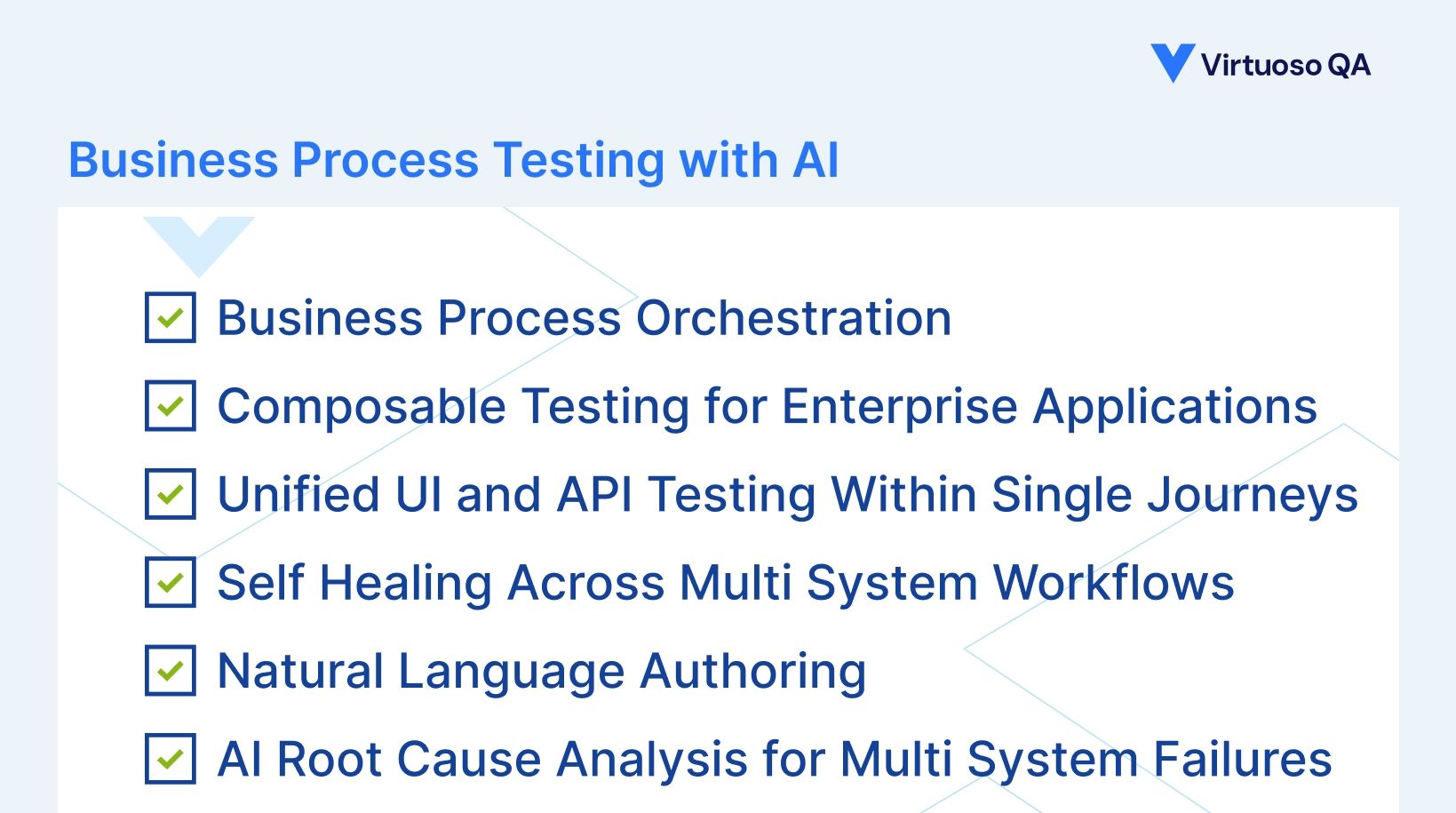
AI powered test automation transforms business process testing from a manual bottleneck into a scalable, reliable, and continuously executable practice. The key capabilities that enable this transformation are business process orchestration, composable testing, unified UI and API validation, and intelligent maintenance through self healing.
1. Business Process Orchestration
Business process orchestration is the capability to sequence multiple test journeys into a single, ordered workflow that mirrors a real business process, with data flowing seamlessly between stages.
In an AI native test platform like Virtuoso QA, business process orchestration enables teams to define multi stage workflows through a visual drag and drop interface. Each stage represents a distinct phase of the business process, such as "Create Customer Account," "Submit Order," "Process Payment," and "Verify Fulfillment." Stages execute in sequence, and critical data like customer IDs, order numbers, authentication tokens, and transaction references passes automatically from one stage to the next.
This context data sharing is essential for realistic business process testing. When Stage 1 creates a customer and generates a customer ID, Stage 2 must use that exact ID to place an order. When Stage 3 processes a payment and generates a transaction reference, Stage 4 must verify that reference in the fulfillment system. Without seamless data sharing between stages, business process tests cannot accurately reflect production behavior.
Comprehensive orchestration reporting provides visibility into every stage execution, including status, duration, environment, device, and data row details. When a business process test fails, teams can immediately identify which stage failed, what data was involved, and what the system state was at the point of failure.
2. Composable Testing for Enterprise Applications
Enterprise business processes frequently follow standardized patterns. Order to Cash, Procure to Pay, and Hire to Retire workflows are structurally similar across organizations that use the same enterprise platforms. Virtuoso QA Composable provides pre-built by providing pre built, reusable test libraries for standard business processes that can be adapted to specific implementations with minimal customization.
Instead of building every test from scratch, teams import pre built automation for common enterprise processes and configure approximately 30% of the steps for their specific environment, data, and business rules. A composable test library for SAP Order to Cash, for example, includes the standard process steps that every SAP customer follows, with configuration points for the organization specific customizations that differentiate one implementation from another.
This approach transforms business process test automation timelines. Enterprise organizations that previously required 1,000 or more hours to build automation for standard business processes can achieve equivalent coverage in as few as 60 hours using composable test assets. Building once and reusing across multiple instances, environments, and customer deployments eliminates the redundant effort that inflates enterprise testing budgets.
3. Unified UI and API Testing Within Single Journeys
Business processes are not purely UI interactions or purely API calls. They are a combination of both. A customer interacts with a web portal (UI), which triggers a backend process (API), which updates a database, which triggers a notification to another system (API), which is then visible in an admin dashboard (UI). Testing business processes accurately requires validating both layers within the same test journey.
AI native test platforms unify UI and API testing within a single test flow. A business process test can navigate a web portal, submit a form through the UI, then immediately validate the backend response through an API call, verify database state through a SQL query, and confirm that downstream systems reflect the expected updates. This unified approach eliminates the gap between UI testing and API testing that allows integration defects to escape detection.
For enterprise applications like Salesforce, Oracle, SAP, and Dynamics 365, this unified capability is critical. A single business transaction in these platforms generates UI events, API calls, workflow triggers, and database updates simultaneously. Testing only the UI misses backend failures. Testing only the API misses rendering defects. Unified testing catches both.
4. Self Healing Across Multi System Workflows
The maintenance challenge for business process tests is amplified by the number of systems involved. When a business process test spans five connected applications, a UI change in any one of them can break the entire test. Traditional coded automation requires manual repair for each broken locator in each affected system.
AI powered self healing addresses this at scale. Intelligent object identification maintains multiple identification strategies for every element across every system in the business process. When a vendor update to Salesforce changes a button ID, or an SAP release restructures a form layout, the self healing engine automatically adapts without human intervention. This capability is what makes automated business process testing sustainable at enterprise scale, where the cumulative rate of change across all connected systems is constant.
5. Natural Language Authoring for Business Process Tests
The people who understand business processes best are rarely the engineers who write automation code. Business analysts, process owners, and domain experts possess deep knowledge of how workflows should behave, what exceptions should be handled, and what business outcomes should be validated. Traditional coded automation excludes these stakeholders from the test creation process.
Natural language test authoring changes this dynamic. Business process tests are written in plain English steps that describe the process from the user's perspective. "Navigate to the customer portal," "Complete the registration form with the generated test data," "Verify the account appears in the admin dashboard," "Confirm the welcome email was triggered via API." These steps are readable by anyone who understands the business process, regardless of their technical background.
StepIQ further accelerates business process test authoring by autonomously generating test steps based on the application context. As testers describe their business process, the AI suggests the next logical steps, validates the intent against the application under test, and autocorrects common errors in real time. This combination of natural language accessibility and AI assisted authoring makes business process test creation 90% faster than traditional coded approaches.
6. AI Root Cause Analysis for Multi System Failures
When a business process test fails, determining the root cause across multiple connected systems is significantly more complex than diagnosing a single component failure. Did the failure originate in the frontend UI, a backend API, a database query, a third party integration, or an asynchronous process that completed out of order?
AI powered root cause analysis automates this diagnostic process. When a business process test fails, the AI examines all available evidence: screenshots at the point of failure, DOM snapshots, network request logs, API response data, and historical failure patterns across the workflow. The analysis identifies the probable cause and the specific stage in the business process where the failure originated, providing actionable diagnostic information that accelerates resolution.
This capability transforms the troubleshooting economics of business process testing. Instead of engineers spending hours manually tracing failures across system logs, they receive targeted diagnostic reports that pinpoint the failure source and provide the evidence needed to open defect tickets with the responsible team.
Business Process Testing by Enterprise Application
Enterprise applications present unique testing challenges based on their architecture, update cycles, and customisation models. Each platform has distinct characteristics that affect how business process tests are created, maintained, and executed. Understanding platform-specific nuances ensures your testing approach aligns with each application's behaviour and release patterns.
1. Salesforce Business Process Testing
Salesforce implementations involve complex workflows that span Sales Cloud, Service Cloud, custom Lightning components, and dozens of third party integrations through AppExchange. Business process tests for Salesforce must validate lead to opportunity conversion, opportunity to close workflows, case management escalation paths, and custom business logic implemented through flows, triggers, and Apex classes.
The challenge is amplified by Salesforce's three annual major releases, which regularly modify Lightning component behavior, API responses, and platform capabilities. AI native self healing handles these platform updates automatically, maintaining test integrity across releases.
Learn how AI native self healing transforms Salesforce test automation in our deep dive on Understanding Salesforce Testing and the Role of AI Test Automation.
2. SAP and Oracle Business Process Testing
ERP business process testing is among the most complex enterprise testing challenges. A single ERP business process like Order to Cash or Procure to Pay may involve 50 or more screens, dozens of decision points, and integration with external systems for payment, shipping, tax calculation, and compliance reporting. SAP S/4HANA and Oracle Cloud deliver frequent updates that alter screen layouts, field behaviors, and integration endpoints.
Composable test libraries for standard ERP business processes provide pre built automation that covers the core process steps, with configuration points for implementation specific customizations. This approach eliminates the months of effort typically required to build ERP test automation from scratch.
3. Guidewire Business Process Testing
Insurance carriers using Guidewire for policy administration, billing, and claims management must validate multi step workflows that span PolicyCenter, ClaimCenter, and BillingCenter. Business process tests for Guidewire must handle complex business rules that vary by product line, jurisdiction, and customer segment, with high data variability across policy types, coverages, and regulatory requirements.
AI native business process testing handles this complexity through data driven testing that parameterizes business process tests across hundreds of data combinations, and composable test assets that cover standard insurance workflows like Quote to Bind, First Notice of Loss, and Claims Adjudication.
4. Microsoft Dynamics 365 Business Process Testing
Dynamics 365 implementations frequently combine multiple modules, including Finance, Supply Chain Management, Customer Engagement, and custom Power Apps, into unified business processes. The complexity of testing cross module workflows, combined with Microsoft's continuous update cadence, creates a sustained testing challenge that manual and traditional automated approaches cannot address at scale.
Virtuoso QA Composable delivers a configurable library of reusable test assets for scalable QA across Microsoft Dynamics 365. See how it works in the video below
Measuring Business Process Testing Effectiveness
1. Business Process Coverage
Measure the percentage of critical business processes that have automated end to end test coverage. Most organizations begin with less than 20% business process coverage and target 80% or higher within the first year of AI powered automation.
2. Mean Time to Detection (MTTD)
Track how quickly business process defects are detected after they are introduced. Automated business process tests running in CI/CD pipelines can detect cross system failures within hours of the code change that caused them, compared to days or weeks when relying on manual validation.
3. Business Process Pass Rate
Monitor the percentage of business process tests that pass on first execution across release cycles. This metric reflects both application stability and test reliability. AI native platforms with self healing typically maintain first time pass rates above 80%, compared to less than 50% for traditional coded automation.
4. Cost Per Business Process Test
Calculate the total cost of creating, maintaining, and executing each business process test over time. AI native platforms dramatically reduce this cost through natural language authoring (faster creation), self healing (minimal maintenance), and cloud execution (no infrastructure overhead).
How VirtuosoQA Enables Comprehensive Business Process Testing
Virtuoso QA provides the industry's most advanced platform for automating complex business process validation across multiple systems and applications, enabling organizations to test complete user journeys with unprecedented efficiency and accuracy.
Business Process Orchestration: End-to-End Workflow Automation
Virtuoso QA's Business Process Orchestration capability enables teams to create sophisticated test scenarios that span multiple applications and systems within single automated workflows.
Cross-Application Testing:
This level of comprehensive testing ensures that complex business workflows function correctly across all involved systems, catching integration failures that would otherwise reach production.
Natural Language Business Process Definition
Virtuoso QA's Natural Language Programming enables business stakeholders to define test scenarios using familiar business terminology rather than technical system details:
Business-Focused Test Authoring:
Product managers can describe customer journey requirements in plain English
Business analysts can translate process documentation directly into automated tests
Subject matter experts can contribute domain-specific knowledge without technical training
Example Business Process Test:
This approach ensures that business process tests accurately reflect real-world workflows while being maintainable by business stakeholders who understand the domain requirements.
Self-Healing Across Multiple Systems
Virtuoso QA's self-healing capabilities extend across complex multi-system business processes, automatically adapting to changes in any component system without breaking the overall workflow validation:
Intelligent Cross-System Adaptation:
When UI elements change in one system, tests automatically adapt while maintaining business process validation integrity
API endpoint modifications are detected and accommodated without manual intervention
Database schema changes are handled transparently, ensuring business process validation continues uninterrupted
95% User Acceptance Rate: Virtuoso QA's self-healing technology maintains this exceptional reliability even across complex multi-system business processes, significantly reducing maintenance overhead.
Live Authoring for Complex Workflows
Virtuoso QA's Live Authoring provides real-time feedback during business process test creation, enabling teams to validate complex multi-system workflows step-by-step:
Real-Time Cross-System Validation:
Each step of a business process test executes in real-time during creation
Teams see immediate confirmation that system integrations work correctly
Complex workflows are validated incrementally, building confidence in test reliability
Business Process Debugging:
When business process steps fail, Live Authoring provides immediate insight into which system or integration point caused the failure
Teams can adjust business process flows in real-time based on actual system behavior
Root cause analysis happens during test creation rather than after deployment failures

Implementing Business Process E2E Testing: Strategic Framework
Phase 1: Business Process Discovery and Mapping (Weeks 1-3)
Critical Business Process Identification:
Map high-value customer journeys that span multiple systems
Identify business processes with highest failure impact or customer visibility
Document current manual testing efforts for complex workflows
Stakeholder Engagement:
Involve business process owners, product managers, and customer experience teams
Capture tribal knowledge about edge cases and common failure scenarios
Define success criteria for business process validation
System Integration Assessment:
Inventory all systems involved in critical business processes
Identify integration points, data flows, and dependencies
Assess current monitoring and alerting capabilities for business process failures
Phase 2: VirtuosoQA Platform Configuration (Weeks 4-6)
Multi-System Integration Setup:
Configure VirtuosoQA access to all systems involved in business processes
Establish test data management strategies for cross-system testing
Set up execution environments that mirror production system configurations
Business Process Test Architecture:
Design reusable components for common business process elements
Create data-driven test frameworks for process variations
Establish reporting and alerting for business process validation failures
Team Training and Enablement:
Train business stakeholders on natural language business process test creation
Enable technical teams on advanced VirtuosoQA capabilities for complex workflows
Establish governance processes for business process test quality and maintenance
Phase 3: Pilot Business Process Implementation (Weeks 7-10)
Start with High-Impact Processes: Begin with business processes that represent significant customer value and organizational risk:
Example: E-commerce Order Fulfillment Process
Incremental Validation Approach:
Use VirtuosoQA's Live Authoring to validate each business process step in real-time
Build comprehensive workflows incrementally, ensuring each integration point functions correctly
Establish baseline performance metrics for business process execution times
Phase 4: Scale and Production Integration (Weeks 11-16)
Comprehensive Business Process Coverage:
Expand testing to cover all critical customer-facing business processes
Include error handling and exception scenarios in business process validation
Implement data-driven testing for business process variations
CI/CD Integration:
Integrate business process tests into continuous deployment pipelines
Establish business process validation as deployment gates
Create monitoring dashboards for business process health in production
Advanced Business Process Testing:
Implement performance testing for business process execution under load
Create business process regression testing for system updates
Establish business process validation for disaster recovery scenarios
Industry-Specific Business Process Testing Strategies
Different industries have distinct business processes shaped by regulatory demands, customer expectations, and operational models. A healthcare organisation and a manufacturing company may both use Salesforce, but their business processes differ significantly. Industry-specific testing strategies must account for unique workflows, compliance obligations, and risk profiles that transcend the underlying technology platforms.
Financial Services: Compliance and Risk Management
Loan Origination Process Testing:
Regulatory Compliance Benefits:
Automated validation of SOX compliance requirements
Comprehensive audit trails for regulatory examinations
Consistent process execution regardless of system changes
Healthcare: Patient Care Coordination
Patient Treatment Workflow Testing:
Healthcare-Specific Advantages:
HIPAA compliance validation across entire patient workflows
Integration testing for complex medical device ecosystems
Patient safety verification through comprehensive care coordination testing
Manufacturing: Supply Chain Integration
Order-to-Cash Process Validation:
Supply Chain Benefits:
End-to-end visibility into complex supply chain workflows
Automated validation of supplier integration points
Quality assurance across entire manufacturing processes
Advanced Business Process Testing Capabilities
Data-Driven Process Variations
VirtuosoQA enables comprehensive testing across multiple business process variations:
This approach ensures comprehensive coverage across all business process permutations without duplicating test logic.
Real-Time Business Process Monitoring
Integration with production monitoring enables continuous business process validation:
Production Workflow Verification: Automated tests validate that business processes function correctly in live environments
Performance Baseline Monitoring: Business process execution times are tracked and compared against established benchmarks
Anomaly Detection: Unusual patterns in business process execution trigger automated investigation workflows
Frequently Asked Questions About Business Process Testing
What is the difference between business process testing and end to end testing?
How does business process orchestration work in test automation?
Can business process tests validate both UI and API interactions?
How does self healing work for business process tests that span multiple systems?
How long does it take to automate a business process test?
What industries benefit most from automated business process testing?