Blog
What is Session Based Test Management? Complete SBTM Guide

Virtuoso QA
Published on

Table of contents
Lorem ipsum
Lorem ipsum
Lorem ipsum
Lorem ipsum
Lorem ipsum
Exploratory testing discovers defects that scripted approaches miss, but its unstructured nature makes it difficult to manage, measure, and scale. Session Based Test Management (SBTM) brings discipline to exploratory testing without sacrificing the creativity that makes it effective. This guide explains how SBTM works, when to apply it, and how modern AI native testing platforms complement session based approaches. Whether you are formalizing existing exploratory practices or introducing structured testing to your organization, SBTM provides the framework for accountable, measurable exploration.
What is Session Based Test Management?
Session Based Test Management is a methodology that structures exploratory testing into time boxed sessions with defined charters, documented activities, and measurable outcomes. Developed by Jonathan and James Bach in the early 2000s, SBTM addresses the primary criticism of exploratory testing: that it lacks accountability and repeatability.
The Core Concept
SBTM organizes testing into sessions, typically 60 to 120 minutes in duration, during which a tester explores a defined area of the application guided by a charter. The charter describes what to test and what to look for without prescribing specific steps.
After each session, the tester documents findings in a session report that captures:
What was tested
What was discovered
How time was spent
What questions emerged
This documentation enables management oversight, knowledge sharing, and progress tracking while preserving tester autonomy in how they conduct the exploration.
SBTM vs Traditional Exploratory Testing
Unstructured exploratory testing lets testers investigate freely without constraints. While this freedom enables creative discovery, it creates challenges:
Accountability: How do you know what was tested?
Coverage: How do you track which areas received attention?
Progress: How do you measure testing completion?
Communication: How do you explain testing activities to stakeholders?
SBTM answers these questions through structure without eliminating the cognitive engagement that makes exploratory testing effective. Testers still decide how to test; they simply document their decisions and findings.
When to Use Session Based Test Management
SBTM excels in situations where:
Requirements are incomplete or evolving
Application areas are unfamiliar or poorly documented
Previous testing has missed defects despite passing scripted tests
Testers need freedom to follow their instincts
Management requires visibility into testing activities
SBTM complements rather than replaces scripted testing. Organizations typically use SBTM for new feature exploration, risk areas, and usability investigation while maintaining automated regression coverage for stable functionality.
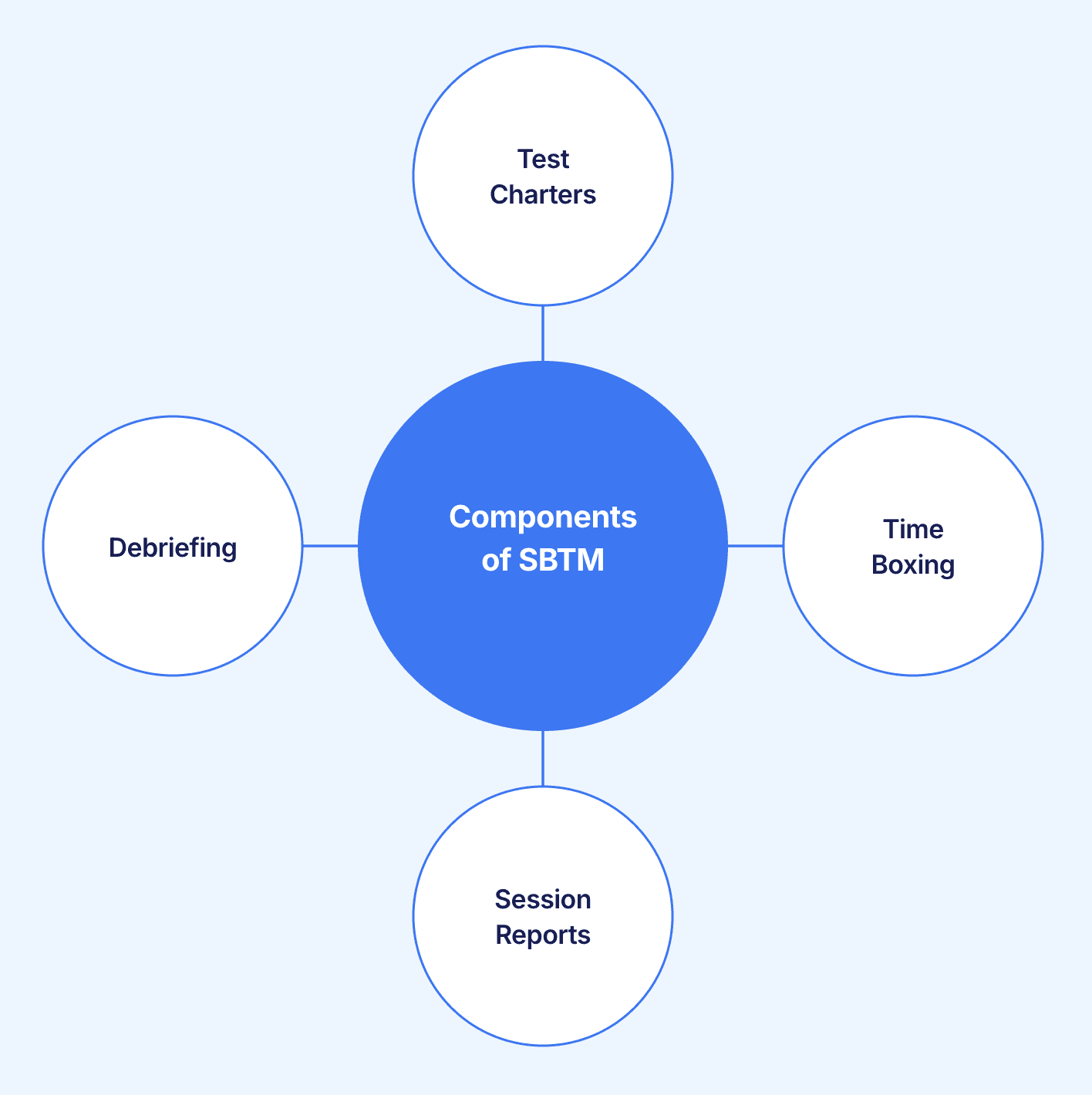
Key Components of Session Based Test Management (SBTM)
Session Based Test Management relies on four interconnected components that transform unstructured exploration into manageable, measurable testing activities. Each component serves a specific purpose while supporting the others. Understanding how these elements work together enables effective implementation and maximises the value SBTM delivers.
1. Test Charters
A test charter defines the mission for a testing session. Effective charters are specific enough to provide direction but broad enough to allow exploration. Too narrow and testers miss important discoveries adjacent to their path. Too broad and sessions lack focus, producing shallow coverage across many areas rather than deep investigation of important ones.
Charter Structure
A well formed charter includes:
Target: What area, feature, or functionality to explore
Resources: Tools, data, environments, or documentation to use
Information: What to look for or learn
Example charters:
"Explore the checkout process using various payment methods to discover usability issues and edge cases"
"Investigate the user profile editing functionality with international characters to identify data handling problems"
"Test the search feature with complex queries to find performance and relevance issues"
Charter Development
Charters emerge from multiple sources:
Risk analysis identifying areas warranting investigation
User stories requiring validation
Bug reports suggesting deeper exploration
Team hunches about problematic areas
Coverage gaps in existing test suites
Involve testers in charter development. Their domain knowledge and testing intuition improve charter quality and increase engagement during sessions. Testers who help create charters feel ownership over the testing mission rather than simply following instructions.
2. Time Boxing
Time boxing means conducting testing sessions within fixed durations. Rather than testing until finished or until interrupted, testers commit to focused exploration for a predetermined period. This simple constraint produces significant benefits for both individual effectiveness and organizational management.
Sessions have defined duration, typically between 45 and 120 minutes. Time boxing provides several benefits:
Focus: Limited time encourages concentrated attention
Measurement: Completed sessions provide progress metrics
Planning: Predictable durations enable scheduling
Freshness: Breaks between sessions prevent fatigue
The optimal session length depends on application complexity, tester experience, and organizational context. Start with 90 minute sessions and adjust based on results.
Session Interruptions
Real world testing involves interruptions: meetings, questions from colleagues, urgent issues. SBTM accounts for this through session metrics that distinguish between:
Session Time: Total elapsed time
On Charter Time: Time spent on the charter mission
Opportunity Time: Time spent on relevant but unplanned activities
Setup Time: Time spent on preparation and configuration
Tracking these categories provides accurate productivity measurement and identifies environmental factors affecting testing effectiveness.
3. Session Reports
Session reports document what happened during testing. They capture the testing story, what was explored, what was discovered, and what questions arose. Unlike scripted test results that indicate pass or fail, session reports preserve the context and reasoning behind testing decisions.
Reports serve multiple purposes. They provide evidence of testing activity for stakeholders. They enable knowledge transfer when testers change assignments. They support debugging when developers need to reproduce issues. They create an audit trail demonstrating due diligence.
Session reports document what happened during testing. Unlike scripted test results that indicate pass or fail, session reports capture the testing story.
Report Contents
Standard session reports include:
Charter: The mission that guided the session
Tester: Who conducted the session
Duration: Start time, end time, and time allocation
Data Files: Test data, configurations, and inputs used
Test Notes: What was tested and how
Bugs: Defects discovered with severity and status
Issues: Problems encountered during testing (environment, access, tools)
Questions: Items requiring clarification or follow up
Note Taking During Sessions
Effective session documentation requires note taking during testing, not reconstruction afterward. Approaches include:
Text notes in a dedicated application
Screen recordings with verbal commentary
Screenshots with annotations
Mind maps capturing exploration paths
The goal is sufficient detail to understand what happened without documentation overhead that slows exploration.
4. Debriefing
Debriefing is where individual testing sessions become organizational knowledge. A test lead or manager meets with testers to discuss session outcomes, share findings, and plan next steps. This conversation transforms isolated exploration into coordinated learning.
Without debriefing, session reports sit in repositories unread. Testers discover the same issues repeatedly. Insights remain trapped in individual minds. The investment in exploratory testing produces far less value than it should. Debriefing unlocks that value through structured conversation.
Debrief Structure
Effective debriefs cover:
Summary: Brief overview of session activities
Findings: Bugs, issues, and observations
Coverage: What was explored and what remains
Learnings: Insights about the application or testing approach
Next Steps: Follow up actions and future sessions
Debriefs should feel like conversations, not interrogations. The goal is understanding and improvement, not performance evaluation.
Debrief Benefits
Regular debriefing delivers:
Early visibility into defects and risks
Knowledge transfer between testers
Coaching opportunities for skill development
Course correction when sessions miss important areas
Recognition of tester contributions
Organizations that skip debriefing lose much of SBTM's value. The conversation transforms individual sessions into organizational learning.

Implementing Session Based Test Management
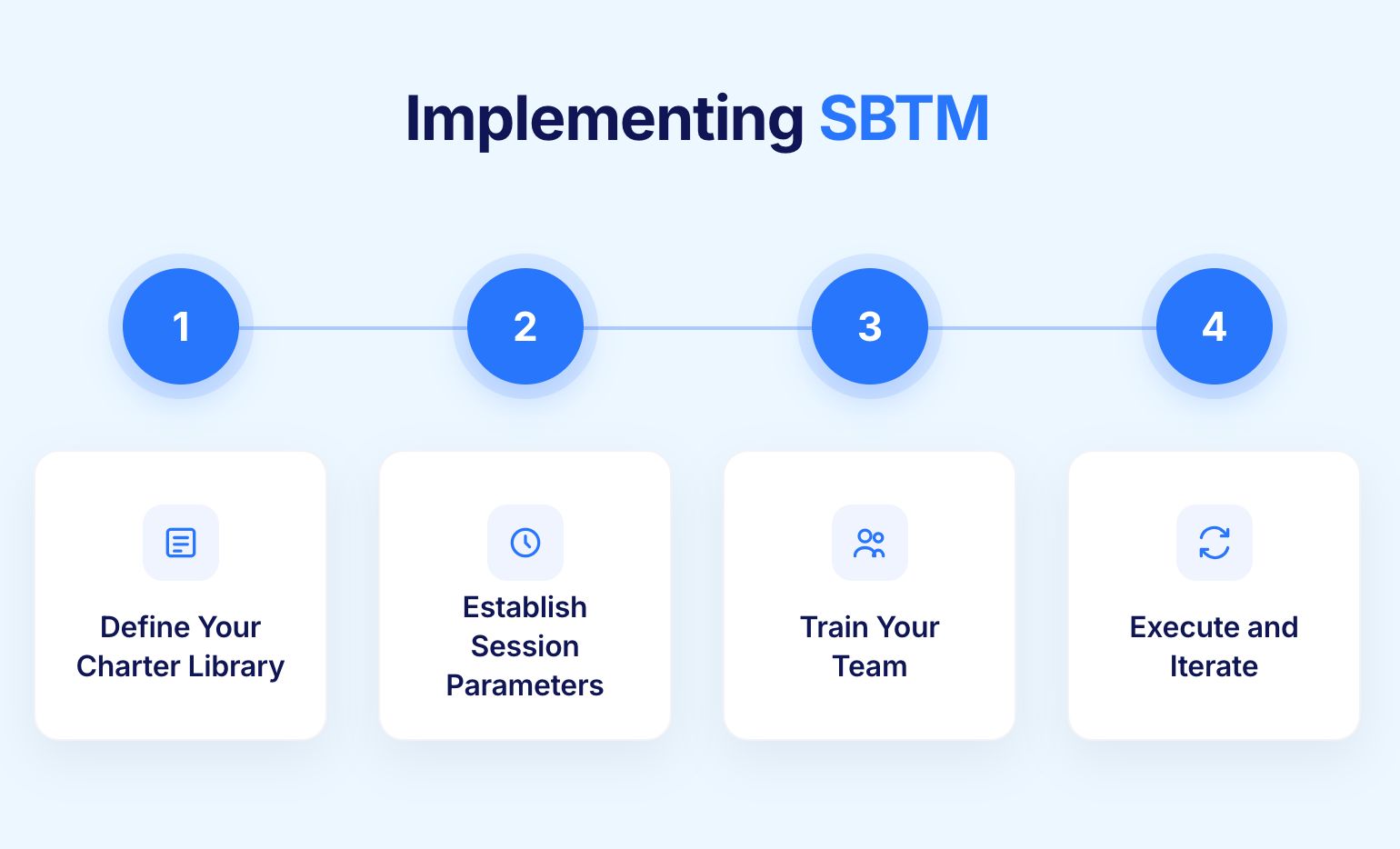
Step 1: Define Your Charter Library
Begin with a collection of charters covering critical application areas. Sources for initial charters include:
Existing test cases translated into exploratory missions
Risk assessments identifying areas requiring investigation
User journey maps highlighting key workflows
Historical defect data pointing to problem areas
Organize charters by application area, risk level, or testing phase. A searchable library enables testers to select appropriate sessions and managers to track coverage.
Step 2: Establish Session Parameters
Define standard parameters for your organization:
Session Duration: How long sessions should last (recommend starting with 90 minutes)
Documentation Requirements: What session reports must include
Debrief Frequency: When and how often debriefs occur
Metrics Tracked: What measurements matter for your context
Document these parameters so all team members apply them consistently. Adjust based on experience, but avoid excessive customization that undermines comparability.
Step 3: Train Your Team
SBTM success requires testers who understand both the methodology and effective exploration techniques. Training should cover:
SBTM concepts and rationale
Charter interpretation and execution
Exploration heuristics and techniques
Documentation practices
Debrief participation
Pair inexperienced testers with veterans for initial sessions. Observation and coaching accelerate skill development more effectively than classroom instruction alone.
Step 4: Execute and Iterate
Begin with a pilot covering a limited application area. Learn from early sessions:
Are charters appropriately scoped?
Does session duration work for your context?
Is documentation capturing useful information?
Are debriefs productive?
Refine your approach based on pilot results before scaling across the organization.
Measuring SBTM Effectiveness
Measuring SBTM effectiveness requires both quantitative metrics and qualitative assessment. Quantitative metrics track measurable outputs like session counts and defect rates. Qualitative assessment evaluates factors that numbers cannot capture, such as bug significance and team learning. Together, these approaches provide a complete picture of testing value.
1. Quantitative Metrics
SBTM enables measurements impossible with unstructured exploration:
Sessions Completed: Volume of testing performed
Coverage by Charter: Which areas received attention
Bugs per Session: Defect discovery rate
Time Allocation: How testers spend their time
Session Productivity: Ratio of testing to setup and interruption time
Track these metrics over time to identify trends and improvement opportunities.
2. Qualitative Assessment
Numbers alone do not capture SBTM value. Qualitative factors include:
Bug Quality: Are discovered defects significant or trivial?
Knowledge Generation: Is the team learning about the application?
Risk Reduction: Are critical areas receiving appropriate attention?
Team Development: Are testers improving their skills?
Balance quantitative tracking with qualitative evaluation for complete assessment.
Common SBTM Pitfalls and How to Avoid Them
SBTM implementation looks straightforward but contains subtle traps that undermine effectiveness. Organizations new to the approach frequently encounter these challenges. Recognising common pitfalls helps teams avoid them and realise SBTM's full potential.
Over Documentation: Session reports become so detailed that documentation consumes more time than testing. Focus on essential information only.
Charter Rigidity: Testers feel constrained to charter scope even when exploration reveals important tangents. Allow flexibility within reason.
Metric Fixation: Managers optimize for session counts rather than defect discovery. Remember that metrics indicate, they do not define success.
Debrief Neglect: Time pressure leads to skipped debriefs. Protect debrief time; it multiplies session value.

Integrating SBTM with Automated Testing
Many teams treat exploratory testing and test automation as separate activities. In practice, they work best when integrated. Exploratory sessions uncover scenarios that automation should cover permanently. Automation results reveal gaps where exploration adds value. Understanding this relationship maximises the return from both approaches.
1. Automation Informs Exploration
Automated test results highlight areas warranting exploration:
Features where automated tests pass but users report issues, indicating gaps between test coverage and real user behaviour
Code changes affecting areas without corresponding test updates
Integration points with limited automated coverage
New functionality awaiting automation
Use automation coverage reports to identify exploration targets. Charter sessions specifically for areas where automation provides insufficient confidence.
2. Exploration Informs Automation
Session discoveries become automation candidates:
Bugs found during exploration indicate scenarios needing regression coverage
Effective exploration paths suggest test case designs
Edge cases discovered during sessions deserve automated validation
AI native test platforms accelerate converting exploration findings into automated tests. Natural Language Programming enables testers to describe discovered scenarios in plain English, which the platform translates into executable tests.
3. AI Augmented Exploration
Modern testing platforms enhance exploratory testing through AI capabilities:
Intelligent Element Identification: Explore without worrying about precise selectors. Describe elements in natural language and let AI locate them accurately.
Real Time Feedback: Live Authoring shows test execution as steps are written, enabling immediate verification of exploration paths.
AI Root Cause Analysis: When exploration discovers failures, AI powered diagnostics accelerate understanding through automatic capture of screenshots, network traffic, and console logs.
Journey Summaries: AI assistants can summarize exploration findings, helping testers document sessions efficiently.
Virtuoso QA complements SBTM by removing technical barriers to exploration. Testers focus on discovering defects rather than fighting with tooling.
4. From Exploration to Regression
The most valuable exploration findings deserve permanent coverage. The workflow:
Explorer discovers a defect scenario during SBTM session
Developer fixes the defect
Tester creates automated regression test covering the scenario
Test joins the regression suite for continuous validation
AI native platforms make step 3 nearly instant. Instead of translating exploration into code, testers describe what they explored:
"Navigate to checkout, apply discount code SAVE20, verify 20% discount appears, complete purchase with PayPal, verify order confirmation shows discounted total"
The platform creates an executable test from this description, immediately adding the scenario to regression coverage.
SBTM for Enterprise Applications
Enterprise applications present unique challenges for session based testing.
1. Complex Business Processes
Enterprise workflows span multiple screens, roles, and systems. Exploration of an order to cash process might involve:
Sales representative creating a quote
Manager approving the quote
Customer accepting terms
Warehouse fulfilling the order
Finance processing invoicing
Collections managing payment
Session charters for enterprise applications should specify which process segment to explore and which role perspective to assume.
2. Test Data Requirements
Enterprise exploration requires realistic data. Exploring insurance claim processing with trivial test data misses complexity that real claims introduce.
AI powered data generation creates contextually appropriate test data on demand. Testers specify data characteristics and receive realistic records supporting meaningful exploration.
3. Integration Points
Enterprise applications integrate with numerous external systems. Exploration should include:
Behavior when integrated systems respond normally
Handling of slow responses and timeouts
Error conditions and failure recovery
Data transformation accuracy
Charter sessions specifically for integration exploration. These areas often harbor defects that pure UI testing misses.
Transform Your Testing Practice
Session Based Test Management brings accountability to exploratory testing without sacrificing the creativity that makes exploration valuable. Organizations implementing SBTM discover defects that scripted testing misses while maintaining the visibility and measurement that management requires.
Modern AI native platforms like Virtuoso QA amplify SBTM effectiveness. Natural language test authoring converts exploration findings into automated coverage instantly. Self healing tests ensure regression coverage remains stable. AI Root Cause Analysis accelerates defect investigation when sessions discover problems.
Virtuoso QA enables testers to focus on what humans do best: creative exploration and critical thinking. The platform handles element identification, test execution, and diagnostic data capture automatically.

Frequently Asked Questions
How long should a testing session last?
Can SBTM work for remote teams?
How many sessions should a tester complete per day?
What is the difference between SBTM and ad hoc testing?
Should we replace scripted testing with SBTM?
How do you track SBTM coverage?