Blog
What is API Contract Testing? Types, Setup and Best Practice

Rishabh Kumar
Published on

Table of contents
Lorem ipsum
Lorem ipsum
Lorem ipsum
Lorem ipsum
Lorem ipsum
API contract testing is the discipline of verifying that two services agree on the structure of their interaction. Every time a provider changes an endpoint or a consumer changes what it depends on, API contract testing catches the breakage before it reaches production.
Most teams that adopt API contract testing see immediate value and then hit a ceiling. The tests pass. The incidents continue. The reason is almost always the same: API contract testing was treated as a complete verification strategy rather than as one precise layer inside a broader approach.
This guide covers what API contract testing actually verifies, how consumer-driven and provider-driven contract testing differ, the mechanics of request and response validation, the four failure modes that cause most production incidents, and the implementation practices that make API contract testing genuinely reliable at enterprise scale.
Types of API Contracts
Before getting into how API contract testing works, it helps to understand that not all API contracts are structured the same way. Two types appear most commonly in enterprise environments, and the type you are working with determines how your contract testing approach should be set up.
1. Consumer-Driven Contracts
Consumer-driven contracts are defined by what the API consumer needs. The consumer declares the endpoints, data formats, and behaviours it depends on, and the provider agrees to satisfy those expectations. This model works well when multiple consumer applications depend on a shared API, because it keeps the provider accountable to real consumer needs rather than to a specification written in isolation.
2. Provider Contracts
Provider contracts are defined by the API provider and describe the available endpoints, request and response structures, and error codes. The provider publishes the contract and consumers code against it. This model is common for public APIs or scenarios where the provider serves a large or undefined number of consumers and cannot coordinate expectations with each one individually.
What is API Contract Testing?
API contract testing is the automated verification that requests sent to and responses returned by an API conform to the agreed structure between the provider and the consumer. The verification covers the endpoint path, the HTTP method, request and response headers, status codes, and the body structure including field names, data types, and field-level constraints.
API contract testing focuses on structural integrity. It verifies that the response has the shape both sides agreed it would have. It does not verify that the values inside that shape are correct for a given business scenario. That distinction is what determines where API contract testing ends and behavioural testing begins.
The Two Parties in API Contract Testing
Every API contract has two parties. The provider exposes the API. The consumer calls it. API contract testing sits between them and catches the failures that happen when either side changes without telling the other.
Two failure patterns dominate. The provider renames a field, drops a header, or changes a status code without notifying the consumer. The consumer starts depending on a field or behaviour the provider never committed to maintaining. Both are silent failures until production exposes them. API contract testing surfaces both before they reach users.
Where API Contract Testing Sits in the Testing Stack
API contract testing sits between integration testing and end-to-end testing. It focuses narrowly on the boundary between services rather than on internal logic or full user workflows.

The position gives API contract testing specific advantages. It runs quickly. It produces fast, precise feedback. It isolates the exact breakage point to the contract boundary rather than requiring an engineer to trace a failure across multiple systems. API contract tests can run on every pull request without slowing the build.
The trade-off is scope. API contract testing cannot prove the system works end to end. It can only prove the agreement between services has not changed.
Why API Contract Testing Matters in Microservices
In a monolithic application, a breaking change in one part of the codebase is visible to the engineer making it. In a microservices architecture, a breaking change in one service is invisible to the teams whose services depend on it until something fails in production.
API contract testing exists specifically to close that gap. When services communicate through APIs, every change to the provider is a potential breaking change for every consumer. Without API contract testing in place, the only way to discover a breaking change is either through integration testing in a shared environment (slow, expensive, difficult to maintain) or through a production incident (unacceptable).
API contract testing moves that discovery to the earliest possible point: the pull request. When a provider change breaks a consumer's contract expectation, the build fails before the change merges. The feedback arrives in minutes rather than days. The fix happens while the engineer still has full context of what they changed and why.
For organisations running dozens or hundreds of microservices, this is not a quality of life improvement. It is the mechanism that makes independent service deployment safe at scale.
Related Read: Microservices vs Monolithic Architecture Testing Strategies
Types of API Contracts
Before getting into how API contract testing works, it helps to understand that not all API contracts are structured the same way. Two types appear most commonly in enterprise environments, and the type you are working with determines how your contract testing approach should be set up.
1. Consumer-Driven Contracts
Consumer-driven contracts are defined by what the API consumer needs. The consumer declares the endpoints, data formats, and behaviours it depends on, and the provider agrees to satisfy those expectations. This model works well when multiple consumer applications depend on a shared API, because it keeps the provider accountable to real consumer needs rather than to a spec written in isolation.
2. Provider Contracts
Provider contracts are defined by the API provider and describe the API's available endpoints, request and response structures, and error codes. The provider publishes the contract and consumers code against it. This model is common for public APIs or scenarios where the provider serves a large or undefined number of consumers and cannot coordinate expectations with each one individually.
Consumer-Driven vs Provider-Driven API Contract Testing
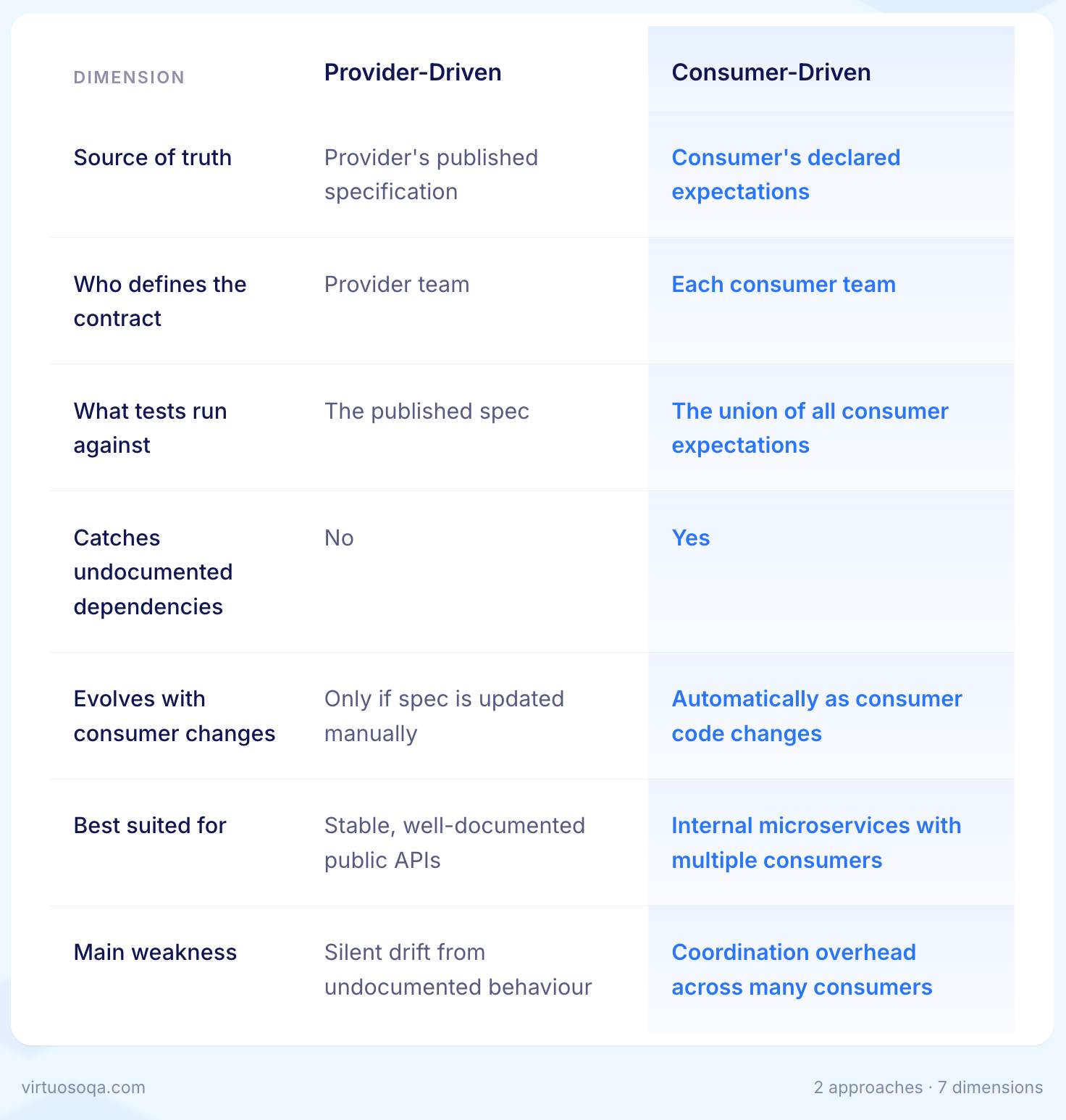
The choice between consumer-driven and provider-driven API contract testing determines everything else about the implementation. It is a structural decision with direct consequences for which failure modes the suite catches and which it misses.
Provider-Driven API Contract Testing
In provider-driven API contract testing, the provider defines the API specification, publishes it, and consumers code against the published shape. Tests verify that the provider's actual responses match the published spec.
The approach is administratively straightforward. It aligns with how most enterprise API governance programmes are structured. The weakness is structural. A consumer may depend on a field the spec documents loosely, or on a behaviour the spec mentions in passing.
The provider, treating the spec as canonical, makes a change the spec permits but the consumer cannot handle. The API contract tests pass. Production fails.
Consumer-Driven API Contract Testing
In consumer-driven API contract testing, each consumer declares what it expects from the provider. Those expectations are collected into a contract the provider must satisfy. Provider tests run against the union of all consumer expectations rather than against a single canonical spec.
Consumer-driven API contract testing has become the standard approach for microservices testing.
The key shift is that the consumer's actual dependencies become the source of truth for the contract. The provider cannot break a consumer without the API contract test suite detecting it, because the suite is built from what consumers actually need rather than what the provider documented.
Why Consumer-Driven API Contract Testing Works Better
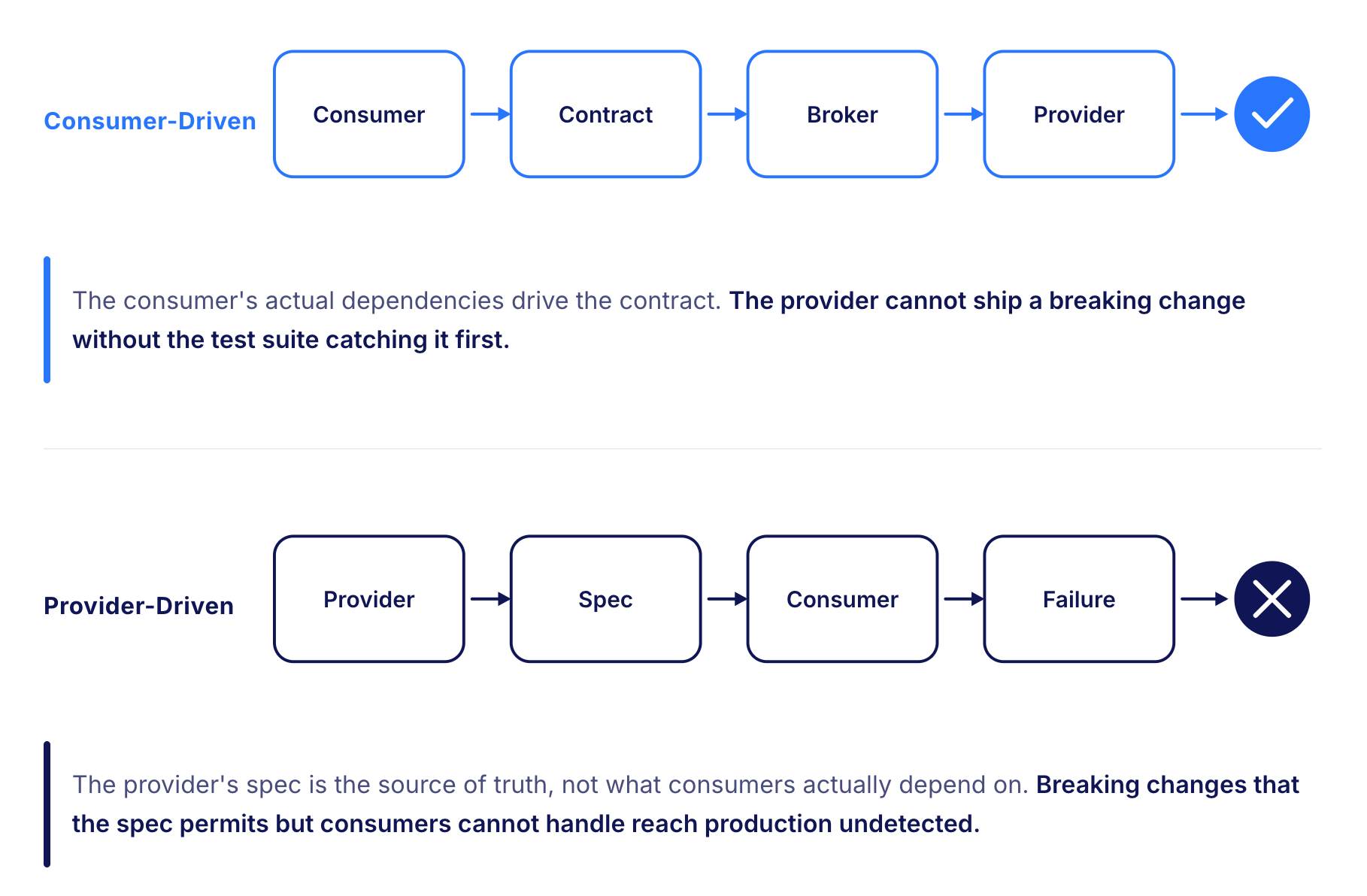
Consumer-driven API contract testing catches failures that provider-driven testing consistently misses for three reasons.
First, it aligns with how breakages actually happen. Consumers depend on what providers do, not on what they document.
Second, consumer expectations evolve with the consumer code, keeping the API contract current without manual maintenance cycles.
Third, it forces real conversations between provider and consumer teams about what they actually rely on rather than leaving the question open to spec interpretation.
The coordination cost is real. Managing consumer expectations across many consumers requires discipline. Most enterprise teams that adopt consumer-driven API contract testing find the cost worth paying within two release cycles.
Request and Response Validation in API Contract Testing
Effective API contract testing validates several layers of the interaction simultaneously. Validating only one layer produces suites that look comprehensive and miss the breakages that matter most.
1. Schema Validation
Schema validation is the foundational layer of API contract testing. It checks that request and response bodies conform to a defined structure expressed in OpenAPI, JSON Schema, or a similar format. Field names, data types, required versus optional fields, nesting structure, and array constraints all get verified against the schema.
Strong schemas in API contract testing reject what they have not explicitly permitted. Weak schemas accept anything that does not violate a written rule. Strong schemas catch drift early. Weak schemas hide it until production surfaces the problem.
2. Status Code Validation
Every API endpoint should return a defined set of status codes under defined conditions. API contract testing verifies the mapping. A GET on a missing resource should return 404, not 200 with an empty body. A POST with invalid input should return 400 or 422 with the documented error structure, not a 500. A successful PUT should return the documented 200 or 204.
Status code drift is a common source of consumer failures in API contract testing programmes that do not validate codes explicitly. A provider that switches from 200 to 204 for a successful operation breaks any consumer that branches on the response code.
3. Header Validation
Headers are easy to overlook when designing API contracts and disproportionately expensive when they drift. Authentication tokens, rate limit indicators, pagination cursors, content negotiation headers, and correlation IDs all live in headers. A consumer depending on an X-Rate-Limit-Remaining header to manage its request rate will fail silently when the provider renames or removes it.
API contract testing should assert the presence, format, and where appropriate the value range of every header the consumer actually depends on, not just the headers that appear obvious in the documentation.
4. Field-Level Validation
Beyond shape, API contracts often specify field-level constraints. A status field must be one of a defined set of values. A timestamp must follow ISO 8601 in UTC. An identifier must match a specific pattern. A numeric field must fall within a defined range.
Field-level validation in API contract testing is where contracts come closest to behavioural assertions without crossing into them. API contract testing checks that a field is in the right format. Behavioural testing checks that the field contains the right value for a given business scenario. The first is contract scope. The second belongs in a different test layer.
5. Versioning and Backwards Compatibility
API contracts evolve. The discipline in API contract testing is ensuring they evolve without breaking existing consumers. Three patterns cover most situations that arise in practice.
Adding new fields to a response is safe if consumers ignore unknown fields, which is the modern default behaviour. Renaming or removing fields is a breaking change that requires a new contract version with a formal migration path. Adding new required fields to a request is a breaking change. Adding new optional fields is not.
Mature API contract testing programmes include regression runs against historical contract versions to confirm the current provider implementation still satisfies what older consumers were promised.
The Four API Contract Testing Failure Modes
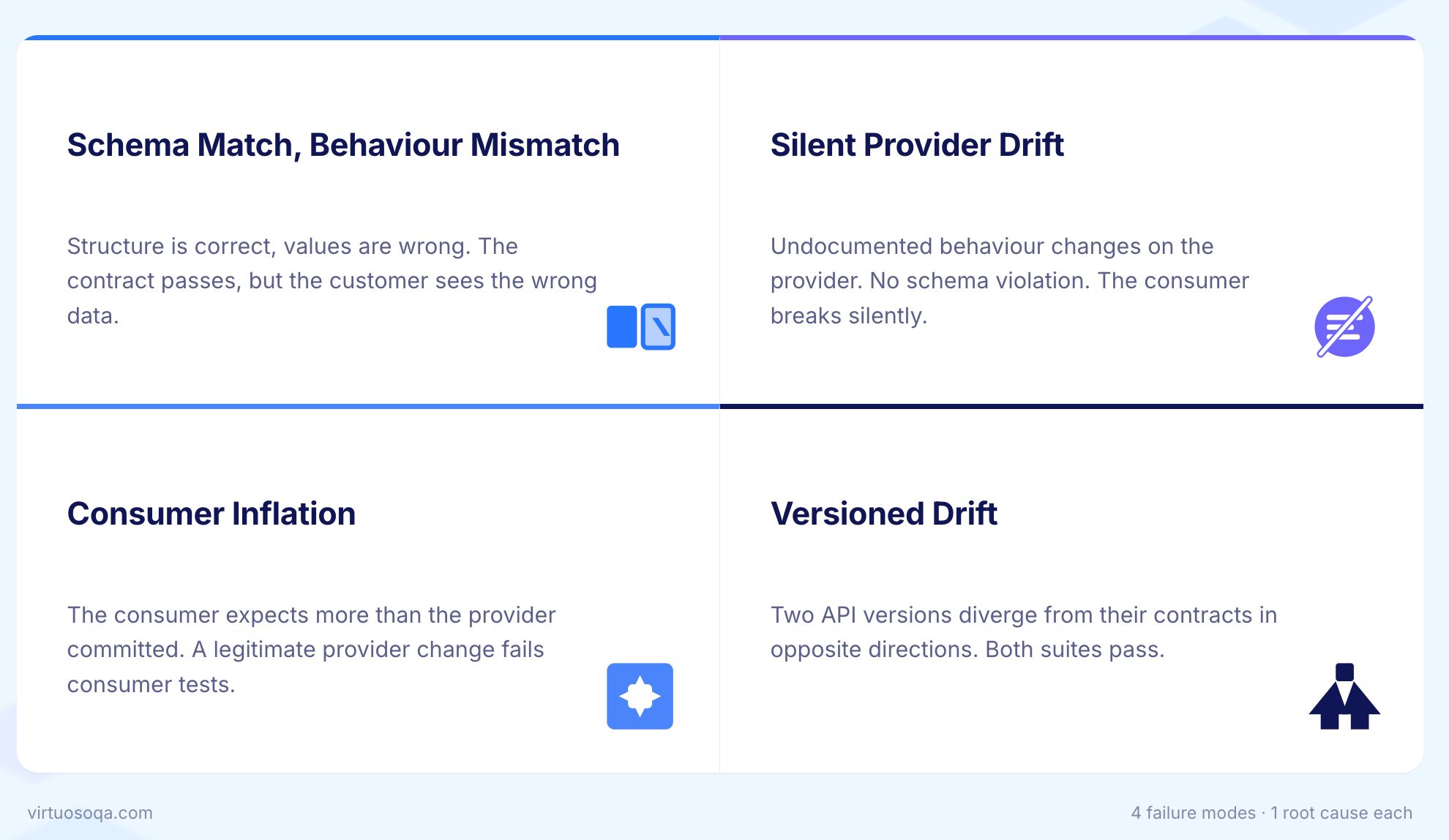
Most production incidents that API contract testing was meant to prevent come from the same four patterns. Understanding them helps teams design suites that catch what matters rather than creating the illusion of coverage.
1. Schema Match, Behaviour Mismatch
The most common failure in API contract testing programmes. The response conforms to the schema. The values inside the response are wrong. The API contract test passes because the structure is correct. The customer sees a balance of zero when it should show the correct amount.
API contract testing cannot catch behaviour mismatches by design. Schema validation ignores values. Teams that treat API contract tests as a substitute for behavioural tests will hit this failure mode the first time a logic defect ships through a correctly shaped response.
2. Silent Provider Drift
The provider makes a change that appears backwards-compatible but breaks a consumer relying on undocumented behaviour. A field that always returned in a specific order. A timestamp that always carried a specific timezone. A boolean that always defaulted to false. None of these changes violate the published schema. All of them break the consumer.
Consumer-driven API contract testing catches most silent provider drift because consumer expectations include the undocumented dependencies that actually drive consumer behaviour. Provider-driven API contract testing does not catch it, which is the core structural argument for the consumer-driven model.
3. Consumer Inflation
The opposite problem. A consumer team writes API contract expectations that exceed what the provider ever committed to. The provider satisfies those expectations by accident for several releases. When the provider makes a legitimate internal change, the consumer's API contract tests fail and the consumer team escalates a breach the provider never owed.
The mitigation is governance. Consumer expectations should be reviewed by the provider team before being included in the API contract test suite. The review reveals where the consumer is overreaching and where the provider's commitments were written too loosely.
4. Versioned Drift
The provider runs two API versions in parallel. API contracts exist for both. Over time, the implementation drifts in ways that make the two versions diverge from their stated contracts in different directions. Both API contract test suites pass. Customers on the older version experience different behaviour from customers on the newer version, and nobody responsible for both versions can determine which behaviour is canonical.
The mitigation is enforced deprecation. Every endpoint in every active API version should have a single canonical contract. Older versions should be retired on published timelines rather than left running until they become a liability.
Where API Contract Testing is Not Enough
API contract testing is precise and fast. It is not complete. Understanding the boundary is what separates teams that get genuine value from API contract testing from teams that are surprised when it fails to prevent production incidents.
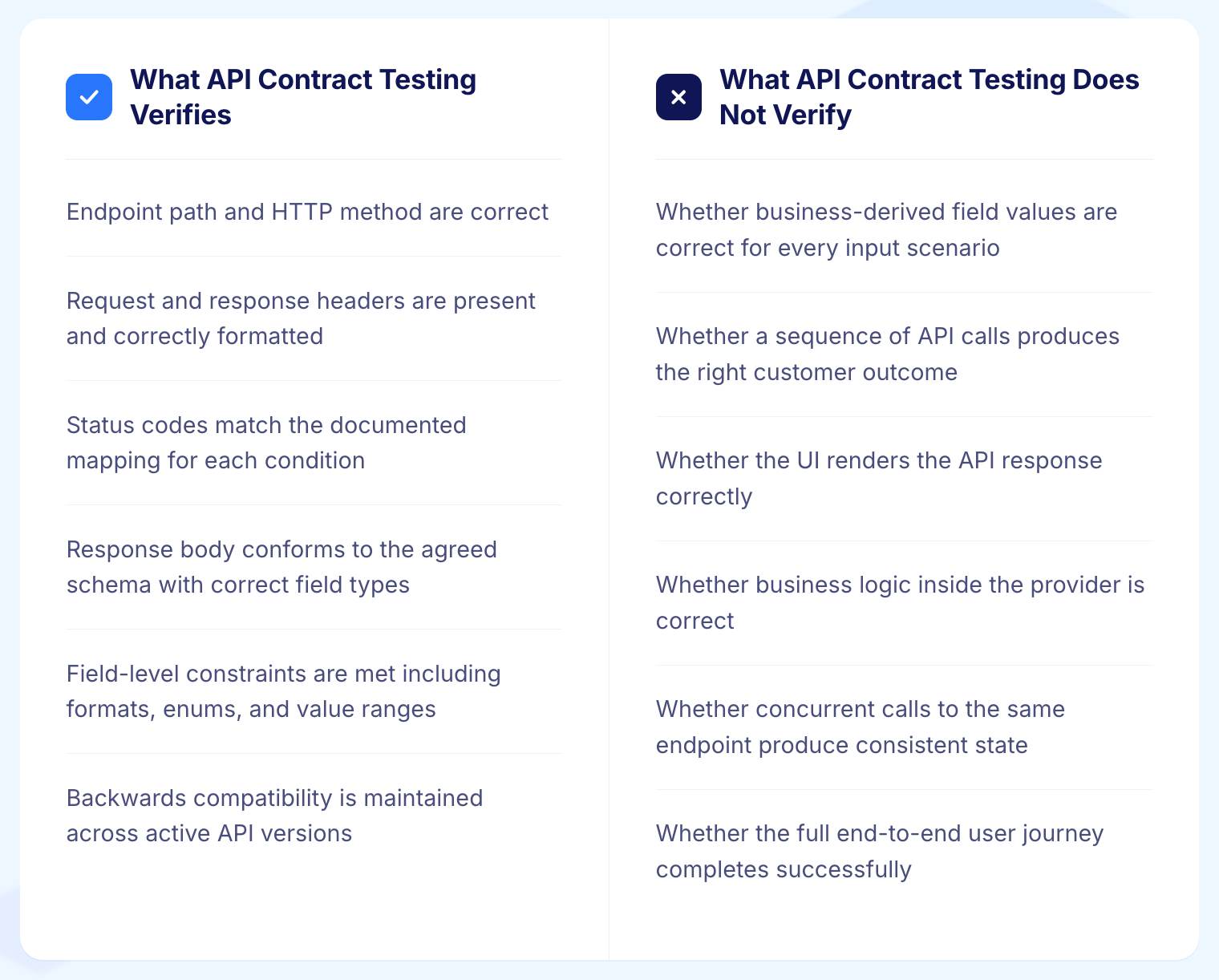
Contract Verification vs Behavioural Verification
API contract testing verifies the agreement. Behavioural testing verifies the action. A login endpoint that returns the correct schema but issues an authentication token to the wrong user passes API contract testing and fails the business. The gap is invisible to a suite running only API contract tests.
A complete API verification approach pairs API contract testing with behavioural tests that assert on specific inputs and expected outputs, run against real or representative data.
Contract Verification vs Workflow Verification
A user journey rarely depends on a single API call. It depends on a sequence: authenticate, fetch profile, search inventory, add to basket, process payment, confirm order. Each call may conform to its API contract. The sequence may still fail because of state mismatch, timing differences, or business logic that crosses multiple calls.
API contract testing verifies individual calls. Workflow testing verifies sequences. Both are necessary at enterprise scale and neither substitutes for the other.
Contract Verification vs UI Verification
The customer does not interact with the API directly. They interact with the application built on top of it. A contract that holds, a backend that behaves correctly, and a UI that renders incorrectly still produces a failed customer experience.
A complete approach treats API contract testing as one layer inside a broader verification stack. Contract tests at the service boundary. Behavioural tests at the call level. Journey tests across the workflow. UI verification at the customer surface. The stack verifies the outcome the customer experiences, not just the layer the API team owns.
API Contract Testing When AI is Writing the Code
AI coding assistants are generating significant portions of new endpoint code in many enterprises. This changes what API contract testing has to handle in ways most contract testing programmes were not designed for.
More endpoints arrive per release than traditional API contract review processes can keep pace with. Variation between implementations widens because AI-generated endpoints for similar functions often differ in subtle ways around header conventions, error response shapes, and pagination patterns. Occasionally an implementation adds a behaviour the requirement did not specify, or quietly omits a field the consumer was promised.
A useful measure is API contract drift velocity: the rate at which contracts change per release, measured in field-level changes. Teams whose drift velocity exceeds their contract review capacity ship breakages even when API contract tests pass, because the contracts themselves are not keeping up with what the implementations and consumers actually depend on.
The teams managing this well automate API contract generation alongside endpoint generation. The contract updates as the API updates, verified continuously rather than reviewed periodically. The same process that keeps the implementation current keeps the API contract current.
How to Set Up API Contract Testing: A Step-by-Step Guide
Step 1: Define the Contract Before Writing Any Code
Write the API specification before any endpoint exists. Use OpenAPI, JSON Schema, or a consumer expectation file depending on whether you are taking a provider-driven or consumer-driven approach. Both the provider and consumer teams review and sign off on the contract before development begins. This surfaces disagreements at the design stage where they are cheapest to resolve.
Step 2: Choose the Right Tools for Your Architecture
Tool selection depends on your architecture and the contract model you are using. For consumer-driven contract testing in microservices, Pact is the most widely adopted option. For OpenAPI-based provider contract testing, Dredd and Schemathesis generate and run tests directly from the specification.
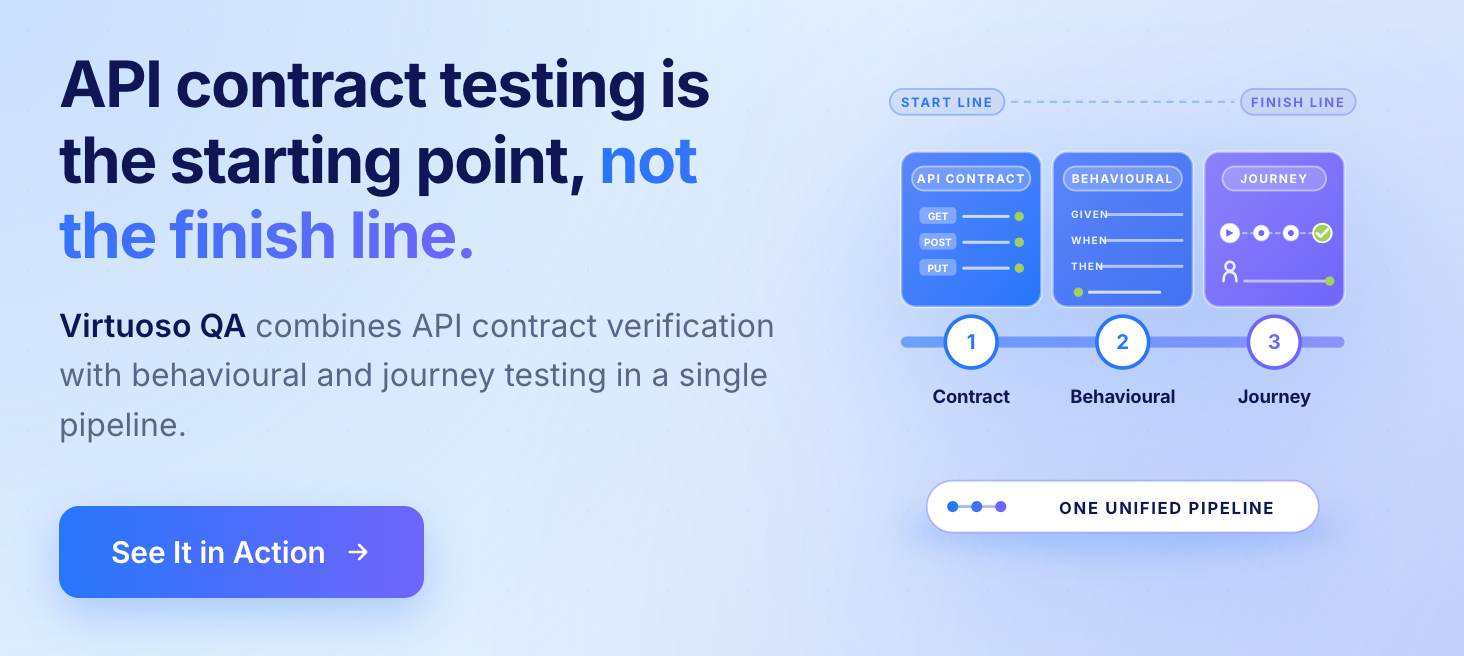
For teams that want API contract verification integrated into broader journey and UI testing, Virtuoso QA combines all three layers in a single pipeline without requiring separate toolchains.
Related Read: Comparing the Best API Automation Testing Tools
Step 3: Set Up Mock Servers for Isolated Testing
Configure mock servers to simulate the provider or consumer so tests can run without depending on live systems. This keeps API contract tests fast and stable. It also means the consumer team can test against the contract before the provider has finished building the endpoint, which removes a common dependency bottleneck in parallel development.
Step 4: Write Contract Tests Covering All Validation Layers
Write test cases that cover schema validation, status code mapping, header presence and format, and field-level constraints. Do not write only happy path tests. Include cases for invalid inputs, missing required fields, and error response shapes. A contract test suite that only validates successful responses is covering half the contract.
Step 5: Integrate API Contract Tests Into the CI/CD Pipeline

Configure the pipeline to run API contract tests on every pull request that touches API code on either side of the contract. Set the pipeline to fail the build if any contract test fails. API contract tests that run nightly rather than on every pull request lose most of their value because breakages merge before they are caught.
Step 6: Manage API Changes and Deprecation
API changes are inevitable. Three strategies work consistently for managing them without silent breakages.
Make additive changes first wherever possible. Adding new optional fields to a response or new optional parameters to a request is backwards-compatible. Consumers that do not need the new field ignore it.
Version explicitly when breaking changes are unavoidable. When a field must be renamed, removed, or a required parameter must be added, create a new API version rather than modifying the existing one. Run both versions in parallel during the migration window and maintain separate API contracts for each.
Enforce deprecation timelines. Publish the date on which the old version will be retired. Monitor which consumers are still calling the deprecated version. Contact them directly rather than waiting for them to discover the retirement through a failure.
Step 7: Monitor, Version, and Maintain
Version API contracts explicitly and track changes between versions. Run regression tests against historical contract versions to confirm the current implementation still satisfies what older consumers were promised.
Review test results regularly to identify patterns. Update contracts and tests whenever the underlying API changes. Retire old versions on published timelines rather than leaving them running indefinitely.
API Contract Testing Best Practices
Most API contract testing failures come from implementations that look thorough but verify the wrong things. These practices consistently produce suites that earn their place.
1. Define the API Contract Before Writing Code
Before any endpoint exists, the OpenAPI specification or consumer expectation file is written and agreed by both teams. Provider and consumer sign off on the interaction before either builds against it.
This forces alignment at the point where it is cheapest. Disagreements surface in the design phase rather than in production incidents.
2. Generate API Contract Tests From the Specification
The specification becomes the single source of truth for both implementation and verification. Provider tests are generated against the spec. Consumer mocks are generated against the spec. The team does not maintain three separate sources, specification, implementation, and tests, that can drift apart independently and silently.
3. Run API Contract Tests on Every Pull Request
API contract tests belong in the CI/CD pipeline running on every pull request that touches API code on either side of the contract. Breakages surface within minutes of being introduced. An API contract testing suite that runs nightly loses most of its value because the feedback loop is too slow to change behaviour at the point of development.
4. Pair API Contract Testing With Behavioural and Journey Tests
The complete verification approach runs all three layers together. API contract tests check the structure. Behavioural tests check the values. Journey tests check the customer outcome. The build passes all three layers or it holds. Running only API contract testing and treating it as sufficient coverage is the most common way API contract testing programmes fail to prevent the incidents they were designed to catch.
5. Write Tight Contracts Not Loose Ones
A contract that permits anything not explicitly forbidden does not protect anyone. Strong API contracts specify what is required, what is allowed, and what is forbidden with field-level precision. Most teams default to loose contracts because tight ones require more effort to write. The cost of that shortcut shows up in production.
6. Retire Versions on a Published Timeline
Older API versions accumulate. Each runs in parallel. Each has its own contract. Without a deprecation timeline that is actually enforced, teams end up maintaining API contracts for endpoints nobody uses while the current version goes under-tested. Publish the deprecation schedule. Enforce it.
Common Mistakes Teams Make With API Contract Testing
1. Treating the Contract Test as the Last Line of Defence
A team adopts API contract testing, sees the immediate value, and stops investing in behavioural and journey-level verification. Production incidents return within two quarters in a different shape: contracts hold, customers still complain. The API contract test is a layer, not the whole stack.
2. Writing Loose Contracts
A contract that permits anything not explicitly forbidden does not protect anyone. Strong API contracts specify what is required, what is allowed, and what is forbidden with field-level precision. Most teams ship loose contracts because tight ones take more effort to write.
3. Versioning Without Retiring
Older API versions accumulate. Each runs in parallel. Each has its own contract. Without a deprecation timeline that is actually enforced, teams end up maintaining contracts for endpoints nobody uses while the current version goes under-verified.
4. Three Sources of Truth Drifting Apart
When the specification, the implementation, and the test suite can all diverge independently, contract tests always pass and breakages still reach production. The fix is structural: generate from the specification, fail the build when the spec and implementation disagree, and treat the specification as the source of truth rather than as documentation written after the fact.
5. Running Contract Tests Without Governance
Consumer expectations added without provider review create consumer inflation. Provider changes made without consumer notification create silent drift. API contract testing only works when both sides of the contract are actively governed, not just technically verified.
How Virtuoso QA Supports API Contract Testing
Virtuoso QA treats API contract verification as one layer inside a unified verification approach rather than as a standalone discipline separate from the rest of the test suite.
The platform runs API contract tests inside the same composable journey as UI tests. A single journey authenticates, calls and asserts on a contract-verified API response, and confirms the resulting UI state. The journey is the unit of verification. API contract validation, behavioural assertions, and UI checks are layers inside it rather than three separate coordinated suites maintained independently.
GENerator produces API contract tests from OpenAPI specifications and from existing API test suites written in older frameworks. Teams with years of invested API test coverage migrate to the Virtuoso QA platform without abandoning that investment.
Self-healing AI keeps API contract assertions current as implementations change, adapting at approximately 95% accuracy rather than breaking every time a provider updates an endpoint.
AI Root Cause Analysis identifies whether a journey failure originated at the API contract layer, the behavioural layer, or the UI layer. The team knows which boundary changed without manually tracing the failure across three separate toolsets. Triage time reduces by up to 75%.
Risk-based execution prioritises journeys that depend on changed API endpoints, so the pipeline gates on the customer outcomes that matter rather than running the full suite uniformly on every commit.
Related Reads
Frequently Asked Questions
What does API contract testing actually verify?
Can API contract testing replace integration testing or end-to-end testing?
How should API contract testing fit into a CI/CD pipeline?
How does Virtuoso handle API contract testing?
How does AI-generated code affect API contract testing?