

Blog
How to Perform Regression Testing in Salesforce

Published on
December 18, 2025


Understand Salesforce regression testing challenges, strategies, and tools. See how enterprises cut maintenance by 88% and shrink regression cycles.
Salesforce regression testing determines whether your CRM remains reliable through relentless change. Three annual platform releases, continuous customization, and frequent integration updates create a testing burden that traditional approaches cannot sustain. Manual regression requires hundreds of person-days per release. Code-based automation demands 80% of QA capacity for maintenance rather than coverage expansion.
AI-native regression testing eliminates this crisis. Enterprises using intelligent platforms report 83% faster core product regression, 88% maintenance reduction, and testing cycles compressing from 475 person-days to 4.5 person-days. Self-healing automation adapts automatically to Salesforce changes. Natural language test authoring democratizes regression coverage. Continuous execution in CI/CD pipelines detects defects minutes after code commits rather than weeks later.
This guide explains how modern QA teams perform Salesforce regression testing effectively, why legacy approaches fail at enterprise scale, and how AI transforms regression from a release bottleneck into a competitive advantage.
Salesforce implementations never stop changing. Your organization deploys customizations weekly, Salesforce releases platform updates quarterly, integration partners modify APIs continuously, and business requirements evolve constantly. Every change risks breaking previously working functionality.
Consider the scope. A typical enterprise Salesforce implementation includes thousands of custom fields, hundreds of workflows and process builders, dozens of Apex classes, numerous Lightning components, and countless integrations with external systems. A single Lightning component update can cascade through dependent objects, trigger modifications, and UI layouts, potentially breaking workflows across multiple business processes.
Traditional regression testing attempts to validate this complexity through comprehensive test suites executed before each release. But Salesforce's velocity creates an impossible equation: test suites grow continuously as implementations expand, while time available for regression shrinks as release cycles accelerate. Manual teams cannot keep pace. Code-based automation collapses under maintenance burden.
Salesforce regression testing diverges from standard application testing in critical ways that determine success or failure.
Enterprises underinvesting in Salesforce regression face predictable consequences. Production defects disrupt revenue operations, corrupt customer data, violate compliance requirements, and damage user trust.
Manual regression creates different problems. QA teams executing comprehensive manual regression require weeks per release, becoming the critical path delaying deployments. Business pressure to accelerate releases forces regression scope reductions, creating gaps where defects escape. Teams face impossible choices: thorough testing that delays releases or rapid testing that risks production incidents.
Code-based automation appears to solve this until maintenance burden emerges. Traditional Selenium frameworks require constant script updates as Salesforce evolves. Teams report spending 80% of automation effort on maintenance, only 10% on authoring new tests, leaving insufficient capacity to expand coverage or validate new features. Regression suites become expensive burdens rather than assets.
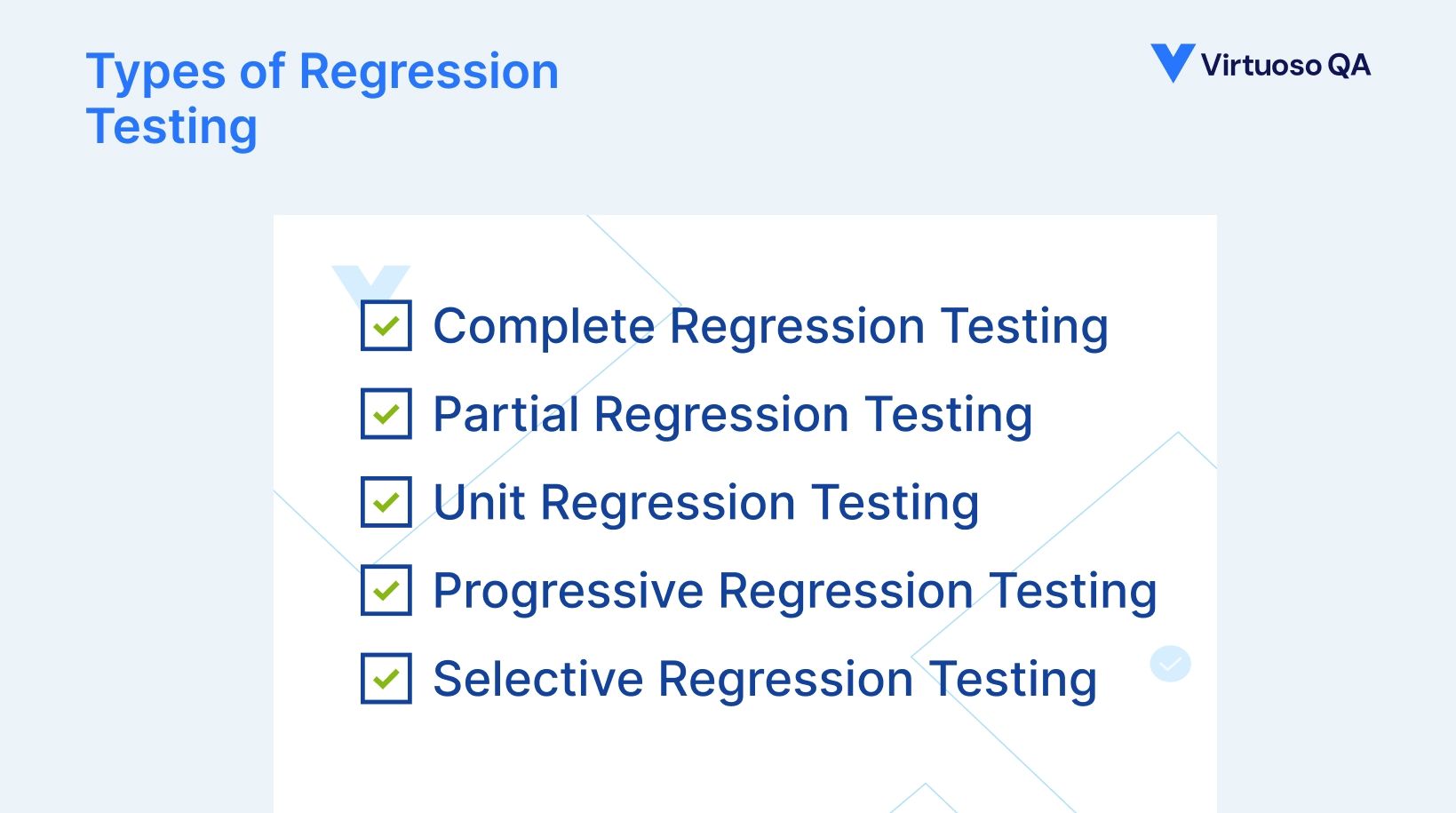
Complete regression validates every feature, workflow, and integration point regardless of what changed. This comprehensive approach provides maximum confidence that nothing broke but requires significant time and resources.
Complete regression makes sense for major Salesforce releases, significant customization deployments, or when changes touch foundational elements like security models or data architectures.
However, complete regression every sprint or deployment is unsustainable without automation. Manual complete regression requires hundreds or thousands of person-hours. Even automated complete regression demands hours of execution time. Enterprises need intelligent approaches determining when complete regression is necessary versus when more targeted testing suffices.
Partial regression validates subsets of functionality likely affected by specific changes. If you modify Opportunity workflows, partial regression tests opportunity management, quote generation, and commission calculations but skips case management and service processes.
Partial regression enables faster feedback cycles by focusing validation effort where risk exists. Development teams receive test results in hours rather than days, enabling rapid iteration. The challenge lies in accurately determining which features might be impacted. Dependencies aren't always obvious, and changes in one area can break seemingly unrelated functionality.
AI-native platforms address this through intelligent test selection. Machine learning algorithms analyze code changes, historical defect patterns, and application architecture to identify which tests should execute. This risk-based approach provides partial regression benefits while minimizing the risk of missing critical defects.
Unit regression validates individual components in isolation: single Apex classes, Lightning components, validation rules, or workflow processes. Salesforce requires Apex test classes for code deployment, providing built-in unit regression for custom code.
Unit regression executes quickly and pinpoints defects precisely but cannot validate end-to-end business processes or integration points. A unit test confirming that an Apex trigger correctly calculates commission doesn't validate that commissions display properly in the UI or synchronize correctly with the payroll system.
Effective Salesforce regression combines unit testing for rapid developer feedback with integration and UI testing validating complete business workflows. Teams executing only unit regression while neglecting end-to-end validation inevitably discover integration defects in production.
Progressive regression incorporates new test cases validating recently added functionality while retaining existing regression coverage. As your Salesforce implementation expands, regression scope grows correspondingly.
This approach ensures comprehensive coverage but creates exponentially growing test suites. Without intelligent test optimization, progressive regression eventually becomes unsustainable. Execution times stretch to days, maintenance burden overwhelms teams, and regression becomes the release bottleneck.
AI-native platforms solve this through autonomous test optimization. Algorithms identify redundant tests covering identical functionality, consolidate overlapping scenarios, and eliminate obsolete tests validating deprecated features. Test suites remain comprehensive while execution remains efficient.
Selective regression executes only tests likely to detect defects based on what changed. If you modify Account validation rules, selective regression tests Account creation, updates, and related workflows but skips Opportunity, Case, and Contact management entirely.
Selective regression provides the fastest feedback but requires sophisticated change impact analysis. Getting selection wrong means missing critical defects. Manual selection is error-prone and time-consuming. Automated selection requires intelligence understanding application architecture and dependencies.
Modern platforms combine multiple regression strategies: selective regression for routine deployments providing rapid feedback, progressive regression for sprint boundaries ensuring new features integrate properly, and complete regression for major releases guaranteeing comprehensive validation.
Effective regression begins by identifying business processes demanding continuous validation. Not all Salesforce functionality carries equal business risk. Prioritize coverage based on impact.
Traditional regression test design creates detailed test cases specifying exact steps, expected results, and validation criteria. This approach generates comprehensive documentation but produces brittle automation that breaks whenever Salesforce changes.
Modern regression design emphasizes composable test architecture. Rather than monolithic test cases hard-coding every step, teams build reusable test components representing common business actions. A "Create Opportunity" component handles all steps for creating opportunities with appropriate fields and validation. A "Submit for Approval" component manages approval workflows.
Regression tests assemble from these components: "Create Account, Create Opportunity, Generate Quote, Submit for Approval, Verify Commission Calculation." When Opportunity creation workflows change, updating one component automatically updates all regression tests using that component. One GSI built composable test assets that deploy across multiple customer Salesforce instances, enabling scaled delivery.
Composability delivers exponential maintenance efficiency. Instead of updating hundreds of individual test cases when workflows change, teams update single components affecting all dependent tests. Regression suites remain stable through Salesforce changes, eliminating the maintenance crisis that cripples traditional automation.
Regression testing requires realistic data reflecting production complexity. Insufficient test data creates false confidence when tests pass in simplified scenarios but fail with real-world data complexity.
Intelligent test data management eliminates the chronic "waiting for test data" bottleneck. Platforms automatically generate test data meeting specific scenario requirements, execute tests, and clean up afterward, maintaining environment stability.
Comprehensive Salesforce regression must validate not just UI functionality but complete business processes including API operations and external system integrations.
Unified testing platforms handling both UI and API testing enable true end-to-end regression. Single test scenarios navigate Salesforce UI, trigger API calls, validate external system responses, and confirm expected outcomes, eliminating complexity of coordinating separate testing tools.
To explore API and integration testing in greater depth, see our guide on Web Service Testing, which covers REST, SOAP, microservices, and unified UI-to-API validation in detail.

Many enterprises initially adopt code-based frameworks like Selenium for Salesforce regression automation. These approaches require significant engineering investment to build frameworks, handle Salesforce's dynamic UI, and maintain test scripts.
Traditional frameworks face predictable challenges in Salesforce environments. Dynamic element IDs change frequently, breaking XPath and CSS selectors. Shadow DOM in Lightning components creates boundaries that standard Selenium struggles to penetrate. Salesforce's three annual releases guarantee constant test maintenance.
Teams report spending 80% of their automation time on maintenance rather than expanding coverage. Regression suites become expensive burdens. QA capacity goes to fixing broken tests instead of validating new features. Organizations stuck in this maintenance trap question whether automation delivers positive ROI.
Record-and-playback tools like UFT or TestComplete reduce initial coding requirements but struggle equally with Salesforce's dynamic nature. Recorded tests break whenever UI elements change. Maintenance remains intensive. These tools cannot handle modern development practices like continuous deployment or progressive delivery.
The fundamental problem is that traditional frameworks were designed for static web applications with predictable element structures. Salesforce's dynamic, evolving nature exceeds their capabilities. Attempting to force-fit legacy automation approaches to modern cloud CRM results in perpetual struggle.
AI-native test platforms transform regression automation through self-healing capabilities that automatically adapt tests when Salesforce changes.
When Salesforce updates modify element selectors, intelligent algorithms detect the changes, evaluate alternative identification strategies, update test steps automatically, and continue execution. Human testers never need to open test scripts.
Consider a practical example. Salesforce Spring '25 release changes a button's ID from "submit-btn-v1" to "submit-btn-v2." Traditional Selenium tests hard-coding this ID immediately break. QA teams must identify failed tests, locate the changed element, update selectors, and rerun tests. Multiply this across hundreds or thousands of tests and maintenance becomes overwhelming.
Self-healing automation handles this automatically. The platform detects the ID change, evaluates alternative identification strategies using button text, position, nearby elements, and visual appearance, determines the most reliable alternative, updates the test step, and continues regression execution. The test remains stable without human intervention.
The business impact is transformational. Enterprises report 88% reductions in test maintenance effort. Regression suites that previously required constant attention remain stable through Salesforce releases. QA teams shift from firefighting broken automation to strategic activities like expanding coverage and improving test design.
Traditional automation requires specialized engineers who understand both Salesforce architecture and programming languages like Java, Python, or JavaScript. This creates bottlenecks limiting regression coverage expansion.
Natural language test authoring democratizes regression automation. Instead of writing complex code navigating Salesforce's DOM structure, testers describe business intent: "Navigate to high-value Opportunities, change Stage to Negotiation, verify approval workflow triggers, confirm commission updates correctly."
The platform translates this intent into executable tests that interact with Salesforce's UI, validate data, and verify workflows. Business analysts, functional testers, and subject matter experts create robust regression tests without coding skills. One enterprise enabled functional testers to become automation engineers within a single sprint, eliminating the traditional six-month ramp-up required for Selenium expertise.
Natural language authoring accelerates regression coverage expansion dramatically. Teams create tests 10x faster than code-based approaches. Coverage gaps close quickly. Business users participate directly in regression design, ensuring tests validate actual business requirements rather than technical interpretations.
This democratization is critical for regression sustainability. As Salesforce implementations grow more complex, regression scope expands correspondingly. Without natural language authoring, regression coverage cannot keep pace with customization velocity. With it, regression becomes a team capability rather than a specialized engineering function.
Monolithic regression tests hard-coding every step create brittle automation that's difficult to maintain and impossible to reuse. Modern regression strategies emphasize composable architecture.
Teams build libraries of reusable test components representing common business actions: "Create Account," "Add Contact to Account," "Create Opportunity," "Generate Quote," "Submit for Approval," "Verify Commission Calculation." Each component encapsulates all steps, validations, and error handling for that specific action.
Regression tests assemble from these components like building blocks. A complete sales cycle regression test combines: "Create Account, Add Contact, Create Opportunity, Add Products, Generate Quote, Submit for Approval, Process Order, Verify Commission." Creating this test requires assembling existing components rather than authoring from scratch.
Composability delivers multiple advantages. Regression suites become dramatically more maintainable because updating a shared component automatically updates all tests using that component. When Quote generation workflows change, teams update one "Generate Quote" component, and hundreds of regression tests incorporating that component update automatically.
Test authoring accelerates exponentially. New regression scenarios assemble from existing components in minutes rather than hours. Coverage expands rapidly.
Reusability enables regression at scale. Global enterprises with multiple Salesforce instances create "lift and shift" regression assets that deploy across customer implementations. Partners delivering Salesforce projects leverage composable regression libraries, accelerating time-to-value and enabling scaled delivery.
Even with natural language authoring and composable components, teams face the challenge of achieving comprehensive regression coverage quickly. Traditional approaches require manually authoring every test scenario, consuming months or years to reach adequate coverage.
Autonomous test generation changes this calculus. AI analyzes Salesforce applications, identifies business workflows, and automatically generates regression coverage. Virtuoso QA's StepIQ examines implementations, recognizes common patterns like opportunity management, case handling, and account maintenance, and generates tests covering these scenarios.
This doesn't replace human test design but dramatically accelerates initial regression automation. Teams review auto-generated tests, refine scenarios based on business requirements, and incorporate company-specific logic. What previously required months of manual test authoring completes in weeks.
Autonomous generation particularly benefits regression testing because it identifies coverage gaps. The AI analyzes existing regression suites, compares against actual application functionality, and highlights areas lacking adequate coverage. Teams focus authoring effort where gaps exist rather than duplicating existing coverage.
How often should regression execute? The answer depends on release velocity, risk tolerance, and automation maturity.
Sequential regression execution creates bottlenecks. Comprehensive Salesforce regression covering thousands of scenarios might require 10-20 hours executing sequentially, delaying feedback and blocking release pipelines.
Parallel test execution solves this by running multiple tests simultaneously across distributed infrastructure. What previously required 10 hours completes in 30-60 minutes, providing rapid feedback while maintaining comprehensive coverage.
Cloud-native testing platforms provide elastic parallel execution. During overnight regression runs, platforms scale to hundreds of parallel executors, maximizing speed. During daytime interactive testing, execution capacity scales down, optimizing cost. Teams don't manage infrastructure but consume testing capacity on demand.
Effective parallel execution requires careful test design. Tests must be independent, not sharing data or depending on execution sequence. Test data isolation ensures reliability.
Salesforce sandboxes serve as regression environments but introduce management complexity. Development sandboxes contain minimal data and customizations. Full Copy sandboxes mirror production. Partial Copy sandboxes balance data volume and refresh costs. UAT sandboxes serve business user acceptance testing.
Effective regression strategies align test execution with appropriate environments. Smoke testing and developer regression use Developer sandboxes, providing rapid feedback without consuming expensive Full Copy refreshes. Comprehensive regression uses Full Copy sandboxes, validating behavior matching production complexity. UAT uses dedicated UAT sandboxes with business-representative data.
Environment stability matters critically. Regression environments experiencing frequent configuration changes or data quality issues produce unreliable results. Teams waste time investigating whether test failures indicate application defects or environment problems.
Isolated regression testing occurring separately from development creates friction and delays. Modern practices embed regression throughout CI/CD workflows.
This integration transforms regression from a testing phase into a continuous quality gate embedded throughout software delivery.

Salesforce generates unique element IDs dynamically, making traditional XPath or CSS selectors unreliable. Lightning updates frequently change element structures. Regression tests using static locators break constantly, requiring intensive maintenance.
Solution: AI-native platforms use multiple identification strategies simultaneously. Rather than relying solely on element IDs, intelligent algorithms evaluate labels, position, context, nearby elements, and visual appearance. When IDs change, tests continue working using alternative attributes. Self-healing automatically adapts when Salesforce changes element properties.
Three annual Salesforce releases introduce UI changes, deprecated features, and new functionality. Traditional regression suites break en masse after releases, requiring emergency maintenance sprints that delay regression cycles and block deployments.
Solution: Self-healing automation detects release changes and adapts automatically. When Spring '25 release modifies Lightning component structure, intelligent algorithms identify affected tests, evaluate alternative element identification strategies, update test steps, and continue execution.
Human testers review changes afterward for validation but don't perform emergency maintenance. Regression continues executing immediately after Salesforce releases rather than waiting days or weeks for test repairs.
As Salesforce implementations grow, regression scope expands correspondingly. New features require new tests. Legacy functionality still demands validation. Regression suites grow from hundreds to thousands to tens of thousands of scenarios, overwhelming QA capacity.
Solution: Natural language authoring and autonomous test generation accelerate regression coverage expansion. Functional testers create tests describing business intent without coding. AI generates comprehensive coverage automatically.
Composable test architecture enables rapid test creation by assembling existing components. Intelligent test optimization identifies redundant scenarios, consolidates overlapping coverage, and eliminates obsolete tests, keeping regression efficient.
Salesforce regression must validate not just CRM functionality but complete business processes spanning external systems. Coordinating regression across multiple environments, synchronizing test data, and validating integration points compounds complexity exponentially.
Solution: Unified testing platforms handling both UI and API testing enable true end-to-end regression. Single test scenarios navigate Salesforce UI, trigger API calls to ERP systems, validate data synchronization, and confirm downstream processing.
This eliminates complexity of coordinating separate UI testing tools, API testing frameworks, and database validation scripts. Regression validates complete business processes rather than isolated components. One enterprise reduced integration regression effort by 60% through unified platform adoption, while improving defect detection.
Comprehensive regression covering thousands of scenarios requires hours or days executing sequentially. Release pipelines stall waiting for regression completion. Business pressure to accelerate deployments forces regression scope reductions, creating gaps where defects escape.
Solution: Parallel execution distributes regression across cloud infrastructure, compressing execution from hours to minutes. Intelligent test selection executes appropriate regression depth based on what changed, balancing speed and coverage.
Continuous regression throughout development provides constant quality visibility without blocking releases.
Regression requires realistic test data reflecting production complexity. Creating this data manually is time-consuming. Production data copies risk privacy violations. Insufficient test data creates false confidence when tests pass in simplified scenarios but fail with real-world complexity.
Solution: AI-powered test data generation analyzes production patterns and creates synthetic datasets matching statistical properties while respecting privacy. Platforms automatically provision test data meeting specific scenario requirements, execute tests, and clean up afterward.
Test data isolation ensures reliability by eliminating dependencies on shared data.
Selecting regression automation platforms requires evaluating multiple dimensions determining long-term success.
Traditional frameworks built for generic web testing struggle with Salesforce's unique characteristics. Purpose-built AI-native test platforms deliver decisive advantages for regression.
These aren't incremental improvements but fundamental differences determining whether regression automation delivers sustained ROI or becomes an expensive burden.
Virtuoso QA represents next-generation AI-native regression automation purpose-built for enterprise applications like Salesforce.
For Salesforce implementations demanding continuous regression, rapid release cycles, and sustainable automation ROI, AI-native platforms like Virtuoso QA represent the only viable long-term strategy.

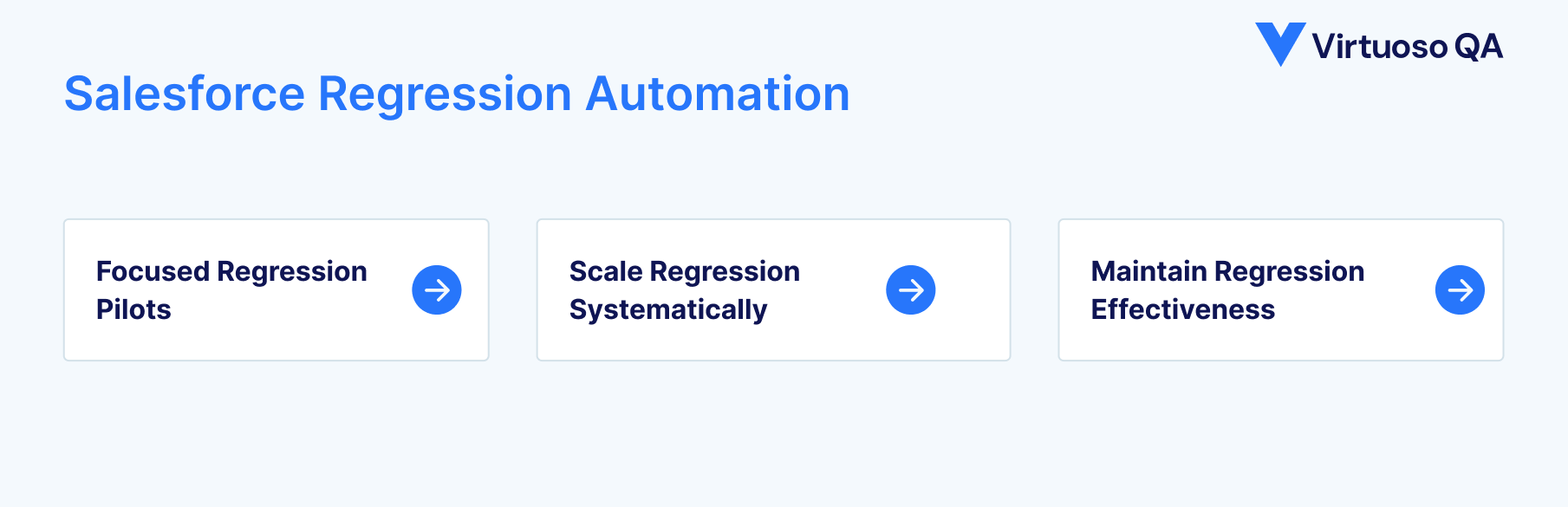
Rather than organization-wide automation rollouts, begin with focused regression pilots demonstrating value quickly.
Choose business-critical Salesforce workflows benefiting from automation but narrow enough to complete within 4-6 weeks. Claims processing, opportunity management, or order fulfillment work well.
Include QA professionals, business analysts, developers, and stakeholders ensuring comprehensive regression design.
Establish clear measurements: regression cycle time, defect detection rate, maintenance effort, and execution frequency. Baseline current state enabling ROI demonstration.
Create regression automation using pilot process, execute against Salesforce releases and customizations, and track metrics demonstrating improvement.
Present tangible results to stakeholders showing regression cycle compression, maintenance reduction, and improved defect detection. Build organizational confidence justifying broader rollout.
After successful pilots, scale regression systematically across complete Salesforce implementations.
Expand regression coverage to additional processes based on business criticality, transaction volume, and regulatory requirements.
Establish expertise hubs training team members, defining regression standards, and supporting automation expansion across organization.
Embed regression throughout CI/CD pipelines making continuous validation standard practice rather than separate testing phase.
Build reusable regression components organized by functional area, enabling test creation through assembly rather than authoring.
Regular regression reviews identifying coverage gaps, optimizing execution performance, and retiring obsolete scenarios maintaining effectiveness.
Regression automation requires ongoing attention ensuring continued value as Salesforce implementations evolve.
Assess regression coverage against current business processes identifying gaps requiring new tests or deprecated scenarios warranting retirement.
Track regression execution times identifying slowest scenarios requiring optimization through parallel execution or test refactoring.
Monitor time fixing broken regression tests. Persistent maintenance indicates tests requiring redesign or migration to more stable automation approaches.
Ensure regression reflects current business priorities rather than historical implementations. Salesforce evolves continuously; regression must evolve correspondingly.
As automation platforms introduce new capabilities like autonomous generation or enhanced self-healing, evaluate adoption accelerating regression effectiveness.

Try Virtuoso QA in Action
See how Virtuoso QA transforms plain English into fully executable tests within seconds.
