Blog
What is BDD Testing? Guide to Behavior-Driven Development Testing

Virtuoso QA
Published on

Table of contents
Lorem ipsum
Lorem ipsum
Lorem ipsum
Lorem ipsum
Lorem ipsum
Behavior-Driven Development (BDD Testing) is an Agile software development methodology that emphasizes collaboration between developers, testers, and business stakeholders to define system behavior using plain language specifications. BDD extends Test-Driven Development (TDD) by focusing on user behavior and business outcomes rather than technical implementation, using a structured Given-When-Then format that all stakeholders can understand.
Traditional BDD requires teams to write scenarios in Gherkin syntax, maintain separate specification files, and bridge the gap between human-readable requirements and executable tests. Modern approaches enhance BDD principles through Natural Language Programming, enabling teams to write executable test scenarios in plain English that directly validate application behavior without separate translation layers.
What is Behavior-Driven Development (BDD)?
Behavior-Driven Development (BDD Testing) is a collaborative software development approach that bridges the communication gap between business stakeholders and technical teams by describing system behavior in plain, human-readable language. Rather than focusing on technical implementation details, BDD emphasizes what the system should do from a user's perspective and why that behavior delivers business value.
The Core Philosophy of BDD Testing
BDD testing emerged from Test-Driven Development (TDD) as developers recognized that writing tests first was valuable, but the language of testing created barriers. Terms like "unit tests," "integration tests," and "test cases" alienated non-technical stakeholders. BDD reframes this conversation around behavior:
Instead of "test cases," BDD uses "scenarios" and "specifications"
Instead of technical assertions, BDD describes expected outcomes
Instead of code-focused tests, BDD creates user-focused examples
Instead of developer-only artifacts, BDD produces shared documentation
The fundamental principle: BDD ensures everyone involved in software development, from product owners to developers to testers shares a common understanding of what the system should do before any code is written.
The Three Amigos: BDD's Collaborative Foundation
BDD testing is built on collaboration between three perspectives, often called the "Three Amigos":
1. Business perspective (Product Owner/Analyst)
Understands user needs, business goals, and desired outcomes. Defines what problem needs solving and why it matters.
2. Development perspective (Engineers)
Understands technical feasibility, implementation approaches, and system constraints. Determines how to build solutions.
3. Testing perspective (QA)
Understands edge cases, failure scenarios, boundary conditions, and quality risks. Asks what could go wrong and validates completeness.
When these three perspectives collaborate to define behavior, they create richer, more complete specifications that prevent misunderstandings and reduce rework.
How BDD Differs from Traditional Development
Traditional development approaches create documentation, hand it to developers, then test the result. This waterfall-like handoff creates misunderstandings, ambiguity, and wasted effort building the wrong things.
BDD eliminates handoffs by creating shared understanding through conversation. Concrete examples replace abstract requirements. Executable specifications replace static documentation. Continuous collaboration replaces sequential phases.
Traditional approach: "The system shall provide search capability for products."
BDD approach: "Given I am on the product catalog page, When I enter 'laptop' in the search field and click search, Then I should see a list of laptops matching my search term."
The BDD version is specific, testable, and unambiguous. Everyone understands exactly what behavior is expected.
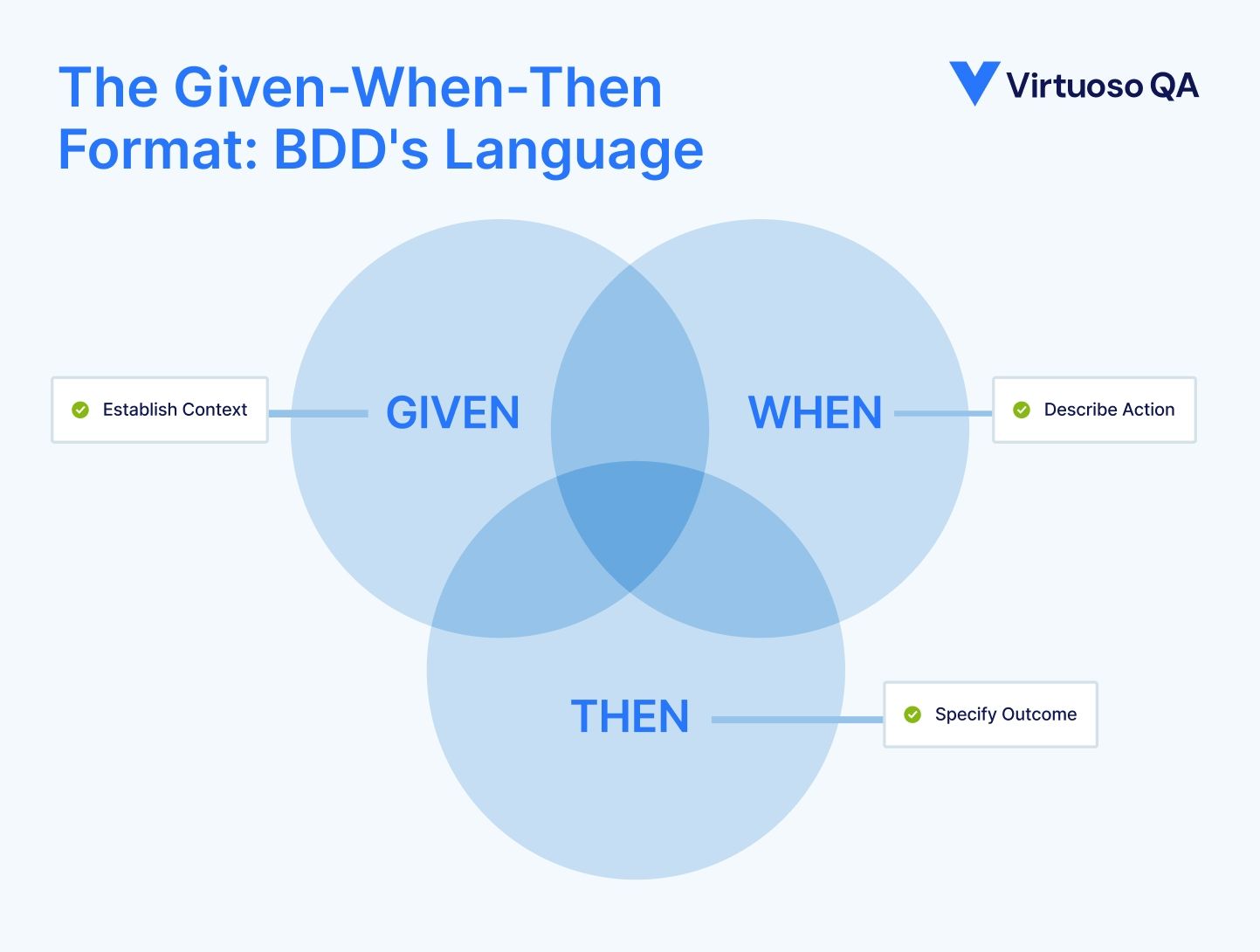
The Given-When-Then Format: BDD's Language
BDD scenarios follow a structured format that makes behavior explicit and testable. This format, popularized by the Cucumber framework, uses three keywords:
1. Given: Establish Context
The Given section establishes the initial state or preconditions before an action occurs. It sets up the context for the scenario.
Examples:
Given I am logged in as an administrator
Given there are 5 items in my shopping cart
Given I have an account with insufficient balance
Given the system is in maintenance mode
Purpose: Provide clear starting conditions so everyone understands the scenario's context.
2. When: Describe Action
The When section describes the action or event that triggers behavior. This is what the user or system does.
Examples:
When I click the "Submit" button
When I enter my password incorrectly three times
When the daily batch process runs
When a customer places an order exceeding $1000
Purpose: Specify the trigger that causes the system to behave in a particular way.
3. Then: Specify Outcome
The Then section describes the expected outcome or result after the action. This defines success criteria.
Examples:
Then I should see a confirmation message
Then my account should be locked for 30 minutes
Then an email report should be generated
Then the order should require manager approval
Purpose: Make expectations explicit and measurable.
Complete BDD Scenario Example
This scenario is readable by anyone. Product owners understand the business logic. Developers understand what to build. Testers understand what to validate. Most importantly, it can be automated.
The BDD Testing Process: Discovery, Formulation, and Automation
Effective BDD testing follows a three-phase process that transforms conversations into executable specifications.
Phase 1: Discovery
Discovery workshops bring together the Three Amigos to explore requirements through concrete examples. The goal is building shared understanding before implementation begins.
Activities:
Present user stories or features requiring implementation
Ask "what are concrete examples of this behavior?"
Explore edge cases, failures, boundary conditions
Identify missing information or unclear requirements
Document agreed-upon examples in Given-When-Then format
Output
Draft scenarios capturing team's shared understanding of desired behavior.
Example discovery conversation:
Product Owner: "Users should be able to search for products."
Tester: "What happens if they search for something that doesn't exist?"
Developer: "Should search be case-sensitive? What about partial matches?"
Product Owner: "Good questions. Let's define several scenarios: exact matches, no results found, partial matches..."
This conversation produces multiple specific scenarios replacing one vague requirement.
Phase 2: Formulation
Formulation refines draft scenarios into precise, unambiguous specifications using proper Given-When-Then structure. The team reviews scenarios for completeness, clarity, and testability.
Formulation criteria:
Each scenario focuses on single behavior
Scenarios are written from user perspective
Given establishes clear preconditions
When describes one specific action
Then specifies measurable outcomes
Scenarios avoid technical implementation details
Language uses domain terminology, not code
Example refinement:
Draft: "User searches and gets results"
Refined:
Phase 3: Automation
Automation transforms human-readable scenarios into executable tests that validate system behavior. This phase connects specifications to actual code that runs against the application.
Traditional BDD automation
Teams write "step definitions" that map each Given/When/Then statement to test code. This requires maintaining two artifacts: the Gherkin scenario file and the underlying step definition code.
Modern approach with Natural Language Programming
Write scenarios directly in executable format without separate translation layer. The natural language itself becomes the automation, eliminating the two-step process.
The goal
Automated scenarios run continuously, validating that implemented behavior matches specified behavior throughout development.
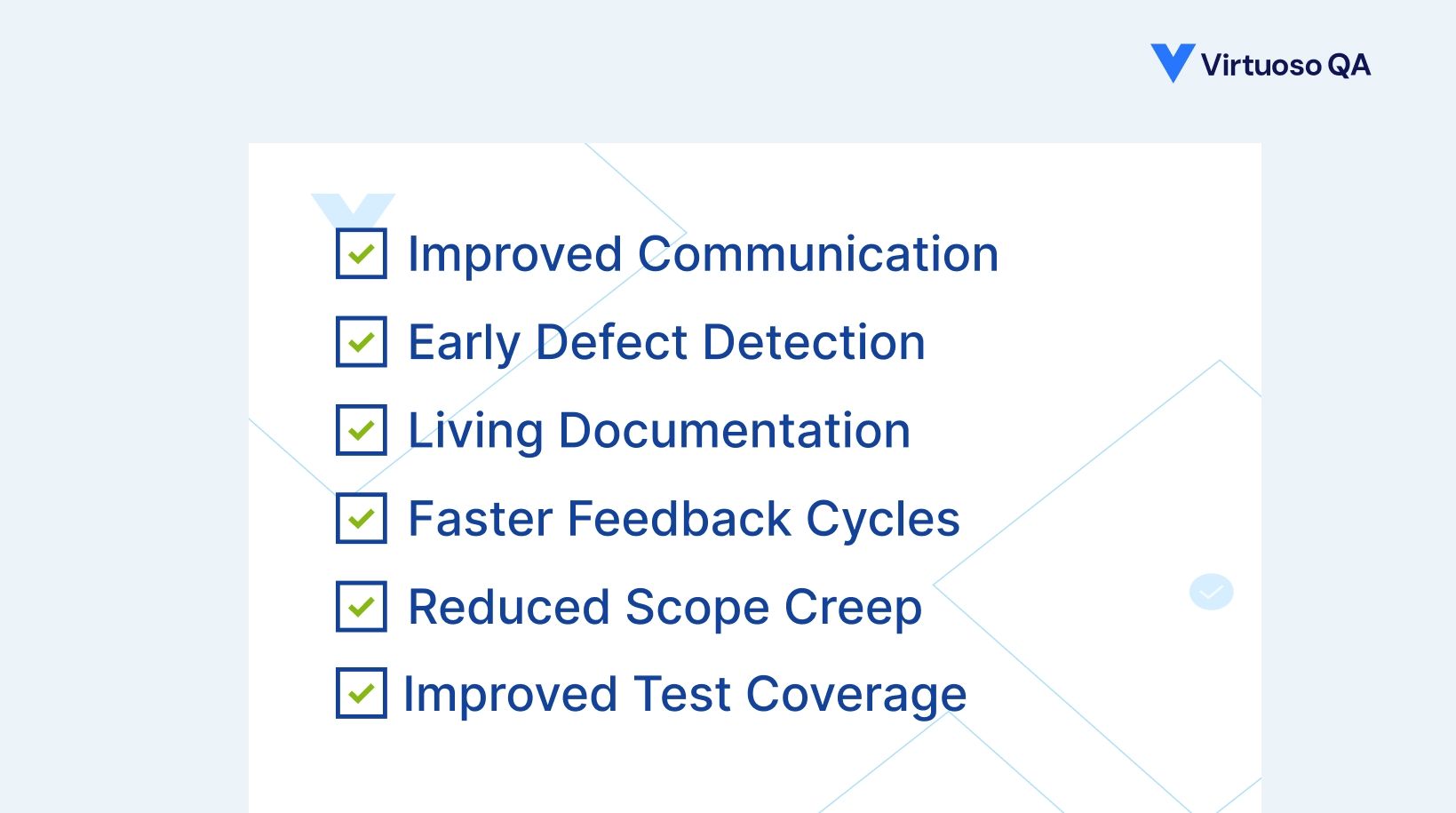
BDD Testing Benefits: Why Teams Adopt Behavior-Driven Development
Organizations implementing BDD testing report measurable improvements in collaboration, quality, and delivery velocity.
1. Improved Communication and Shared Understanding
BDD creates a common language for discussing requirements. Business stakeholders, developers, and testers literally speak the same language using Given-When-Then scenarios. This eliminates the "telephone game" where requirements get distorted as they pass between roles.
Impact: Teams report 30-40% reduction in requirements clarification cycles and rework from misunderstood specifications.
2. Early Defect Detection
By defining expected behavior before implementation begins, BDD catches misunderstandings, missing requirements, and edge cases during specification rather than after deployment.
Traditional approach: Build feature based on vague requirements, deploy to QA, discover requirements were misunderstood, rework implementation.
BDD approach: Define concrete examples collaboratively, identify ambiguities immediately, build correct implementation first time.
Impact: Organizations report 50% reduction in late-stage defect discovery and associated rework costs.
3. Living Documentation
BDD scenarios serve as executable documentation that stays synchronized with actual system behavior. Unlike traditional documentation that becomes outdated, BDD scenarios fail when behavior changes, forcing teams to update specifications.
Value: New team members read scenarios to understand what the system does. Business stakeholders review scenarios to verify requirements are met. Automated scenarios prevent documentation drift.
4. Faster Feedback Cycles
Automated BDD scenarios execute continuously in CI/CD pipelines, providing immediate feedback when changes break expected behavior. Teams discover regressions within minutes rather than weeks.
Integration pattern: Every code commit triggers automated BDD scenario execution. Failures block deployment until behavior is restored or scenarios are updated to reflect intended changes.
5. Reduced Scope Creep
BDD's focus on concrete examples and business value prevents building features that don't deliver user value. Each scenario ties to specific business outcomes, making it easier to say "no" to nice-to-have features that don't justify implementation cost.
Principle: If you can't write a meaningful Given-When-Then scenario demonstrating business value, don't build it.
6. Improved Test Coverage
BDD scenarios naturally capture edge cases, error conditions, and boundary scenarios because testers participate in discovery workshops. Traditional requirements often overlook failure cases until testing begins.
Example: Product owner describes happy path. Tester asks "What if the user enters invalid data? What if the network fails? What if they click Submit twice?" These scenarios are captured and automated.
BDD Testing Frameworks and Tools
Multiple frameworks support BDD testing automation, each with strengths for different technology stacks.
1. Cucumber
Cucumber is the most widely adopted BDD framework, supporting multiple programming languages including Java, Ruby, JavaScript, and Python. Cucumber uses Gherkin syntax for writing scenarios and requires step definitions that implement each Given/When/Then statement.
Strengths: Large ecosystem, extensive documentation, supports multiple languages, widespread community adoption.
Considerations: Requires maintaining separate Gherkin files and step definition code, learning curve for non-technical users writing step definitions.
2. SpecFlow
SpecFlow brings BDD to .NET applications, providing Cucumber-like functionality for C# and Visual Basic projects. It integrates with Visual Studio and popular .NET testing frameworks.
Strengths: Native .NET integration, Visual Studio tooling, supports all major .NET test runners.
Use case: Teams building applications on Microsoft technology stacks.
3. Behave
Behave is a BDD framework specifically designed for Python developers. Like Cucumber, it uses Gherkin syntax and requires step definitions in Python.
Strengths: Pythonic implementation, clean syntax, integrates well with Python testing ecosystem.
Use case: Python development teams adopting BDD practices.
4. JBehave
JBehave is one of the original BDD frameworks for Java and JVM languages. While older than Cucumber, it remains popular in certain Java ecosystems.
Strengths: Mature framework, stable, good performance for Java applications.
Considerations: Less active development than Cucumber, smaller community.
Natural Language Programming: Modern BDD Test Automation
Traditional BDD frameworks require maintaining two artifacts: human-readable Gherkin scenarios and technical step definition code. This two-step process creates maintenance overhead and barriers for non-technical participants.
The Evolution Beyond Gherkin
Natural Language Programming eliminates the separation between specification and automation by making the specification itself executable. Instead of writing Gherkin then translating to code, teams write executable scenarios directly in natural language.
Traditional BDD process:
Write Gherkin scenario
Write step definition code mapping to Gherkin
Maintain both artifacts
When UI changes, update step definitions
Technical expertise required for step definitions
Natural Language Programming:
Write executable scenario in plain English
Scenario runs directly against application
Self-healing automatically adapts to changes
No separate artifact maintenance
Anyone can create and understand scenarios
BDD-Style Testing with Natural Language
Natural Language Programming embodies BDD principles while simplifying implementation:
Business-readable syntax:
This reads like a BDD scenario but executes directly without translation layer.
Collaborative authoring: Product managers, QA analysts, and developers all create and understand these scenarios. Natural language removes the technical barrier preventing non-developers from authoring automated tests.
Living documentation: Scenarios document expected behavior and execute automatically to validate actual behavior matches expectations. When behavior changes, tests fail, prompting documentation updates.
Continuous validation: Natural language scenarios integrate into CI/CD pipelines, running on every commit to provide immediate feedback on behavior changes.
Self-Healing Maintains BDD Scenarios
Traditional BDD testing automation breaks when applications change. UI modifications require updating step definitions across all affected scenarios. This maintenance burden makes BDD automation unsustainable at scale.
Self-healing test automation achieves 95% accuracy in automatically adapting to application changes. When UI elements change, scenarios self-repair and continue executing. This eliminates the maintenance overhead that traditionally plagued BDD automation.
Impact: Teams report 81-88% reduction in BDD test maintenance effort, making behavior-driven approaches sustainable even for large test suites.
BDD for Enterprise Applications
Enterprise applications benefit significantly from BDD testing’s collaborative approach due to complexity, diverse stakeholders, and mission-critical nature.
1. BDD for SAP and Oracle ERP Systems
Enterprise resource planning systems span multiple integrated modules serving diverse user roles. BDD scenarios capture complex business processes spanning procurement, finance, manufacturing, and HR workflows.
Example BDD scenario:
This scenario documents business process behavior in language stakeholders understand. SAP consultants, business analysts, and developers all comprehend the expected workflow.
2. BDD for Salesforce and CRM Platforms
CRM implementations combine standard Salesforce functionality with custom business logic. BDD scenarios validate both out-of-box and customized behaviors.
Collaborative value
Business stakeholders define lead conversion workflows, opportunity management processes, and customer service scenarios using Given-When-Then format. Developers implement against these specifications. QA validates using automated scenarios.
3. BDD for Healthcare Systems like Epic EHR
Healthcare applications require rigorous validation of clinical workflows that impact patient safety. BDD scenarios provide traceable specifications linking requirements to automated validation.
Regulatory benefit
BDD scenarios serve as verification documentation for regulatory submissions, demonstrating that implemented behavior matches clinical requirements.
Example:
3. BDD for Financial Services Applications
Banking, insurance, and investment platforms must meet strict regulatory requirements while delivering intuitive user experiences. BDD scenarios document regulatory compliance behaviors alongside functional requirements.
Traceability
Each BDD scenario maps to specific regulatory requirements, providing clear audit trails demonstrating compliance validation.
BDD Best Practices for Successful Implementation
Effective BDD requires disciplined practices ensuring scenarios remain valuable throughout development.
1. Start with User Stories and Concrete Examples
BDD scenarios emerge from user stories. For each story, ask "What are concrete examples of this behavior?" Generate multiple scenarios covering happy paths, edge cases, and failure conditions.
Anti-pattern: Writing scenarios that describe implementation details rather than user behavior.
Best practice: Scenarios describe what users see and do, not how the system implements functionality internally.
2. Keep Scenarios Focused and Independent
Each scenario should validate one specific behavior. Scenarios that test multiple things become difficult to understand and maintain.
Focused scenario: Tests login with valid credentials
Unfocused scenario: Tests login, then navigation, then data entry, then reporting
Independent scenarios can execute in any order without dependencies on other scenarios. This enables parallel execution and makes failure diagnosis easier.
3. Use Domain Language, Not Technical Terms
BDD scenarios should use terminology from the business domain, not technical jargon. This ensures all stakeholders understand specifications.
Technical language: "When the HTTP POST request is submitted to the authentication endpoint..."
Domain language: "When I click the Login button..."
The second version is accessible to everyone while remaining precise.
4. Involve All Three Amigos
Don't write BDD scenarios in isolation. Discovery workshops bringing together business, development, and testing perspectives produce richer, more complete specifications.
Time investment: Initial discovery workshops feel slow compared to developers just building features. However, time invested in shared understanding dramatically reduces rework from misunderstood requirements.
5. Automate Scenarios for Continuous Validation
BDD scenarios provide maximum value when automated and executed continuously. Manual execution makes scenarios documentation-only artifacts rather than living validation.
Integration: Connect automated BDD scenarios to CI/CD pipelines so every code change triggers behavior validation.
6. Maintain Scenarios as Living Documentation
When behavior changes, update scenarios immediately. Outdated scenarios mislead stakeholders and undermine trust in specifications.
Discipline: Failed scenarios indicate either a bug or outdated specification. Never ignore failures. Fix the bug or update the scenario.
7. Use Scenario Outlines for Data Variations
When the same behavior should work with multiple data inputs, use scenario outlines rather than duplicating scenarios.
Example:
This eliminates duplication while maintaining clarity.
Common BDD Challenges and Solutions
Even experienced teams encounter challenges implementing BDD effectively.
1. Non-Technical Stakeholders Struggle with Gherkin
Problem
While Gherkin aims for readability, the formal syntax (Feature, Scenario, Given, When, Then keywords) still creates barriers for non-technical participants.
Solution
Natural Language Programming removes syntax requirements entirely. Scenarios written in plain English without keywords are more accessible to all stakeholders while remaining executable.
2. Maintaining Step Definitions
Problem
Traditional BDD frameworks require maintaining step definition code alongside Gherkin scenarios. UI changes necessitate updating step definitions, creating maintenance burden.
Solution
Self-healing automation adapts automatically to UI changes, eliminating 81-88% of maintenance effort. Natural language scenarios with self-healing make BDD automation sustainable at scale.
3. Scenarios Become Too Technical
Problem
Developers writing scenarios alone tend toward technical implementation details rather than user behavior descriptions.
Solution
Enforce Three Amigos collaboration. Product owners and testers naturally steer scenarios toward user-focused language.
4. Too Many Scenarios Slow Execution
Problem
Comprehensive BDD scenario suites grow large, causing slow feedback cycles that undermine continuous integration.
Solution
Execute scenarios in parallel across cloud-based execution grids. Modern platforms run thousands of scenarios simultaneously, delivering results in minutes rather than hours.
5. Scenarios Become Outdated
Problem
Scenarios document intended behavior, but when actual behavior changes, scenarios don't update, becoming misleading documentation.
Solution
Treat scenario failures seriously. Never ignore failing scenarios. Either fix the bug or update the scenario to match new intended behavior.
Transform Requirements into Executable Behavior Specifications
Traditional requirements documents gather dust. Gherkin scenarios require maintaining separate step definitions. Teams struggle bridging the gap between business language and test automation. These frictions prevent organizations from fully realizing BDD's collaborative benefits.
Natural Language Programming embodies BDD principles while eliminating implementation barriers. Write behavior specifications in plain English that all stakeholders understand. Execute those specifications directly as automated tests without translation layers. Self-healing maintains scenarios as applications evolve. Continuous execution provides living documentation validated against actual behavior.
The result: True collaboration between business, development, and testing. Shared understanding through concrete examples. Automated validation ensuring specifications match reality. Living documentation that never drifts from actual behavior.
Ready to enable behavior-driven practices?
Explore how Virtuoso QA's AI-native test automation platform enables teams to create executable behavior specifications using Natural Language Programming. See how plain English scenarios validate application behavior without Gherkin syntax or step definitions, while 95% self-healing accuracy maintains specifications as systems evolve.
Request a demo to see behavior-driven testing for SAP, Salesforce, Oracle, Epic EHR, and other enterprise applications, or explore our interactive demo to experience Natural Language Programming firsthand.
Related Reads
Frequently Asked Questions
What does Given-When-Then mean in BDD?
Who writes BDD scenarios?
How do you write good BDD scenarios?
Can BDD be used with Agile methodologies?
What is the difference between BDD and ATDD?
How do you integrate BDD testing with CI/CD?