Blog
What is Behavioural Testing? Outcomes Over Code

Rishabh Kumar
Published on

Table of contents
Lorem ipsum
Lorem ipsum
Lorem ipsum
Lorem ipsum
Lorem ipsum
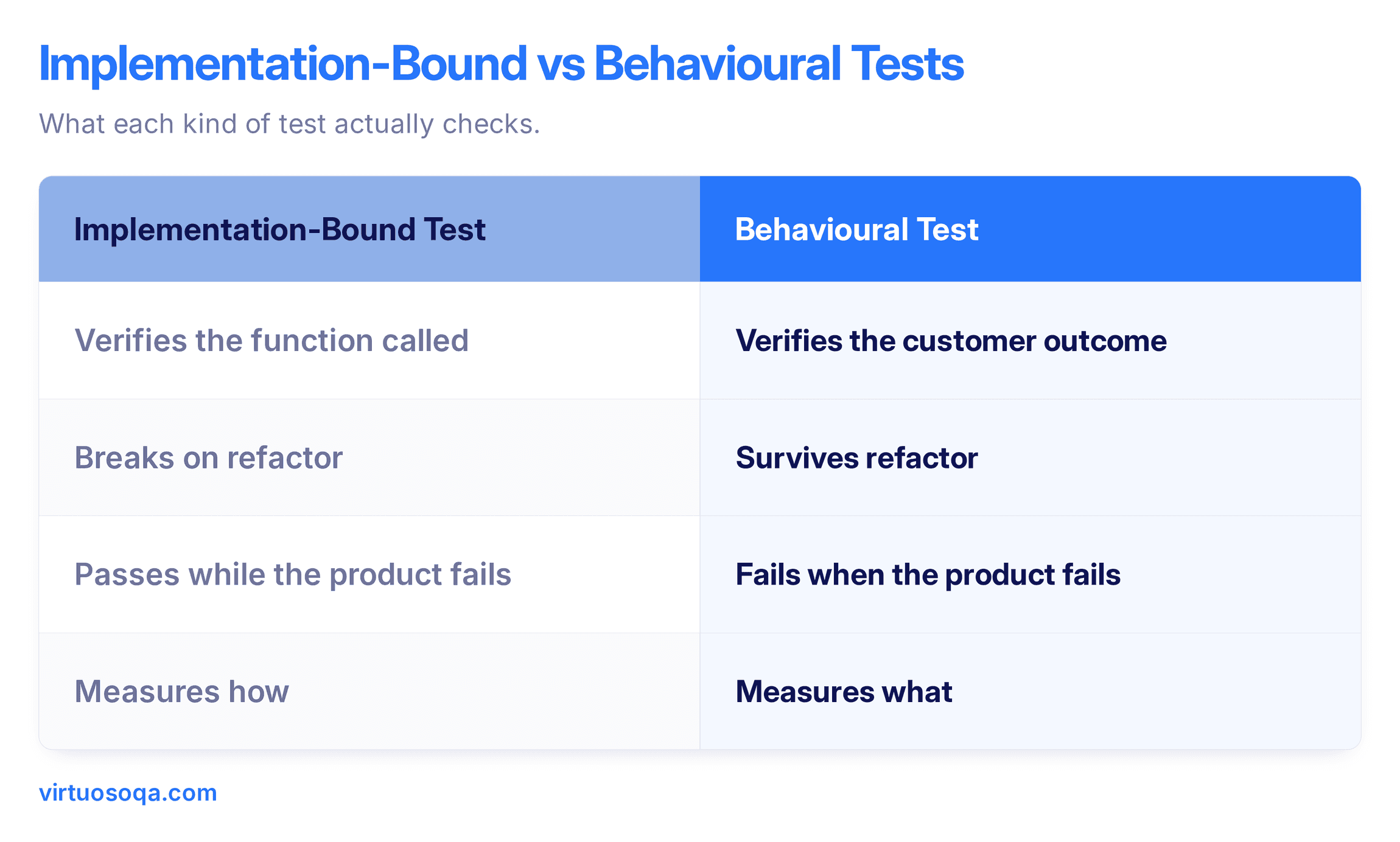
A team ships a release with 95 percent unit test coverage. Every assertion passes, the continuous integration build is green, and within thirty-six hours customer support reports that loan approvals are silently failing in production. The investigation finds the cause quickly. A refactor moved one calculation into a different service, and every unit test in the affected module kept passing, because each test verified the function it called. None of them verified the outcome the customer was supposed to receive.
The defect was not in the code. It was in what the tests measured. Coverage was high and behaviour was unverified. Code answers how, behaviour answers what, and a test estate that obsesses over how can ship a product that fails on what. Behavioural testing is the discipline that closes that gap.
Behavioural testing is the discipline of verifying that a system produces the outcomes customers expect, anchored to workflows rather than to implementation. The term is overloaded, and it gets conflated with Behaviour-Driven Development, with black-box testing, and with functional testing. The definition this page advances is sharper than any of those, namely that behavioural testing verifies expected behaviour against actual behaviour, independent of how the code is structured, with customer outcomes as the anchor and workflows as the unit of verification.
In an environment where AI accelerates code change and brittle implementation-bound tests collapse under refactors, that discipline has moved from one technique among many to the centre of release confidence.
What is Behavioural Testing?
Behavioural testing is the discipline of verifying that a system produces the outcomes customers expect, when triggered by the inputs and conditions customers actually use, regardless of how the underlying code is structured.
Three properties separate it from adjacent practices.
The anchor is the outcome: A behavioural test asserts what the system is supposed to do for the user, not what the code is supposed to compute internally.
The unit of verification is the workflow: Behavioural tests are scoped to user journeys, namely submit a claim, place an order, admit a patient, bind a policy, rather than to individual functions.
The framing is independent of implementation: A behavioural test that passes against the current implementation should still pass against a clean rewrite of the same functionality. If a refactor breaks the test, either the test is wrong or the refactor changed behaviour.
A useful working definition is that behavioural testing verifies expected behaviour against actual behaviour, with workflows as the unit and customer outcomes as the anchor.
The Three Things People Mean by Behavioural Testing
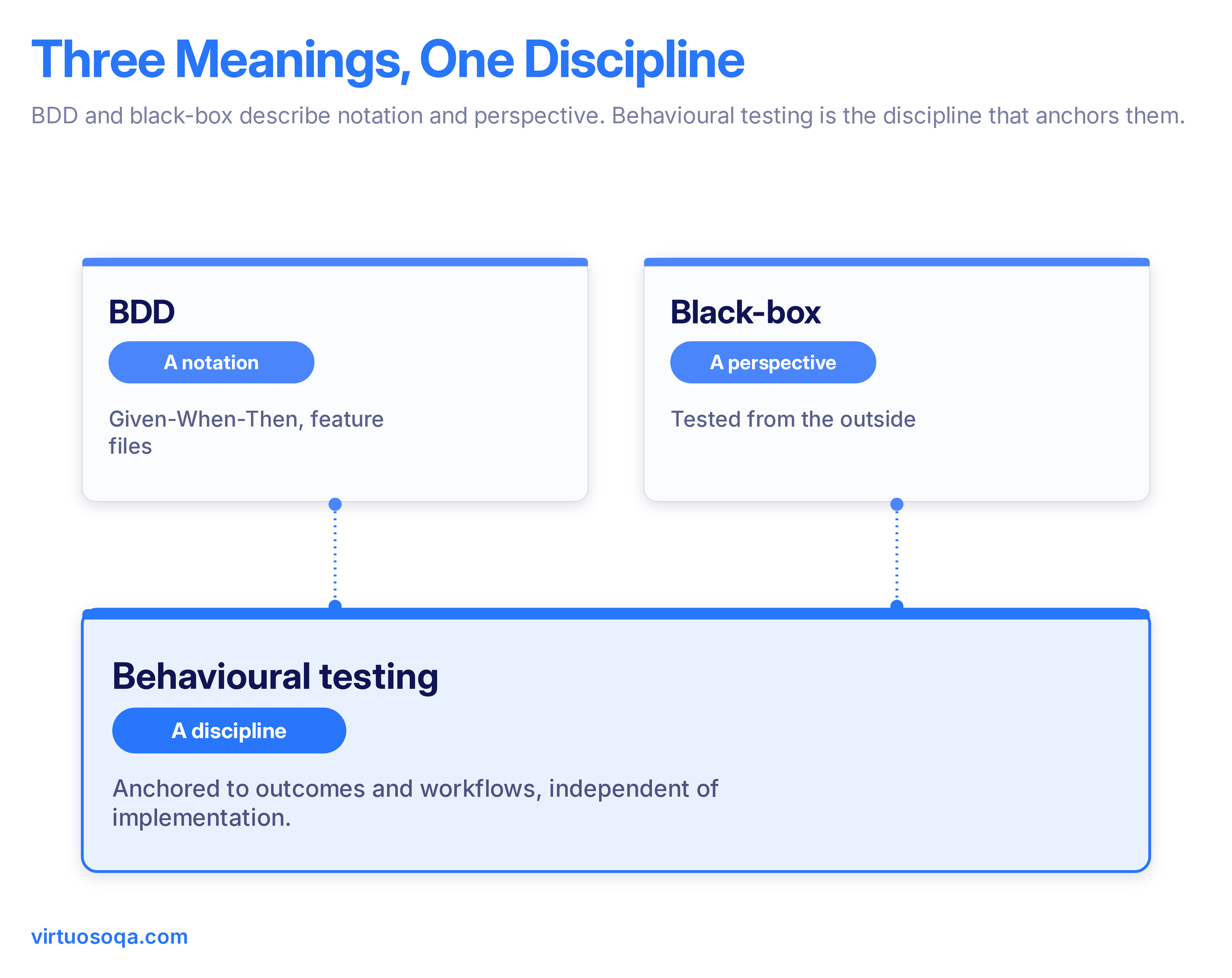
The term is overloaded, and practitioners use it to mean three related but distinct things. Clarifying the distinction stops most conversations going in circles, and it matters here because most published material on this topic collapses these three into one, usually by declaring behaviour testing and black-box testing to be the same thing. They are not.
Behaviour-Driven Development Testing
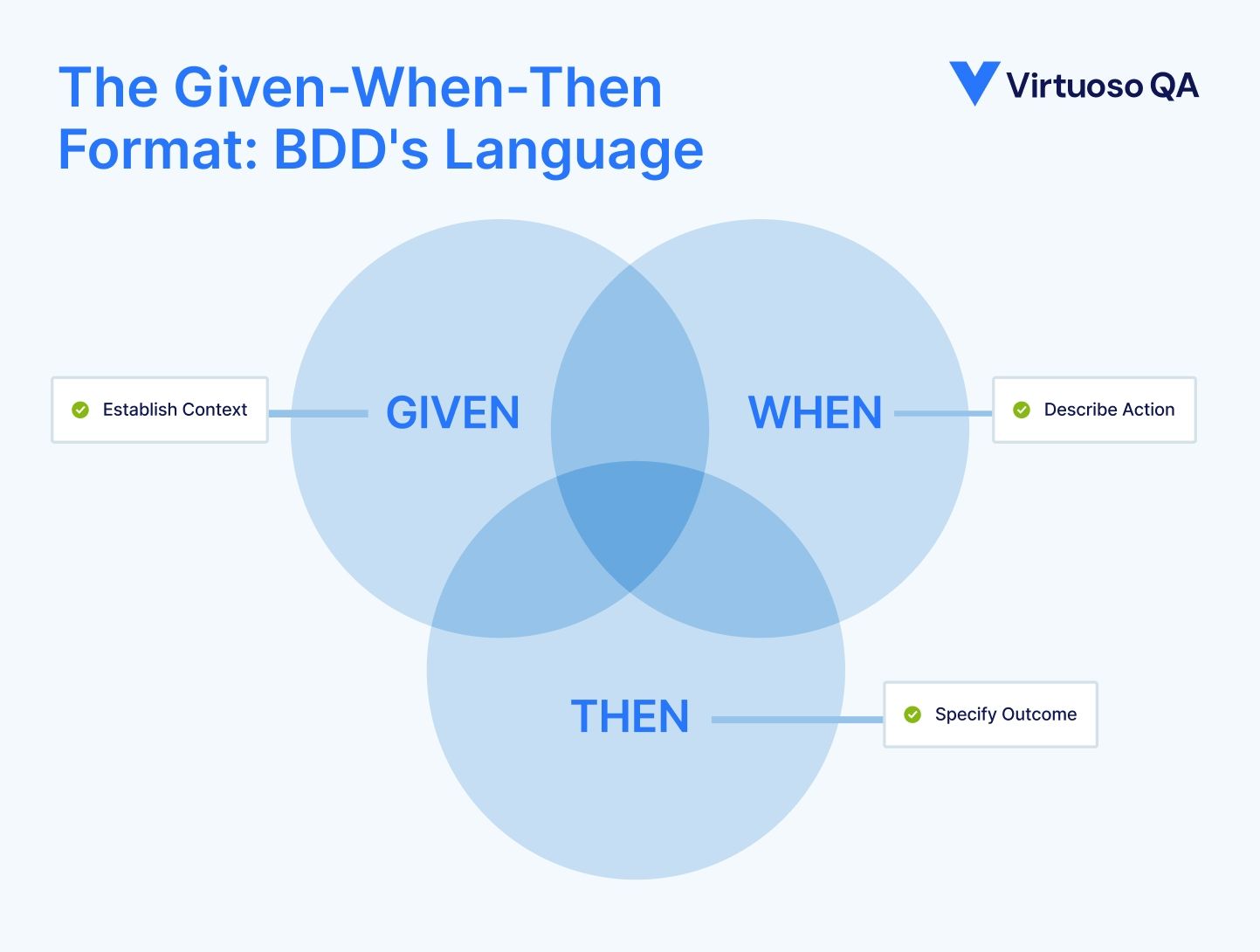
A specific approach where tests are written in a constrained natural language, often Given-When-Then expressed in Gherkin and executed by frameworks such as Cucumber, SpecFlow, or behave, and shared between business and engineering as living documentation. BDD is a notation, a workflow, and a collaboration practice.
It is one expression of behavioural testing, not the entire discipline, and Given-When-Then steps can be just as implementation-bound as classical scripts.
Black-Box Behavioural Testing
A perspective in which tests are designed without knowledge of the internal implementation, examining inputs and outputs from the outside. Black-box is a perspective, not a discipline.
It is a useful constraint that stops tests leaking implementation assumptions, but on its own it does not anchor verification to customer outcomes, and a black-box test can still be a low-level functional check that misses workflow-level failures.
Modern Behavioural Testing as a Discipline
The interpretation this page uses, namely verification of expected behaviour against actual behaviour, anchored to customer outcomes, scoped to workflows, independent of implementation, and structured for durability across refactors.
It absorbs the strengths of BDD (shared specifications, plain-language expression) and of black-box thinking (implementation independence) and adds two things, an explicit customer-facing anchor and the workflow as the unit of verification.
BDD is a notation, behavioural testing is a discipline, and the first lives inside the second. The rest of this page uses behavioural testing in that third sense.

Why Behavioural Testing Matters More Now Than Ever
Behavioural testing is not a new idea, and the discipline has existed in some form since the earliest acceptance testing of the 1970s. What has changed is the cost of not practising it, and three forces have raised that cost from a nuisance to a structural risk.
Code is Generated Faster Than it Can Be Reviewed
AI assistants and agents produce material portions of contemporary codebases, so the implementation surface changes daily. Tests bound to the implementation break daily and produce false confidence in between failures, while tests bound to customer-facing behaviour survive the rewrite because the behaviour is what the customer is buying.
The Expensive Failures Are at Workflow Level
The bugs that take businesses down are not function-level defects, they are workflow breaks, namely a claim that cannot be submitted, an order that cannot be completed, a login that succeeds and fails on the next page. These live in the integration between functions, where behavioural tests scoped to workflows catch them and unit tests scoped to functions do not.
Regulation Has Started Asking Different Questions
Regulators in financial services, healthcare, insurance, and increasingly the broader AI space are asking not just whether you tested but whether what you tested matches what the customer experiences.
A verification report mapped to customer workflows and signed off on release day is a defensible answer in a way that a coverage percentage on internal code structures is not.
Behavioural Testing vs Functional Testing
Functional testing is a broad category and behavioural testing is a discipline within it, so the relationship is hierarchical rather than opposed. Functional testing verifies that the system does what it is supposed to do, as against non-functional testing, which verifies how well it does it in dimensions like performance and accessibility.
Behavioural testing is a way of doing functional testing that anchors to customer outcomes and workflows. A functional test that asserts a button click changes a field value is functional but not necessarily behavioural.
A functional test that asserts a user completing a checkout flow receives an order confirmation is both. In environments where code changes rapidly, customer-anchored behavioural testing is the most useful form of functional testing, while narrower function-bound functional testing still has its place at the unit level.
Behavioural Testing vs Behaviour-Driven Development
The two are easily confused, and the distinction is worth the time. BDD is a methodology that emerged in the mid-2000s, combining specification, collaboration, and automated testing. Its core practices are plain-language specification of expected behaviour, usually in Given-When-Then, joint authorship by business and engineering, execution of those specifications as automated tests through frameworks like Cucumber or SpecFlow, and maintenance of the specifications as living documentation.
Behavioural testing is the broader discipline, and BDD is one structured expression of it. A team practising BDD is identifiable by its notation, namely Gherkin specifications in feature files executed through a BDD framework.
A team practising behavioural testing without BDD vocabulary might use natural-language authoring on a modern platform, with the same anchoring to outcomes and workflows and none of the Gherkin syntax. Both are valid, and the deeper question is whether the tests anchor to customer outcomes and workflows regardless of notation.
BDD earns its keep when business analysts and developers co-author specifications, when living documentation is a stated goal, and when the team values the explicit Given-When-Then form enough to carry the overhead of feature files and step definitions. BDD becomes overhead when the team is small and specifications are not jointly owned, when the translation between feature files and step definitions turns into a maintenance burden, or when natural-language authoring achieves the same anchoring with less ceremony.
For many modern teams the right answer is to practise behavioural testing rigorously and adopt BDD vocabulary selectively, where the collaboration value justifies the structural cost.

Behavioural Testing vs Black-Box Testing
This is the distinction most published material on behaviour testing gets wrong, usually by asserting that the two are the same thing. They overlap, and they are not identical.
Black-box testing describes a perspective, namely that the tester examines the system from the outside without knowledge of its internal implementation, contrasted with white-box testing (full access to internal code) and grey-box testing (partial access). Most behavioural tests are black-box, because their value depends on being independent of implementation. But not all black-box tests are behavioural.
A black-box test that probes individual field validations without anchoring to a workflow or a customer outcome is a low-level functional black-box test, not a behavioural test. The distinction is one of focus, namely that black-box constrains what the tester sees while behavioural testing constrains what the test verifies.
Black-Box Test-Design Techniques
Because black-box testing is a design perspective, it comes with a well-established set of test-design techniques. These are frequently listed on other pages as "behavioural testing techniques," which is imprecise, they are black-box design techniques, useful within behavioural tests for choosing which inputs to exercise, but they are tactics for selecting cases rather than the discipline itself. The main ones are worth knowing.
Equivalence partitioning: Divide inputs into classes expected to behave the same, then test one representative from each rather than every value, on the assumption the class behaves uniformly.
Boundary value analysis: Test at and just beyond the edges of input ranges, since defects cluster at boundaries. For a field accepting 1 to 100, exercise 0, 1, 2, 99, 100, and 101.
Decision table testing: Lay out combinations of conditions and their expected outcomes in a table, so complex multi-condition logic is covered systematically rather than ad hoc.
State transition testing: Verify that the system moves correctly between states on given events, useful for anything modelled as modes or stages, such as an order moving from draft to submitted to approved.
Error guessing: Use experience to anticipate likely failure points and design cases for them, an unstructured technique that leans on the tester's intuition.
Used within a behavioural test, these techniques help decide which preconditions and inputs to parameterise. They do not, by themselves, make a test behavioural. A decision table that exercises field validations without anchoring to a customer outcome is still black-box functional testing, not the discipline this page describes.
Behavioural Testing vs User Acceptance Testing
User acceptance testing is a phase and behavioural testing is a discipline, so the two intersect without being synonyms.
UAT is the phase in which actual end users, or their representatives, verify that the system meets their needs before it is accepted for production, and the participants are usually business users rather than engineers. Behavioural testing is the discipline that produces tests anchored to user outcomes and workflows, usually authored by engineers or QA practitioners and automated.
In practice behavioural tests are excellent inputs to UAT, because they describe expected behaviour in language the user can verify, and a team with a strong behavioural suite often finds UAT becomes lighter because the suite has already verified what the user would check.
How to Design a Behavioural Test
A practical methodology, suitable for adoption inside any test programme, runs in six steps.
1. Identify the Customer Outcome
Begin with the outcome the customer is supposed to receive, not the screen, the API, or the field. The outcome is the anchor, for example "the customer receives a confirmation email after completing checkout" or "the claim is approved and the payment is initiated."
2. Define the Preconditions
Establish the state the system must be in for the test to be meaningful, namely user authenticated, account in good standing, product available. These are the equivalent of Given.
3. Specify the Workflow
Set out what the user does, in order, to trigger the outcome, namely the sequence of actions rather than the implementation. This is the equivalent of When, expanded to the full sequence rather than a single event.
4. Assert the Outcome
State what must be true for the test to pass, anchored to the customer-facing result, namely the confirmation appears, the email arrives, the claim status updates, the payment is recorded. This is the equivalent of Then.
5. Identify the Boundary Conditions
Decide which variations of precondition or workflow should also be verified, namely different user types, product categories, locales, or currencies, and parameterise the same workflow across them.
6. Confirm Implementation Independence
Re-read the test and check whether anything depends on how the code is structured today, namely a specific selector, function name, or internal state. If so, refactor the test to remove the dependency, because a well-designed behavioural test should survive a clean rewrite of the underlying implementation.
The Three Anchors of Behavioural Testing
Behavioural testing is held in place by three anchors. A test that has all three is durable, and a test missing any one of them drifts.
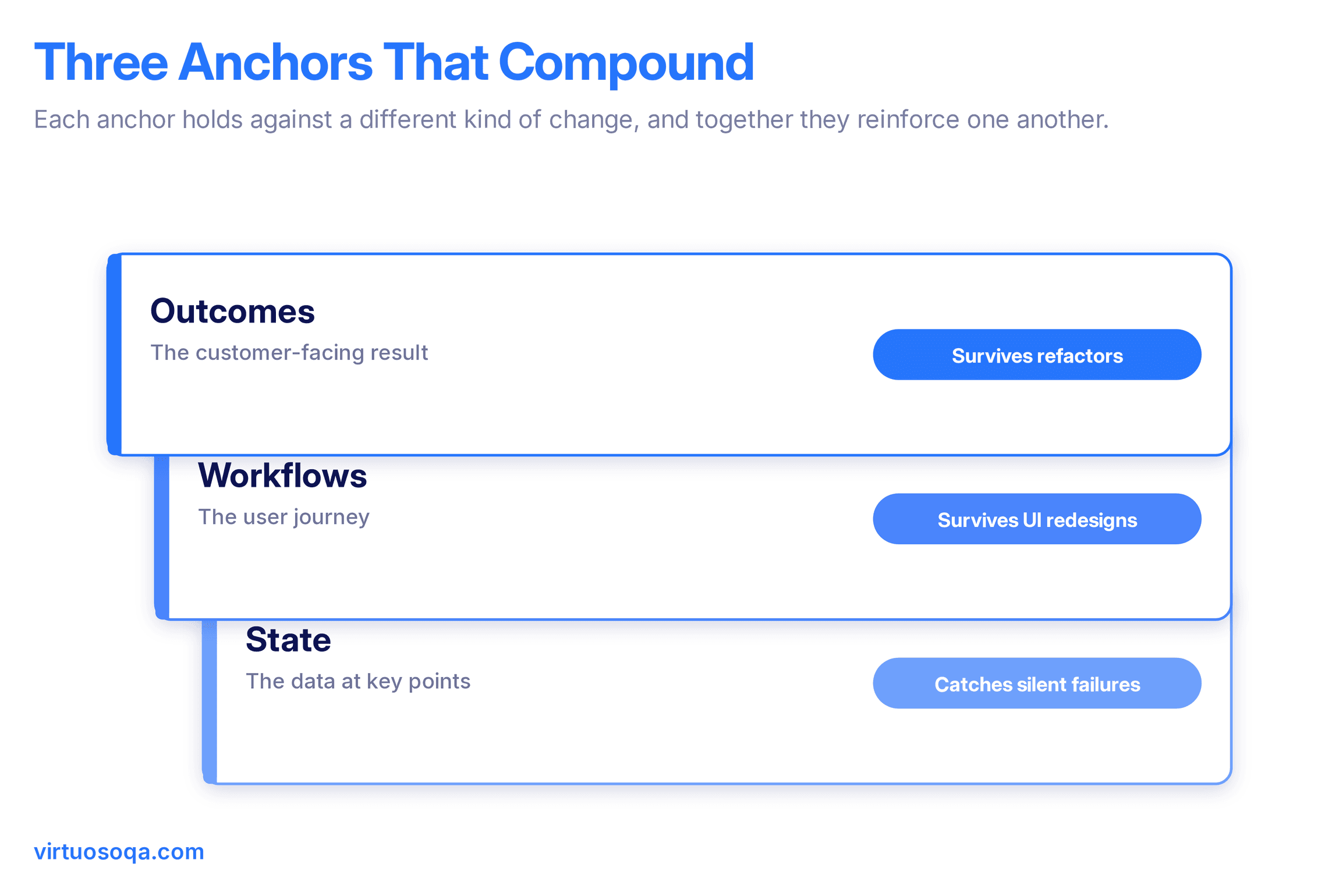
Outcomes: The customer-facing result the system is supposed to produce, observable from outside, namely a confirmation, a payment, an updated status, a generated document. Tests anchored here survive refactors because the outcome is what the customer is paying for.
Workflows: The user journey that produces the outcome, modelled at the level of user intent rather than UI mechanics. Tests anchored here survive UI redesigns because the logical structure of search, select, configure, pay outlasts any specific layout.
State: The condition of relevant data at meaningful points in the workflow, not every internal state but the state visible to the user or material to downstream systems, namely the order record exists, the inventory decremented, the balance updated. Tests anchored here catch the silent failures that pure outcome assertions miss, such as a confirmation that appears while no order record is created.
The three anchors compound. A test that asserts outcomes alone may pass on screens that lie, a test that asserts workflows alone may pass when an intermediate state is wrong, and a test that anchors to all three is what release confidence actually looks like.
Anti-Patterns in Behavioural Testing
Six patterns degrade behavioural testing in practice. The first three are common in teams new to the discipline, and the last three appear in teams that adopted the vocabulary without committing to the substance.
Behavioural Tests Bound to UI Selectors
A test labelled behavioural that asserts against specific CSS selectors, element IDs, or XPath is not implementation-independent and will break on the next UI change.
Outcomes Asserted as UI Text
A test that asserts the page displays "Order Confirmed" is checking text rendering, not outcome. The order may not be recorded, the email may not have fired, the downstream system may have received nothing. The text is necessary but not sufficient.
Workflows That Skip Steps
A test that jumps from "user logged in" to "order completed" via direct API calls or database manipulation misses the workflow integrity the discipline exists to verify. The test passes and the workflow does not.
Behavioural Vocabulary, Implementation Substance
Given-When-Then steps whose definitions are tight bindings to implementation. The notation is behavioural and the substance is not, so the team pays the operational cost of BDD without earning the durability benefit.
Outcomes Specific to Internal State
Tests that assert on internal state the customer never sees, namely a table row, a cache value, a session token. The assertion is implementation-bound regardless of the label.
One Test Trying to Verify Everything
A test that walks fourteen steps and asserts on seventeen outcomes is fragile, slow, and impossible to diagnose on failure. Behavioural tests should be scoped to one workflow and a small number of related assertions.

Tools and Approaches That Support Behavioural Testing
The landscape organises by how each approach fits behavioural test design, and the choice of tool matters less than the discipline of anchoring to outcomes, workflows, and state.
BDD Frameworks
Cucumber, SpecFlow, behave, and similar express tests in Gherkin-style Given-When-Then with step definitions that bind to executable code, and the durability benefit depends heavily on the quality of those step definitions. Best fit where business and engineering collaborate closely on specifications and living documentation is a stated goal.
Natural-Language Test Platforms
Modern platforms, including Virtuoso QA, author tests in plain English mapped to workflow modules, with no translation between feature files and step definitions, so the behavioural intent is the test. Best fit for teams who want the behavioural anchoring of BDD without the feature-file overhead and who want authoring open beyond developers.
Workflow-Modelling Tools
Platforms that model user workflows visually or in structured form and generate executable tests from the models, so the model becomes the source of truth. Best fit for organisations with high audit requirements where the model itself is an artefact of value.
Custom DSLs and Frameworks
Internal domain-specific languages tailored to the product vocabulary, high in cost but occasionally the right fit when the product is unusual enough that off-the-shelf tools struggle. Best fit for large organisations with mature engineering practice and unusually specific domains.
A team using basic tooling well will produce better behavioural verification than a team using sophisticated tooling badly.
The AI-Era Case for Behavioural Testing as the Central Discipline
Three structural shifts make behavioural testing the centre of verification now, rather than one technique among many.
Implementation is volatile, behaviour is stable: When agents rewrite code on a weekly cadence, the implementation surface is in constant motion and tests bound to it move with it, breaking or silently passing against the wrong checks. Behaviour is stable by contrast, since the claim still needs to be paid and the order still needs to be shipped, so tests anchored to that persistence survive the churn.
Regulators are asking behaviour-level questions: The shift toward "show your work, mapped to what the customer experiences" is incompatible with reports that only produce code-level coverage. Behavioural test evidence, namely this workflow was verified on this release date with this outcome, is what is increasingly being asked for.
Trust in AI-coded systems is the bottleneck: The strategic bottleneck in AI-accelerated development is not the code, it is trust in the code. Behavioural testing produces the evidence trust requires, since a suite that passes on release day with the outcomes the customer expects, in the workflows the customer actually walks through, is the highest-confidence claim a release team can make.
In an AI-coded world, behaviour is the only stable contract.
How Virtuoso QA Approaches Behavioural Testing
Four design decisions align the platform with the discipline.
Natural-language authoring at the workflow level: Tests are written in plain English describing what the user does and what should result, so the form is behavioural by construction, with no translation between feature files and step definitions and no selector-bound brittleness.
Composable modules that map to business actions: A login module, a submit-claim module, an apply-discount module, built once and reused across hundreds of tests, so the workflow is the unit of reuse and tests stay anchored at the behavioural level.
Self-healing for implementation drift: When the underlying UI is refactored, often by an AI assistant, the behavioural test keeps verifying the workflow, with proposed repairs running at approximately 95% user acceptance under human oversight and healing decisions logged for review.
Outcome assertions beyond UI text: Tests can verify that the order is recorded, the email is sent, the downstream system received the event, and the state is updated, so the discipline does not stop at the rendered confirmation message.
Every AI action is proposed for review, executed by a deterministic engine, and recorded, so the autonomy stays governed. The practice the platform supports is simple to describe, namely verification anchored to customer outcomes, tests that survive refactors, and evidence on every release, and enterprises including London Market Group and AerCap use it to keep customer-critical workflows verified as their systems change.

Frequently Asked Questions
What Are the Black-Box Test-Design Techniques
Why Is Behavioural Testing Important
How Do You Write a Behavioural Test
Can Behavioural Testing Be Automated
How Do You Measure Behavioural Test Coverage