Blog
Guidewire Testing: What to Test, When, and How to Keep Up With the Release Calendar

Rishabh Kumar
Published on

Table of contents
Lorem ipsum
Lorem ipsum
Lorem ipsum
Lorem ipsum
Lorem ipsum
Guidewire runs the core of property and casualty insurance, namely the policies, the claims and the billing. When it breaks, an insurer does not lose a feature, it loses the ability to quote, settle or invoice. So Guidewire testing carries board-level weight, and it comes with a constraint most QA programmes never face.
The constraint is the calendar. Guidewire ships three cloud releases a year, named after ski resorts, and its cloud standards give insurers roughly seven months to go live on a release after it lands. Every one of those releases can move the UI, the APIs and the behaviour underneath your tests, which means regression happens on Guidewire's schedule, not yours, three times a year, forever.
This page covers what Guidewire testing involves module by module, why it defeats manual approaches and most script-based ones, and how insurers structure automation that survives the cadence.
What is Guidewire?
Guidewire is the market-standard core platform for P&C insurers. InsuranceSuite is built around PolicyCenter for policy administration, ClaimCenter for claims, and BillingCenter for billing, joined more recently by PricingCenter and UnderwritingCenter.
Guidewire Cloud delivers it all as a managed service on AWS, with Jutro powering the digital portals that agents and policyholders actually touch, and Integration Gateway handling the connections to everything else an insurer runs.
Two facts about the platform shape everything about testing it. Almost every insurer configures and extends it heavily, so no two Guidewire estates behave alike, and the vendor updates it three times a year whether you are ready or not.
What is Guidewire Testing?
Guidewire testing validates that an insurer's configured Guidewire estate does what the business rules say it should, across four layers at once:
Module behaviour, so rating, claims handling and billing logic work as configured
Cross-module journeys, so a policy written in PolicyCenter bills correctly in BillingCenter and pays claims correctly through ClaimCenter
Integrations, so data flows correctly between Guidewire and the rating engines, document systems, payment providers and data platforms around it
The release treadmill, so three vendor updates a year land without breaking any of the above
Functional, regression, integration, migration and user acceptance testing all apply. What makes it Guidewire testing rather than generic testing is that the logic under test is insurance logic, and the pace is set by the vendor.
What to Test in Each Guidewire Module?
PolicyCenter
The system of record for the policy lifecycle, and the module where configuration runs deepest.
What to Validate
Quote and rating logic across lines of business, including the rate tables and algorithms your actuaries actually configured
Submission, bind and issuance flows, with underwriting rules firing where they should
Mid-term endorsements, and whether the premium change lands correctly downstream in billing
Renewals, cancellations and reinstatements, including the notice periods regulation requires
Product model changes, since a new line of business touches rating, forms and rules at once
ClaimCenter
Where the promise gets kept, and where a defect is most visible to a policyholder on the worst day of their year.
What to Validate
First notice of loss across every intake channel, portal, phone-entered and API
Claim segmentation and assignment rules routing work to the right adjusters
Reserves, payments and recoveries calculating and posting correctly
Litigation, fraud-flag and catastrophe workflows behaving as configured
The financial handshake with BillingCenter and the general ledger
BillingCenter
The module where errors become customer complaints and regulatory letters.
What to Validate
Invoicing across payment plans, instalments and billing methods
Payment application, including partial payments and the awkward orderings
Delinquency workflows, notices and cancellation triggers firing on the configured schedule
Commission calculations for the distribution channels you actually pay
Refunds, write-offs and the audit trail behind each
Jutro Portals and Digital Channels
The layer policyholders and agents see, rebuilt more often than any core module.
What to Validate
Quote-and-buy journeys end to end, from the portal into PolicyCenter and back
Self-service flows, claims tracking, document upload and payments
The same journeys on the devices customers actually use
Accessibility on the flows regulation and decency both require
Integrations and Data
The seams, which is where Guidewire estates actually fail.
What to Validate
Integration Gateway flows and app events reaching the systems that subscribe to them
External rating, payment, document and communication services handling both success and timeout
Data migration during any transition, with record counts, field mappings and financial totals reconciled, not sampled
Reporting and data platform feeds carrying the numbers the business will repeat to the regulator

Why Guidewire Testing is Hard?
1. Every Estate is Unique
Guidewire ships a platform and insurers configure a business onto it, so the test cases that matter are yours alone, and no off-the-shelf pack covers the rating rule your actuaries wrote last quarter.
2. The Release Cadence is Relentless
Three cloud releases a year, each able to change UI structure, APIs and out-of-the-box behaviour, with roughly seven months to be live on a release after it ships. A regression suite that needs weeks of repair after each update spends its life being repaired.
3. The Journeys Cross Modules
A policy is written in one module, billed in a second, and claimed against in a third, so the tests that protect the business must span all three plus the portal, and module-level testing misses exactly the handoffs where money goes missing.
4. Integrations Outnumber Modules
Rating engines, payment providers, document generation, data platforms and regulatory feeds all connect through the integration layer, and each connection is a place where a timeout or a mapping error becomes a wrong premium or an unpaid claim.
5. Migration is a One-Way Door
Insurers moving to Guidewire Cloud or consolidating legacy books must prove that decades of policies and claims survived the move intact, and sampling is not proof when the regulator asks.
6. The platform Now Ships AI Features
The current Qusar release embeds agentic AI into core workflows, namely AI-generated claim summaries, conversational first-notice-of-loss intake and policy-change agents. Insurers now have to test non-deterministic outputs inside regulated processes, which is a testing problem most insurance QA teams are meeting for the first time.
7. Compliance is a Test Requirement, Not a Document
Solvency regimes, conduct rules and state or national filing requirements all reach into rating, notices and claims handling, and the evidence that they were tested has to survive an audit.
How to Structure a Guidewire Testing Programme That Survives the Release Calendar
Five practices separate the Guidewire QA programmes that keep up from the ones that drown. Each states why it matters, then what doing it looks like.
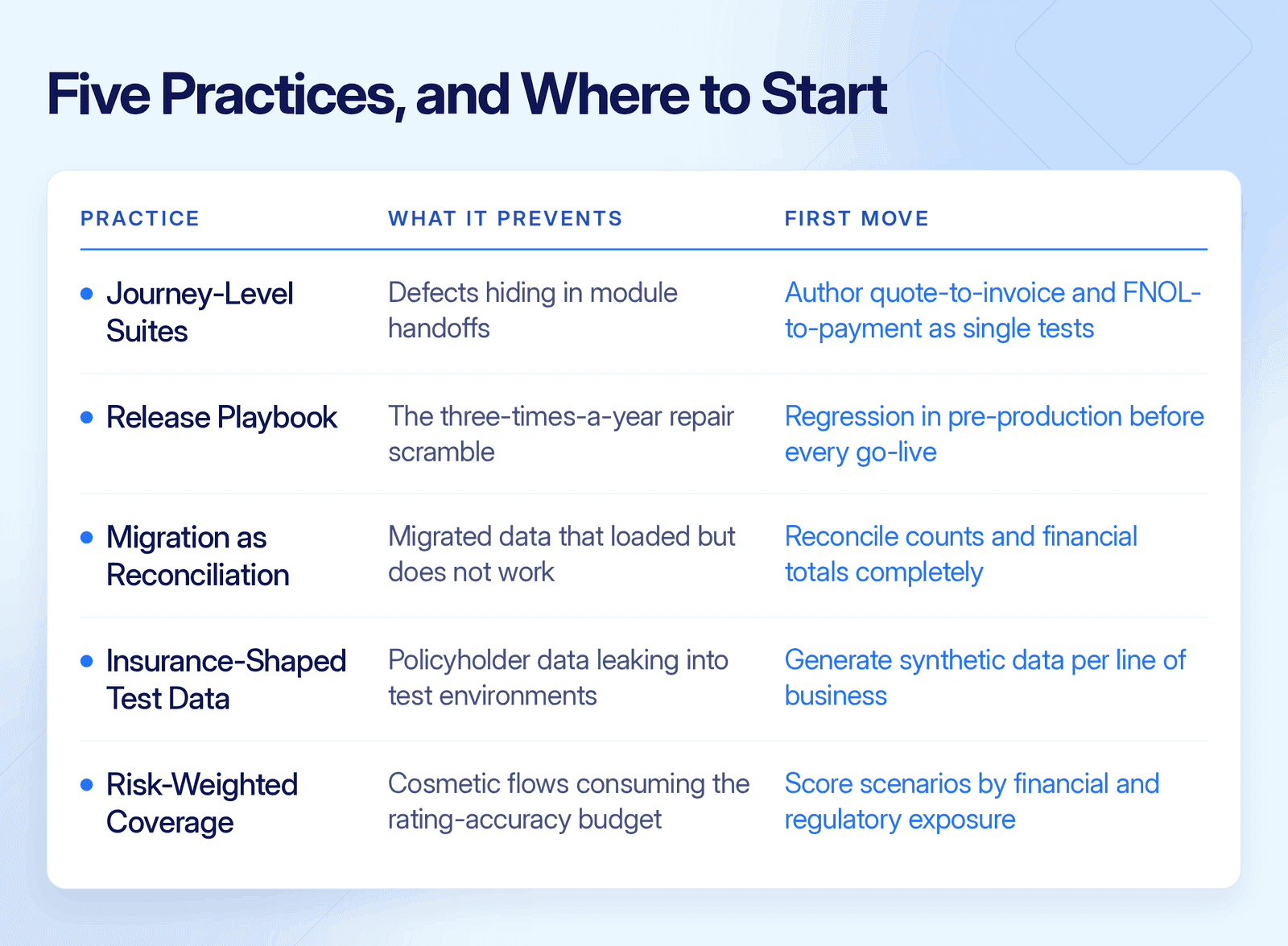
Build the Suite Around Insurance Journeys Rather Than Screens
A screen-level test proves a page works. The business runs on journeys, quote to bind to invoice, loss to settlement, and the defects that cost money live in the handoffs between modules.
Author tests as complete journeys, quote-and-bind through first invoice, FNOL through payment and recovery
Cover each line of business you write, since rating and rules diverge per line
Include the portal in the journey, because the policyholder's path starts in Jutro and ends in the core
Verify the data behind the screen, since a journey that looks right in the UI can still post the wrong figure to the ledger
Run a Release Playbook Instead of a Release Scramble
The three-a-year cadence rewards insurers who treat each Guidewire release as a rehearsed event with a standing suite, and punishes everyone else.
Regression-test in a pre-production environment on the new release before any go-live decision
Compare new out-of-the-box capability against your customisations, since each release is a chance to retire configuration you no longer need
Prioritise the suite by what the release notes say changed, then run the full journey set before sign-off
Track repair effort per release, because that number is your business case for better tooling
Treat Migration Testing as Reconciliation
Reconcile record counts, financial totals and status distributions between source and target, completely rather than by sample
Validate field mappings on the awkward records, the legacy policy with structures the new model never anticipated
Re-run the core journeys on migrated data, since data that loaded is not data that works
Keep the reconciliation evidence, because it will be asked for
Make the Data Strategy Insurance-Shaped
Build test data per line of business, covering the policy structures, coverages and jurisdictions you actually write
Include the hard cases deliberately, multi-vehicle claims, mid-term cancellations with refunds due, policies in delinquency
Generate synthetic data rather than copying production, since policyholder data carries the same regulatory weight in a test environment as anywhere else
Weight Coverage by Financial and Regulatory Risk
Score scenarios by the money and the compliance exposure behind them, so rating accuracy and claims payments outrank cosmetic flows at any likelihood of failure
Revisit the weighting when a release, a new line of business or a regulatory change moves the risk
Let the weighting decide what runs on every build versus what runs before release, keeping the fast feedback loop fast

How Virtuoso QA Approaches Guidewire Testing
Virtuoso QA is an AI-native test automation platform, and Guidewire test automation is one of the workloads it is used on most, from the core modules to the Jutro portals in front of them.
Plain-English authoring, so the people who know insurance write the tests: A claims specialist or underwriting SME authors the journey in natural language, and the whole team can read what the suite actually checks.
Live authoring: Each step runs as it is written, so a PolicyCenter journey is validated while it is being built.
Self-healing built for the release treadmill: When a Guidewire update moves the UI, Virtuoso proposes repairs, running at approximately 95% user acceptance, with your team approving each one. The suite comes back from a ski release in review sessions, not rebuild sprints.
Handles what Guidewire's front end actually is: Single-page application behaviour, iFrames and shadow DOM are handled automatically, which is precisely the territory where locator-based frameworks go brittle.
One journey across UI, API and database: A test can drive the portal, call the integration layer, and query the database to confirm the premium, the reserve or the invoice landed correctly, covering the seams where Guidewire estates actually fail.
AI test data generation: Data tables are generated from a written description, so line-of-business scenarios get realistic variation without production policyholder data entering a test environment.
Composable reuse across lines of business: Shared steps and checkpoints mean the quote journey for one line becomes the starting point for the next, instead of another build from zero.
Audit-ready evidence: Runs trace through Jira, Xray, TestRail and Azure Test Plans with exportable reports, which is what the compliance conversation needs when the question is what was tested before go-live.
Frequently Asked Questions
How often should Guidewire regression run?
Can Guidewire testing be automated without coding skills?
How do you test a Guidewire data migration?
How do you test Guidewire's new AI features?