Blog
Test Data Management Tools: 10 Options Compared for 2026

Rishabh Kumar
Published on

Table of contents
Lorem ipsum
Lorem ipsum
Lorem ipsum
Lorem ipsum
Lorem ipsum
Test data is the silent constraint on most automation programmes. The framework can be modern, the pipeline can be fast, and the team can be capable, and the suite will still stall if the data underneath it is wrong, stale, or missing. Test data management is the discipline that fixes that, and the tooling market around it has matured into a serious category with several distinct shapes of product inside it.
The list below covers ten tools worth knowing in 2026. The selection is deliberately mixed: AI-native test platforms with embedded data generation, enterprise data fabrics with referential integrity at scale, synthetic data specialists, and lightweight options that fit small teams without the budget for an enterprise contract. Each tool is described as it actually behaves, with strengths, limitations, and the situations it fits best. The piece is not a ranking. Tools that suit one context are wrong for another. The honest comparison is the one that helps the reader pick rather than pushing them all towards the same answer.
What Test Data Management Tools Actually Do
A modern TDM tool covers some or all of the following capabilities. Few tools cover them equally well. The category breakdown matters when picking.
Data masking and tokenisation: anonymising production data so it can be used in non-production environments without breaching regulation.
Data subsetting: producing smaller, representative slices of production data for faster test cycles.
Synthetic data generation: creating artificial data that mirrors the structure and statistical properties of production data without containing any real customer information.
Referential integrity management: maintaining relationships across tables and systems when data is masked, subset, or synthesised.
Self-service provisioning: allowing testers to request and refresh test data without going through a database team.
Data versioning and rollback: managing test data sets across versions so a test can be re-run against the original data.
CI/CD integration: wiring data provisioning into the build and deployment pipeline so tests get the data they need automatically.
Compliance and audit: producing the audit trail that regulators require for handling of sensitive data.
A tool that focuses on synthetic data generation (Gretel.ai, Tonic.ai) will do that well and may not cover subsetting at enterprise scale. A tool built around data virtualisation (Delphix) will excel at provisioning speed and may not be the right home for rules-based synthetic generation. The category breakdown is the first decision point.
The Top Test Data Management Tools in 2026
1. Virtuoso QA
Virtuoso QA is an AI-native end-to-end test automation platform with test data management built into the test authoring and execution experience. Where standalone TDM tools focus on producing data for tests to consume, Virtuoso QA integrates data generation, parameterisation, and management inside the journeys themselves.
What it Does Well
AI-driven data generation through GENerator
Plain-English parameterisation of test data across journeys
API-based extensibility for complex data requirements
Integration of UI tests with API and database validation in a single end-to-end journey
AI Root Cause Analysis that surfaces diagnostic evidence, namely screenshots, logs and the affected functional area, to speed triage when failures occur
Natural Language Programming makes data-driven test design accessible to business users and analysts, not only SDETs
Self-healing proposes repairs at approximately 95% user acceptance under human oversight, absorbing the routine application change that historically broke data-driven test suites
Limitations
Virtuoso QA is a test automation platform with journey-level data handling, not a standalone enterprise data fabric
Organisations that need production database virtualisation at petabyte scale, deep enterprise data governance across hundreds of source systems, or specialised mainframe data handling should pair Virtuoso QA with a dedicated platform for that layer
Best Fit
QA programmes where test data management lives inside the test journey
Programmes where business-readable data parameterisation matters
Programmes where the unit economics of authoring and maintenance are the binding constraints
2. K2View
K2View pioneered the entity-based approach to test data management. Rather than treating tables as the unit of data, K2View organises data around business entities, namely a customer, a policy, an order, keeping all related data linked across systems.
What it Does Well
Referential integrity across complex multi-system landscapes
Fast self-service provisioning
Data subsetting that preserves business-entity relationships
Masking and synthetic generation in one platform
API-driven integration into CI/CD pipelines
Strong fit for enterprises with data spread across many source systems where integrity across them is the operating constraint
Limitations
Initial setup requires meaningful technical investment and a clear data model
The entity-based abstraction is powerful but takes time to configure correctly
Smaller teams may find the platform heavier than their data complexity justifies
Best Fit
Large enterprises with data fragmented across multiple systems where end-to-end integration testing depends on integrity across the whole landscape
3. Delphix, now part of Perforce
Delphix is the data virtualisation specialist. Rather than copying production databases, Delphix creates lightweight virtual copies that can be provisioned in minutes, accessed concurrently by multiple test environments, and refreshed or rolled back on demand.
What it Does Well
Speed of provisioning
Low storage overhead through virtualisation
Integrated data masking
Support for a wide range of source databases, namely Oracle, SQL Server, PostgreSQL, Db2 and SAP HANA
Strong fit for organisations running many parallel test cycles against large databases
Limitations
The virtualisation model is most valuable when production database size is the bottleneck
For applications with relatively small datasets, the architectural overhead may exceed the benefit
Licensing carries enterprise weight
Best Fit
Organisations with large production databases, namely financial services, healthcare and telco, where the cost of cloning and refreshing dominates test environment economics
4. Informatica Test Data Management
Informatica's TDM module sits inside the broader Informatica data management ecosystem. The product covers discovery, masking, subsetting, and synthetic generation, with strong integration into the wider Informatica platform for data governance, ETL, and quality.
What it Does Well
Comprehensive coverage of TDM capabilities
Deep integration with the rest of the Informatica stack
Robust masking algorithms for sensitive data
Audit-grade reporting for compliance-heavy industries
Limitations
Implementation is complex and benefits most when the organisation has already standardised on the Informatica ecosystem
The platform is heavyweight by design and may be over-engineered for teams that do not need the broader data governance footprint
Best Fit
Enterprises already running Informatica for data integration or data quality, particularly in regulated industries where unified data governance is a board-level concern
5. Tonic.ai
Tonic.ai focuses on synthetic data generation with strong privacy guarantees. The platform uses statistical models to generate data that mirrors the properties of production data without containing any real customer information, addressing the GDPR and HIPAA constraints that make using production data in lower environments increasingly difficult.
What it Does Well
Privacy-preserving synthetic data generation
Support for relational, document, and event-based data
Integration into developer workflows through CLI and API
A focus on usability that contrasts with the heavyweight enterprise platforms in the category
Limitations
Tonic is a synthetic data specialist rather than a full TDM platform
Organisations that need extensive subsetting, virtualisation, or data fabric capabilities will pair Tonic with another tool
Best Fit
Engineering and QA teams that need synthetic data quickly and cleanly, particularly in environments where regulatory exposure makes production data unusable in non-production tiers
6. Gretel.ai
Gretel.ai is the synthetic data platform built around generative AI. The product uses transformer-based models to learn the structure of production data and generate synthetic equivalents that preserve statistical properties while applying differential privacy guarantees.
What it Does Well
AI-driven synthetic data generation
Differential privacy controls that satisfy strict regulatory requirements
Support for tabular and time-series data
API-driven workflows that fit modern engineering teams
Limitations
Like Tonic, Gretel focuses on the synthetic data slice of TDM rather than the full lifecycle
Setup for complex schemas requires care
Cost can grow with data volume and model training requirements
Best Fit
Organisations using synthetic data for both software testing and AI model training, where differential privacy guarantees are part of the compliance posture
7. GenRocket
GenRocket is the rules-based synthetic data platform. Rather than learning from production data, GenRocket lets users define the rules and patterns the data should follow, generating large volumes of synthetic data that satisfy the rules.
What it Does Well
High-volume synthetic data generation
Fine-grained control over data shape and distribution
Integration into CI/CD pipelines
A model that does not require access to production data to produce useful test data
Limitations
The rules-based approach requires effort upfront to define realistic patterns
Organisations that prefer learning from production data find the workflow less intuitive than statistical or AI-driven alternatives
Best Fit
QA teams that need predictable, controllable synthetic data at scale, particularly in environments where access to production data is restricted or undesirable
8. Broadcom Test Data Manager
Formerly CA Test Data Manager, the Broadcom offering is a full-featured enterprise TDM platform covering synthetic generation, masking, subsetting, and self-service provisioning. The tool is common in long-established enterprises with significant Broadcom investment.
What it Does Well
Comprehensive TDM coverage in a single platform
Web-based self-service portal
Integration with other Broadcom tools, Agile Requirements Designer in particular
Strong fit for large enterprise data landscapes with governance requirements
Limitations
Implementation overhead is real
Usability is improving but still feels less pipeline-first than newer alternatives
Licensing and administration carry typical enterprise weight
Best Fit
Enterprises already invested in the Broadcom tooling ecosystem that need robust, governance-oriented TDM at scale
9. IBM InfoSphere Optim
IBM InfoSphere Optim is the TDM platform of choice for enterprises with significant mainframe and legacy system footprints. The product provides robust data archiving, subsetting, and masking with deep support for Db2, AS/400, IMS, and VSAM datasets that other platforms handle poorly or not at all.
What it Does Well
First-class support for mainframe and legacy data sources
Mature subsetting and archiving capabilities
Audit-grade compliance reporting
The maturity that comes from decades of enterprise deployment
Limitations
Heavyweight by design
Requires specialised expertise to operate
Implementation timelines are longer than modern alternatives
Best value emerges when the mainframe footprint is a primary concern
Best Fit
Banks, insurers, and government organisations with substantial mainframe and legacy estates where modern alternatives lack the source-system coverage required
10. Mockaroo
Mockaroo is the lightweight option. The platform generates realistic synthetic data through a web interface or API, with a generous free tier and a paid tier for higher volumes and additional features.
What it Does Well
Fast to use, no setup required
Broad library of data types and formats
Useful for prototyping and small-scale testing
A comfortable on-ramp for teams not yet ready for an enterprise platform
Limitations
Not a full TDM platform
Lacks the subsetting, virtualisation, masking, and governance capabilities that enterprise programmes require
Best used as a complement to other tooling rather than as the strategic answer
Best Fit
Individual developers, small teams, and prototyping work where the question is how to get plausible test data right now rather than how to manage test data across the enterprise
How to Choose: A Decision Framework
The category map below helps narrow the choice quickly.
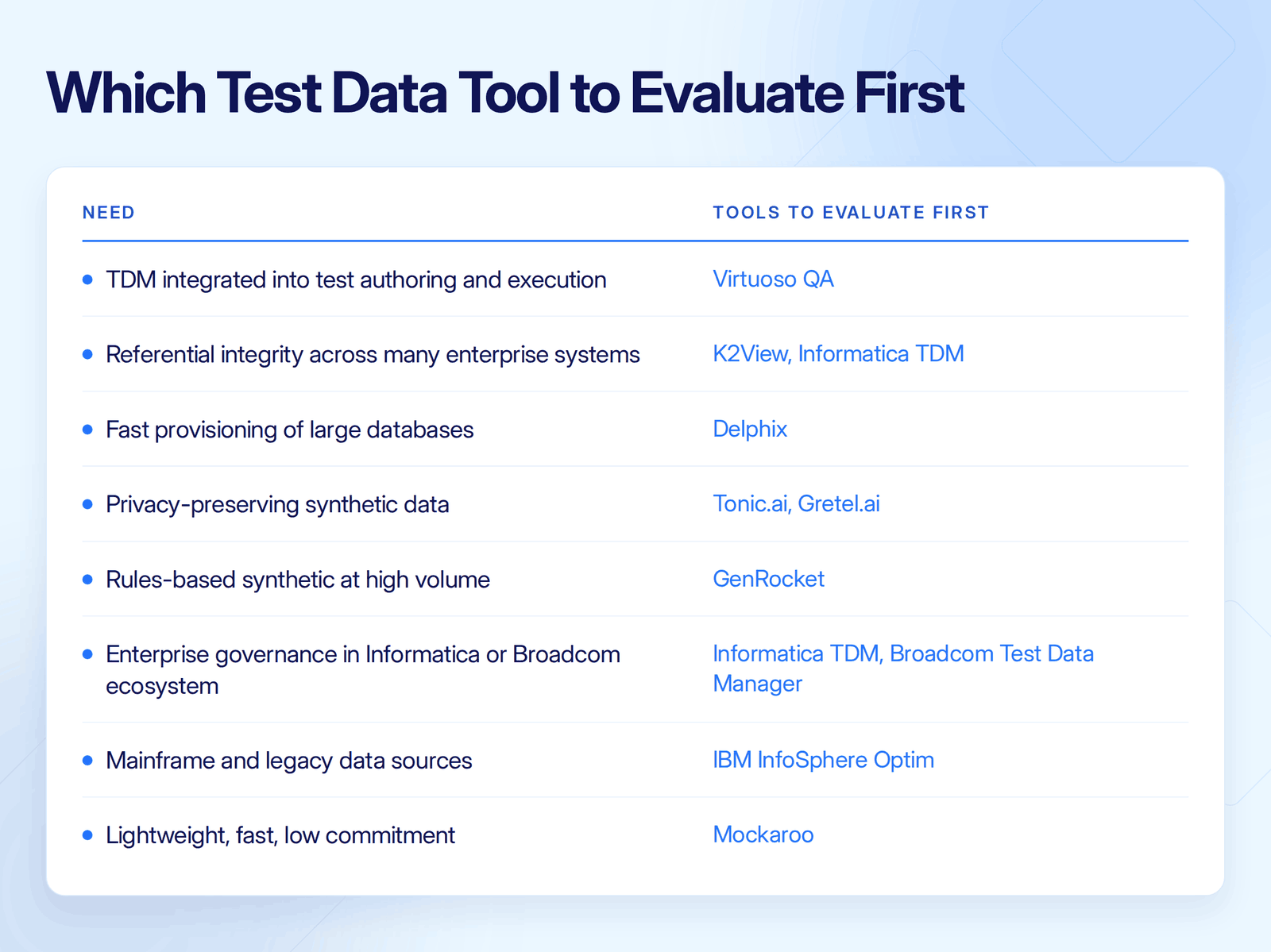
The honest answer is that mature enterprise programmes often run two tools. A data fabric or virtualisation platform handles the strategic data layer. A synthetic data tool covers privacy-constrained scenarios. A test platform with embedded TDM handles the journey-level data parameterisation that the standalone tools were not designed for.
Evaluation Criteria Worth Applying
Selection benefits from a small set of criteria applied consistently. The list below is what mature programmes use.
1. Coverage of the TDM Lifecycle
How much of the lifecycle (masking, subsetting, synthetic, provisioning, versioning, governance) does the tool actually handle? Tools that cover three of seven well usually beat tools that cover seven of seven poorly.
2. Integration Depth into the Engineering Stack
Does the tool integrate with the CI/CD platform, the test automation platform, the defect tracker, and the observability stack? Test data that does not flow into the pipeline automatically is test data that nobody uses.
3. Support for the Source Systems in the Environment
Modern web applications run on relational databases, document stores, message queues, and API integrations. Mainframe-heavy enterprises also need IMS, Db2, and VSAM coverage. The tool needs to cover the actual landscape, not the landscape the vendor finds easiest to demo.
4. Self-Service Maturity
Can testers and developers request and refresh test data themselves, or does every request go through a database team? Self-service maturity is one of the largest predictors of whether the tool actually changes day-to-day productivity.
5. Compliance and Audit Posture
For regulated industries, the tool's compliance posture is non-negotiable. GDPR, HIPAA, PCI-DSS, and emerging AI governance regulations all touch test data. The vendor's audit-grade reporting is part of the buy.
6. Total Cost of Ownership
Licensing is the visible cost. Implementation, ongoing administration, training, and integration are usually larger. A tool that lists for less but requires three platform engineers to operate is not the cheap option.
How AI-Accelerated Development is Reshaping Test Data Management
Three shifts have changed what TDM tooling has to handle.
Volume is up sharply
AI coding assistants generate large fractions of new code. The test surface scales with code volume. The data surface scales with the test surface. Programmes that ran adequately on weekly data refreshes find themselves needing data continuously.
Privacy exposure is up
Regulatory regimes around personal data have tightened. Using production data in non-production environments without rigorous masking or synthesisation is increasingly untenable. Synthetic data, once a nice-to-have, has become a structural requirement for many programmes.
Variability is up
AI-generated code introduces more pattern variation and more edge cases than fully human-authored code. Test data has to cover more of the input space. Tools that generate only "plausible" data miss the edge cases that AI-generated implementations now stumble on.
The implication is not that one tool category wins. The implication is that the TDM strategy has to cover more ground than it did three years ago, and the tooling decision should reflect the new reality rather than the old one.
How Virtuoso QA Fits the Modern TDM Conversation
Virtuoso QA is not a substitute for an enterprise data fabric or a database virtualisation platform. The honest framing matters. What Virtuoso QA provides is the TDM layer that lives inside the test journey itself: AI-driven data generation through the platform's AI assistant, plain-English parameterisation across tests, API-based extensibility for complex data scenarios, and integration of UI, API, and database validation in a single end-to-end journey.
The combination changes the unit economics of data-driven testing.
Tests are authored in plain English, including the data parameterisation.
Self-healing accurate to around 95% absorbs the application change that historically broke data-driven suites.
AI Root Cause Analysis includes data context when failures occur, accelerating triage.
Native integrations with Jenkins, GitHub Actions, Azure DevOps, GitLab, CircleCI, Bamboo, Jira, Xray, and TestRail mean the platform fits the existing engineering stack rather than asking the team to rebuild around it.
The outcomes show up in deployment data. A leading UK specialty insurance marketplace running data-heavy claims and policy workflows cut test creation time by 85% and maintenance by 81%, reaching 95% functional coverage with a team 50% leaner than the predecessor framework allowed.
A global aircraft leasing enterprise on Salesforce moved first-time pass rates from under 20% to 83% on workflows with extensive data variation. A global healthcare software provider compressed release cycles from 475 days to 4.5 days per release across data-intensive clinical applications.
A global wealth management platform moved automation coverage from under 5% to over 80% on portfolio and reporting workflows with rich parameterised data.
For enterprises running heavyweight TDM platforms for the strategic data layer (Delphix, K2View, Informatica), Virtuoso QA pairs naturally as the test-journey layer above. For programmes where data parameterisation lives inside the tests rather than in a separate dedicated platform, Virtuoso QA covers more of the lifecycle in a single platform than its category would suggest.
Related Reads
Frequently Asked Questions
What is the difference between data masking and synthetic data generation?
How do test data management tools integrate with CI/CD pipelines?
Which test data management tool is best for small teams?
How does AI-driven test data generation work?
Should test data management be part of the test automation platform or a separate tool?