Blog
How to Build a Solid Regression Test Plan? (Template + Implementation)

Rishabh Kumar
Published on

Table of contents
Lorem ipsum
Lorem ipsum
Lorem ipsum
Lorem ipsum
Lorem ipsum
A regression test plan transforms testing from reactive firefighting into strategic quality assurance. Without a plan, teams run whatever tests they remember whenever time permits. With a plan, teams execute targeted tests at optimal times, catching defects early while maintaining release velocity. This guide walks through building a regression test plan that works, including a practical template ready for immediate use.
What is a Regression Test Plan?
A regression test plan documents how an organization validates that software changes do not break existing functionality. The plan specifies what to test, when to test, how to test, and who owns testing responsibilities.
Unlike one time test plans for specific features, regression test plans address ongoing validation across the application lifecycle. They evolve as applications change, accommodating new features, deprecated functionality, and shifting priorities.
Effective regression test plans answer critical questions before testing begins. What functionality requires validation? Which tests cover that functionality? When do tests execute? What constitutes passing versus failing? Who responds to failures? Without clear answers, testing becomes ad hoc and unreliable.
Why Regression Test Plans Matter
Preventing Production Defects
Production defects cost 30 times more to fix than defects caught in development. Regression test plans ensure systematic validation catches defects before they reach production. Without plans, critical tests get skipped, coverage gaps appear, and defects escape.
Enabling Release Confidence
Release decisions require confidence that changes work and existing functionality remains intact. Regression test plans provide this confidence through documented coverage and execution evidence. Stakeholders can assess quality objectively rather than relying on gut feelings.
Optimizing Testing Resources
QA teams face resource constraints. Regression test plans direct limited capacity toward maximum value. Clear priorities prevent wasted effort on low value testing while ensuring high value tests always execute.
Supporting Compliance
Regulated industries require documented testing processes. Regression test plans provide artifacts demonstrating systematic quality assurance. Auditors can trace requirements to tests to results.
Regression Test Plan Components

Scope Definition
Scope defines what the regression test plan covers and excludes. Clear scope prevents both under-testing (missing critical coverage) and over-testing (wasting resources on out of scope areas).
In Scope
Document applications, modules, integrations, and functionality included in regression testing. Be specific enough that anyone can determine whether a given area falls within scope.
Out of Scope
Explicitly document what regression testing does not cover. This prevents assumptions about coverage that do not exist. Common exclusions include performance testing, security testing, and new feature testing (covered by separate plans).
Scope Changes
Define the process for modifying scope as applications evolve. New features eventually become existing functionality requiring regression coverage. Deprecated features eventually exit scope.
Test Objectives
Objectives state what regression testing aims to achieve. Objectives should be specific, measurable, and aligned with business goals.
Primary Objectives
Typical primary objectives include validating core functionality after changes, ensuring integration points function correctly, and confirming no regressions in critical business workflows.
Secondary Objectives
Secondary objectives might include validating cross browser compatibility, confirming accessibility compliance, and verifying data migration correctness.
Success Criteria
Define what success looks like. Criteria might include specific pass rates (99% of critical tests pass), coverage thresholds (90% of core workflows tested), or defect limits (zero critical defects in regression areas).
Test Environment
Document environments where regression testing executes. Environment details enable consistent test execution and troubleshooting.
Environment Specifications
Specify operating systems, browsers, devices, and infrastructure configurations. Document versions and patch levels where relevant.
Environment Access
Document how testers access test environments. Include URLs, credentials management, and access request procedures.
Environment Constraints
Note limitations affecting regression testing. Shared environments may have availability windows. Data refresh schedules may require test coordination.
Environment Parity
Document how test environments compare to production. Differences may affect test validity and require documentation.
Test Data Strategy
Test data significantly impacts regression test effectiveness. Document how tests obtain necessary data.
Data Sources
Identify where test data originates. Options include production copies, synthetic generation, and maintained test data sets.
Data Management
Document data refresh procedures, backup processes, and restoration capabilities. Tests may require specific data states.
Data Privacy
Address how test data handling complies with privacy requirements. Production data copies may require anonymization.
Data Dependencies
Document data dependencies between tests. Some tests may require specific records created by other tests or setup procedures.
Test Coverage Strategy
Coverage strategy defines how tests map to application functionality and what coverage levels regression testing targets.
Coverage Model
Define the coverage model used. Common models include requirements coverage (tests mapped to requirements), functionality coverage (tests mapped to features), and risk coverage (tests mapped to risk areas).
Coverage Targets
Set coverage targets for different priority levels. Critical functionality might require 100% coverage while lower priority areas target 80%.
Coverage Tracking
Document how coverage is measured and reported. Traceability matrices link tests to requirements. Coverage tools measure code coverage.
Coverage Gaps
Acknowledge known coverage gaps and document remediation plans. Perfect coverage is impractical. Documenting gaps enables informed risk acceptance.
Test Selection and Prioritization
Document how tests are selected for each regression cycle. Selection criteria balance thoroughness against time constraints.
Priority Levels
Define priority categories and their selection rules. Priority 1 tests run every cycle. Priority 2 tests run on releases. Priority 3 tests run periodically.
Selection Criteria
Document criteria determining test selection. Recent code changes, defect history, and business criticality inform selection.
Minimum Coverage
Define minimum test sets that must execute regardless of constraints. These tests cover functionality so critical that skipping them creates unacceptable risk.
Execution Schedule
Document when regression tests execute throughout the development lifecycle.
Continuous Integration
Specify which tests run on each code commit or pull request. These tests must execute quickly (minutes, not hours) to maintain developer productivity.
Nightly Builds
Specify tests running overnight against daily builds. Longer running tests fit here without blocking daytime development.
Release Testing
Specify comprehensive test suites running before releases. These thorough validations may take hours but provide release confidence.
Scheduled Runs
Document any recurring test executions outside CI/CD triggers. Weekly comprehensive runs or monthly full regression cycles fit this category.
Roles and Responsibilities
Document who owns regression testing activities. Clear ownership prevents tasks falling through cracks.
Test Planning
Identify who maintains the regression test plan, updating it as applications evolve.
Test Development
Identify who creates and maintains regression tests. Multiple people may share this responsibility.
Test Execution
Identify who triggers test execution and monitors results. Automated pipelines may handle execution while humans monitor.
Failure Response
Identify who investigates failures and routes defects. Clear ownership prevents failures languishing uninvestigated.
Reporting
Identify who produces and distributes regression test reports. Stakeholders need timely visibility into quality status.
Entry and Exit Criteria
Entry criteria define conditions required before regression testing begins. Exit criteria define conditions required before regression testing completes.
Entry Criteria
Typical entry criteria include stable build availability, test environment readiness, test data availability, and prerequisite testing completion.
Exit Criteria
Typical exit criteria include test execution completion (all scheduled tests run), pass rate achievement (above threshold), critical defect resolution (none outstanding), and documentation completion (results recorded).
Suspension Criteria
Define conditions causing regression testing to pause. Severe environment instability, blocking defects, or resource unavailability might warrant suspension.
Resumption Criteria
Define conditions required to resume suspended testing. Criteria address whatever caused suspension.
Risk Assessment
Document risks threatening regression testing effectiveness and mitigation strategies.
Technical Risks
Environment instability, test tool failures, and data corruption threaten execution. Mitigation includes redundancy, monitoring, and recovery procedures.
Resource Risks
Staff unavailability, skill gaps, and competing priorities threaten capacity. Mitigation includes cross training, documentation, and priority alignment.
Schedule Risks
Compressed timelines, scope expansion, and dependency delays threaten completion. Mitigation includes buffer time, scope management, and escalation procedures.
Defect Management
Document how regression testing identifies, tracks, and resolves defects.
Defect Reporting
Specify defect tracking systems, required fields, and severity definitions. Consistent reporting enables analysis and prioritization.
Defect Triage
Document triage processes determining defect priority and assignment. Triage should occur promptly to maintain momentum.
Defect Resolution
Document expectations for resolution timelines by severity. Critical defects may require immediate attention while minor defects queue for future sprints.
Regression Verification
Document how defect fixes are verified. Fixes should pass the test that identified the original defect plus related tests.
Reporting and Metrics
Document what information regression testing produces and how it reaches stakeholders.
Execution Reports
Specify report contents including tests executed, pass and fail counts, failure details, and execution duration.
Trend Reports
Specify trend analysis including pass rate trends, defect trends, and coverage trends over time.
Report Distribution
Identify report recipients and distribution frequency. Different stakeholders need different information at different frequencies.
Dashboard Access
Document real time dashboard access for stakeholders wanting current status without waiting for reports.
Regression Test Plan Template
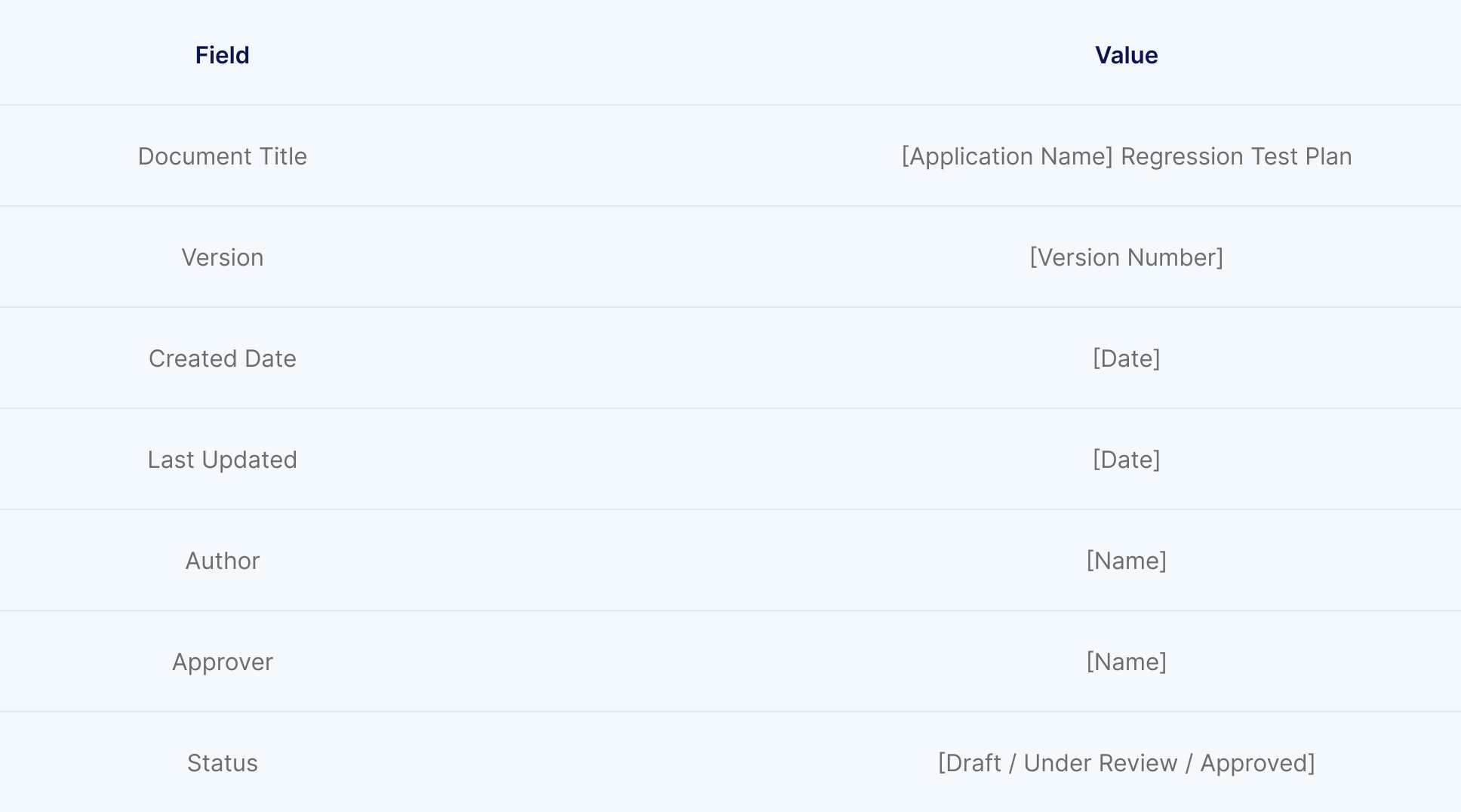
The following template provides a starting structure. Customize sections based on organizational needs, application characteristics, and regulatory requirements.
Document Information
Revision History

Introduction
Purpose
This regression test plan documents the approach for validating that [Application Name] functionality remains correct after software changes. The plan establishes scope, strategy, schedule, and responsibilities for regression testing activities.
Scope
In Scope: [List applications, modules, and functionality covered by this plan]
Out of Scope: [List areas explicitly excluded from this plan]
References
[List related documents including requirements specifications, design documents, and other test plans]
Test Objectives
Primary Objectives
[List primary objectives, e.g., validate core business workflows after each release, ensure integration stability across microservices, verify backward compatibility for API consumers]
Success Criteria

Test Environment
Environment Details

Environment Configuration

Test Data

Test Coverage
Coverage Model
[Describe your coverage approach: requirements based, functionality based, risk based, or a combination. Define how you measure coverage completeness.]
Coverage Matrix

Known Coverage Gaps

Test Selection and Prioritisation
Priority Definitions

Selection Criteria
[Document criteria for selecting which tests run in each execution cycle. Include risk based selection, change impact analysis, and test retirement rules.]
Execution Schedule
Continuous Integration

Scheduled Execution

Roles and Responsibilities

Entry and Exit Criteria
Entry Criteria
[List conditions required before regression testing begins, e.g., build deployed successfully, smoke tests passed, test environment stable, test data loaded]
Exit Criteria
[List conditions required before regression testing is considered complete, e.g., all P1 tests executed, pass rate above target, no unresolved critical defects]
Suspension and Resumption Criteria
[List conditions for pausing testing, e.g., environment outage, critical blocker defect. List conditions for resuming, e.g., environment restored, blocker resolved]
Risk Assessment

Defect Management
Defect Tracking
[Specify tracking system (Jira, Azure DevOps, etc.) and procedures for logging, assigning, and resolving defects found during regression testing]
Severity Definitions

Reporting

Tools and Infrastructure

Approvals

Implementing Your Regression Test Plan
Start With Current State
Before creating an ideal plan, document current regression testing practices. Understanding what exists prevents building plans disconnected from reality.
Inventory Existing Tests
Catalog tests currently used for regression validation. Note which tools contain them, who maintains them, and when they execute.
Assess Current Coverage
Evaluate what current tests actually cover. Coverage may be narrower than assumed. Identifying gaps enables targeted improvement.
Understand Current Processes
Document how regression testing currently happens. When do tests run? Who monitors results? How are failures handled?
Define Target State
With current state understood, define what effective regression testing looks like for your organization.
Coverage Goals
Set realistic coverage targets based on application criticality and available resources. 100% coverage is rarely achievable or necessary.
Execution Goals
Define execution frequency and duration targets. Balance thoroughness against delivery speed requirements.
Quality Goals
Set defect detection and escape rate targets. Goals should be ambitious but achievable.
Bridge the Gap
Develop plans bridging current state to target state. Prioritize improvements delivering maximum value with available resources.
Quick Wins
Identify improvements implementable immediately. Running existing tests more consistently or fixing chronically failing tests may provide immediate value.
Medium Term Improvements
Plan improvements requiring weeks to implement. Expanding coverage, automating manual tests, or integrating with pipelines fit here.
Long Term Transformation
Plan fundamental improvements requiring months. Platform migrations, architecture changes, or capability building fit this horizon.
Iterate and Improve
Regression test plans are living documents requiring ongoing refinement.
Regular Reviews
Schedule periodic plan reviews assessing effectiveness. Quarterly reviews suit most organizations.
Metrics Driven Improvement
Let metrics guide improvements. High defect escape rates indicate coverage gaps. High maintenance burden indicates fragility.
Stakeholder Feedback
Solicit feedback from development, product, and operations stakeholders. Their perspectives reveal improvement opportunities testing teams may miss.
Modern Regression Testing: What AI-Native Testing Changes
Traditional regression testing runs into the same problems release after release. Tests need constant repair, coverage gaps never quite close, and run times keep growing as the application does.
AI-native testing platforms change how regression works. With Virtuoso QA's AI-powered regression testing, teams build coverage faster, spend less time fixing tests, and can show exactly what each run proved.
Faster test creation
Natural language authoring lets testers write regression tests in plain English, with each step running live as they write. Touchstone agents can also draft tests from your existing specs and Jira stories. On the Virtuoso platform, SugarCRM saw 8x faster test creation.
Maintenance that stays under control
Self-healing keeps tests running when the UI changes, and every repair is logged for your team to review. Time that used to go on fixing broken tests goes back into coverage.
End-to-end coverage in one journey
UI, API and database checks run together in a single test, so regression catches the integration defects that separate suites miss.
Faster cycles
Tests run in parallel across 2,000+ browser, OS and device combinations, making full regression before every release realistic rather than aspirational.
Evidence for every run
Each run records which requirement every test covers and who approved it. A release decision rests on a record, not just a pass rate.
Related Reads
Frequently Asked Questions
What should a regression test plan include?
How do I define regression test scope?
How do I prioritize regression tests?
What is the difference between a test plan and test strategy?
What are entry and exit criteria for regression testing?
How often should I update the regression test plan?