Blog
Functional Testing vs Regression Testing: Understanding the Critical Differences

Adwitiya Pandey
Published on

Table of contents
Lorem ipsum
Lorem ipsum
Lorem ipsum
Lorem ipsum
Lorem ipsum
Functional testing and regression testing are foundational quality assurance practices that serve distinct but complementary purposes. Functional testing verifies that software features work according to requirements. Regression testing verifies that existing features continue to work after changes. Confusing these testing types or implementing them poorly leads to escaped defects, delayed releases, and wasted resources. Understanding when and how to deploy each testing type is essential for building quality software at speed.
The Quality Assurance Challenge
Software development teams face a fundamental tension. They must verify that new features work correctly while ensuring that changes have not broken existing functionality. These are different problems requiring different solutions.
The consequences of conflating functional and regression testing are severe. Teams that treat all testing as the same activity either over-test early in development when functionality is still forming, or under-test later when regression risks are highest. Both approaches waste resources and allow defects to escape.
The scale of this challenge grows with application complexity. Enterprise applications contain thousands of features, each requiring functional verification at creation and ongoing regression protection throughout the product lifecycle. A single e-commerce platform may have hundreds of user journeys spanning search, browsing, authentication, cart management, checkout, payment processing, order tracking, and customer service. Each journey requires initial functional testing and continuous regression coverage.
Traditional testing approaches cannot scale to meet this demand. Manual testing is too slow. Automation helps but creates its own challenges. The path forward requires understanding what functional and regression testing actually are, how they differ, and how modern AI native approaches transform both.
What is Functional Testing
Functional testing validates that software behaves according to specified requirements. It answers a direct question: does this feature do what it is supposed to do?
Functional testing focuses on what the system does, not how it does it. A functional test for a login feature verifies that valid credentials grant access and invalid credentials are rejected. It does not verify the internal encryption algorithms, database queries, or session management mechanisms. Those are concerns for other testing types.
Core Characteristics of Functional Testing
Requirement-driven
Functional tests derive directly from requirements, user stories, or acceptance criteria. If a requirement states that users can reset passwords via email, functional testing verifies that capability works as specified.
Black box approach
Functional testing treats the system as a black box. Testers interact with the application through its user interface or APIs without knowledge of internal implementation. This approach mirrors how real users experience the software.
Feature-focused
Each functional test targets a specific feature or capability. Tests are designed, executed, and tracked at the feature level. Coverage metrics measure which features have been functionally verified.
New functionality emphasis
Functional testing primarily applies to new or modified features. When a development team builds a new shopping cart capability, functional testing verifies that capability works correctly before it reaches users.
Types of Functional Testing
Functional testing encompasses several subspecialties, each addressing different verification needs.
Unit functional testing
Validates individual components in isolation. A function that calculates sales tax should return correct values for various inputs. This level of functional testing typically falls to developers.
Integration functional testing
Validates that components work together. A checkout flow involves cart services, inventory services, payment services, and order services. Integration functional testing verifies these services interact correctly.
System functional testing
Validates end-to-end functionality from the user perspective. A complete order placement journey spanning product selection through order confirmation represents system-level functional testing.
User acceptance testing
Validates that functionality meets business needs. Business stakeholders verify that the software serves its intended purpose, not just that it technically works.
Functional Testing Example
Consider a new feature: customers can save multiple shipping addresses to their account.
Functional test cases might include:
User can add a new shipping address with all required fields
User can add a new shipping address with only required fields, leaving optional fields blank
System validates address format and rejects invalid entries
User can save up to the maximum allowed addresses (e.g., 10)
System prevents saving beyond the maximum with appropriate message
User can edit an existing saved address
User can delete a saved address
User can set a default shipping address
Default address appears pre-selected during checkout
Saved addresses persist across sessions after logout and login
Each test case verifies a specific aspect of the feature's functionality as defined in requirements.

What is Regression Testing
Regression testing validates that previously working functionality continues to work after code changes. It answers a different question: did our changes break anything?
The term "regression" refers to software regressing to a previous defective state. Despite best intentions, code changes frequently introduce unintended side effects. A modification to the checkout flow might inadvertently break inventory updates. An authentication enhancement might disrupt session management. Regression testing catches these defects before they reach production.
Core Characteristics of Regression Testing
Change-triggered
Regression testing responds to changes in the codebase. Bug fixes, feature additions, refactoring, infrastructure updates, and dependency upgrades all warrant regression testing. Without changes, there is nothing to regress.
Existing functionality focus
Regression tests verify features that previously worked. They are not designed to verify new capabilities. New capabilities require functional testing first, then become candidates for regression coverage.
Cumulative growth
The regression test suite expands continuously throughout the product lifecycle. Every new feature eventually becomes existing functionality requiring regression protection. Every bug fix adds a test case to prevent recurrence. Mature applications may have thousands of regression test cases.
Maintenance intensive
As applications evolve, regression tests require updates. User interface changes break test selectors. Business rule modifications invalidate expected results. API changes require test adjustments. This maintenance burden is why 68% of automation projects are abandoned within 18 months.
Types of Regression Testing
Regression testing varies in scope depending on the change type and risk assessment.
Unit regression testing
Unit regression testing verifies that changes to individual components have not broken those components. Developers typically execute unit regression as part of the build process.
Partial regression testing
This testing approach focuses on areas directly affected by changes and their immediate dependencies. If the payment service changes, partial regression tests payment flows and closely related features like order completion and refund processing.
Complete regression testing
It executes the entire regression suite across all application areas. This comprehensive approach suits major releases, significant architectural changes, or high-risk modifications.
Selective regression testing
This approach uses risk analysis to prioritise test execution. High-risk areas receive full coverage while low-risk areas receive sampling. This approach balances thoroughness with time constraints.
Regression Testing Example
Continuing with the saved shipping addresses feature, once functional testing confirms the feature works, it enters the regression suite.
Subsequent changes to the application trigger regression testing. If the development team modifies the user profile page layout, regression testing verifies that:
Existing saved addresses still display correctly
Add, edit, and delete operations still function
Default address selection still persists
Checkout still pre-selects the default address
Address validation still enforces format rules
These tests existed before the profile page modification. They run after the modification to confirm no regression occurred.
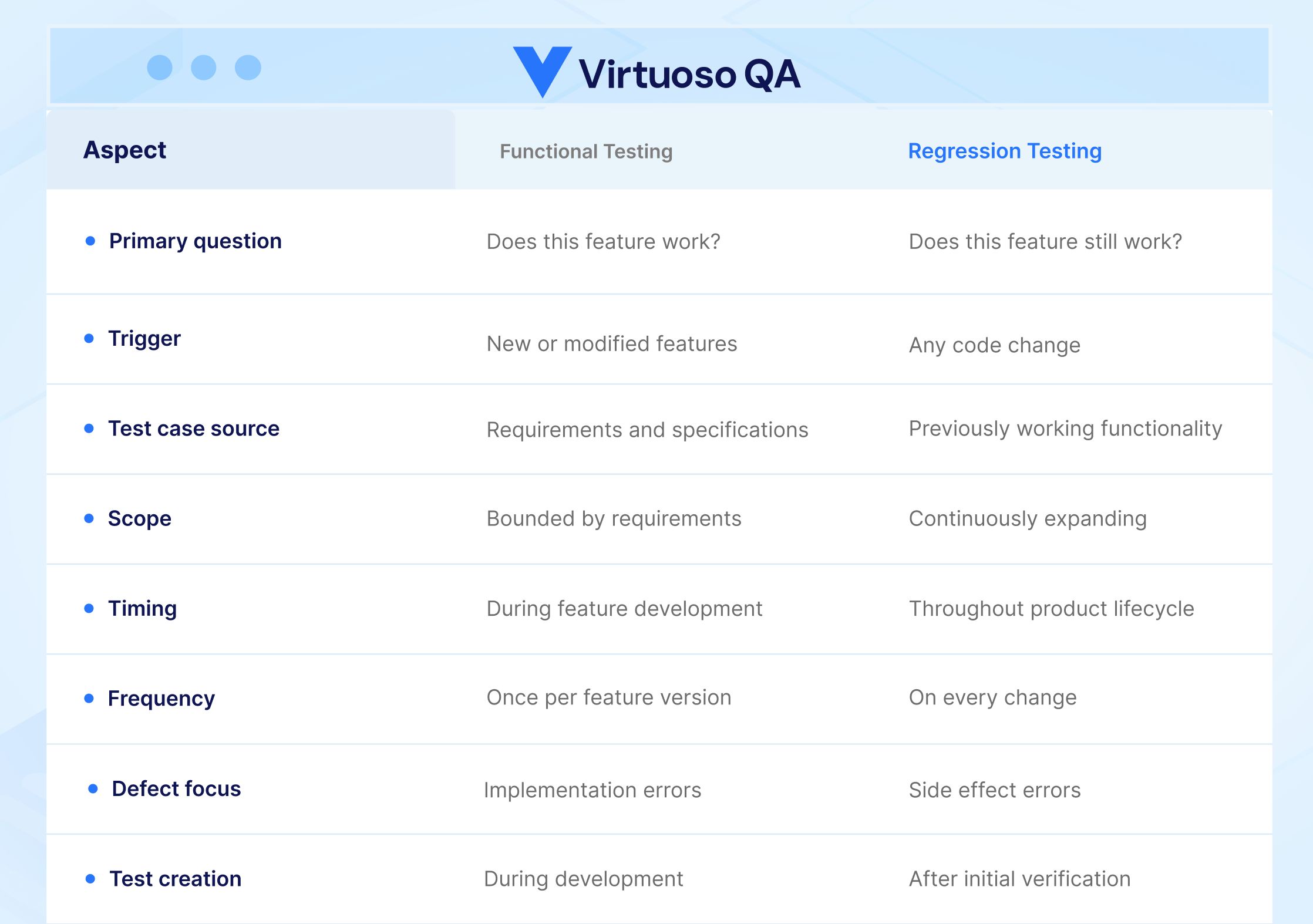
Key Differences Between Functional Testing and Regression Testing
Understanding these distinctions enables effective test strategy design.
1. Purpose and Objective
Functional testing verifies that features work as intended. It confirms that requirements have been implemented correctly. The question is: does this work?
Regression testing verifies that features continue to work after changes. It confirms that modifications have not introduced defects. The question is: does this still work?
Timing in the Development Lifecycle
Functional testing occurs when features are new or modified. It is most intensive during initial development and feature enhancement phases. Functional testing for a new capability happens once, when that capability is built.
Regression testing occurs continuously throughout the product lifecycle. It is triggered by any code change. The same regression tests may execute hundreds or thousands of times over the product lifespan.
Test Case Sources
Functional test cases derive from requirements, user stories, acceptance criteria, and specifications. Test designers translate requirements into verification scenarios.
Regression test cases derive from previously verified functionality, fixed defects, and production incidents. The regression suite is the accumulated history of what the application should do, based on what it has successfully done before.
Scope Dynamics
Functional testing scope is defined and bounded. A feature has a finite set of requirements. Once those requirements are verified, functional testing for that feature is complete.
Regression testing scope grows continuously. Every verified feature becomes a regression candidate. Every fixed bug adds a regression test. The regression suite never stops growing, which is why maintenance consumes such enormous resources in traditional automation approaches.
Execution Frequency
Functional testing executes during development and enhancement cycles. A feature might undergo functional testing for two weeks during development, then never require new functional tests unless it is modified.
Regression testing executes on every change. A mature application with hundreds of daily commits might trigger dozens of regression cycles per day. Annual regression test executions can reach hundreds of thousands for enterprise applications.
Defect Types Detected
Functional testing catches implementation errors where features do not match requirements. The code is wrong relative to what was specified.
Regression testing catches side effect errors where changes have unintended consequences. The code was right but a subsequent modification broke it.
The Relationship Between Functional and Regression Testing
Functional testing and regression testing are sequential and complementary. Functional testing validates new capabilities. Those validated capabilities then join the regression suite for ongoing protection.
Consider the lifecycle of a single feature:
Development phase
The team builds a customer review capability. Functional testing verifies that customers can write reviews, rate products, edit their reviews, and delete their reviews. Testing confirms all requirements are satisfied.
Release phase
The verified feature ships to production. Functional test cases become regression test cases. They no longer verify whether the feature works initially. They verify whether the feature continues working.
Maintenance phase
Six months later, the team enhances the review display algorithm. This change might affect review visibility, sorting, or filtering. Regression testing executes the review-related tests to confirm the enhancement did not break existing functionality.
Expansion phase
The team adds photo uploads to reviews. New functional testing verifies the photo capability. Existing regression tests verify that text reviews still work correctly.
This lifecycle repeats for every feature throughout the product's existence. Functional testing feeds the regression suite. The regression suite grows until maintenance becomes untenable without intelligent automation.

Regression and Functional Testing - Implementation Challenges
Both testing types face significant implementation obstacles in traditional approaches.
Functional Testing Challenges
Requirement ambiguity
Incomplete or unclear requirements make functional test design difficult. Testers cannot verify functionality against requirements that do not exist or are open to interpretation.
Environment availability
Functional testing requires stable test environments that mirror production sufficiently. Environment instability causes false failures and delays verification.
Test data management
Functional tests require appropriate data states. Testing a checkout flow requires products, inventory, customer accounts, and payment configurations. Creating and maintaining this data is complex.
Integration dependencies
Modern applications depend on numerous external services. Third-party payment processors, identity providers, shipping calculators, and other integrations must be available or simulated for complete functional testing.
Regression Testing Challenges
Test suite growth
Every feature adds regression tests. Every bug fix adds regression tests. Without discipline, regression suites become bloated and slow. Execution times stretch from minutes to hours to days.
Maintenance burden
Application changes break tests. Industry data shows that 60% of QA time goes to maintenance in traditional automation. Selenium users spend 80% of their time maintaining tests and only 10% creating new coverage. This maintenance spiral consumes all automation benefits.
Flaky tests
Tests that pass sometimes and fail sometimes destroy confidence in automation. 59% of developers encounter flaky tests monthly. Teams stop trusting test results and revert to manual verification.
Execution time
Comprehensive regression testing takes time. If regression cycles take days, teams cannot run them frequently. If teams cannot run them frequently, they skip regression testing when time is short, precisely when risk is highest.
The Common Challenge: Scale
Both functional and regression testing must scale with application complexity. Enterprise applications are not static. They grow continuously. New features, enhanced features, integrated systems, and expanded user bases create exponentially increasing testing demands.
Manual testing cannot scale. There are not enough testers. The testing takes too long. Human attention spans cannot maintain consistency across thousands of test executions.
Traditional automation cannot scale either. The maintenance burden grows faster than the productivity gains. Teams spend their time fixing tests rather than expanding coverage. Eventually the automation delivers negative value, consuming more resources than it saves.
The AI Native Test Automation Solution
AI native test automation fundamentally changes the economics of both functional and regression testing.
Self-Healing Eliminates Maintenance
Traditional automation breaks when applications change because tests depend on brittle locators. A button ID changes and dozens of tests fail. A page layout shifts and the entire checkout suite breaks.
AI native test platforms understand test intent, not just element locations. When the application changes, the platform adapts automatically. Virtuoso QA achieves approximately 95% accuracy in self-healing, meaning tests survive application changes that would break traditional automation.
Natural Language Accelerates Creation
Traditional automation requires coding skills. Selenium, Cypress, Playwright, and similar frameworks demand programming expertise. This creates bottlenecks. Teams queue work behind limited automation engineers.
AI native platforms enable test authoring in plain English. Describe what you want to test in natural language and the platform generates executable tests. This democratises test creation. Business analysts, manual testers, and product managers can contribute to automation.
The velocity improvement is dramatic. Teams create functional tests in hours instead of weeks. Regression suites expand continuously because creation is no longer the bottleneck.
Unified Platform Covers All Testing Types
Traditional approaches fragment testing across multiple tools. One tool for UI testing, another for API testing, another for database validation. Each tool requires separate expertise, maintenance, and integration.
AI native platforms unify testing types on a single platform. UI testing, API testing, and database validation combine in unified journeys. A single test can verify a user interface action, validate the resulting API call, and confirm database state changes.
This unification is critical for comprehensive functional testing. Modern applications span multiple layers. Functional verification must cross those layers to confirm complete feature operation.
Parallel Execution Collapses Cycle Times
Manual regression testing takes weeks. Traditional automation reduces this to hours or days. AI native platforms collapse it further to minutes.
Parallel test execution distributes tests across hundreds of concurrent execution streams. A regression suite that takes 10 hours sequentially completes in 6 minutes with 100 parallel executions.
This speed enables continuous regression. Every commit triggers a regression cycle. Every merge verifies nothing has broken. The concept of a "regression testing phase" disappears because regression testing happens constantly.
Best Practices for Functional Testing
1. Design Tests from Requirements
Every functional test should trace to a specific requirement. This traceability ensures complete coverage and identifies gaps. If a requirement has no tests, it has no verification. If a test has no requirement, it may be unnecessary.
2. Test Early and Often
Functional testing should begin as soon as features are testable. Waiting until code complete to start testing creates a testing bottleneck before release. Shift-left testing approaches integrate testing throughout development, catching defects when they are cheapest to fix.
3. Combine UI and API Verification
Modern applications present functionality through multiple interfaces. A feature available via web UI is often also available via API. Comprehensive functional testing verifies both interfaces and confirms they produce consistent results.
4. Automate from Day One
Manual functional testing is appropriate for exploratory investigation. Formal verification should be automated immediately. Tests created during functional testing become regression assets. Creating them as automated tests from the beginning maximises their long-term value.
5. Use Real-World Data Scenarios
Functional tests using artificial data may miss defects that occur with production-like data. Test with realistic data volumes, formats, and edge cases. AI native platforms can generate realistic test data automatically, enabling comprehensive data-driven functional testing.
Best Practices for Regression Testing
1. Prioritise by Risk
Not all functionality carries equal business risk. Core revenue-generating features require more regression coverage than minor administrative capabilities. Risk-based prioritisation focuses regression investment where it matters most.
2. Maintain Test Independence
Regression tests should execute independently without dependencies on other tests or shared state. Independent tests can run in parallel, reducing cycle time. They can also run selectively without requiring complete suite execution.
3. Implement Continuous Regression
Waiting for release candidates to run regression testing delays defect detection. Continuous regression executes tests on every code change, catching issues immediately. Modern CI/CD pipelines support this approach with automated test triggering.
4. Eliminate Flaky Tests
A flaky test that sometimes passes and sometimes fails provides negative value. It wastes time investigating false failures. It creates noise that obscures real defects. Eliminate or stabilise flaky tests aggressively. AI native platforms with intent-based testing significantly reduce flakiness compared to locator-based approaches.
5. Leverage Self-Healing
The maintenance burden that kills traditional regression automation stems from test brittleness. AI native self-healing eliminates this burden. Tests adapt to application changes automatically, maintaining their validity without manual intervention.
Conclusion
Functional testing and regression testing serve different but complementary purposes in software quality assurance. Functional testing verifies that new capabilities work correctly. Regression testing verifies that existing capabilities continue working after changes. Both are essential for delivering quality software.
The challenge has never been understanding these testing types. The challenge has been executing them effectively at scale. Manual approaches cannot keep pace with modern development velocity. Traditional automation drowns in maintenance overhead.
AI native platform like Virtuoso QA fundamentally change these economics. Self-healing eliminates the maintenance spiral that kills regression automation. Natural language authoring removes the coding bottleneck from functional test creation. Parallel execution collapses regression cycle times from days to minutes.
The organisations that adopt AI native testing gain compounding advantages. Their functional testing accelerates. Their regression coverage expands. Their defect escape rates decline. Their release velocity increases.
The transition from traditional to AI native testing is not optional. It is the inevitable evolution of software quality assurance. The only question is timing.

Related Reads
Frequently Asked Questions
Can a test be both functional and regression?
How much regression testing is enough?
Which should be done first, functional testing or regression testing?
How often should regression testing run?
How do you measure functional and regression testing effectiveness?
Why do regression test suites become so large?