Blog
A Practical Guide to AI Test Case Generation for QA

Adwitiya Pandey
Published on






Table of contents
Lorem ipsum
Lorem ipsum
Lorem ipsum
Lorem ipsum
Lorem ipsum
AI powered test case generation transforms testing from manual script writing to autonomous creation. Where traditional approaches require engineers to code every test manually, generative AI analyzes applications, understands requirements, and produces comprehensive test coverage automatically. This guide examines how AI test generation works, which capabilities deliver genuine value, and how QA teams implement autonomous generation to achieve faster test creation with maintenance reduction.
The Test Creation Bottleneck
Every QA team faces the same constraint: test creation cannot keep pace with development velocity.
Manual test authoring requires specialized engineers, consumes weeks per sprint, and creates backlogs that never shrink. Applications grow faster than teams can write tests.
AI powered test case generation eliminates this bottleneck entirely. Rather than humans writing every test manually, artificial intelligence analyzes applications, interprets requirements, and generates comprehensive test suites autonomously.
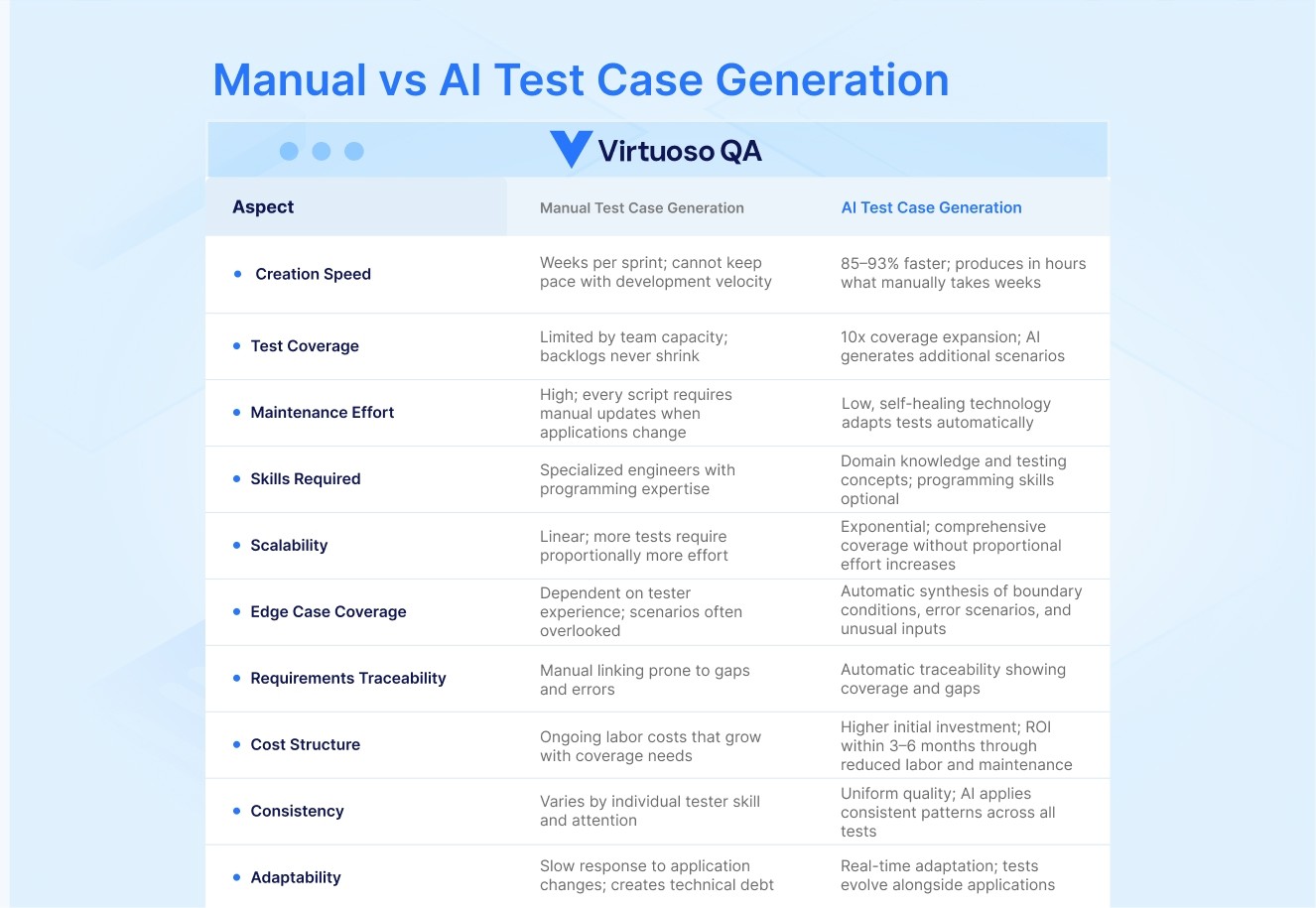
This is not incremental improvement. Organizations implementing AI test generation report reduction in testing time, 10x increase in test coverage, and maintenance reduction. The testing economics transform completely.
Understanding AI Test Case Generation
What AI Test Generation Actually Does
AI test case generation applies machine learning, natural language processing, and generative AI to create software tests with minimal human intervention. The technology shifts test creation from labor intensive manual coding to intelligent automated synthesis.
Traditional automation requires humans to write every test step, define every element locator, handle every edge case, and update every script when applications change. AI test generation transfers this burden from humans to machines.
The AI analyzes applications, generates tests autonomously, identifies elements intelligently, heals broken tests automatically, and provides actionable failure insights without manual effort.
How AI Generates Tests
AI test generation operates through several interconnected capabilities:
Application analysis examines UI structure, element relationships, user flows, and business logic patterns. The AI builds comprehensive models of how applications work, enabling intelligent test creation based on actual application behavior.
Requirement interpretation processes natural language specifications, user stories, acceptance criteria, and business requirements. Generative AI understands testing intent and translates requirements into executable validation scenarios.
Pattern recognition identifies common business workflows: login processes, search functionality, e-commerce checkout, form submissions, data management operations. This pattern knowledge accelerates test generation by applying proven approaches to recognized scenarios.
Assertion generation automatically creates appropriate validations based on context. When tests navigate to checkout, AI generates assertions verifying cart totals, shipping calculations, and payment processing outcomes.
Edge case synthesis produces variations covering boundary conditions, error scenarios, and unusual input combinations. AI generates comprehensive test coverage including scenarios human testers might overlook.
Benefits of AI-Driven Test Case Generation
Accelerated Test Creation
AI generates comprehensive test suites in hours rather than weeks. Teams eliminate backlogs and match test creation velocity to development speed. New features ship with complete validation rather than partial coverage.
Expanded Test Coverage
Autonomous generation produces scenarios human testers might overlook. Edge cases, boundary conditions, and unusual input combinations receive systematic coverage. Applications achieve validation depth impossible through manual approaches.
Reduced Maintenance Burden
Self-healing technology keeps tests functional as applications evolve. Element changes, layout modifications, and attribute updates no longer break test suites. Engineering effort redirects from maintenance to coverage expansion.
Democratized Test Creation
Natural language programming enables anyone who understands requirements to create tests. Business analysts, manual testers, and product owners contribute directly to automation without coding skills.
Consistent Quality
AI applies uniform patterns and standards across all generated tests. Quality no longer varies by individual tester skill or attention. Every test follows established best practices automatically.
Faster Feedback Cycles
Rapid test creation and CI/CD integration provide immediate validation feedback. Developers learn about defects within minutes of committing code rather than days or weeks later.
Lower Long-Term Costs
Initial platform investment yields returns within months through reduced labor, eliminated maintenance, and decreased infrastructure requirements. Testing costs decline as coverage expands.
When to Use AI Test Case Generation
AI test generation delivers maximum value in specific contexts. Understanding ideal use cases guides implementation priorities.
High-Volume Regression Testing
Applications requiring extensive regression validation benefit immediately. AI generates and maintains comprehensive regression suites that would overwhelm manual approaches.
Rapid Development Environments
Teams practicing continuous delivery need test creation that matches development velocity. AI generation keeps pace with frequent releases and constant change.
Legacy Application Modernization
Organizations migrating from legacy systems gain immediate coverage through AI analysis and generation. Existing manual test cases convert to automated suites efficiently.
Resource-Constrained Teams
QA teams lacking automation expertise leverage natural language generation to build coverage without hiring specialized engineers.
Standard Business Workflows
Applications featuring common patterns like authentication, search, e-commerce, and data management align well with AI pattern recognition capabilities.
Cross-Browser and Cross-Device Testing
AI efficiently generates test variations covering multiple browsers, devices, and configurations without multiplicative manual effort.
Key AI Test Generation Technologies
1. Natural Language Programming
Natural Language Programming enables test creation by describing actions and expected outcomes in plain English. Instead of coding test scripts, teams write specifications that AI translates into executable automation.
"Customer logs in with valid credentials, searches for products in electronics category, adds items to cart, proceeds to checkout, verifies order total calculates correctly" becomes working test automation without any programming.
The technology provides intelligent autocomplete suggesting logical next steps, context aware recommendations based on application state, automatic assertion generation inferring expected outcomes, and real time syntax validation ensuring test correctness.
This democratizes test creation beyond technical specialists. Anyone who understands requirements can create tests: business analysts, manual testers, product owners, and domain experts.
2. Autonomous Test Generation
Autonomous test generation analyzes applications and creates comprehensive test suites without human authoring. The AI observes application structure, understands user workflows, and generates validation scenarios covering functional requirements.
Real time application understanding inspects UI elements as you navigate, comprehending their purpose from context. The AI identifies buttons, inputs, dropdowns, and links, recognizing relationships and dependencies while mapping complete user workflows.
Intelligent step generation suggests appropriate next actions based on current context. After navigating to a login page, autonomous generation identifies username and password fields, suggesting data entry steps followed by form submission with appropriate assertions.
Business process recognition identifies common patterns like authentication flows, search functionality, CRUD operations, and transactional workflows. This recognition enables accurate test generation that covers real user behaviors rather than arbitrary action sequences.
Continuous learning improves generation quality based on execution results. The AI learns which test patterns prove most effective, which validations catch actual defects, and which scenarios require attention. Generation improves continuously through actual usage.
3. Generative AI and LLM Capabilities
Large language models power next generation test creation through sophisticated understanding of testing context:
Requirement parsing extracts testable criteria from specifications, user stories, and acceptance criteria. LLMs understand nuanced business requirements and translate them into specific validation scenarios.
Test scenario synthesis generates comprehensive test cases from diverse starting points including requirements documents, application wireframes, legacy test suites, manual test cases, and design files. The generative AI analyzes source material, understands testing intent, and produces executable automation.
Data generation creates realistic, contextually appropriate test data on demand. Testers describe data needs in natural language: "Generate 50 customer records with addresses in California, ages 25 to 65, with purchase histories" and AI produces appropriate data instantly.
Code generation produces custom validation logic when needed. AI Extension Assistants generate JavaScript from plain English commands, extending platform capabilities without requiring coding expertise.

Agentic AI: The Next Evolution
Beyond Task Execution to Outcome Ownership
Agentic AI represents a fundamental leap beyond traditional automation. Where AI agents execute specific tasks within predetermined boundaries, agentic AI takes responsibility for outcomes rather than just actions.
The distinction transforms AI from tool into collaborator, from assistant into strategic partner. Agentic AI does not just respond to "do this task" commands. It understands "achieve this outcome" objectives and independently determines how to reach them.
Agentic Testing in Practice
Agentic AI testing platforms operate as intelligent quality partners that independently manage entire testing processes:
Test selection optimization dynamically identifies which tests to run based on code changes and risk analysis. Using triggers like Jira tickets and Git commits, agentic AI selects relevant tests without requiring source code access.
Adaptive execution adjusts testing strategies based on real time results. When tests fail, agentic AI analyzes causes, determines if application changes are responsible, adapts test definitions when appropriate, and retries execution. The system makes dozens of decisions independently.
Self directed maintenance handles test evolution without human intervention. When applications change, agentic testing recognizes modifications, updates affected tests, and continues ensuring quality coverage. Human escalation occurs only when genuinely necessary.
Strategic quality insights go beyond pass/fail reporting to provide actionable intelligence about application health, risk areas, and quality trends. Agentic AI identifies patterns that human analysis might miss.
Putting AI Test Generation into Practice
1. Starting with AI Test Generation
Successful AI test generation implementation follows a progressive approach:
Pilot selection chooses an appropriate starting point. Select applications with stable requirements, clear business value, and representative complexity. Avoid both trivial applications that do not demonstrate value and massively complex systems that overwhelm initial efforts.
Baseline establishment documents current testing metrics before AI implementation. Measure test creation time, maintenance effort, coverage levels, and defect escape rates. These baselines enable accurate ROI calculation after implementation.
Initial generation leverages AI to create test suites for pilot applications. Focus on core user workflows, business critical functionality, and high risk areas. Let AI generate comprehensive coverage while teams learn the technology.
Quality validation verifies that AI generated tests provide genuine value. Execute generated suites, analyze results, and confirm that tests catch meaningful defects. Adjust generation parameters based on observed quality.
Progressive expansion extends AI test generation to additional applications and teams. Apply lessons from pilot implementations to accelerate subsequent rollouts.
2. Integrating AI with Existing Processes
AI test generation integrates with established QA workflows:
Requirements traceability connects AI generated tests to source requirements. Modern platforms maintain automatic traceability, showing which requirements each test validates and which lack coverage.
CI/CD integration incorporates AI generated tests into continuous integration pipelines. Tests execute automatically on code commits, providing rapid feedback without manual intervention.
Test management alignment synchronizes AI generated tests with existing test management systems. Integration with tools like TestRail and Xray maintains unified test asset visibility.
Reporting consolidation combines AI generated test results with traditional reporting structures. Dashboards present unified quality metrics regardless of test origin.
3. Migrating from Legacy Frameworks
Organizations with existing test automation face migration decisions. AI platforms accelerate migration through intelligent conversion:
Legacy analysis examines existing test suites in Selenium, Cypress, Playwright, or other frameworks. AI understands test intent beyond literal script content.
Intelligent conversion transforms legacy tests into AI native format. Rather than simple code translation, the conversion extracts testing intent and generates optimal representations.
Enhancement application improves converted tests with AI capabilities. Migrated tests gain self healing, natural language representation, and integration with autonomous generation.
Parallel validation runs original and converted tests simultaneously, verifying equivalent coverage before retiring legacy implementations.
AI Test Generation Best Practices
Maximize AI test generation value through proven implementation approaches.
Start with Clear Requirements
AI generates better tests from well-defined requirements. Invest time in clear user stories, acceptance criteria, and business process documentation before generation.
Validate Generated Tests
Review AI-generated tests before trusting them completely. Confirm tests address actual business needs, assertions validate meaningful outcomes, and coverage aligns with risk priorities.
Combine AI with Human Expertise
Use AI for high-volume generation and maintenance while human experts focus on test strategy, exploratory testing, and complex scenario design. The combination outperforms either approach alone.
Iterate and Refine
Treat initial AI generation as a starting point. Refine generated tests based on execution results, add scenarios AI missed, and adjust generation parameters based on observed quality.
Maintain Traceability
Connect AI-generated tests to source requirements systematically. Traceability ensures coverage visibility and supports compliance requirements.
Monitor Generation Quality
Track metrics showing whether AI-generated tests catch real defects, produce false positives, or miss important scenarios. Use insights to improve generation over time.
Measuring AI Test Generation Value
Key Performance Indicators
AI test generation delivers measurable improvements across multiple dimensions:
Test creation velocity measures time required to produce test coverage. AI generation achieves 85 to 93% faster creation compared to manual scripting, producing in hours what traditionally required weeks.
Maintenance reduction quantifies effort spent keeping tests functional. Self healing with 95% accuracy reduces maintenance burden by 81 to 90%, redirecting engineering capacity to coverage expansion.
Coverage expansion tracks test coverage growth over time. Autonomous generation enables 10x coverage increases as AI continuously produces additional scenarios without proportional effort increases.
Defect detection measures bugs found by AI generated tests. Comprehensive AI coverage catches defects that limited manual suites miss.
Release acceleration tracks deployment frequency improvements. Faster test creation and reduced maintenance enable more frequent releases with maintained quality gates.
ROI Calculation
AI test generation ROI typically manifests within three to six months:
Direct savings include reduced test creation labor, eliminated maintenance effort, and decreased infrastructure requirements.
Indirect value encompasses faster time to market, improved defect detection, reduced production incidents, and enhanced team productivity.
Strategic benefits include competitive differentiation through quality velocity, talent retention by eliminating tedious maintenance work, and organizational capability expansion.
The Virtuoso QA Approach
1. StepIQ Autonomous Generation
StepIQ represents Virtuoso QA's autonomous test generation capability, observing applications and generating complete test scenarios including setup, navigation, data entry, validations, and cleanup.
As testers navigate applications, StepIQ analyzes UI elements, understands their purpose from context, identifies relationships and dependencies, and maps complete user workflows. The AI suggests next logical steps based on current context, generates appropriate test data for form fields, creates smart assertions validating critical outcomes, and builds comprehensive coverage including happy paths and edge cases.
2. GENerator Agentic Creation
Virtuoso QA GENerator uses agentic AI to automate the hardest part: getting started. The platform creates comprehensive test suites from diverse sources including requirements documents, user stories, application UI screens, legacy test suites, manual test cases, and design files.
GENerator analyzes source material, understands testing intent, extracts testable criteria, generates scenarios in natural language, creates executable automation with appropriate assertions, and provides traceability to original requirements.
Natural Language Programming
Virtuoso QA enables test creation by describing expected behaviors in plain English. Complex validation logic translates automatically: "If the shopping cart total exceeds $100, verify free shipping applies" becomes sophisticated test automation without coding.
The LLM powered system provides intelligent autocomplete, context aware recommendations, automatic assertion generation, and real time validation ensuring test correctness.

Conclusion: The Inevitable Transformation
Test creation bottlenecks constrained QA for decades. Manual approaches simply cannot scale to modern development velocity. Mathematics makes comprehensive manual test coverage impossible.
AI powered test case generation removes this constraint entirely. Autonomous generation creates comprehensive test suites in hours instead of months. Natural language authoring eliminates programming requirements. Self healing maintenance reduces upkeep to near zero. Agentic AI takes responsibility for quality outcomes, not just task execution.
Organizations still relying on manual test creation face compounding disadvantages as competitors accelerate through AI. The transformation is not optional. It is inevitable.
The question is not whether to adopt AI test generation, but how quickly.
Related Reads
Frequently Asked Questions
How accurate is AI generated test coverage?
Can AI replace human testers?
What skills do QA teams need for AI test generation?
How does AI handle complex business logic?
What maintenance do AI generated tests require?
How quickly can teams adopt AI test generation?