Blog
Software Test Design: Principles, Techniques, Methodologies

Andy Dickin
Published on






Table of contents
Lorem ipsum
Lorem ipsum
Lorem ipsum
Lorem ipsum
Lorem ipsum
Software test design determines whether test automation becomes strategic asset or maintenance burden. Well-designed tests scale efficiently, adapt through application changes, and provide comprehensive coverage without duplication. Poorly designed tests break constantly, consume perpetual maintenance effort, and eventually get abandoned as technical debt.
Traditional test design approaches created rigid, brittle automation requiring complete rewrites when applications evolved. Manual test case design consumed weeks translating requirements into executable scenarios. Design decisions made early in automation initiatives compound into maintenance nightmares or efficiency multipliers.
Modern test design leverages AI-native patterns, composable architectures, and intelligent reusability achieving transformational outcomes impossible with traditional approaches.
This guide provides comprehensive test design methodologies proven in enterprise environments. You will learn modular design principles, reusable component patterns, AI-native test generation techniques, and composable testing architectures delivering measurable business results.
The Evolution of Software Test Design
Software test design evolved through distinct eras, each addressing limitations of previous approaches while introducing new capabilities enabling greater testing sophistication.
Traditional Manual Test Design (1990s-2000s)
Manual test case design dominated early software testing. QA teams created detailed test scripts specifying exact steps, inputs, and expected outcomes. Test cases lived in spreadsheets, Word documents, or basic test management systems.
Characteristics:
Detailed step-by-step instructions written in natural language
Separate test cases for every workflow variation
Minimal reusability between similar scenarios
High effort creating and maintaining test documentation
Difficult synchronizing test documentation with evolving applications
Limitations: Manual design scaled poorly. Creating comprehensive test documentation consumed weeks. Updating tests through application changes required reviewing hundreds of test cases identifying affected scenarios. Teams spent more time maintaining test documentation than executing validation.
Scripted Test Automation (2000s-2010s)
Selenium and similar frameworks enabled programmatic test automation. QA engineers wrote code interacting with applications and validating behaviors. Test design shifted from documentation to script architecture.
Characteristics:
Code-based test implementation using programming languages
Page Object Model organizing element locators and interactions
Shared utility functions reducing code duplication
Version control managing test code evolution
CI/CD integration enabling automated execution
Advancements: Code-based automation executed faster than manual testing, enabling regression automation and continuous integration validation.
Limitations: Tests broke constantly through UI changes. Maintenance consumed 80% of automation capacity. Test creation required programming expertise limiting who could contribute. Duplication proliferated across teams building similar automation independently.
Data-Driven and Keyword-Driven Design (2010s)
Data-driven and keyword-driven approaches separated test logic from test data and implementation details. Tests became more maintainable through abstraction layers.
Data-Driven Testing
Single test scenario executes multiple times with different data sets. Instead of creating separate login tests for 100 user accounts, one parameterized test executes 100 times with different credentials.
Keyword-Driven Testing
High-level keywords represent complex actions. Instead of coding detailed Selenium commands, testers write "Login with valid credentials" and "Navigate to dashboard" keywords implemented separately.
Advancements: Abstraction reduced duplication and improved maintainability. Non-programmers contributed through data files and keyword sequences.
Limitations: Still required significant upfront framework development. Keyword maintenance became new burden. Self-healing remained manual intervention when applications changed.
AI-Native Composable Design (2020s-Present)
AI-native test platforms revolutionized test design through autonomous generation, intelligent self-healing, and composable reusability. Modern test design leverages artificial intelligence handling complexity that overwhelmed manual approaches.
Characteristics:
Natural Language Programming expressing test intentions directly
Autonomous test generation from application analysis
Self-healing automatically adapting tests through application changes
Composable libraries providing pre-built reusable components
Intelligent pattern recognition across similar implementations
Transformational Capabilities: Organizations reduce test design effort by 94%, build once to deploy everywhere, and achieve comprehensive coverage without duplication through intelligent reusability.
Virtuoso QA pioneered AI-native composable design. Modular components organize into Goals (containing Journeys containing Checkpoints containing Steps) enabling systematic reusability. Pre-built libraries provide proven automation for enterprise business processes configurable to specific implementations within hours.
Fundamental Test Design Principles
Effective test design follows core principles regardless of specific techniques or tools employed. These principles distinguish robust, maintainable automation from brittle, unmaintainable technical debt.
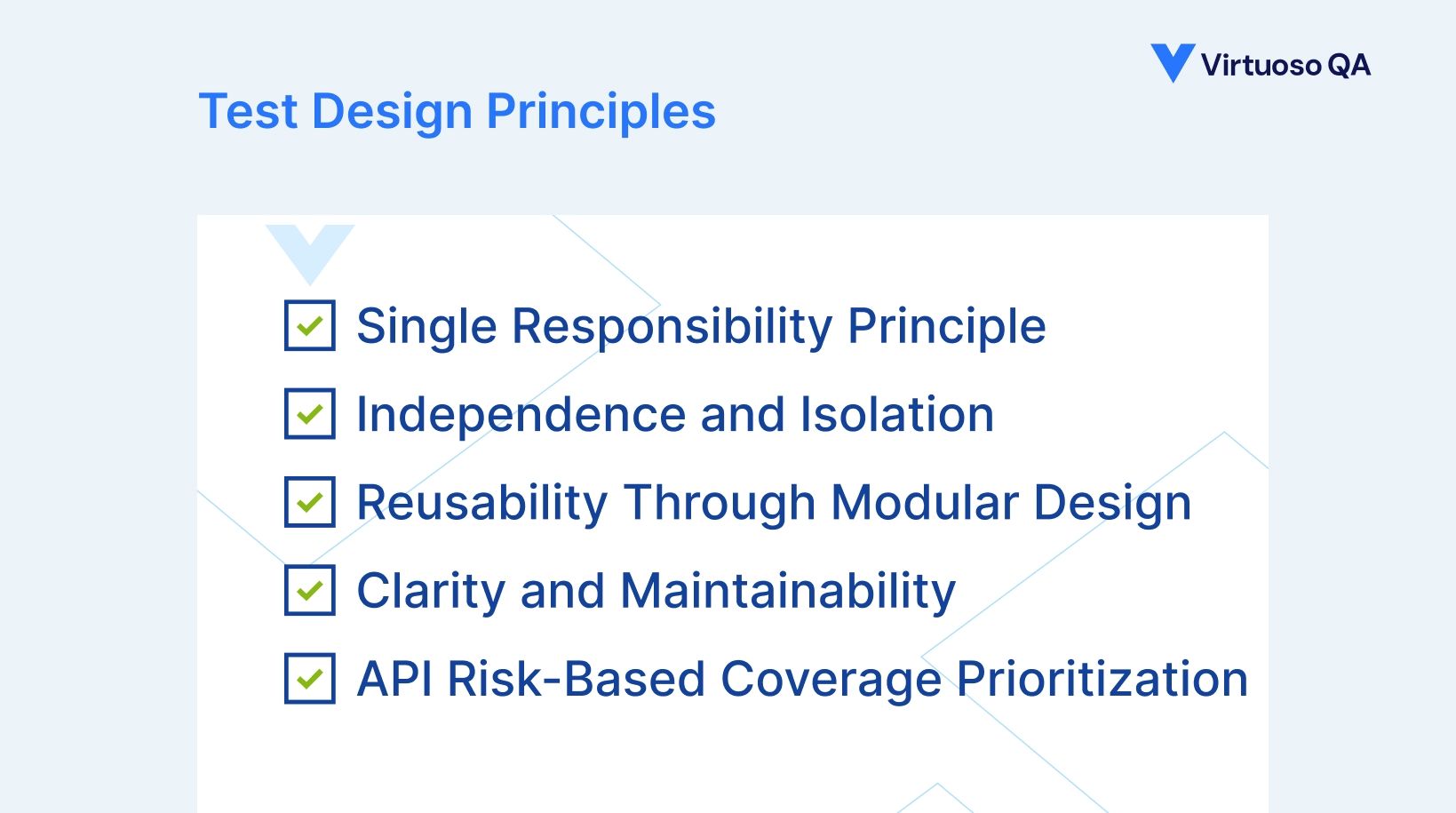
1. Single Responsibility Principle
Each test should validate one specific behavior or requirement. Tests validating multiple independent functionalities become difficult debugging when failures occur. Which of five validations actually failed? Which application behavior caused the issue?
Poor Design Example: A single test validates user registration, profile editing, password changes, account deletion, and email notifications. Test failures provide limited diagnostic value because any step failure prevents subsequent validations.
Good Design Example: Separate tests validate each capability independently. Registration test validates account creation. Profile editing test validates data updates. Password change test validates credential modifications. Each test provides precise failure diagnostics.
Implementation Pattern:
Test Journeys: Focus on complete user workflow or business process
Checkpoints: Validate specific expected outcomes within journeys
Granular Assertions: Verify individual conditions rather than compound validations
2. Independence and Isolation
Tests should execute successfully regardless of execution order or other test outcomes. Dependent tests create debugging nightmares where one test failure cascades through dozens of subsequent tests.
Test Isolation Requirements:
Data Independence: Tests create required data rather than assuming pre-existing state
Order Independence: Tests execute successfully in any sequence
Environment Independence: Tests adapt to development, staging, production environments
Parallel Execution: Tests run concurrently without interference
Virtuoso QA Pattern: Each Journey establishes required preconditions, executes validation, and cleans up afterward. Data-driven testing generates fresh test data for every execution. Environment variables configure tests adapting to different deployment contexts.
3. Reusability Through Modular Design
Effective test design maximizes reusability minimizing duplication. Shared components update once benefiting all tests incorporating them. Changes to authentication flows update centrally rather than requiring modifications across hundreds of tests.
Modular Design Hierarchy:
Steps: Atomic actions (click button, enter text, verify element exists)
Checkpoints: Reusable validation patterns (login successful, order confirmation displayed)
Journeys: Complete workflows (user registration, product purchase, report generation)
Goals: Related journey collections (authentication scenarios, order management workflows)
Composable Testing Advantage: Pre-built libraries provide proven components for enterprise business processes. Organizations import Order-to-Cash, Hire-to-Retire, or Procure-to-Pay automation configured to specific implementations rather than building from scratch.
4. Clarity and Maintainability
Test design should communicate intent clearly to anyone reviewing automation. Six months later, team members should understand what tests validate and why they exist. Unclear tests become unmaintainable as institutional knowledge disappears.
Natural Language Programming Advantage: Tests written as "Navigate to inventory page, filter by category Electronics, verify products sorted by price ascending" communicate intent immediately without deciphering code.
Design Guidelines:
Descriptive Naming: Journey names describe complete workflows
Clear Checkpoints: Validation names specify expected outcomes
Minimal Complexity: Avoid convoluted logic requiring extensive documentation
Consistent Patterns: Similar scenarios follow identical structure
5. Risk-Based Coverage Prioritization
Comprehensive testing validates everything. Practical testing prioritizes validation based on business risk and impact. Critical workflows demand exhaustive coverage. Minor features accept lighter validation.
Risk Assessment Criteria:
Business Criticality: Revenue impact, regulatory requirements, customer satisfaction
Failure Probability: Change frequency, technical complexity, historical defect rates
Failure Impact: System downtime, data loss, security exposure, customer churn
Coverage Economics: Effort required achieving comprehensive validation versus risk mitigation value
Prioritization Pattern:
Tier 1 (Critical): Authentication, transactions, data integrity, security controls
Tier 2 (Important): Major features, common workflows, integration points
Tier 3 (Standard): Secondary features, administrative functions, reporting
Organizations achieve optimal coverage allocating automation effort proportional to business risk rather than uniform validation across all functionality.
Essential Test Design Techniques
Proven test design techniques provide systematic approaches creating comprehensive coverage efficiently. These techniques apply universally across testing types and technologies.
1. Equivalence Partitioning
Equivalence partitioning divides input values into groups expected to behave identically. Instead of testing every possible input value, test representative values from each partition.
Example: Age Validation Application accepts ages 18-65 for account creation.
Partitions:
Below Minimum: 0-17 (expected: rejected)
Valid Range: 18-65 (expected: accepted)
Above Maximum: 66+ (expected: rejected)
Test Design: Three tests validate representative values: age 10 (rejected), age 35 (accepted), age 75 (rejected). This provides equivalent coverage to testing all 100+ possible values.
AI-Native Enhancement: Intelligent test generation automatically identifies equivalence classes from application validation rules, creating optimal test scenarios without manual analysis.
2. Boundary Value Analysis
Boundary Value Analysis focuses testing on values at partition edges where defects cluster. Off-by-one errors, rounding issues, and validation mistakes occur disproportionately at boundaries.
Example: Discount Calculation
Orders $0-$99: no discount
Orders $100-$499: 10% discount
Orders $500+: 15% discount
Boundary Values: Test $0, $99, $100, $499, $500 representing boundaries where behavior changes. Also test $99.99, $100.01 detecting rounding errors.
Traditional Approach: Manual identification of boundary values and test case creation.
AI-Native Approach: Platforms analyze validation rules automatically generating boundary value tests. Virtuoso QA's intelligent test data generation creates comprehensive boundary scenarios including edge cases human testers might overlook.
3. Decision Table Testing
Decision tables map combinations of conditions to expected actions. Complex business logic with multiple interacting conditions benefits from systematic decision table validation.
Example: Loan Approval Logic
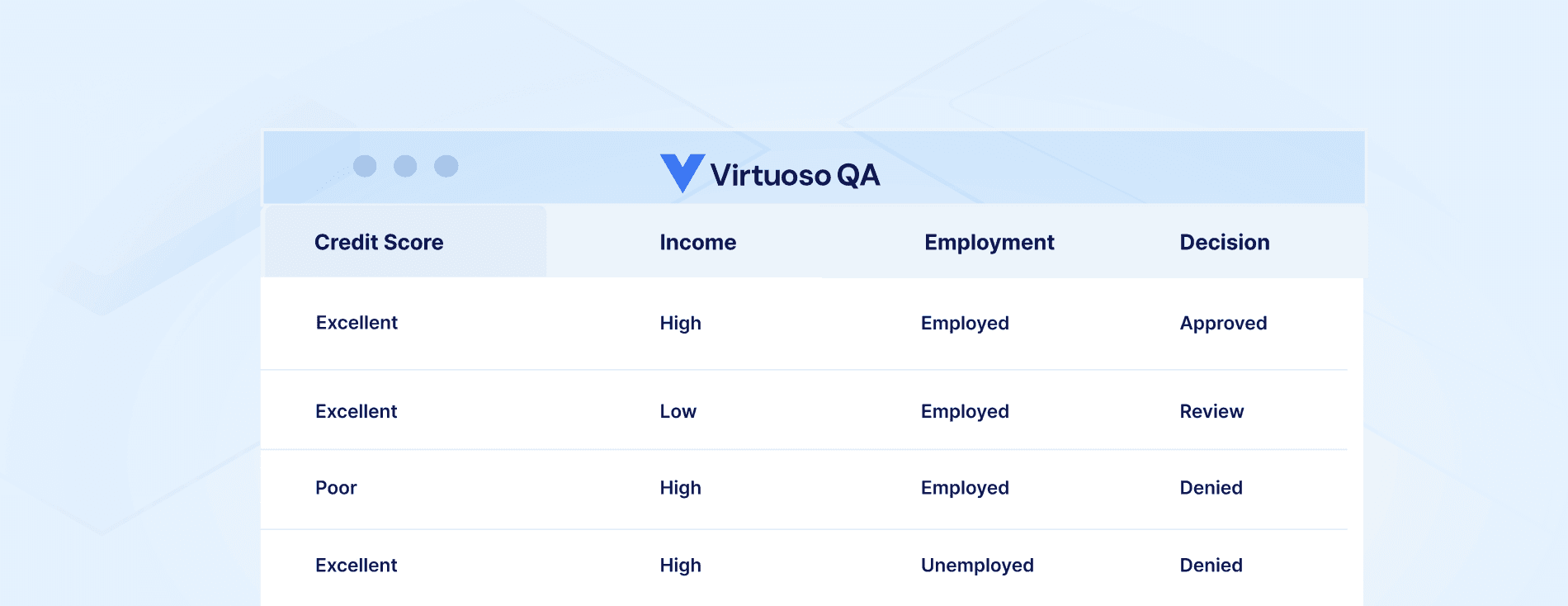
Test Design: Create scenarios exercising each decision table row ensuring all condition combinations receive validation.
Complexity Management: Real business logic involves dozens of conditions creating thousands of combinations. Test design prioritizes combinations representing common scenarios and high-risk edge cases rather than exhaustive validation.
4. State Transition Testing
State transition testing validates systems transitioning between defined states. Workflows involving status changes (order processing, approval workflows, device states) benefit from state transition validation.
Example: Order Processing States
Pending → Confirmed → Processing → Shipped → Delivered
Pending → Cancelled
Processing → On Hold → Processing
Shipped → Returned
Test Design: Validate allowed transitions execute correctly and invalid transitions prevent appropriately. Ensure each state displays correct information and enables appropriate actions.
Composable Testing Application: Enterprise business processes (Order-to-Cash, Procure-to-Pay) represent complex state transitions. Pre-built composable libraries provide proven state transition validation configured to specific implementations.
5. Error Guessing and Exploratory Design
Error guessing leverages testing experience identifying scenarios likely revealing defects. Exploratory testing combines simultaneous learning, design, and execution discovering issues formal techniques might miss.
Common Error Patterns:
Null/Empty Values: Omitted required fields, empty strings, null references
Special Characters: SQL injection attempts, cross-site scripting, Unicode edge cases
Boundary Violations: Maximum length inputs, negative numbers, extreme values
Timing Issues: Race conditions, timeout scenarios, concurrent access
AI-Native Enhancement: Machine learning analyzes historical defect patterns suggesting error guessing scenarios. Autonomous test generation includes negative testing scenarios and edge cases automatically.
Modular Test Architecture and Organization
Effective test organization structures automation enabling scalability, maintainability, and systematic reusability. Hierarchical organization provides clear structure while modular components maximize reuse.
1. The Virtuoso QA Hierarchical Model

Virtuoso QA organizes test automation into four hierarchical levels optimizing reusability and maintainability:
Projects → Goals → Journeys → Checkpoints → Steps
Projects: Highest level organization grouping complete test suites for applications or systems. Organizations maintain separate projects for different products, environments, or testing purposes.
Goals: Logical collections of related Journeys. Goals group functionally related scenarios like "Authentication Workflows," "Order Management," or "Reporting Capabilities." Goals provide organizational structure improving test navigation and maintenance.
Journeys: Complete end-to-end test scenarios validating specific workflows or user stories. Journeys represent executable test cases executing from start to completion. Example: "User Registration Journey," "Product Purchase Journey," "Invoice Generation Journey."
Checkpoints: Reusable validation components verifying expected outcomes. Checkpoints encapsulate common validations (login successful, order confirmation displayed, data saved correctly) used across multiple Journeys. Checkpoint updates propagate automatically to all incorporating Journeys.
Steps: Atomic test actions representing individual interactions. Steps include actions (click button, enter text, navigate URL) and assertions (verify element exists, validate data correctness). Steps chain together creating Checkpoints and Journeys.
Reusability Advantage
This hierarchy maximizes reuse at every level. Steps compose into Checkpoints. Checkpoints integrate into Journeys. Journeys organize under Goals. Changes at any level cascade appropriately through dependent components.
2. Creating Reusable Checkpoints
Checkpoints represent the most powerful reusability mechanism in test design. Well-designed Checkpoints eliminate duplication and centralize maintenance for common validations.
Checkpoint Design Principles:
Single Purpose: Each Checkpoint validates one specific outcome (successful login, order confirmation, error message display)
Parameterization: Checkpoints accept inputs enabling reuse across scenarios (login Checkpoint accepts username/password, search Checkpoint accepts search terms)
Comprehensive Validation: Checkpoints verify all relevant conditions (successful login validates authentication, dashboard visibility, welcome message, navigation availability)
Error Handling: Checkpoints include appropriate error detection and reporting when validations fail
Example: Login Validation Checkpoint
Navigate to login page
Enter provided credentials
Click login button
Verify dashboard displays
Confirm welcome message contains username
Validate navigation menu appears
Check authentication token exists
Usage
Every Journey requiring authentication incorporates Login Checkpoint rather than duplicating login validation logic. Login procedure changes update once in Checkpoint propagating to all Journeys automatically.
Checkpoint Libraries
Organizations build checkpoint libraries covering common application behaviors. Authentication checkpoints, navigation checkpoints, data validation checkpoints, and error handling checkpoints provide proven components accelerating new Journey creation.
3. Journey Design Patterns
Journeys represent complete test scenarios and should follow consistent design patterns ensuring clarity, maintainability, and systematic execution.
Journey Structure Pattern:
Setup Phase: Establish preconditions (authenticate, navigate to starting point, create required data)
Execution Phase: Perform actions under test (submit forms, process transactions, generate reports)
Validation Phase: Verify expected outcomes (confirm success messages, validate data correctness, check state transitions)
Cleanup Phase: Reset environment to initial state (delete test data, logout, restore settings)
Journey Independence
Each Journey executes successfully regardless of other test outcomes. Journeys create required data rather than depending on pre-existing state. This enables parallel execution and reliable results regardless of execution order.
Journey Naming Conventions
Descriptive names communicate Journey purpose immediately: "Complete Product Purchase with Credit Card Payment," "User Registration with Email Verification," "Generate Monthly Sales Report with Filters."
Data-Driven Journeys
Single Journey structure executes multiple times with different data sets. Purchase Journey executes with various products, quantities, payment methods, and shipping addresses maximizing coverage from single Journey design.
4. Composable Testing Libraries
Composable Testing provides pre-built, reusable test libraries for standard enterprise business processes. Instead of building automation from scratch, organizations import proven components configured to specific implementations.
Composable Testing Concept
Common business processes (Order-to-Cash, Hire-to-Retire, Procure-to-Pay, Policy Administration) follow standard workflows across implementations. Composable libraries provide tested automation for these processes requiring only 30% customization for specific environments.
How Composable Libraries Work:
Step 1 - Select Application: Choose target enterprise system (SAP, Oracle, Salesforce, Epic EHR, Dynamics 365)
Step 2 - Import Pre-Built Tests: Download complete automation for standard business processes
Step 3 - Configure for Setup: Customize approximately 30% adapting to specific implementation details (field names, custom workflows, data requirements)
Step 4 - Deploy Immediately: Execute comprehensive test coverage from Day 1 without months of automation development
Component Reusability
Composable libraries contain thousands of reusable checkpoints tested across multiple implementations. Organizations leverage proven patterns rather than discovering best practices through trial and error.
Build Once, Use Everywhere
The transformational advantage of composable testing enables organizations building automation once and deploying across multiple projects, clients, or implementations. Global System Integrators achieve 94% effort reduction and 10x productivity improvements through systematic reusability.
AI-Native Test Design Methodologies
Artificial intelligence fundamentally transforms test design from manual analysis and authoring to autonomous generation and intelligent optimization. AI-native methodologies achieve comprehensive coverage impossible through traditional approaches.
1. Natural Language Test Design
Natural Language Programming revolutionizes test design by expressing test intentions directly in plain English. Business analysts, manual testers, and domain experts describe workflows naturally without learning programming syntax or automation frameworks.
Traditional Test Design:
Natural Language Test Design
"Navigate to inventory page, filter by category Electronics, verify products display sorted by price ascending"
Platform Translation
AI-native platforms translate natural language into executable automation handling technical implementation automatically. Testers focus on describing what to validate rather than how to implement validation.
Design Advantages:
Anyone describes test scenarios without technical training
Test intentions remain clear six months later without code interpretation
Business logic changes update by modifying natural descriptions
Non-programmers expand automation coverage independently
Virtuoso QA pioneered Natural Language Programming enabling organizations achieving 85-93% faster test creation.
2. Autonomous Test Generation from Application Analysis
Autonomous generation analyzes applications and automatically creates comprehensive test scenarios without human authoring. This capability accelerates initial coverage establishment by 10x and identifies scenarios manual design would overlook.
How Autonomous Generation Works:
Application Analysis: Computer vision examines interface identifying interactive elements (buttons, forms, navigation, data tables)
Pattern Recognition: Machine learning recognizes standard workflow patterns (authentication sequences, search interactions, form submissions, checkout processes)
Scenario Generation: Generative AI creates complete test scenarios including navigation, actions, validations, and edge cases
Contextual Understanding: Natural language processing interprets labels, placeholders, and surrounding content determining element purposes and expected behaviors
StepIQ Capabilities: Virtuoso QA's StepIQ autonomously creates 93% of test steps by analyzing application structure. Testers review and refine suggested scenarios rather than authoring from scratch.
Generation Strategies:
Exploratory Generation: Platform navigates application discovering workflows and creating validation scenarios
Requirement-Based Generation: AI analyzes user stories, acceptance criteria, or specifications generating tests validating stated requirements
UI-Based Generation: Platform examines interface elements creating tests exercising all interactive components
3. Intent-Based Test Design
Intent-based design focuses on what to validate rather than how to implement validation. Testers express test intentions and AI platforms determine optimal implementation strategies.
Intent Expression Examples:
"Verify user cannot purchase products exceeding inventory availability"
"Confirm password reset email contains valid reset link expiring after 24 hours"
"Validate report calculations match expected formulas for all data combinations"
Platform Intelligence
AI interprets intentions, identifies required validations, generates appropriate test steps, and handles technical implementation details automatically.
Design-Led QA
Start testing from Figma designs, Jira requirements, or visual diagrams. Platforms analyze design artifacts generating test scenarios validating specified behaviors before implementation completes.
Advantage
Intent-based design enables testing at requirements definition rather than waiting for implementation completion. Tests validate specifications directly preventing misunderstandings and defects.
4. Pattern Recognition and Reuse
AI platforms recognize common patterns across similar implementations automatically suggesting reusable components. Rather than rebuilding authentication tests for every project, platforms identify authentication patterns and recommend proven implementations.
Pattern Recognition Capabilities:
Workflow Similarity: Identify similar user journeys across applications (registration flows, checkout processes, approval workflows)
Component Similarity: Recognize equivalent interface elements (login forms, search boxes, navigation menus)
Business Process Similarity: Detect common business logic (order processing, user management, report generation)
Intelligent Suggestions: When creating new tests, platforms suggest existing Checkpoints, Journeys, or components applicable to similar scenarios. "This looks like user registration. Would you like to reuse the existing registration Checkpoint?"
Composable Intelligence: AI recognizes when new project requirements match pre-built composable library capabilities, suggesting appropriate components rather than custom development.
Test Design for Different Application Types
Different application architectures and technologies require adapted test design approaches. Effective strategies acknowledge technology-specific considerations while maintaining core design principles.
1. Single Page Applications (SPAs)
Single Page Applications load once then dynamically update content without full page refreshes. React, Angular, and Vue applications represent common SPA implementations.
Design Considerations:
Dynamic Content Loading: Tests must wait for asynchronous content loading rather than assuming immediate page readiness
State Management: Application state changes without navigation requiring validation of dynamic updates
Component Reusability: SPAs built from reusable components benefit from test design mirroring component architecture
AI-Native Advantage
Intelligent platforms handle dynamic loading automatically through smart waiting strategies. Visual analysis identifies when content finishes loading regardless of technical implementation.
2. Multi-Page Applications (MPAs)
Traditional multi-page applications reload completely when navigating between pages. Each page represents distinct URL and complete HTML response.
Design Considerations:
Page Object Patterns: Organize tests around page structures encapsulating element locators and interactions
Navigation Validation: Verify correct page loads after navigation actions
Session Management: Handle authentication, cookies, and session state across page transitions
Composable Patterns: Standard MPA workflows (login → dashboard → action → confirmation) benefit from pre-built composable components.
3. Enterprise Business Systems (ERP, CRM, HCM)
Enterprise systems (SAP, Salesforce, Oracle, Epic EHR, Dynamics 365, Workday) present unique testing challenges requiring specialized design approaches.
Design Considerations:
Complex Business Processes: Multi-step workflows spanning multiple screens, systems, and approvals
Extensive Customization: Standard systems customized significantly per implementation
Frequent Updates: Vendor releases quarterly requiring adaptation without breaking automation
Integration Testing: Validate interactions between enterprise systems and external applications
Composable Testing Solution
Pre-built libraries provide proven automation for standard enterprise business processes. Organizations achieve 94% effort reduction configuring proven patterns to specific implementations rather than building from scratch.
4. API and Microservices Architectures
Modern applications built on microservices architectures require testing individual services and their interactions.
Design Considerations:
Service Independence: Test individual microservices independently validating functionality and contracts
Integration Validation: Verify services communicate correctly handling expected and error conditions
Unified Testing: Combine API and UI testing validating complete workflows rather than isolated layers
Business Process Orchestration Advantage
Virtuoso QA unifies UI actions, API validations, and database checks within single test Journeys. "Submit order via UI, verify API creates transaction, confirm database inventory updates, validate notification sent."
Organizations achieve comprehensive end-to-end validation without maintaining separate toolchains for different testing types.
Test Data Design Strategies
Test data determines whether automation executes reliably or fails unpredictably. Effective test data design ensures consistent, realistic validation without privacy violations or environmental dependencies.
1. Data Independence Principle
Tests should create required data rather than depending on pre-existing state. Data-independent tests execute reliably in any environment without manual setup.
Poor Practice: Tests assume specific user accounts exist with known credentials. When environments refresh, tests fail until data manually recreated.
Good Practice: Tests generate required accounts with random credentials before execution. Data cleanup removes generated accounts after validation completes.
2. Intelligent Test Data Generation
AI-powered data generation creates realistic synthetic data on demand without manual effort or privacy concerns.
Traditional Approach
Testers manually create customer records, products, orders, and transactions for every test scenario. Data becomes stale as schemas evolve.
AI-Native Approach
Natural language prompts generate contextually appropriate data: "Create 100 customer records with diverse demographics, valid US addresses, purchase histories spanning 2 years."
Virtuoso QA Capability
Leverage large language models generating realistic test data through natural language specifications. Organizations eliminate weeks of manual data preparation.
Generated Data Characteristics:
Realistic Patterns: Names, addresses, emails, phone numbers follow valid formats
Business Logic Compliance: Data respects validation rules and constraints
Edge Case Coverage: Automatically includes boundary values and special characters
Volume Scalability: Generate thousands of records for performance and volume testing
3. Data-Driven Testing
Single test scenarios execute multiple times with different data sets maximizing coverage from minimal test design effort.
Implementation Pattern:
Design Journey structure once (login, navigate, perform action, validate outcome)
Create data file containing multiple test cases (100 different user scenarios)
Execute Journey 100 times with different data producing 100 validations
Parameterized Journeys
Virtuoso QA Journeys accept parameters enabling data-driven execution. Single purchase Journey validates credit cards, PayPal, gift cards, and bank transfers by executing with different payment method parameters.
Coverage Amplification
Data-driven design amplifies single Journey into comprehensive test suite. One registration Journey with 50 data variations provides equivalent coverage to 50 separately designed Journeys.
Measuring and Improving Test Design Quality
Effective test design requires systematic measurement and continuous improvement. Organizations tracking test design metrics identify improvement opportunities and demonstrate automation value.
Test Design Effectiveness Metrics
Coverage Metrics:
Requirements coverage: Percentage of specifications with automated validation
Code coverage: Percentage of application code exercised by tests
Business process coverage: Percentage of critical workflows validated
Risk coverage: Validation completeness for high-risk functionality
Efficiency Metrics:
Test creation velocity: Time required creating comprehensive scenarios
Reusability index: Percentage of test components shared across scenarios
Maintenance burden: Time spent updating tests versus creating new validation
Execution efficiency: Test suite runtime and resource consumption
Quality Metrics:
Defect detection rate: Percentage of defects discovered through automation
False positive rate: Percentage of test failures caused by test issues rather than defects
Test stability: Percentage of tests executing reliably without intermittent failures
Virtuoso QA Outcomes:
93% autonomous test generation reducing creation effort
88% maintenance reduction through self-healing
94% effort reduction through composable reusability
Continuous Test Design Improvement
Refactoring for Reusability: Identify duplicated validation logic across Journeys. Extract common patterns into reusable Checkpoints benefiting multiple scenarios.
Pattern Recognition: Analyze test portfolios identifying common workflows. Create composable components for repeated patterns accelerating future automation.
Coverage Gap Analysis: Compare automated coverage against requirements and risk assessments. Prioritize automation expansion addressing highest-impact coverage gaps.
Maintenance Hotspot Identification: Track which tests require frequent updates. Redesign high-maintenance tests using more robust patterns or intelligent self-healing.
AI-Powered Optimization: Platforms analyze test execution patterns suggesting consolidation opportunities, redundancy elimination, and execution optimization.
Transform Your Test Design with AI-Native Intelligence
Software test design determines whether automation becomes strategic asset delivering 94% effort reduction or maintenance burden consuming 80% of capacity. Modern test design leverages AI-native patterns, composable architectures, and intelligent reusability achieving transformational outcomes impossible through traditional approaches.
Virtuoso QA pioneered AI-native composable design organizing automation into hierarchical structures maximizing systematic reusability. Natural Language Programming enables anyone describing test scenarios without coding expertise. StepIQ autonomous generation creates 93% of test steps automatically. Composable Testing libraries provide pre-built automation for enterprise business processes configured to specific implementations within hours.
Frequently Asked Questions
What makes effective test design different from poor test design?
How does AI-native test design differ from traditional approaches?
What test design techniques should I prioritize?
How do I design tests that won't break when applications change?
What test design anti-patterns should I avoid?
How do enterprise organizations scale test design across teams?