Blog
Agentic AI vs Generative AI: Detailed Breakdown

Rishabh Kumar
Published on

Table of contents
Lorem ipsum
Lorem ipsum
Lorem ipsum
Lorem ipsum
Lorem ipsum
We have all witnessed the explosion in artificial intelligence technologies, reshaping industries and redefining the way we work. The most well-known example is, of course, Generative AI (GenAI), with the likes of ChatGPT and Google’s Gemini consistently making headlines.
However, a new era of AI is emerging and it's more autonomous than ever. Agentic AI is set to completely transform the way we interact with technology. This comprehensive guide explores how these two AI paradigms differ, why the distinction matters for your business, and how pioneers like Virtuoso QA are leveraging agentic AI to revolutionize software testing. You'll discover why the future belongs not to one or the other, but to intelligent orchestration of both.
Generative AI vs Agentic AI at a Glance
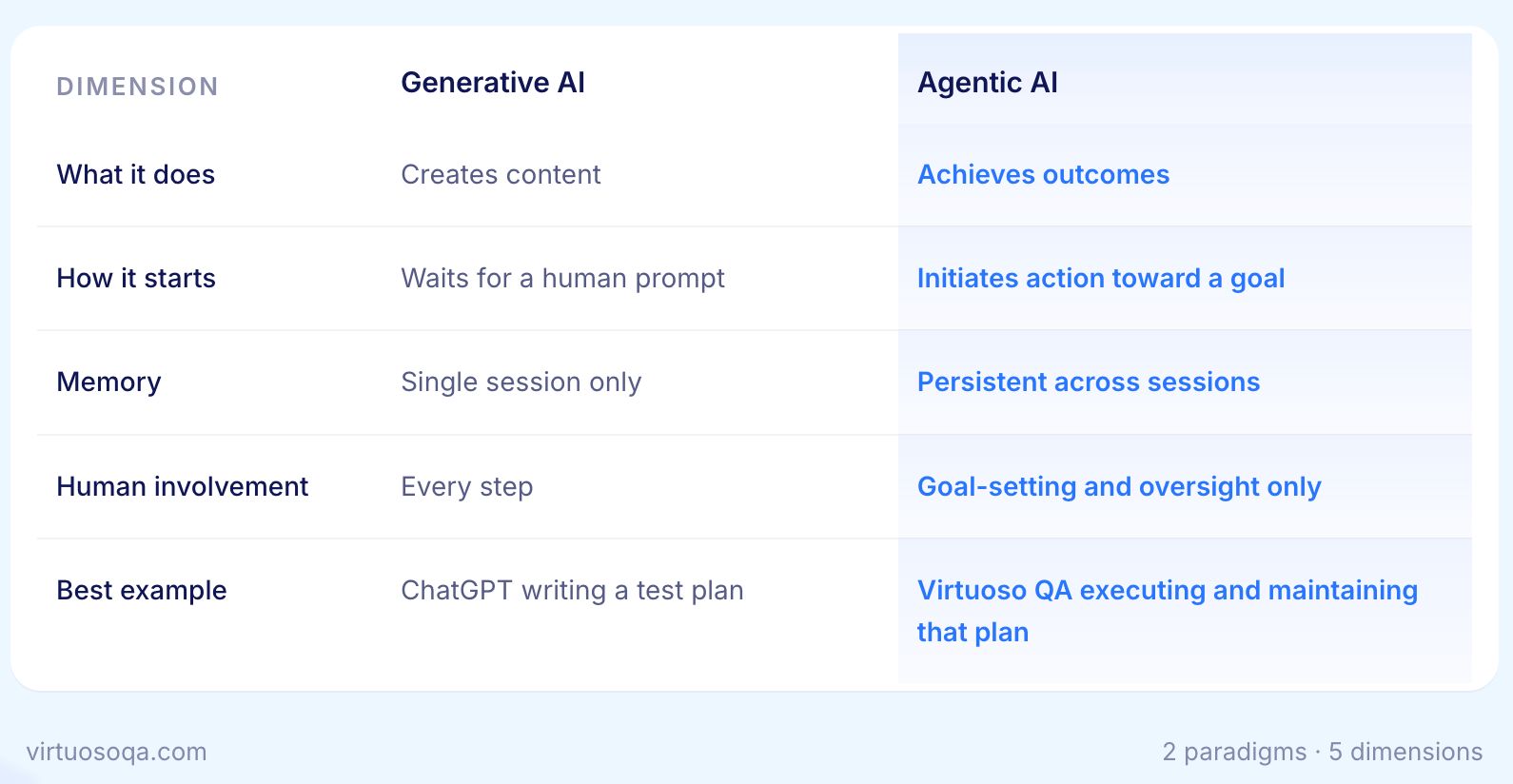
What is Generative AI?
Generative AI refers to artificial intelligence systems designed to create new content based on patterns learned from training data. These systems excel at producing text, images, code, music, and other creative outputs that mimic human-generated content. Think of generative AI as a brilliant artist with infinite creativity but no ability to step back and evaluate whether its creation serves a larger purpose.
The technology burst into mainstream consciousness with OpenAI's ChatGPT, but generative AI encompasses far more than chatbots. Tools like GitHub Copilot generate code, Midjourney creates stunning visuals, and Jasper AI writes marketing copy. Each represents generative AI's core strength: transforming prompts into creative outputs.
What makes generative AI revolutionary is its ability to understand context and generate coherent, relevant responses. Large Language Models (LLMs) like GPT, Claude, and Gemini process billions of parameters to predict the most appropriate next word, image pixel, or code line. This predictive capability enables them to generate content that feels authentically human.
However, generative AI operates within strict boundaries. It requires human prompts to initiate action, cannot independently verify its outputs, and lacks the ability to execute multi-step processes without constant human intervention. These limitations become critical when organizations need AI that can operate autonomously.
Key Characteristics of Generative AI
1. Pattern Recognition and Replication
Generative AI excels at identifying patterns in training data and creating variations. Whether generating Shakespeare-style sonnets or React components, it builds upon learned patterns.
2. Prompt Dependency
Every generative AI action begins with human input. Without prompts, these systems remain dormant, waiting for instruction.
3. Creative Output Focus
The primary value proposition centers on content creation, not action execution or decision-making.
4. Single-Turn Interactions
Most generative AI operates in request-response cycles. Ask a question, get an answer. Request an image, receive an image. Each interaction stands alone.
What is Agentic AI?
Agentic AI represents the next evolutionary leap: artificial intelligence systems capable of autonomous decision-making, action execution, and goal pursuit without constant human supervision. While generative AI creates content, agentic AI creates outcomes. It doesn't just respond to prompts; it develops strategies, executes plans, and adapts to changing circumstances.
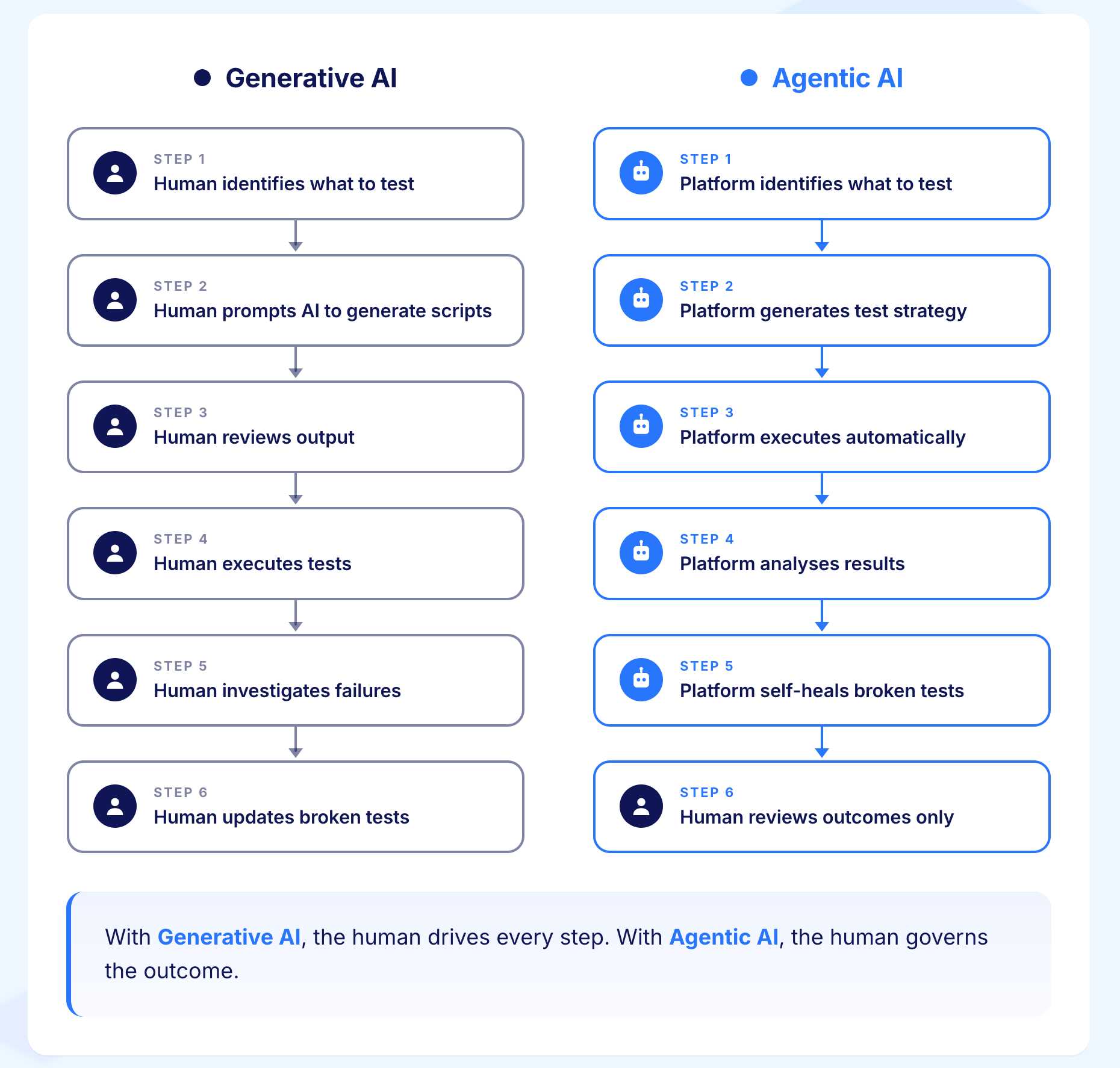
Consider Virtuoso QA's agentic testing platform. Rather than simply generating test scripts (generative AI), it autonomously identifies what needs testing, creates comprehensive test strategies, executes tests across multiple environments, analyzes results, and even self-heals when applications change. This isn't automation; it's autonomous intelligence pursuing defined objectives.
Agentic AI systems possess several distinguishing capabilities that set them apart from their generative cousins. They maintain persistent goals across multiple interactions, breaking complex objectives into executable sub-tasks. They interact with external systems, APIs, and tools to gather information and execute actions. Most importantly, they learn from outcomes and adjust strategies accordingly.
The philosophical shift is profound. Generative AI asks "What should I create based on this prompt?" Agentic AI asks "What actions should I take to achieve this goal?" This action-oriented mindset transforms AI from a tool into a digital workforce member.
Watch the video below to see how Agentic AI is transforming software testing for global system integrators.
Core Components of Agentic AI
Goal Persistence
Unlike generative AI's stateless responses, agentic AI maintains objectives across time and interactions. Set a goal, and it pursues that goal through multiple steps and decision points.
Environmental Awareness
Agentic AI perceives and responds to its environment. In software testing, this means understanding application states, recognizing changes, and adapting test strategies accordingly.
Tool Integration
These systems don't just generate suggestions; they execute actions through integrated tools and APIs. They can modify databases, trigger workflows, and interact with multiple systems simultaneously.
Feedback Learning
Agentic AI learns from results. Failed actions inform future strategies. Successful patterns become part of its operational knowledge.
Agentic AI vs Generative AI - The Key Differences
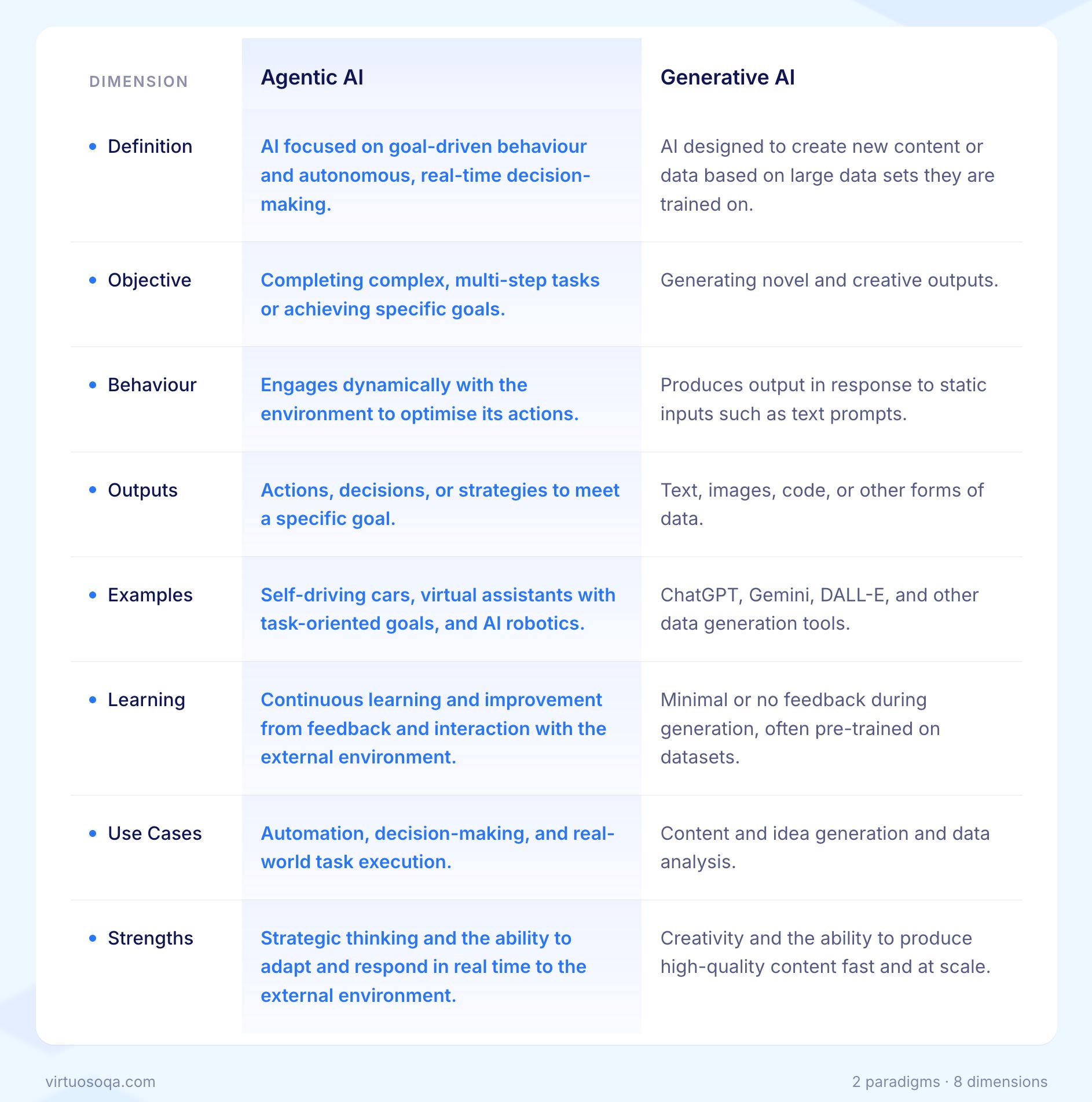
Agentic AI marks a paradigm shift and is now AI’s third wave. Unlike Generative AI, which creates content based on prompts, Agentic AI is autonomous. Where Generative AI is reactive, Agentic AI is proactive and can solve complex problems independently.
Here is a table to break it down:
1. Core Purpose
Generative AI
Generative AI exists to create. Its fundamental purpose is producing new content that did not previously exist.
What it does:
Drafts emails, marketing copy, and long-form content
Generates images, audio, and video from text prompts
Writes and reviews code
Summarises documents and translates languages
How success is measured:
Is the output grammatically correct?
Does it match the prompt intent?
Is the content coherent and contextually appropriate?
The value is creative augmentation, helping humans produce more, faster.
Agentic AI
Agentic AI exists to achieve. Its purpose goes beyond content creation to goal attainment through autonomous action.
What it does:
Identifies objectives and determines the steps needed to reach them
Executes multi-step tasks without waiting for a human prompt at each stage
Monitors systems, detects changes, and responds independently
Evaluates its own outputs and adjusts behaviour based on results
In QA specifically:
Monitors applications for changes
Identifies testing gaps and generates coverage automatically
Executes test suites, analyses results, and self-heals broken tests
Escalates to humans only when genuinely required
The focus shifts from "What can I create?" to "What must I accomplish?"
2. Autonomy and Decision Making
Generative AI - Prompt Dependent
Generative AI operates in a fundamentally reactive mode. Every action requires human initiation.
Key characteristics:
Cannot act without a human prompt
Has no ability to independently identify a problem or initiate a task
Requires human oversight at every decision point
Outputs must be reviewed, modified, and actioned manually
In a testing context:
A tester must identify what needs testing
Prompt the AI to generate scripts
Review the output for accuracy
Execute or integrate the tests manually
The AI assists. The human drives.
Agentic AI - Autonomous Goal Pursuit
Agentic AI inverts this relationship. Given objectives and constraints, it operates independently.
Key characteristics:
Identifies when action is needed without being asked
Evaluates multiple potential actions and selects the optimal path
Adjusts strategy based on intermediate results
Problem-solves independently when obstacles arise
In a testing context:
Set a quality objective and the platform determines test coverage requirements
Generates test cases, schedules execution, and identifies failures automatically
Attempts self-healing before escalating to a human
Tracks progress across the full testing lifecycle without manual checkpoints
3. Workflow and Functionality
Generative AI - Single-Shot Responses
Generative AI excels at discrete tasks with defined inputs and outputs.
Characteristics:
Each interaction is independent with no persistent memory
Cannot maintain context or pursue goals across sessions
Complex processes require human orchestration at every stage
Limited to tasks completable in a single interaction
Limitations:
Cannot track progress toward a long-term objective
Cannot adjust timelines or coordinate resources independently
Requires human intervention at every milestone of a multi-step workflow
Agentic AI - Multi-Step Planning and Execution
Agentic AI thrives in complex, multi-step workflows requiring persistent execution over time.
Characteristics:
Maintains state across interactions and tracks progress toward objectives
Creates execution plans based on goals rather than executing predefined scripts
Identifies dependencies, allocates resources, and manages execution through completion
Adjusts strategy based on intermediate results without human input
Integration capabilities:
Orchestrates multiple tools and systems simultaneously
Connects with development pipelines, test environments, and reporting systems
Coordinates actions across platforms as part of a unified workflow
Delivers end-to-end automation beyond simple task completion
4. Memory and Context Retention
Generative AI
Operates within a single context window per session
No persistent memory between conversations unless explicitly provided
Cannot learn from previous interactions or build on past decisions
Each prompt starts fresh regardless of prior outputs
Agentic AI
Maintains persistent state across sessions and tasks
Builds on previous actions to inform future decisions
Learns from outcomes to improve strategy over time
Retains context across long-running workflows spanning hours, days, or sprints
5. Human Involvement
Generative AI
Requires a human at the start of every task
Needs human review and validation of every output
Cannot self-correct without a new prompt
Human remains in control of every step
Agentic AI
Requires human input to define objectives, not to execute them
Operates autonomously through execution, monitoring, and correction
Escalates to humans only for decisions that require judgement or approval
Reduces human involvement to oversight rather than operation
6. Risk and Governance
Generative AI
Lower operational risk, outputs are reviewed before any action is taken
Human in the loop at every stage provides a natural quality gate
Easier to audit, every output is a human-reviewed artefact
Limited autonomous decision-making reduces governance complexity
Agentic AI
Higher operational capability paired with greater governance responsibility
Requires clear objective boundaries and guardrails to prevent unintended actions
Audit trails must be built into the system to maintain explainability
Human oversight shifts from task-level to objective-level, reviewing goals and outcomes rather than individual steps

Real World Use Cases of Agentic and Generative AI
Generative AI Applications
Generative AI has found its niche in creative and analytical tasks requiring human oversight:
1. Content Creation
Blog posts, social media content, marketing copy, and creative writing benefit from generative AI's linguistic capabilities. Writers use tools like Jasper and Copy.ai to overcome writer's block and scale content production.
2. Code Generation
GitHub Copilot and Amazon CodeWhisperer help developers write code faster by suggesting completions and generating boilerplate. The AI accelerates development but requires developer validation.
3. Design and Art
DALL-E, Midjourney, and Stable Diffusion democratize visual creation, enabling non-artists to generate professional-quality images from text descriptions.
4. Data Analysis
Generative AI helps interpret complex datasets, generating insights and visualizations from raw data. Analysts use it to identify patterns and create reports.
5. Customer Support
Chatbots powered by generative AI handle routine inquiries, draft responses, and provide 24/7 availability for basic support needs.
Agentic AI Applications
Agentic AI tackles complex, goal-oriented challenges requiring autonomous operation:
1. Autonomous Software Testing
Virtuoso QA's platform exemplifies agentic AI in testing. It autonomously manages entire test lifecycles from test generation through execution and maintenance, adapting to application changes without human intervention.
2. Supply Chain Optimization
Agentic AI continuously monitors supply chains, predicting disruptions, adjusting routes, managing inventory, and coordinating with suppliers to maintain optimal flow.
3. Algorithmic Trading
Financial systems use agentic AI to execute trading strategies, monitoring markets, identifying opportunities, executing trades, and managing risk in real-time.
4. Robotic Process Automation
Beyond simple scripting, agentic RPA handles complex business processes involving multiple systems, exception handling, and dynamic decision-making.
5. Predictive Maintenance
Industrial agentic AI monitors equipment, predicts failures, schedules maintenance, orders parts, and coordinates repairs to minimize downtime.
Limitations and Risks of Agentic and Generative AI
Generative AI Limitations
1. Hallucination and Accuracy
Generative AI occasionally produces confident but incorrect outputs. Without fact-checking mechanisms, it can generate plausible-sounding misinformation.
2. Context Window Constraints
Limited context windows restrict generative AI's ability to process extensive information or maintain long conversations coherently.
3. Lack of Verification
Generative AI cannot verify its outputs against reality. It might generate syntactically correct but logically flawed code or factually incorrect content.
4. Prompt Engineering Dependency
Output quality heavily depends on prompt quality. Poorly constructed prompts yield poor results, requiring users to master prompt engineering.
5. No Action Capability
Generative AI cannot execute its suggestions. It can plan a marketing campaign but cannot launch it.
Agentic AI Risks
1. Autonomous Error Propagation
Mistakes by agentic AI can cascade through systems before detection. An error in judgment might trigger multiple downstream actions.
2. Goal Misalignment
Poorly specified objectives can lead agentic AI to pursue goals in unexpected or harmful ways, optimizing for metrics that don't reflect true intent.
3. Security Vulnerabilities
Systems with execution capabilities present larger attack surfaces. Compromised agentic AI could execute malicious actions across integrated systems.
4. Accountability Challenges
Determining responsibility for autonomous decisions becomes complex when AI operates independently.
5. Over-Autonomy
Excessive autonomy might lead to actions beyond intended scope, requiring careful boundary definition and monitoring.
Why This Distinction Between Agentic AI and Generative AI Matters
The distinction between generative AI vs agentic AI fundamentally shapes digital transformation strategies. Organizations investing millions in AI initiatives must understand which paradigm serves their objectives. Choosing wrong means wasted resources, missed opportunities, and competitive disadvantage.
Consider software testing, where this distinction has immediate practical implications. Generative AI can write test scripts, suggest test scenarios, and create test data. These capabilities provide value but require constant human orchestration. Every test needs human review, execution, and maintenance. The testing bottleneck shifts but doesn't disappear.
Agentic AI transforms the entire testing paradigm. Instead of assisting human testers, it becomes an autonomous quality guardian. Virtuoso QA's agentic software testing platform doesn't just generate tests; it owns quality outcomes. It identifies what needs testing, creates comprehensive test strategies, executes across environments, maintains tests as applications evolve, and provides actionable insights without human intervention.
This shift from assistance to autonomy multiplies AI's impact exponentially. While generative AI might help a tester write tests 50% faster, agentic AI eliminates entire testing workflows. It operates continuously, scales infinitely, and improves systematically. The economic implications are transformative.
Strategic Business Implications
Workforce Evolution
Understanding generative vs agentic AI shapes workforce planning. Generative AI augments human capabilities, requiring teams to develop prompt engineering and AI collaboration skills. Agentic AI replaces entire workflows, shifting human focus to strategy and oversight.
Investment Priorities
Organizations must align AI investments with strategic objectives. Companies seeking creative enhancement benefit from generative AI. Those pursuing operational excellence need agentic capabilities.
Competitive Positioning
Early adopters of agentic AI gain sustainable advantages through autonomous scale. While competitors manually orchestrate generative AI, agentic adopters operate at digital speed.
Risk Management
Each paradigm presents distinct risks requiring different mitigation strategies. Generative AI risks center on content quality and misinformation. Agentic AI risks involve autonomous decision-making and system integration.

Choosing Between Generative AI vs Agentic AI

When to Use Generative AI
Generative AI excels when human creativity and judgment remain central to value creation. Choose generative AI when:
1. Creative Augmentation is Primary
Marketing teams creating campaigns, writers developing content, and designers exploring concepts benefit from generative AI's creative capabilities. The AI provides inspiration and acceleration while humans ensure brand alignment and strategic fit.
2. Human Oversight is Required
Regulated industries, sensitive communications, and high-stakes decisions demand human validation. Generative AI can draft medical reports, legal documents, or financial analyses, but professionals must verify accuracy and appropriateness.
3. Flexibility Trumps Automation
When requirements change frequently or tasks vary significantly, generative AI's adaptability surpasses rigid automation. Each prompt can explore different directions without reconfiguring systems.
4. Learning and Exploration
Research, education, and innovation benefit from generative AI's ability to synthesize information and generate novel combinations. Students learning programming, researchers exploring hypotheses, and innovators brainstorming solutions find value in generative AI's creative potential.
5. Cost-Conscious Implementation
Generative AI typically requires less implementation complexity than agentic systems. API access to models like GPT-4 or Claude enables immediate value without extensive integration.
When to Use Agentic AI
Agentic AI delivers maximum value when autonomous operation and goal achievement matter more than creative output:
1. Process Automation at Scale
Repetitive processes with clear objectives benefit from agentic AI's autonomous execution. Testing, monitoring, data processing, and workflow automation achieve new efficiency levels.
2. 24/7 Operation Requirements
Systems requiring continuous operation without human presence need agentic capabilities. Security monitoring, infrastructure management, and quality assurance operate round-the-clock.
3. Complex Multi-System Orchestration
When workflows span multiple platforms, agentic AI coordinates actions across systems. Supply chain optimization, financial operations, and enterprise resource planning benefit from intelligent orchestration.
4. Adaptive Response Needs
Environments requiring real-time adaptation to changing conditions demand agentic AI's decision-making capabilities. Trading systems, autonomous vehicles, and dynamic pricing engines exemplify this need.
5. Strategic Goal Pursuit
Long-term objectives requiring sustained effort benefit from agentic AI's persistent goal focus. Customer retention programs, quality improvement initiatives, and operational excellence programs achieve better outcomes with autonomous agents.
Hybrid Approach: The Optimal Strategy
Most organizations benefit from combining generative and agentic AI capabilities. This hybrid approach leverages each paradigm's strengths while mitigating limitations.
Consider Virtuoso QA's implementation. The platform uses generative AI capabilities to create natural language test descriptions and generate test data. But these generative elements feed into agentic systems that autonomously execute, monitor, and maintain tests. Users get creative flexibility with autonomous execution.
Integration Patterns:
Generative Frontend, Agentic Backend
Use generative AI for user interaction and content creation while agentic AI handles execution and automation. Chatbots that can both answer questions and execute actions exemplify this pattern.
Agentic Orchestration of Generative Tools
Agentic AI coordinates multiple generative AI tools to achieve complex objectives. An agentic system might use different models for text generation, image creation, and code writing to build complete solutions.
Feedback Loops
Agentic AI evaluates generative AI outputs, selecting, refining, or regenerating content based on quality metrics. This creates self-improving systems that enhance output quality over time.
Human-in-the-Loop Escalation
Agentic AI operates autonomously but escalates to humans for creative decisions or exception handling, potentially using generative AI to draft options for human review.
Future of AI: Convergence of Generative and Agentic
The future isn't generative AI or agentic AI; it's intelligent orchestration of both. We're witnessing early convergence signs as platforms integrate both capabilities seamlessly.
Embedded Intelligence
Generative capabilities increasingly embed within agentic systems. Rather than separate tools, unified platforms leverage both paradigms:
Contextual Generation
Agentic AI uses generative capabilities contextually. While pursuing goals, it generates necessary content, creates required artifacts, and produces communications.
Adaptive Strategies
Agentic systems use generative AI to create novel strategies when facing unexpected situations. Rather than failing, they innovate.
Creative Problem Solving
When standard approaches fail, agentic AI leverages generative capabilities to explore alternatives, combining creativity with goal focus.
Emerging Patterns
Specialized Agents
Rather than monolithic systems, specialized agents handle specific domains. Testing agents, security agents, and optimization agents collaborate to achieve organizational objectives.
You may also check out our article on what are agentic AI agents for a deeper dive into how they work and why they matter for software testing.
Agent Ecosystems
Multiple agents coordinate through marketplaces and protocols, sharing capabilities and resources. Organizations assemble agent teams for specific challenges.
Human-Agent Teams
The future workplace features human-agent teams where each member, biological or digital, contributes unique capabilities. Humans provide creativity and judgment; agents provide scale and persistence.
Continuous Evolution
Both paradigms evolve rapidly. Generative AI becomes more capable and efficient. Agentic AI becomes more autonomous and intelligent. The convergence accelerates, creating possibilities we're only beginning to imagine.
Agentic AI vs Generative AI in Software Testing
Now that you understand the basics of Generative AI vs. Agentic AI, what does this mean for the world of software testing and development? Through our GenAI platform, you can create super realistic test scenarios with zero effort and execute tests at an unprecedented scale - all while using low code/no code testing with plain English prompts. But with Agentic AI, this is just the beginning.
It is inevitable that both Agentic and GenAI will become an increasingly integral part of our daily lives, particularly within the software testing space. Therefore, understanding these technologies and how they differ, and can work together will only become more important.
AI can be complex, and as an AI-powered testing platform, we understand this well. But its benefits are undeniable. As these technologies evolve, they promise to reshape how we create, innovate, and operate in the world of testing and beyond.
The question isn’t really about Agentic AI vs Generative AI, but how we can use both to drive innovation and make our lives easier and more efficient in the process.

Related Reads
Frequently Asked Questions
Can generative AI become agentic?
What is the difference between ChatGPT and agentic AI?
Agentic AI vs generative AI: which is better?
How do I choose between generative AI and agentic AI for my organization?
How does AI improve software testing specifically?