

Blog
Autonomous Testing with Agentic AI: The Next Evolution in QA
.png)
Published on
May 13, 2026

Learn how autonomous testing with agentic AI works, how it differs from traditional automation, and how enterprise teams use it to ship faster.
Software testing has moved through several generations. Manual scripts gave way to record-and-playback tools. Record-and-playback gave way to automation frameworks like Selenium. Automation frameworks reduced the execution burden but kept the authoring and maintenance burden firmly with the engineering team.
The next shift is different in kind, not just degree. Autonomous testing with agentic AI does not just execute tests faster. It changes who creates them, what triggers them, how they stay current, and how failures are explained. The human role moves from operator to governor.
Autonomous testing is the practice of using AI to plan, generate, execute, maintain, and reason about software tests with minimal human involvement at each individual step. The system does the work. The human sets direction and reviews outcomes.
Agentic AI is the capability that makes this possible. An AI agent is a system that can perceive its environment, make decisions based on what it observes, and take action toward a goal without being explicitly programmed for every step.
In testing, this means an AI agent can analyse an application, identify what needs verifying, generate the relevant test cases, run them, heal them when the application changes, and explain what went wrong when something fails.
The combination produces something qualitatively different from traditional automation. A Selenium test executes exactly what a human wrote. An agentic autonomous test decides what to execute, executes it, and adapts when the application moves on without it.
The distinction matters because many platforms use the word autonomous while delivering something considerably narrower. Understanding the difference prevents buying one when you need the other.
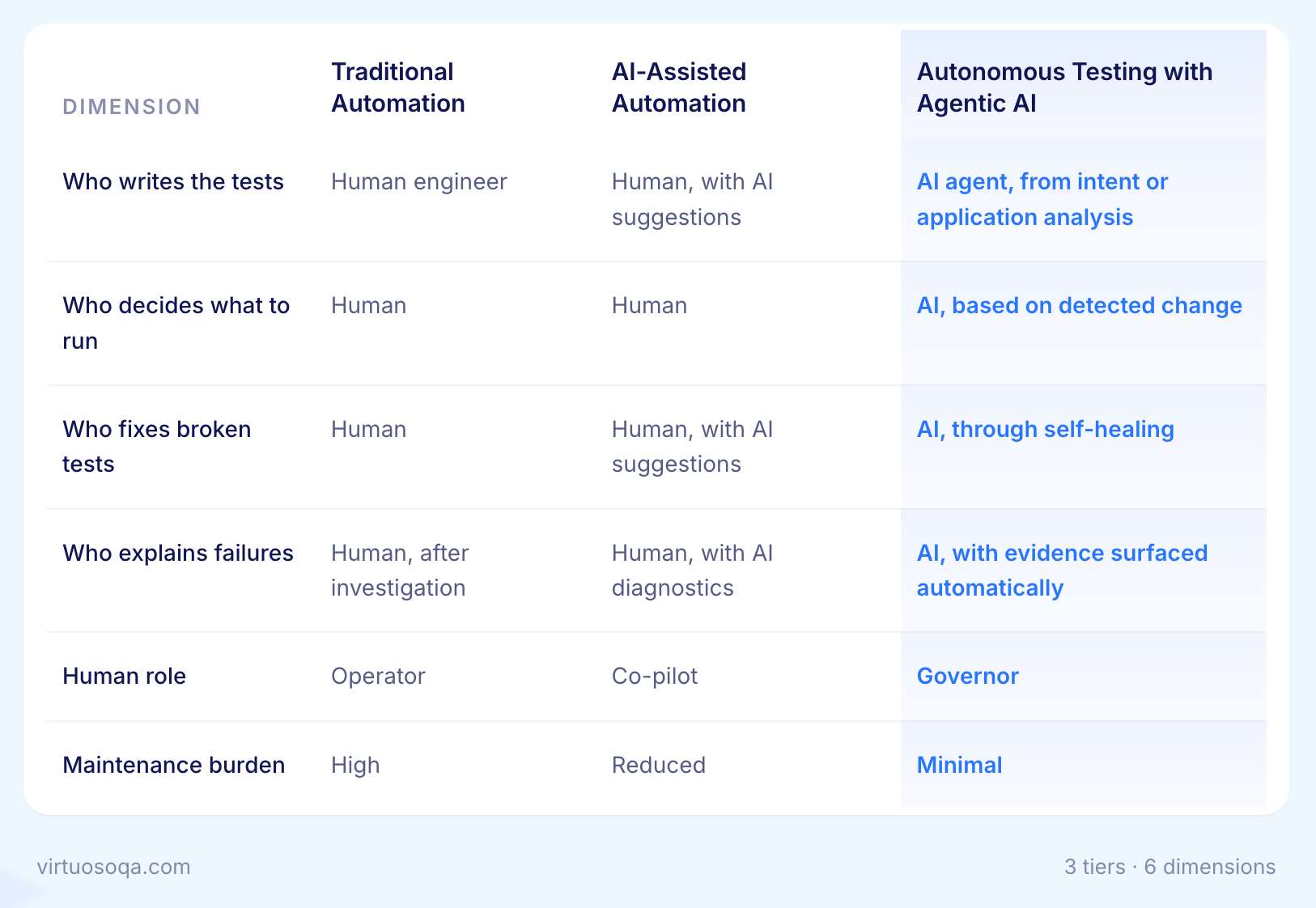
The practical difference is the loop. Traditional automation and AI-assisted automation both keep a human involved in every significant decision. Autonomous testing removes the human from most individual decisions and moves them into a strategic oversight role.
Agentic AI in testing is not a single feature. It is a stack of capabilities that each remove a specific source of human effort and delay.
Rather than waiting for a human to record a user journey, an agentic testing platform can analyse the live application, understand its structure and behaviour, and generate test cases from that understanding. Virtuoso's StepIQ does this by examining the screens, fields, and flows of the application under test and producing contextually accurate test steps without a human defining each one.
Tests can also be generated from external inputs: requirements documents, user stories, Jira tickets, Figma designs, Gherkin scenarios, or plain English descriptions. The AI reads the intent and produces executable coverage from it. What used to take weeks of manual test authoring can be completed in hours.
Application UIs change constantly. A field moves. A button is renamed. A page is restructured. In traditional automation, each of these changes breaks the affected tests and requires an engineer to find and fix the broken locators. In a large test suite, this maintenance work can consume more engineering time than the original test authoring.
Agentic self-healing addresses this directly. The AI detects that an element it expected to find has changed, identifies the new element by combining visual analysis, DOM structure, and contextual signals, and updates the test automatically. Virtuoso QA's self-healing operates at approximately 95% accuracy, meaning the vast majority of UI changes are absorbed without human intervention.
Running the full regression suite on every code change is computationally expensive and slows feedback cycles. Agentic test selection maps code and UI changes to the flows they are most likely to affect and runs only the relevant tests. This produces faster feedback on the changes that matter without skipping coverage of the areas at risk.
When a test fails in traditional automation, finding out why typically requires an engineer to examine logs, screenshots, and network traces manually. This investigation can take hours for complex end-to-end failures spanning multiple systems.
Agentic AI Root Cause Analysis changes this by correlating failures across UI state, API responses, network traffic, and database records in a single diagnostic view. The platform surfaces the likely cause of the failure, the specific step that broke, and a suggested remediation. Triage time drops from hours to minutes.
Autonomous testing produces output that extends beyond pass/fail counts. Every decision the system takes (which tests ran, which tests were healed, which were skipped and why) is recorded in an auditable trail. The output is readable by QA teams, engineering leadership, compliance functions, and regulators, not just by automation engineers who understand the platform's internals.
Autonomous testing with agentic AI does not replace QA. It changes what QA does.
The work that disappears is the work that should never have been the QA engineer's primary job: writing locator-based scripts, updating broken selectors after every UI change, manually investigating false failures, and re-running the same regression suite by hand cycle after cycle.
The work that takes its place is more demanding and more valuable: deciding what the coverage strategy should be, reviewing AI-generated test cases for accuracy and completeness, adding the exploratory and experience-based testing that AI cannot produce from a specification, and governing the quality programme rather than operating the tools.
For QA leaders, the shift means more coverage from the same team, faster feedback cycles, and a reduction in the maintenance debt that erodes confidence in automated test suites over time. For individual testers, it means less repetitive execution and more strategic contribution to quality outcomes.
Autonomous testing with agentic AI is not limited to a single type of application or industry. The same capabilities apply wherever software changes continuously and quality failures carry business consequences.
Virtuoso QA is built around a single proposition: AI makes software easier to create and harder to trust. Agentic software testing is how it closes that gap.
The most effective way to adopt autonomous testing is to start narrow and expand based on evidence.
Choose a journey that breaks visibly when it fails: checkout, claims submission, account opening, policy renewal. Something with a clear business impact when it does not work.
Virtuoso QA runs proofs of concept against real enterprise applications and real existing test suites rather than staging demo scenarios. The output is a verified set of autonomous tests covering the chosen workflow, with documented before-and-after measurements on maintenance effort, cycle time, and false-failure rate.
How long does regression take on this workflow? How many failures are false positives from broken locators? How many engineering hours go to test maintenance each sprint? These baseline measurements make the value of the transition visible and defensible.
Each workflow added carries the credibility of the previous result. Coverage grows through proof rather than through commitment.

Try Virtuoso QA in Action
See how Virtuoso QA transforms plain English into fully executable tests within seconds.
