Blog
Automated Regression Testing - All You Need to Know

Rishabh Kumar
Published on

Table of contents
Lorem ipsum
Lorem ipsum
Lorem ipsum
Lorem ipsum
Lorem ipsum
Software evolves constantly. Every bug fix, feature enhancement, and code refactoring carries an inherent risk: breaking functionality that previously worked perfectly. This is where regression testing becomes your safety net, and automation transforms it from a time-consuming bottleneck into a strategic accelerator.
In this comprehensive guide, you'll discover everything about automated regression testing: what it is, why automation is essential, how to implement it effectively, and how modern AI-powered platforms like Virtuoso QA are revolutionizing regression testing for agile teams.
What is Regression Testing?
Regression testing is a type of software testing that verifies existing functionality continues working correctly after code changes. When developers fix bugs, add features, or refactor code, they risk introducing new defects or breaking previously working features. Regression testing catches these unintended consequences before they reach production.
Core Purpose of Regression Testing
Regression testing answers the critical question: Did our changes break anything that was working before?
The term "regression" literally means going backward. In software context, regression occurs when application quality decreases because changes inadvertently break existing functionality. Regression testing prevents this backward movement in quality.
To understand how visual aspects of your application are validated during regression cycles, explore our guide to visual regression testing.
When Regression Happens:
Bug fixes inadvertently break related features
New features interfere with existing workflows
Code refactoring introduces unexpected side effects
Library or framework updates change behavior
Configuration changes affect system stability
Without regression testing, each release becomes a gamble. With comprehensive regression testing, teams release with confidence knowing existing functionality remains intact.
What is Automated Regression Testing?
Automated regression testing uses software tools and frameworks to execute regression test cases without human intervention. Instead of manually clicking through workflows repeatedly, automated tests run programmatically, validating that existing functionality continues working correctly after code changes.
This approach transforms regression testing from a manual, labor-intensive process into a fast, reliable, automated validation that happens continuously throughout development. Automated regression tests can execute thousands of test cases in minutes, providing immediate feedback on whether changes maintain application stability.
Automated regression testing enables modern Agile and CI/CD pipelines where code changes occur frequently and releases happen multiple times daily. Without automation, testing simply cannot keep pace with the velocity of modern software development.
Why Automate Regression Testing?
The case for automating regression testing is compelling and straightforward. Manual regression testing cannot meet the demands of modern software delivery.
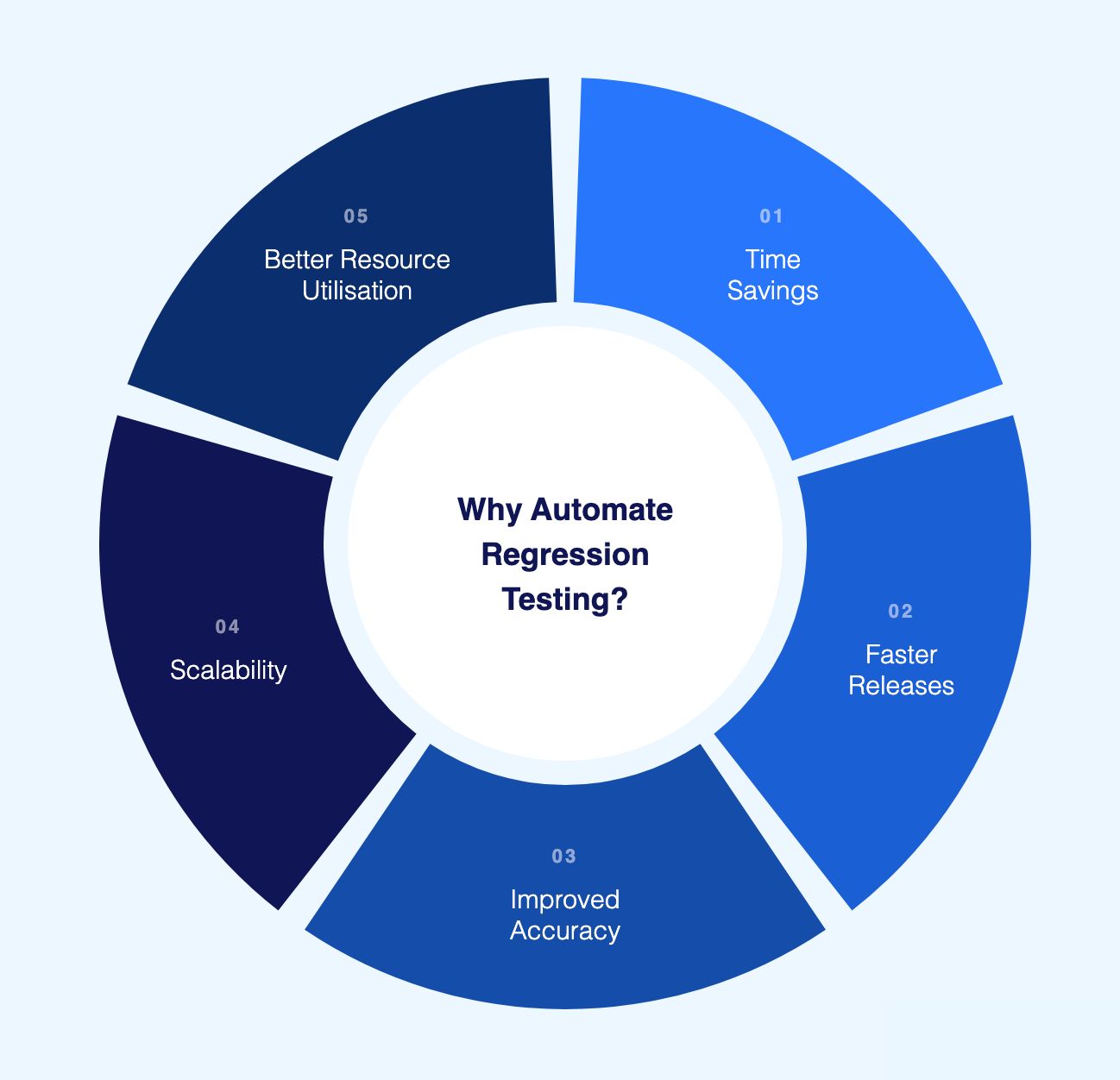
Time Savings
Manual regression testing consumes enormous time. Testing even medium-complexity applications manually can take days or weeks for each release. As applications grow, manual regression becomes impractical.
Automated regression tests execute the same validations in minutes or hours instead of days or weeks. This time savings compounds with each release cycle, delivering massive efficiency gains.
A regression suite that takes two weeks manually might execute in two hours when automated, a 42x improvement in speed.
Faster Releases
Speed-to-market provides competitive advantage. Organizations shipping features faster respond to customer needs more effectively and capitalize on market opportunities quickly.
Automated regression testing removes the testing bottleneck that traditionally delays releases. Fast, reliable automated regression validation enables teams to release confidently and frequently, supporting continuous delivery and rapid iteration.
Improved Accuracy
Humans make mistakes, especially during repetitive tasks. Manual regression testing suffers from:
Accidentally skipped test steps
Inconsistent test execution across testers
Fatigue-induced errors during long test sessions
Variation in how testers interpret test cases
Automated tests execute identically every time, eliminating human error and inconsistency. When an automated regression test passes, you know precisely what was validated and can trust the results completely.
Scalability
As applications grow in complexity and size, regression test suites expand proportionally. Manual execution becomes increasingly impractical and eventually impossible at scale.
Automated regression testing scales effortlessly. Adding more test cases to automated suites doesn't require hiring more testers. Parallel execution across cloud-based grids enables running hundreds or thousands of tests simultaneously.
Better Resource Utilization
Manual testers performing repetitive regression testing represent underutilized talent. These skilled professionals could provide much greater value through exploratory testing, test design, and automation development.
Automating regression testing frees QA engineers from repetitive execution, allowing them to focus on high-value activities like:
Designing comprehensive test strategies
Conducting exploratory testing to find unexpected issues
Creating and maintaining automation frameworks
Analyzing quality metrics and trends
Collaborating with developers on quality improvements
Automated vs Manual Regression Testing

The practical conclusion is that manual and automated regression testing are not competing approaches. Manual regression testing is irreplaceable for exploratory scenarios, usability evaluation, and rapidly changing features where automation overhead exceeds value. Automated regression testing handles the stable, high-frequency validation that manual testing cannot sustain at pace.
Most mature QA programmes target 70 to 80 percent automated regression coverage and preserve manual capacity for discovery-oriented testing. AI-native platforms like Virtuoso QA shift this balance further by making automation faster to create and cheaper to maintain.
When Should Regression Tests be Automated?
Not all regression tests deserve automation. Strategic automation focuses effort on tests providing maximum value.
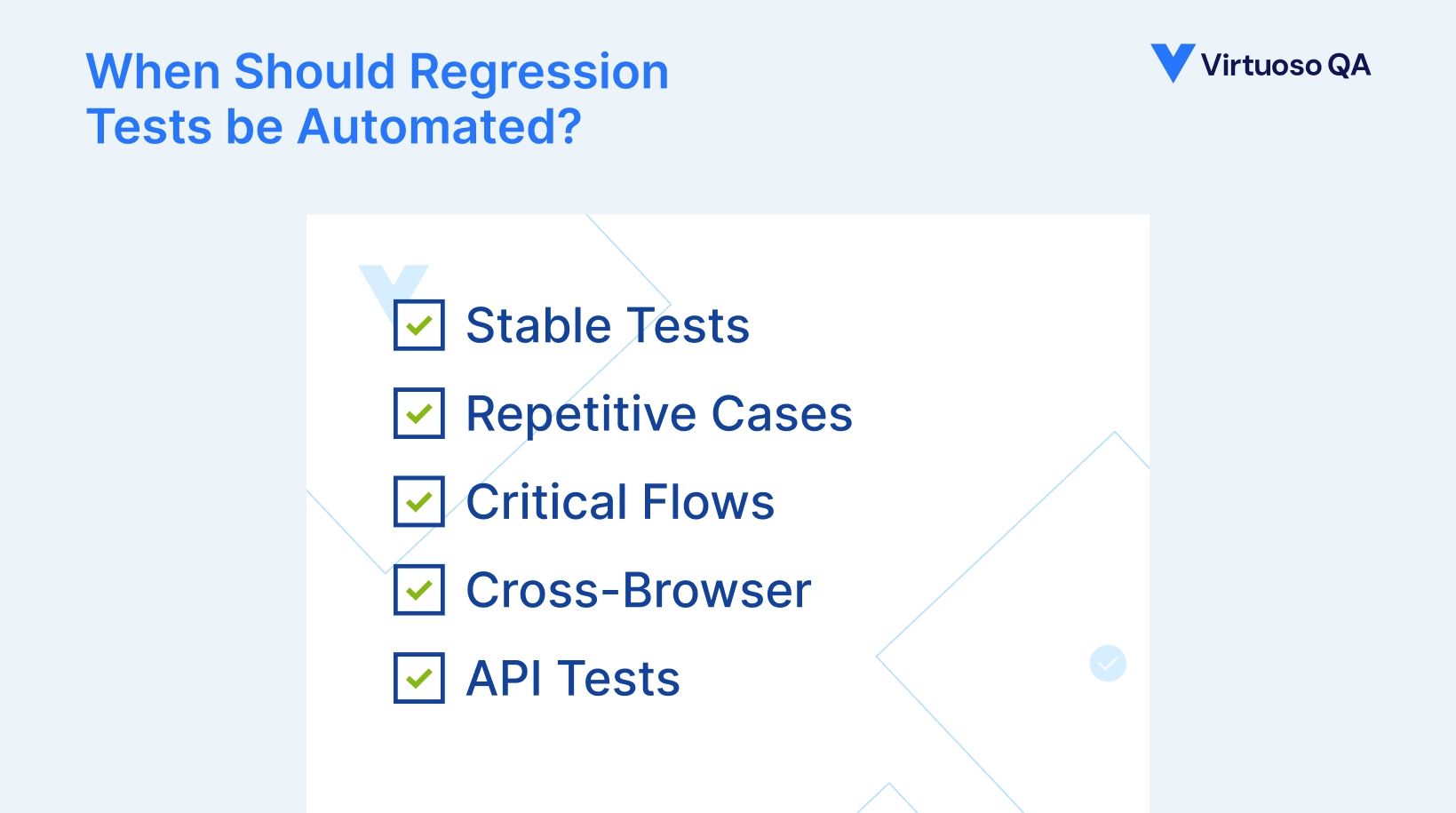
Stable, Reusable Test Cases
Automate regression tests for stable functionality that changes infrequently. Tests for features under active development require constant updates, making automation premature.
Ideal automation candidates have:
Well-defined, consistent test steps
Stable expected outcomes
Minimal churn in tested functionality
Clear pass/fail criteria
Infrequent requirement changes
Frequently Executed Scenarios
Tests that run repeatedly provide maximum automation ROI. If you execute a test case once per release, manual execution may suffice. If you run it daily or multiple times per day, automation delivers substantial value.
Prioritize automating:
Daily regression suites executed with every build
Smoke tests validating critical functionality
Tests run across multiple environments or configurations
Validation required before every deployment
Tests supporting continuous integration workflows
Critical Business Workflows
Business-critical functionality deserves comprehensive automated regression coverage regardless of execution frequency. The cost of defects in revenue-generating or customer-facing features justifies automation investment.
Prioritize automating regression tests for:
E-commerce checkout and payment processing
User authentication and authorization
Financial transactions and calculations
Data integrity and security features
Regulatory compliance requirements
Cross-Browser/Cross-Platform Tests
Validating functionality across browsers, devices, and operating systems creates exponential test combinations. Manual cross-platform testing becomes prohibitively expensive.
Automated regression testing excels at cross-platform validation:
Execute identical tests across Chrome, Firefox, Safari, and Edge simultaneously
Validate responsive designs on various screen sizes in parallel
Test on Windows, macOS, and Linux concurrently
Catch platform-specific regressions reliably
Maintain comprehensive coverage sustainably
Integration and API Tests
Backend services and APIs change frequently. Automated regression testing catches integration breakages immediately:
Validate API contracts remain stable
Check data formats and structures
Verify error handling and edge cases
Test service-to-service communication
Ensure backward compatibility

How to Automate Regression Testing
Implementing automated regression testing successfully requires systematic planning and execution.
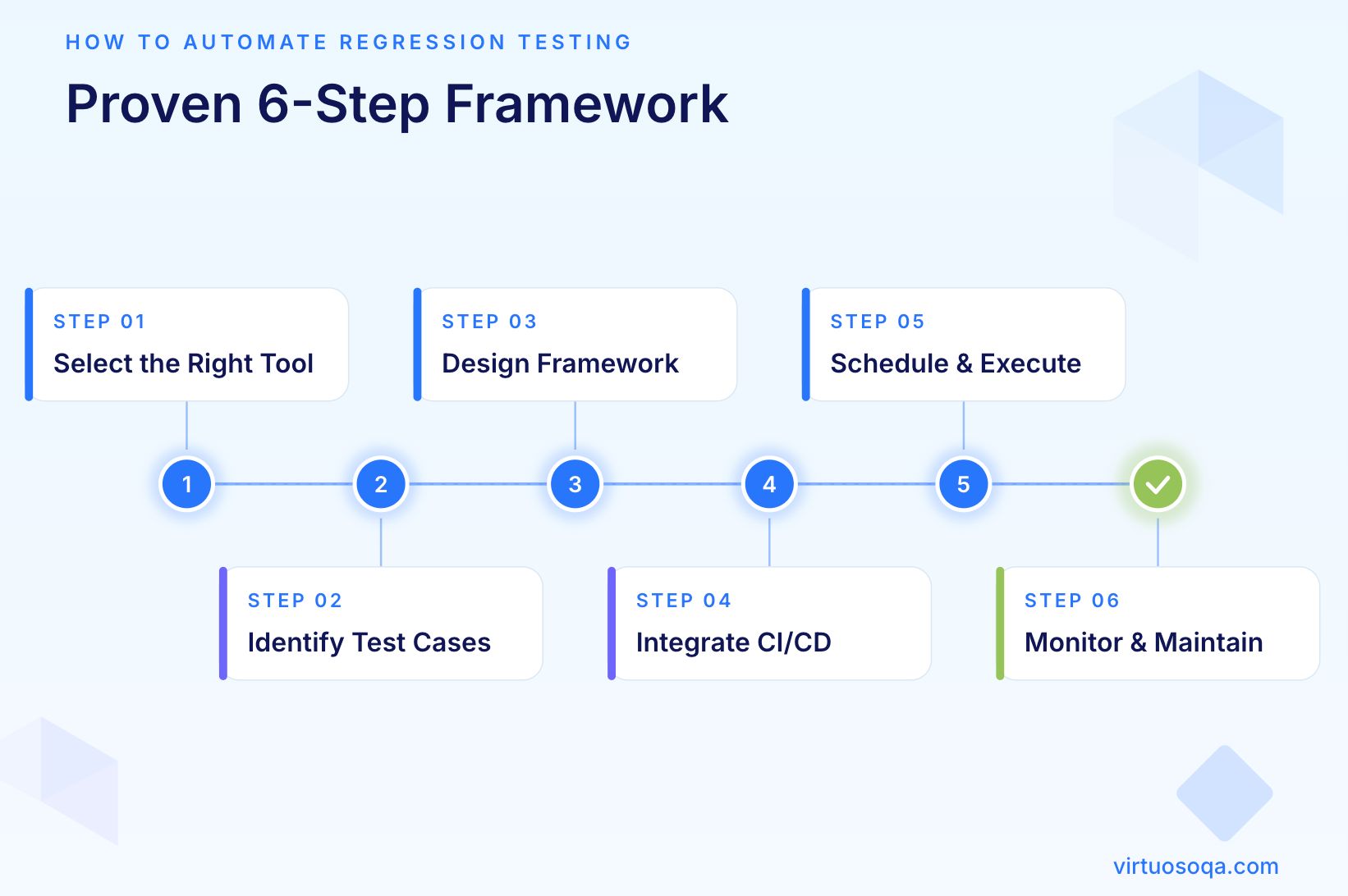
Step 1: Select the Right Automation Tool
Tool selection significantly impacts automation success. Consider these factors:
Based on Application Type: Web applications need different tools than mobile apps or desktop software. Ensure tools support your technology stack.
Skill Set: Traditional scripting tools like Selenium require programming expertise. No-code platforms like Virtuoso QA enable non-technical team members to create automated tests.
Budget: Consider licensing costs, infrastructure requirements, training expenses, and ongoing maintenance overhead.
Popular options include:
Virtuoso QA: AI-powered, no-code platform with self-healing tests and natural language test creation
Selenium: Open-source, script-based framework requiring programming skills
Cypress: Modern JavaScript-based framework for web applications
Playwright: Microsoft's cross-browser automation framework
Step 2: Identify Suitable Test Cases
Not every test case deserves automation. Prioritize based on:
Stable, Repetitive, High-Value Flows: Focus on tests that run frequently, cover critical functionality, and remain relatively stable over time.
Apply these criteria:
Execution frequency (daily/weekly tests first)
Business criticality (revenue and customer-facing features)
Test stability (avoid automating tests that change constantly)
Manual execution time (longer tests provide greater ROI)
Cross-platform requirements (tests needing browser/device coverage)
Step 3: Design an Automation Framework
Framework architecture impacts maintainability and scalability. Common approaches include:
Keyword-Driven Frameworks: Tests use predefined keywords representing actions. Non-technical team members can create tests by combining keywords.
Data-Driven Frameworks: Tests separate test logic from test data. The same test executes with different datasets, enabling comprehensive coverage efficiently.
Hybrid Frameworks: Combine keyword-driven and data-driven approaches for flexibility.
No-Code Platforms (Virtuoso QA): Modern platforms eliminate traditional framework complexity through AI-powered test creation in natural language and automatic maintenance.
Step 4: Integrate with CI/CD Pipelines
Automated regression tests deliver maximum value when integrated into continuous integration and deployment pipelines:
Jenkins, GitHub Actions, GitLab CI: Configure pipelines to trigger automated regression tests automatically when developers commit code, create pull requests, or deploy to test environments.
Pipeline integration ensures:
Every code change undergoes regression validation
Failed tests prevent broken code from advancing
Developers receive immediate feedback on changes
Quality gates enforce standards before deployment
Continuous testing becomes effortless and automatic
Step 5: Schedule and Execute Tests
Strategic test execution balances comprehensiveness with speed:
Nightly Builds: Execute comprehensive regression suites overnight when infrastructure utilization is low. Teams arrive to fresh results each morning.
Triggered by Code Commits: Run fast regression smoke tests with every code commit. Catch critical breakages within minutes.
Pre-Deployment: Execute full regression validation before deploying to staging or production environments.
On-Demand: Enable manual test execution for ad-hoc validation needs.
Step 6: Monitor and Maintain Automation Suites
Automated tests require ongoing care to remain effective:
Update Scripts with Application Changes: When features change, update corresponding test cases. Self-healing platforms like Virtuoso QA automate much of this maintenance.
Remove Obsolete Tests: Regularly review and delete tests for removed features or deprecated workflows.
Optimize Performance: Identify and improve slow-running tests that delay feedback.
Analyze Failures: Investigate failed tests promptly to distinguish true defects from test issues.
Track Metrics: Monitor automation coverage, pass rates, execution times, and ROI.
Best Practices for Automated Regression Testing
Following established best practices maximizes automated regression testing effectiveness while avoiding common pitfalls.
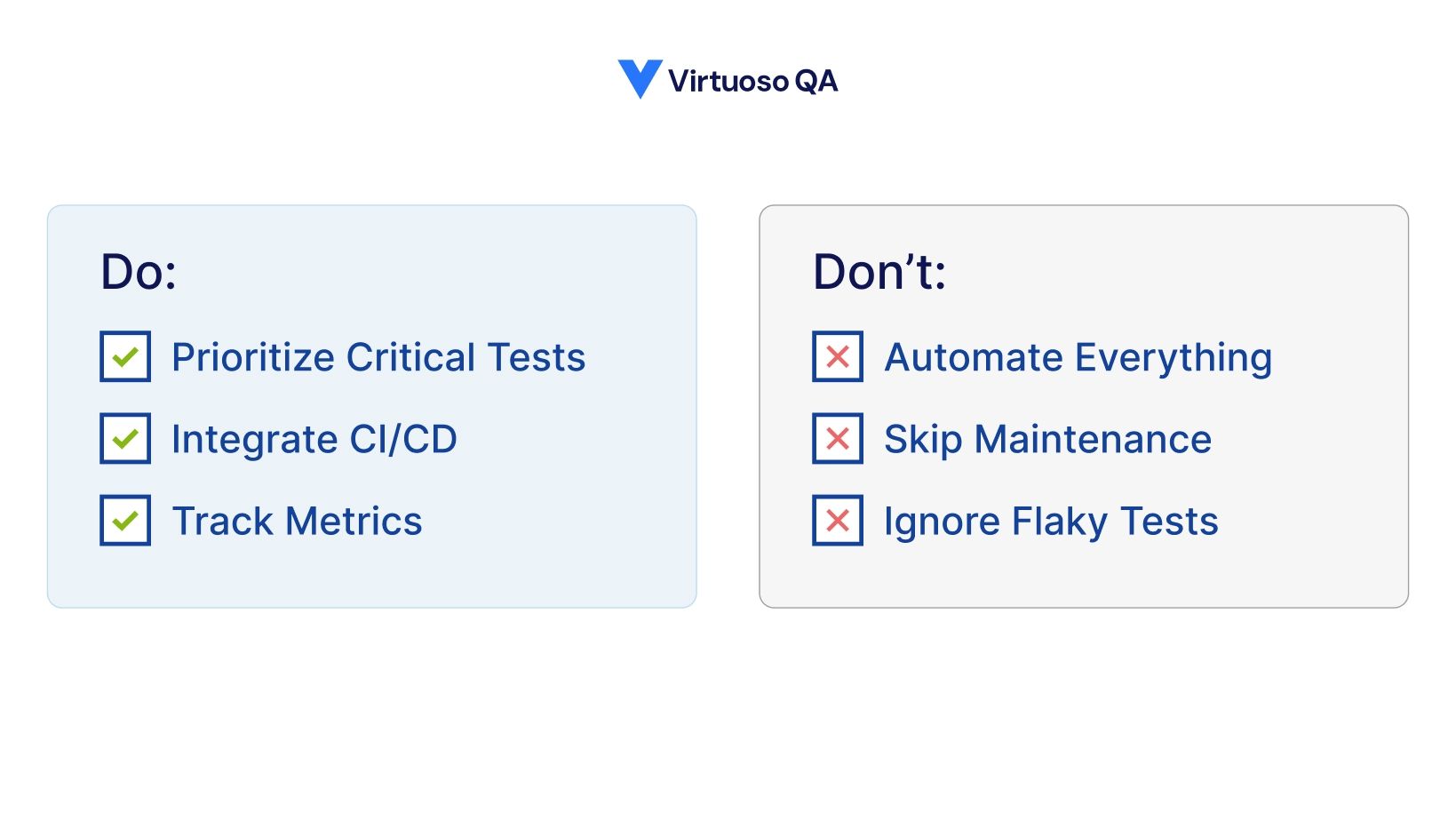
Automate the Right Test Cases
Strategic automation focuses resources where they provide maximum value. Don't attempt to automate everything blindly.
Focus automation on:
Tests executed frequently (daily or multiple times per day)
Stable test cases that change infrequently
Time-consuming manual tests
Cross-browser/cross-device scenarios
Business-critical workflows
Avoid automating:
Tests for features under active development
One-time or rarely executed tests
Tests requiring human judgment or creativity
Usability and aesthetic validations
Keep Tests Maintainable
Test maintainability determines long-term automation success. Poorly designed tests become technical debt that consumes resources without providing value.
Maintain automated tests through:
Clear, descriptive test names that explain purpose
Modular test design with reusable components
Consistent coding standards and patterns
Comprehensive documentation
Regular refactoring to improve structure
Leveraging self-healing capabilities to reduce manual maintenance
Combine Manual and Automated Testing
Optimal regression testing strategically combines both approaches:
Automate stable, repetitive regression flows that execute frequently in CI/CD pipelines.
Manual test exploratory scenarios, usability evaluations, and rapidly-changing features where automation overhead exceeds value.
The goal is not 100% automation but rather optimal resource allocation between automated and manual approaches.
Integrate with CI/CD for Continuous Testing
Automated regression tests deliver maximum value when integrated into continuous delivery pipelines:
Trigger regression suites automatically with code commits
Gate deployment progression on test results
Provide fast feedback to developers
Maintain continuous quality visibility
Enable confident, frequent releases
Track Metrics (Coverage, Defect Detection Rate)
Measure what matters to drive continuous improvement:
Automation coverage: Percentage of regression scenarios automated
Pass/fail rates: Trends indicating quality improvements or regressions
Defect detection efficiency: Bugs caught by automation vs. escaping to production
Execution time: Speed of feedback delivery
Maintenance effort: Time spent updating tests
ROI: Value delivered vs. automation investment
Leverage AI/No-Code for Faster Adoption
Modern AI-powered no-code platforms dramatically accelerate automated regression testing adoption:
Enable non-programmers to create automated tests
Reduce test creation time by 10x
Eliminate 70-85% of maintenance through self-healing
Improve test stability and reduce flakiness
Allow teams to focus on strategy rather than script maintenance

Challenges of Automated Regression Testing
Understanding common challenges enables proactive solutions that prevent automation initiatives from failing.
1. High Initial Setup Costs
Automated regression testing requires upfront investment:
Tool licensing and infrastructure costs
Training team members on automation
Creating initial test framework
Developing first batch of automated tests
Establishing processes and standards
Solution: No-code platforms like Virtuoso QA dramatically reduce setup costs through intuitive interfaces, minimal training requirements, and rapid test creation. ROI typically arrives within 6-12 months as execution efficiency compounds.
2. Test Script Maintenance
Traditional automated tests break when applications change:
UI modifications require test updates
Workflow changes necessitate test revisions
New features need new test coverage
Deprecated features require test removal
Solution: AI-powered self-healing automation eliminates 70-85% of maintenance burden. Virtuoso QA automatically adapts tests to application changes, keeping regression suites current with minimal manual effort.
3. Flaky Tests in Dynamic Environments
Regression tests can fail inconsistently due to environmental issues rather than actual defects:
Network latency causes timeouts
Asynchronous operations complete unpredictably
Test data issues create unstable conditions
Resource contention affects timing
Solution: Robust test design with proper wait strategies, test isolation, and stable test data management minimize flakiness. Modern platforms incorporate intelligent stability features that handle timing issues automatically.
4. Complex Test Data Management
Comprehensive regression testing requires managing diverse test datasets:
Creating realistic test data
Maintaining data across environments
Resetting data between test runs
Handling data dependencies
Protecting sensitive information
Solution: Dedicated test data management tools, synthetic data generation, and containerized test environments simplify data management significantly.
5. Balancing Automation Coverage vs ROI
Teams must decide how much to automate given finite resources:
Complete automation may not be cost-effective
Partial automation leaves gaps in coverage
Prioritization requires judgment and expertise
Solution: Apply risk-based prioritization focusing automation on high-value, frequently-executed tests. Monitor ROI metrics and adjust strategy based on results. Accept that some tests are better suited for manual execution.
Automated Regression Testing in Agile & DevOps
Modern development methodologies transform how regression testing integrates into software delivery.
Continuous Testing in Sprints
Agile teams test continuously throughout sprints rather than in distinct testing phases:
Automated regression tests run with every code commit
Failed tests block pull request merging
Regression validation happens before story acceptance
Quality feedback arrives immediately rather than days later
Shift-Left Testing with Automation
Shift-left moves testing earlier in the development lifecycle:
Developers run regression tests locally before committing code
Automated tests validate changes during development
Earlier feedback reduces defect resolution costs
Quality becomes a development responsibility, not just QA
Parallel Execution for Faster Feedback
Parallel test execution accelerates regression validation:
Distribute tests across multiple machines
Execute different browsers simultaneously
Run independent test suites in parallel
Cloud-based execution grids provide unlimited capacity
Reduce multi-hour test suites to minutes
Automation as Part of CI/CD Pipeline
Regression testing integrates seamlessly into deployment pipelines:
Commit triggers automated unit and integration tests
Pull requests execute faster regression smoke tests
Staging deployments trigger comprehensive regression suites
Production deployments require passed regression validation
Failed tests automatically prevent code advancement

Regression Testing Automation Framework Design
Framework architecture significantly impacts automation success, maintainability, and scalability.
Keyword-Driven Frameworks
Keyword-driven frameworks abstract test actions into reusable keywords:
Test cases combine predefined keywords
Non-technical testers can create tests
Changes to implementation affect keywords, not all tests
Enables test creation without programming
Data-Driven Frameworks
Data-driven frameworks separate test logic from test data:
Same test executes with different input datasets
Efficient validation of multiple scenarios
Test data maintained separately from test scripts
Enables comprehensive coverage with fewer tests
Hybrid Frameworks
Hybrid frameworks combine keyword-driven and data-driven approaches:
Provides flexibility for different test types
Leverages strengths of both approaches
Supports diverse team skill levels
Balances ease-of-use with power
Model-Based Testing
Model-based testing generates tests from application models:
Creates tests automatically from state models
Ensures comprehensive coverage systematically
Reduces manual test design effort
Adapts to model changes automatically
AI-Powered/Agentic Testing (Virtuoso QA)
Modern AI-powered platforms represent the future of regression testing:
Natural language test creation eliminates scripting
Self-healing tests adapt to application changes automatically
AI-generated test suggestions improve coverage
Intelligent element identification remains stable
Dramatically reduced maintenance burden
Automated Regression Testing Metrics & KPIs
Measuring automated regression testing effectiveness requires tracking relevant metrics that drive improvement.
Execution Time Reduction
How much faster do automated tests execute compared to manual regression?
Track baseline manual execution time
Measure automated suite execution time
Calculate time savings per execution
Monitor trends as test suites grow
Optimize slow tests to maintain fast feedback
Automation Coverage Percentage
What proportion of regression scenarios are automated?
Calculate automated tests vs. total regression test cases
Set coverage targets based on risk and value
Track coverage growth over time
Identify high-value manual tests for automation
Balance comprehensive coverage with ROI
Defect Detection Efficiency
How effectively do automated regression tests find real defects?
Track defects found by automation vs. manual testing
Measure defects caught before production
Calculate defect leakage rate
Monitor defect severity distributions
Assess ROI based on prevented production incidents
Flakiness Rate of Tests
How often do tests fail due to test issues rather than actual defects?
Track inconsistent test failures
Identify and eliminate flaky tests
Monitor stability trends over time
Target near-zero flakiness
Leverage self-healing to improve stability
ROI of Test Automation
What return are you getting on automation investment?
Calculate time saved through automated execution
Measure costs avoided through early defect detection
Factor in maintenance and tooling costs
Quantify faster time-to-market benefits
Compare against baseline manual testing approach
Common Mistakes to Avoid
Learning from common automated regression testing mistakes helps teams succeed faster.
Trying to Automate 100% of Tests
Complete automation is neither achievable nor desirable:
Some tests suit manual execution better
Rapidly changing features have poor automation ROI
Exploratory testing requires human creativity
Usability evaluations need human judgment
Solution: Target 70-80% automation coverage for stable regression scenarios while maintaining manual testing for appropriate use cases.
Neglecting Test Maintenance
Automated tests require ongoing care to remain effective:
Applications change, tests must evolve
Obsolete tests waste execution time
Flaky tests erode confidence
Poor maintenance creates technical debt
Solution: Schedule regular test maintenance, leverage self-healing platforms, monitor test health metrics, and retire obsolete tests promptly.
Skipping Test Data Management
Poor test data management undermines automated regression testing:
Inconsistent data causes flaky failures
Insufficient data misses edge cases
Data dependencies create fragile tests
Stale data doesn't represent reality
Solution: Invest in test data management tools, establish data refresh processes, use synthetic data generation, and containerize test environments.
Not Integrating with CI/CD
Automated regression tests disconnected from development workflows provide limited value:
Manual test execution delays feedback
Tests run infrequently
Developers don't see immediate results
Quality visibility remains poor
Solution: Integrate automated regression testing deeply into CI/CD pipelines with automatic triggering, clear quality gates, and fast feedback loops.
Ignoring Test Metrics
Teams flying blind cannot improve effectively:
Unknown automation coverage leaves gaps
Untracked flakiness erodes trust
Unmeasured ROI risks management support
Missing trends prevent proactive improvement
Solution: Establish automation dashboards, track key metrics, review trends regularly, and use data to drive continuous improvement.
Conclusion: The Future of Automated Regression Testing
Automated regression testing has evolved from a specialized discipline practiced by automation experts into an essential capability accessible to entire development organizations. Modern AI-powered platforms democratize automation, making comprehensive regression testing achievable without specialized programming skills.
The benefits are undeniable: faster releases, higher quality, reduced costs, and increased confidence. The traditional barriers of high maintenance overhead and technical complexity have been shattered by self-healing AI and no-code platforms.
Virtuoso QA delivers intelligent, no-code regression automation designed for fast-moving teams. AI-powered self-healing tests adapt automatically to application changes, reducing maintenance by up to 85%. Natural language test creation enables non-technical team members to contribute to automation. Seamless CI/CD integration provides continuous regression validation without friction.
Key advantages of Virtuoso QA for automated regression testing:
10x faster test creation through natural language interfaces
85% reduction in maintenance via AI-powered self-healing
Zero flakiness through intelligent stability features
Complete CI/CD integration for continuous testing
Cross-browser execution from single test definitions
AI Root Cause Analysis for rapid failure debugging
Enterprise scalability supporting thousands of parallel tests
Organizations embracing modern automated regression testing gain competitive advantages through confident, frequent releases and exceptional software quality. The question is no longer whether to automate regression testing but rather how quickly you can implement intelligent, self-healing automation that scales with your business.

Related Reads
Frequently Asked Questions About Automated Regression Testing
When should we automate regression tests?
What tools are best for automated regression testing?
How long does it take to implement automated regression testing?
What percentage of regression tests should be automated?
How do we handle flaky regression tests?
How does AI improve automated regression testing?