Blog
Best Test Automation Tools & Frameworks of 2026 Compared

Abhilash
Published on

Table of contents
Lorem ipsum
Lorem ipsum
Lorem ipsum
Lorem ipsum
Lorem ipsum
Every test automation tool on the market will tell you what it does well. Very few will tell you what it costs you to use it, not in licensing fees, but in the trade-offs that only become visible six months into an implementation.
A team that chooses Selenium gains maximum flexibility and zero licensing cost. What they give up is the engineering capacity that will go to maintenance from the moment the suite gets large enough to matter. A team that chooses an AI-native platform gains dramatically lower maintenance overhead. What they give up is some degree of technical control and a higher upfront cost.
Neither choice is wrong. Both choices have consequences that should be understood before the contract is signed rather than after the first major release breaks forty percent of the test suite.
This guide is built around that idea. Each tool is assessed as an honest trade-off. What the team gains, what they give up, and the specific situation where the gains outweigh the costs. Read it as a decision framework rather than a feature list.
The Question Every Team Gets Wrong at the Start
Most teams begin a test automation tool evaluation by asking which tool has the best features. The more useful question is which problem is costing us the most right now, and which tool was built to solve that specific problem.
There are three problems that test automation programmes typically face.
The first is the cost of creating tests. Teams without technical contributors spend weeks building coverage that an AI-native platform would generate in hours.
The second is the cost of maintaining tests. Teams on traditional frameworks spend the majority of their automation budget repairing tests that break when the application changes rather than building new coverage.
The third is the cost of coverage gaps. Teams that have fast authoring and manageable maintenance still ship defects because the right things are not being tested.
Most tools are designed to solve one of these three problems well. Very few solve all three. Knowing which problem is most expensive for the team today is the most important input to the tool selection decision.
21 Best Test Automation Tools and Frameworks Evaluated
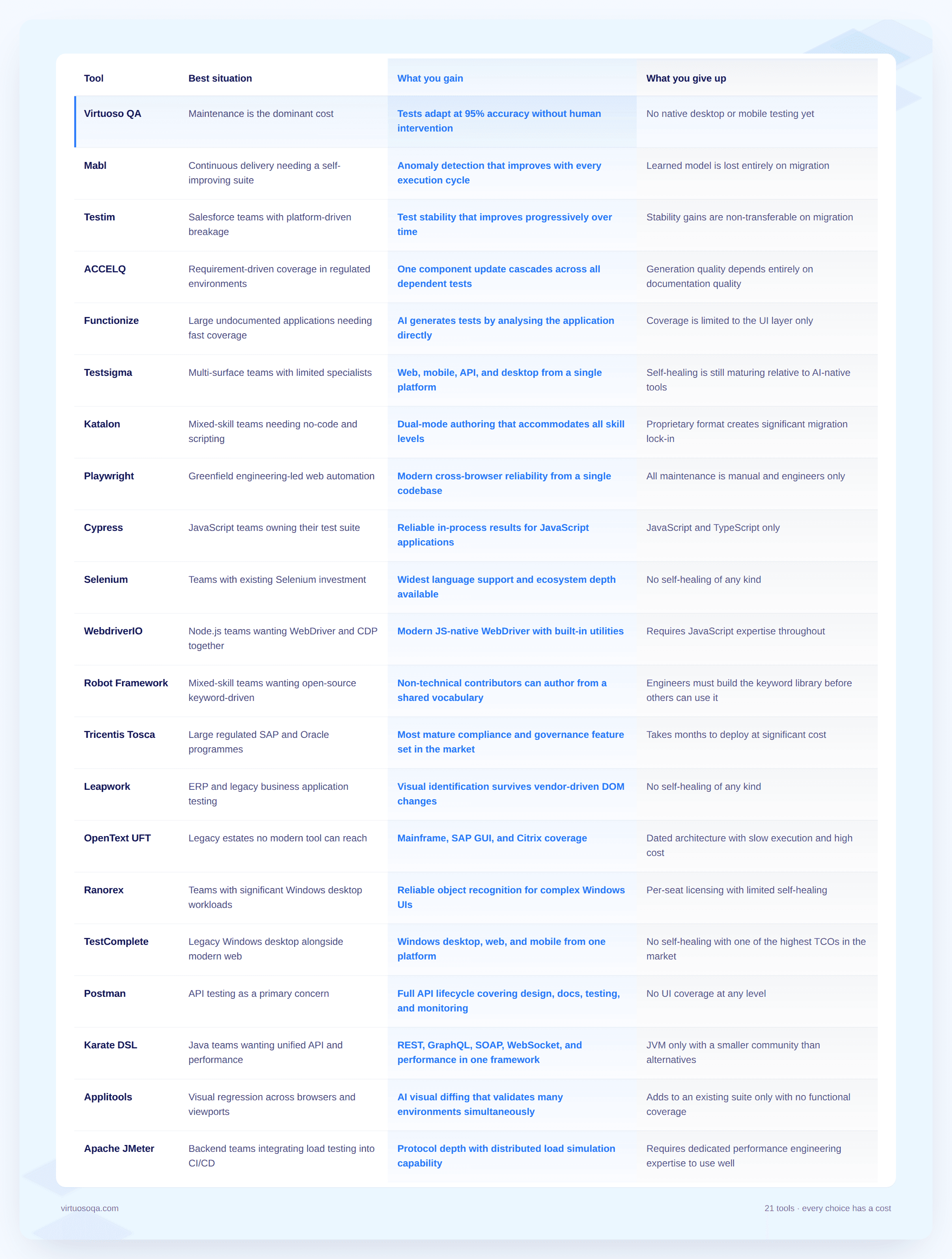
1. Virtuoso QA - AI Native Test Automation Platform
Virtuoso QA is an AI-native end-to-end testing platform built for enterprise teams. Unlike platforms that add AI on top of a traditional framework, Virtuoso QA is architected around AI from the ground up, which is what makes the maintenance reduction structurally different rather than marginally better.
What You Gain:
Tests adapt at approximately 95 percent accuracy when the UI changes, without anyone touching the test
StepIQ generates test steps by reading the live application, removing scripting from the authoring process entirely
GENerator converts existing Selenium, Tosca, and TestComplete assets into AI-native journeys without a manual rebuild
API testing runs within the same journey as UI steps, eliminating the need for separate suites managed by separate teams
Every test run produces audit-grade evidence automatically, covering steps, screenshots, video, and traceability links
Composable test libraries let verified journeys be reused across releases, environments, and applications without rebuilding
Native integrations with Jenkins, GitHub Actions, Azure DevOps, GitLab, CircleCI, Bamboo, Jira, Xray, and TestRail
SOC 2 Type 2 certified with AWS deployment across EU, US, and UK regions
What You Give Up:
Native desktop and mobile testing are not yet available, which means teams with those surfaces need supplementary tooling
Enterprise pricing requires a sales conversation before the total cost is clear
Teams that want to own every line of test code will need to adjust how they think about test ownership
The Situation Where Virtuoso QA is the Right Choice:
The team is spending more than 30 percent of automation engineering capacity repairing tests rather than building new coverage. Or the team has a legacy Selenium or Tosca suite that is no longer keeping pace with the application. Or both.
2. Playwright
Playwright is a modern open-source browser automation framework developed by Microsoft. It is the strongest current open-source option for engineering teams building web automation from scratch and addresses most of the historic frustrations with traditional browser automation frameworks.
What You Gain:
Full test isolation per context prevents cross-test interference during parallel execution
Built-in handling of asynchronous application states removes the need for manual timing management
Network interception lets teams test application behaviour under API failure and degraded response conditions
Trace files capture every network request, DOM change, and screenshot during a failed run for post-failure analysis
Multi-language support across JavaScript, TypeScript, Python, Java, and .NET accommodates most engineering teams
What You Give Up:
Non-engineering contributors cannot participate in the test suite without learning to script
There is no self-healing of any kind and all repair after UI changes is manual
Reporting, retry logic, and parallelisation infrastructure must all be built by the team
At scale the maintenance burden is significant and grows with the application
The Situation Where Playwright is the Right Choice:
The team is engineering-led, technically strong, starting a new automation programme from scratch, and is clear-eyed about the ongoing cost of owning all maintenance work.
3. ACCELQ
ACCELQ is a codeless test automation platform built around reusable business process components. It is designed for regulated environments where keeping test coverage aligned with frequently changing business requirements is as important as the automation itself.
What You Gain:
Updating one component cascades the fix automatically across every test scenario that references it
A single codeless environment covers web, mobile, API, and desktop without framework switching
Native Gherkin authoring integrates BDD without requiring a separate collaboration framework
AI change impact analysis identifies affected tests before a requirements change reaches execution
On-premises deployment available for regulated industries with strict data residency requirements
What You Give Up:
Generation quality is directly tied to the quality of input documentation, so sparse requirements produce weaker output
Self-healing reliability decreases when applications change rapidly across multiple layers simultaneously
The Situation Where ACCELQ is the Right Choice:
The team has strong requirements documentation and the primary challenge is keeping test coverage aligned with business rules that change frequently across multiple application types in a regulated environment.
4. Cypress
Cypress is an open-source testing framework that runs inside the browser process rather than controlling it externally. It is built for JavaScript-first engineering teams where developers own and maintain the test suite alongside the application code.
What You Gain:
In-process execution gives tests direct access to application state that external frameworks cannot reach
Per-command snapshots let engineers see the exact application state at every step of a failed run
Network stubbing makes it practical to test application responses to specific API conditions and errors
Component testing mode validates individual UI components in isolation before integration testing
Live reloading during development gives feedback within seconds of saving a code change
What You Give Up:
The framework works only with JavaScript and TypeScript, excluding teams that use other languages
Workflows spanning multiple browser tabs require workarounds that add complexity
Parallel execution and test recording require Cypress Cloud, a paid product separate from the open-source framework
The Situation Where Cypress is the Right Choice:
Frontend developers own the test suite and the team works exclusively in JavaScript or TypeScript, with developer feedback speed during active development as important as the pipeline result.
5. Selenium
Selenium is the most widely used browser automation framework in the world, with an ecosystem built over more than fifteen years. It gives engineering teams complete flexibility over how tests are built and run, at the cost of owning all maintenance work when the application changes.
What You Gain:
Language support across Java, Python, C#, Ruby, JavaScript, and Kotlin covers virtually any engineering team
Selenium Grid distributes execution across browser and OS combinations at scale without additional tooling
Compatible with every major CI/CD platform, cloud execution provider, and test management system on the market
Community ecosystem depth means almost any problem the team encounters has a documented solution
What you give up:
There is no self-healing and all UI changes require manual locator updates across every affected test
Reporting, test management, and parallelisation all require separate tools or custom engineering
At scale the maintenance burden becomes the defining characteristic of the programme
The Situation Where Selenium is the Right Choice:
The team has substantial accumulated Selenium coverage that rebuilding on another platform would require replacing. Starting a new programme on Selenium in 2026 requires an honest conversation about whether the flexibility justifies the maintenance cost that follows.
6. WebdriverIO
WebdriverIO is an open-source automation framework built specifically for the Node.js ecosystem. It combines WebDriver protocol compatibility with modern JavaScript tooling and ships with utilities that Selenium teams typically have to build themselves.
What You Gain:
Supports both WebDriver protocol and Chrome DevTools Protocol from the same framework
Built-in retry logic, custom reporters, and service integrations for major cloud execution providers
Appium support through the same API makes mobile and web testing consistent in one codebase
Works with Cucumber, Jasmine, and Mocha as test runners without additional configuration
What You Give Up:
Requires JavaScript expertise and is most productive within the Node.js ecosystem
Community support is smaller than Selenium, meaning fewer pre-answered questions for unusual problems
There is no self-healing
The Situation Where WebdriverIO is the Right Choice:
The team is JavaScript-first, wants WebDriver compatibility, and needs built-in utilities that would require custom engineering to replicate in Selenium.
7. Robot Framework
Robot Framework is an open-source keyword-driven automation framework that lets non-technical contributors build test scenarios from a vocabulary defined by engineers. It bridges the gap between open-source flexibility and non-technical contributor access without requiring a commercial platform.
What You Gain:
Keyword-driven syntax lets non-technical contributors build scenarios from a defined vocabulary without writing code
SeleniumLibrary, RequestsLibrary, and AppiumLibrary extend coverage to web, API, and mobile
Plain-text test files integrate naturally with version control and code review workflows
Detailed HTML reports generate automatically after every run without additional tooling
What You Give Up:
Engineers must build and maintain the keyword library before non-technical contributors can participate meaningfully
There is no self-healing
Large suites require significant infrastructure investment for reliable parallel execution
The Situation Where Robot Framework is the Right Choice:
The team wants open-source flexibility but needs non-technical contributors to participate in test authoring and is willing to invest upfront in building the keyword library that makes that participation possible.
8. Mabl
Mabl is a cloud-native test automation platform that learns from every execution and uses that learning to detect problems before they surface as failures. It is designed for engineering-led teams running continuous delivery where suite stability under high commit frequency is the primary concern.
What You Gain:
Execution history builds a behavioural model that improves anomaly detection accuracy across release cycles
Problems are flagged before they break the build rather than discovered through a failed pipeline run
UI and API testing managed within the same platform without switching tools
Performance anomaly detection runs alongside functional checks without requiring a separate tool
Native integrations with GitHub, GitLab, Jenkins, CircleCI, Azure DevOps, Jira, and PagerDuty
What You Give Up:
The behavioural model is tied to the platform and is lost entirely if the team migrates to another tool
Backend system and database coverage requires external tooling alongside Mabl
Developer-centric design creates friction for traditional QA teams who prefer deterministic pass or fail outputs
The Situation Where Mabl is the Right Choice:
The team runs continuous delivery with high commit frequency and needs the test suite to serve as a reliable pipeline gate without requiring a dedicated QA engineer to monitor it between runs.
9. Testim
Testim is an AI-assisted test automation platform that progressively stabilises tests over time by learning which element identification strategies produce the most consistent results.
It has particularly strong capabilities for Salesforce environments where Lightning component updates are a persistent source of test breakage.
What You Gain:
Competing identification strategies run simultaneously during every execution and shift weight toward the most reliable ones over time
Salesforce Lightning-specific recognition handles component and dynamic rendering patterns natively
AI stability scoring identifies scenarios at elevated failure risk before they break a build
Branch-based test management mirrors the Git branching strategy the development team already uses
Reusable component library reduces duplication across large regression suites
What You Give Up:
Stability gains are tied to the platform and are lost if the team migrates to a different tool
Human review of AI-generated updates remains a necessary part of the workflow
Limited public outcome data makes committing without a direct proof of concept a meaningful risk
The Situation Where Testim is the Right Choice:
Salesforce is a primary testing surface and vendor-driven platform updates are the main source of test breakage. Or the suite is producing enough intermittent failures that developers have started treating the pipeline as unreliable.
10. Functionize
Functionize is an AI-powered test automation platform that generates test coverage by analysing the application directly rather than waiting for a human to define the flow first.
It is designed for teams with large applications where manually authoring coverage for every important flow would take months.
What You Gain:
Application-driven generation analyses the product and produces tests without requiring recorded flows
SmartFix self-healing evaluates alternative element strategies when the original approach no longer works
Visual regression and functional checks run in the same execution pass without separate suite management
Natural language authoring lets contributors add scenarios without scripting knowledge
Parallel cloud execution scales regression runs to fit CI/CD pipeline time constraints
What You Give Up:
Coverage is primarily at the UI layer and API or database test generation requires supplementary tooling
No legacy migration capability for teams moving from existing Selenium or framework-based suites
Architecture is AI-augmented rather than AI-native, which caps the maintenance reduction at a lower ceiling
The Situation Where Functionize is the Right Choice:
The team has a large undocumented application and needs meaningful coverage quickly without a structured authoring phase as the prerequisite.
11. Testsigma
Testsigma is a unified test automation platform that covers web, mobile, API, and desktop from a single environment with plain-English authoring.
It is designed for teams that test across multiple application surfaces but cannot staff specialist automation engineers for each one.
What You Gain:
A single platform covers web, mobile web, native iOS, native Android, API, and desktop without framework switching
NLP authoring produces test steps from plain English accessible to non-technical contributors
Smart execution engine selects the most relevant tests for each build rather than running everything
Built-in test data management removes the dependency on external data tooling
Native integrations with Jira, GitHub, GitLab, Jenkins, CircleCI, and Azure DevOps
What You Give Up:
Self-healing accuracy is still developing compared to platforms built AI-native from the ground up
Complex multi-condition business logic produces less reliable generated test output
Very large enterprise programmes with thousands of interconnected scenarios require careful architecture planning
The Situation Where Testsigma is the Right Choice:
The team tests across multiple application surfaces and does not have specialist automation engineers for each one, with non-technical contributors needing to participate in authoring without learning to code.
12. Katalon Studio
Katalon Studio is a commercial test automation platform that combines no-code recording and full scripting capability in the same environment. It is designed for teams that span a wide range of technical skills and need a single tool that accommodates all of them.
What You Gain:
Dual-mode environment supports recording for simple flows and Groovy or Java scripting for complex logic
Covers web, API, and mobile testing without switching platforms
TestOps provides centralised result tracking and analytics across distributed QA teams
Data-driven parameterisation supports the same scenario executing against multiple data sets
Free community edition lets teams evaluate the platform before committing to paid plans
What You Give Up:
Tests are built on element locators which means UI changes require manual updates in the same way as traditional frameworks
The proprietary format creates lock-in that makes migrating to another platform significantly more expensive than teams anticipate
Self-healing is limited compared to platforms where it is architecturally central
The Situation Where Katalon is the Right Choice:
The QA team spans a wide range of technical skills and contributors need different interfaces for the same test suite without the team paying enterprise platform prices.
13. Tricentis Tosca
Tricentis Tosca is an enterprise test automation platform built around model-based testing and risk-based optimisation. It is designed for large organisations running complex compliance-driven test programmes across SAP, Oracle, and Salesforce at scale.
What You Gain:
Model-based generation produces coverage from business process definitions rather than recorded interactions
Risk-based optimisation prioritises high-impact scenarios when time or resources constrain full suite execution
Deep native integration with SAP, Oracle, and Salesforce for enterprise application testing at scale
The most mature formal compliance reporting and audit trail features in the market
Centralised test repository with version control and governance workflows for large distributed teams
What You Give Up:
Full deployment typically takes several months before the programme is operational
Total cost of ownership is significantly higher than AI-native alternatives
Heavy architecture creates friction in fast-moving agile delivery environments
Requires weeks of training before teams can manage complex suites independently
The Situation Where Tosca is the Right Choice:
The organisation runs a large regulated programme across SAP or Oracle where compliance evidence from the testing programme is a formal requirement and budget reflects the complexity of what needs to be governed.
13. Leapwork
Leapwork is an enterprise automation platform that identifies UI elements visually rather than through DOM structure. It is designed for teams testing ERP and legacy business applications where vendor-driven updates make DOM-based automation unreliable.
What You Gain:
Visual element identification survives DOM structure changes that vendor-driven updates introduce
Pre-built automation flows for SAP, Dynamics 365, Salesforce, and ServiceNow reduce time to first test
Compliance reporting generates audit-ready evidence of test execution for regulated industries
On-premises deployment available for enterprises with strict data residency requirements
Strategic Microsoft partnership provides validated testing patterns for Dynamics 365 and Power Platform
What You Give Up:
There is no AI self-healing and visual changes in legacy interfaces require manual test updates
Regression flowcharts become progressively harder to manage and audit as suite volume grows
Less suited to fast-moving web application programmes where release cadence is high
The Situation Where Leapwork is the Right Choice:
ERP or legacy business application testing is the primary workload and standard DOM-based automation tools have repeatedly failed to provide reliable coverage.
14. OpenText UFT
OpenText UFT, formerly Micro Focus UFT, is one of the longest-established enterprise test automation platforms. It provides coverage of legacy application environments including mainframe, SAP GUI, and Citrix that no modern web-based tool can reach reliably.
What you gain:
Industry-leading coverage of mainframe, SAP GUI, Citrix, and complex Windows desktop environments
Advanced object recognition for enterprise UI environments including non-standard controls
Deep ALM integration for end-to-end lifecycle management from requirement to test to defect
Professional services and support infrastructure for large enterprise programmes
What you give up:
The architecture reflects its origins and has not kept pace with modern engineering workflows
Execution performance is slower than cloud-native alternatives
Licensing costs are high and the interface requires significant training before contributors are productive
The Situation Where OpenText UFT is the Right Choice:
The organisation has a large existing UFT investment and a legacy application estate that genuinely cannot be covered by any modern web-based tool.
15. Ranorex
Ranorex is a commercial test automation platform with strong object recognition for Windows desktop applications, legacy GUI systems, and complex enterprise interfaces with non-standard controls. It is designed for teams that web-first tools have consistently failed in desktop application testing environments.
What You Gain:
Object recognition handles Windows desktop, web, and mobile application interfaces in a single tool
Visual spy tool identifies elements without requiring code knowledge from the tester
Modular test structure with reusable components reduces duplication across the test suite
Detailed execution reports with screenshots and logs for every test step and failure
What You Give Up:
Per-seat commercial licensing adds meaningful cost for teams with larger contributor counts
Self-healing is limited compared to AI-native platforms
Teams without significant Windows desktop testing requirements will find web-first tools more cost-effective
The Situation Where Ranorex is the Right Choice:
The team has a substantial Windows desktop application testing workload and web-first automation tools have failed to provide reliable coverage on the specific UI environments involved.
16. TestComplete
TestComplete is a commercial test automation platform from SmartBear that covers Windows desktop application testing alongside web and mobile in a single environment. It is one of the few tools that handles legacy Windows UI frameworks reliably.
What You Gain:
Covers Windows desktop, web, and mobile testing from a single platform and licence
Object recognition for legacy Windows frameworks including WinForms and WPF that web-first tools cannot handle
Keyword-driven and scripted authoring modes accommodate different contributor skill levels
Integration with the SmartBear ALM and test management ecosystem
What You Give Up:
No self-healing of any kind means every UI change requires manual test updates
The authoring environment is Windows-only which excludes macOS and Linux contributors entirely
Per-seat licensing at approximately $6,085 per year plus maintenance is one of the highest total costs of ownership in the market
The Situation Where TestComplete is the Right Choice:
Windows desktop applications represent a meaningful and unavoidable share of the test coverage requirement and no web-first tool has been able to cover them reliably.
17. Postman
Postman is the most widely used API testing and collaboration platform. It manages API design, documentation, testing, and monitoring in a single environment and is the go-to choice for teams where API coverage is a primary concern rather than a secondary layer of an end-to-end suite.
What You Gain:
Collections organise API requests, tests, and documentation together for the same endpoint
Newman CLI integration runs collections automatically in Jenkins, GitHub Actions, and other CI/CD pipelines
Environment variables allow the same collection to run against development, staging, and production configurations
Automated monitoring alerts when API behaviour changes unexpectedly between releases
Mock server capability lets front-end teams build against API contracts before the backend is ready
What You Give Up:
Postman covers APIs only and teams expecting UI testing alongside API coverage will be disappointed
Advanced collaboration features and monitoring require paid plans beyond the free tier
The Situation Where Postman is the Right Choice:
API testing is a primary concern rather than a secondary layer of an end-to-end suite, and the team needs API documentation and test coverage to stay synchronised as the API evolves across releases.
18. Karate DSL
Karate DSL is an open-source framework that combines API testing, performance testing, and basic UI automation in a single BDD-style syntax. It is built for Java-first engineering teams who want unified coverage across multiple layers without maintaining separate tools for each.
What You Gain:
BDD-style syntax makes API test scenarios readable without requiring dedicated scripting knowledge
Native support for REST, GraphQL, SOAP, and WebSocket protocols in a single framework
Gatling integration enables performance testing using the same scenarios written for functional testing
Built-in mock server for contract testing and testing against unavailable downstream services
What You Give Up:
The framework runs on the JVM and is most productive for Java teams, creating friction for other ecosystems
Community support is smaller than Postman or REST Assured
UI automation capabilities are less mature than dedicated UI frameworks
The Situation Where Karate DSL is the Right Choice:
The team is Java-first and wants a single open-source framework for API and performance testing rather than separate tools for each layer.
19. Applitools
Applitools is a visual testing platform that uses AI to distinguish genuine layout regressions from the rendering noise that makes pixel-comparison visual testing impractical at scale. It adds a visual validation layer to an existing automation framework rather than replacing it.
What You Gain:
Visual AI filters rendering noise from genuine layout regressions, reducing false failure rates significantly
Integrates with Selenium, Playwright, Cypress, and Appium without replacing existing test code
Ultrafast grid executes visual comparisons across many browser and viewport combinations simultaneously
Baseline management provides version-controlled approval workflows for expected visual states
Root cause analysis highlights the specific DOM change that caused a visual regression
What You Give Up:
Applitools adds a visual layer to an existing suite and does not replace functional automation
Teams without a functioning test framework need to build one before Applitools can contribute value
Pricing scales with checkpoint volume which requires careful planning for large suites
The Situation Where Applitools is the Right Choice:
Visual bugs are reaching production despite functional tests passing and the application ships to many browser and viewport combinations where a layout regression would cause a measurable customer or business impact.
20. Percy by BrowserStack
Percy is a visual testing tool that integrates at the pull request level, posting visual diffs directly to GitHub and GitLab for review alongside code changes. It is designed for teams where visual quality is reviewed as part of the code review process rather than as a separate testing phase.
What You Gain:
Pull request integration posts visual diffs directly to GitHub and GitLab before code merges
Cross-browser snapshot comparison covers Chrome, Firefox, and Safari without separate execution configuration
Integrates with Selenium, Cypress, Playwright, and Storybook for component-level visual testing
Responsive snapshot capture validates the same UI across multiple viewport sizes in a single run
What You Give Up:
Percy captures and compares visual snapshots only and needs pairing with a functional automation framework
Larger programmes with high snapshot volumes require paid plans with usage-based pricing that scales quickly
The Situation Where Percy is the Right Choice:
Visual regression needs to be caught before code merges rather than after deployment, and the team has an active code review process that design and engineering both participate in.
21. Apache JMeter
Apache JMeter is an open-source load and performance testing tool that simulates concurrent user traffic against applications and APIs. It is designed for teams that treat performance validation as a continuous pipeline gate rather than a pre-launch ceremony.
What You Gain:
Concurrent user simulation covers load, stress, spike, and endurance testing patterns from a single tool
Protocol support extends to JDBC, JMS, TCP, LDAP, and other non-HTTP services
Distributed load mode coordinates multiple machines to simulate geographically distributed traffic
Plugin ecosystem extends the base tool with additional protocols, listeners, and reporting formats
CLI execution integrates directly into Jenkins, GitHub Actions, and other CI/CD pipelines
What You Give Up:
JMeter requires performance engineering expertise and careful scenario design to produce meaningful results
Generic scripts produce misleading data that leads to incorrect decisions about system capacity
Teams adding JMeter without dedicated performance engineering knowledge consistently get less value than the implementation effort costs
The Situation Where JMeter is the Right Choice:
Backend performance under realistic concurrent load is a genuine concern, the team has or can develop performance engineering expertise, and performance validation needs to be a continuous pipeline gate rather than an occasional manual exercise.
Related Reads
Frequently Asked Questions
What should I look for in a test automation tool?
Why do so many test automation programmes fail to deliver expected ROI?
What is the difference between self-healing and AI-native test automation?
How long does it take to see ROI from a test automation tool?
Can non-technical team members contribute to test automation?
What is the most important capability to validate during a proof of concept?