Blog
Regression Testing in CI/CD Pipelines - Automate Quality at Every Commit

Adwitiya Pandey
Published on

Table of contents
Lorem ipsum
Lorem ipsum
Lorem ipsum
Lorem ipsum
Lorem ipsum
Continuous integration and continuous delivery promise faster, safer software releases. Regression testing is the quality gate that makes this promise real. Without automated regression in the pipeline, CI/CD accelerates defect delivery rather than value delivery. This guide presents practical approaches for embedding regression testing into CI/CD workflows, with implementation patterns from organizations executing 100,000+ automated test runs annually through their pipelines.
Why Regression Testing Belongs in CI/CD
CI/CD transforms software delivery from periodic events into continuous flow. Code commits trigger builds. Builds trigger tests. Tests trigger deployments. This automation eliminates the manual handoffs that slow delivery and introduce errors.
Regression testing validates that each change preserves existing functionality. Without it, teams deploy changes hoping nothing broke. With it, teams deploy changes knowing the system still works.
The Mathematics of Early Defect Detection
The economics of early testing are compelling and non-negotiable. Defects discovered at commit cost minutes to fix. Defects discovered in staging cost hours. Defects discovered in production cost days, plus customer impact, plus reputation damage, plus incident response overhead.
CI/CD regression testing catches defects at their cheapest possible point, making it one of the highest-ROI investments in any engineering programme.
The True Cost of Skipping Regression in CI/CD
The instinct to skip or thin regression gates is common under deadline pressure. The downstream numbers make it indefensible:
30x more expensive to fix a production bug versus a development-stage bug
$4.88M average cost of a data breach, many of which trace back to logic regressions that slipped through
22% of users abandon an application after a single crash
50% of software budgets are consumed by post-release fixes in organisations with weak regression discipline
The pipeline speed gained by removing a regression gate is always smaller than the release risk created by removing it.
What is a CI/CD Quality Gate and Why Most Teams Get it Wrong
A quality gate is a pipeline checkpoint that blocks progression until defined criteria are met. Regression testing forms the most critical of these gates: changes cannot advance to deployment until regression passes.
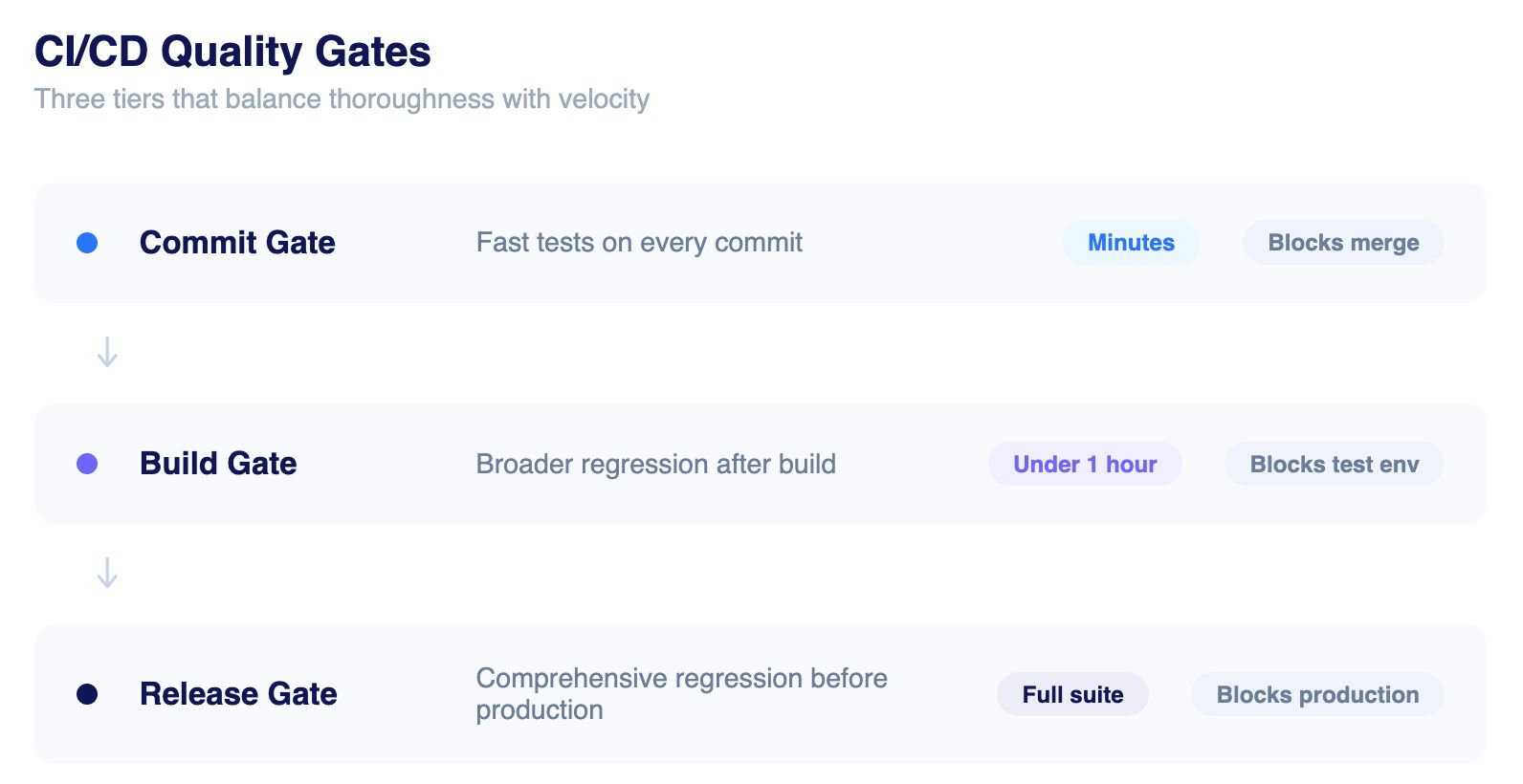
The mistake most teams make is treating quality gates as binary, either a single large gate that takes too long, or no gate at all. Modern enterprises configure tiered quality gates that balance thoroughness with velocity:
Commit Gate runs fast tests validating basic functionality. Execution completes in minutes. Failures block merge to mainline. Every commit must pass without exception.
Build Gate runs broader regression after successful builds. Execution completes in under an hour. Failures block deployment to test environments.
Release Gate runs comprehensive regression before production deployment. Failures block production release, protecting customers from regressions that earlier gates missed.
The art of quality gate design lies in achieving maximum defect detection within acceptable time constraints, and this is precisely where AI-native platforms outperform traditional frameworks.
The Flaky Test Crisis: CI/CD's Silent Pipeline Killer
Flaky tests are the single most destructive force in CI/CD regression programmes. 59% of developers encounter flaky tests monthly. In enterprise environments running thousands of tests per pipeline, this compounds into a systemic reliability crisis.
What Causes Test Flakiness?
The root causes are well understood: timing dependencies, shared data state, environment variability, brittle element locators, and order-dependent test design. Each forces a lose-lose choice. Ignore failures (accepting risk) or investigate every run (wasting engineering time).
The Business Cost of Flaky Tests in Enterprise Pipelines
Flaky tests do not just slow pipelines. They erode trust in the regression programme entirely. When engineers stop trusting test results, they start overriding failure signals. The quality gate becomes theatre. Defects pass through unchecked.
Organisations using script-based frameworks like Selenium report spending 80% of automation time on maintenance and only 10% on actual test authoring. The flakiness problem is not incidental; it is architectural.
CI/CD Pipeline Architecture for Regression Testing
Getting regression testing into a CI/CD pipeline is not a single decision. It is a series of architectural choices: which tools connect, how tests are triggered, where results surface, and how execution is orchestrated at scale. The good news is that modern testing platforms are built to slot into the systems engineering teams already use, with minimal configuration and no bespoke infrastructure.
Every enterprise needs to get two layers right: integration patterns (how your testing platform connects to your pipeline toolchain) and execution orchestration (how tests run efficiently once triggered).
Integration Patterns
Regression testing integrates with pipelines through APIs, webhooks, and native connectors. Modern testing platforms like Virtuoso QA provide direct integrations with common CI/CD systems.
Jenkins Integration
Jenkins pipelines trigger regression through dedicated plugins, API calls, or command line interfaces. Tests execute on distributed agents, with results reported back to Jenkins for pipeline decisions.
Azure DevOps Integration
Azure Pipelines invoke regression as pipeline tasks or through Azure Test Plans integration. Results feed into Azure analytics dashboards for trend visibility.
GitHub Actions Integration
GitHub workflows trigger regression on pull requests, merges, and releases. Test results annotate commits and pull requests with pass/fail status.
GitLab CI/CD Integration
GitLab pipelines execute regression as CI jobs with configurable triggers and failure policies. Results integrate with GitLab merge request workflows.
CircleCI and Bamboo Integration
Both platforms support regression through orbs/tasks and API integration patterns similar to other CI/CD systems.
Execution Orchestration
Connecting a testing platform to a pipeline is only half the picture. The other half is controlling how tests actually run once they are triggered. Without deliberate orchestration, even well-integrated regression suites become bottlenecks, running too many tests sequentially, blocking developers for hours, or running every test on every commit regardless of relevance. Three patterns address this directly, and most mature CI/CD regression programmes use all three in combination.
Parallel Execution
Running tests concurrently across multiple agents reduces cycle time linearly. A 4 hour sequential suite completes in 1 hour across 4 parallel streams. Platforms supporting massive parallelization, executing 100+ concurrent tests, compress regression to minutes regardless of suite size.
Selective Execution
Not every commit requires full regression. Impact analysis identifies tests relevant to changed components. Selective execution runs only affected tests, dramatically reducing gate duration for focused changes.
Progressive Execution
High priority tests run first, providing fast feedback on critical functionality. Lower priority tests continue running while developers review initial results. This pattern delivers actionable information faster without sacrificing coverage.

Designing Regression Tests for CI/CD
Tests designed for CI/CD differ fundamentally from tests designed for manual execution. Pipeline constraints impose specific requirements that most legacy test architectures were never built to satisfy.
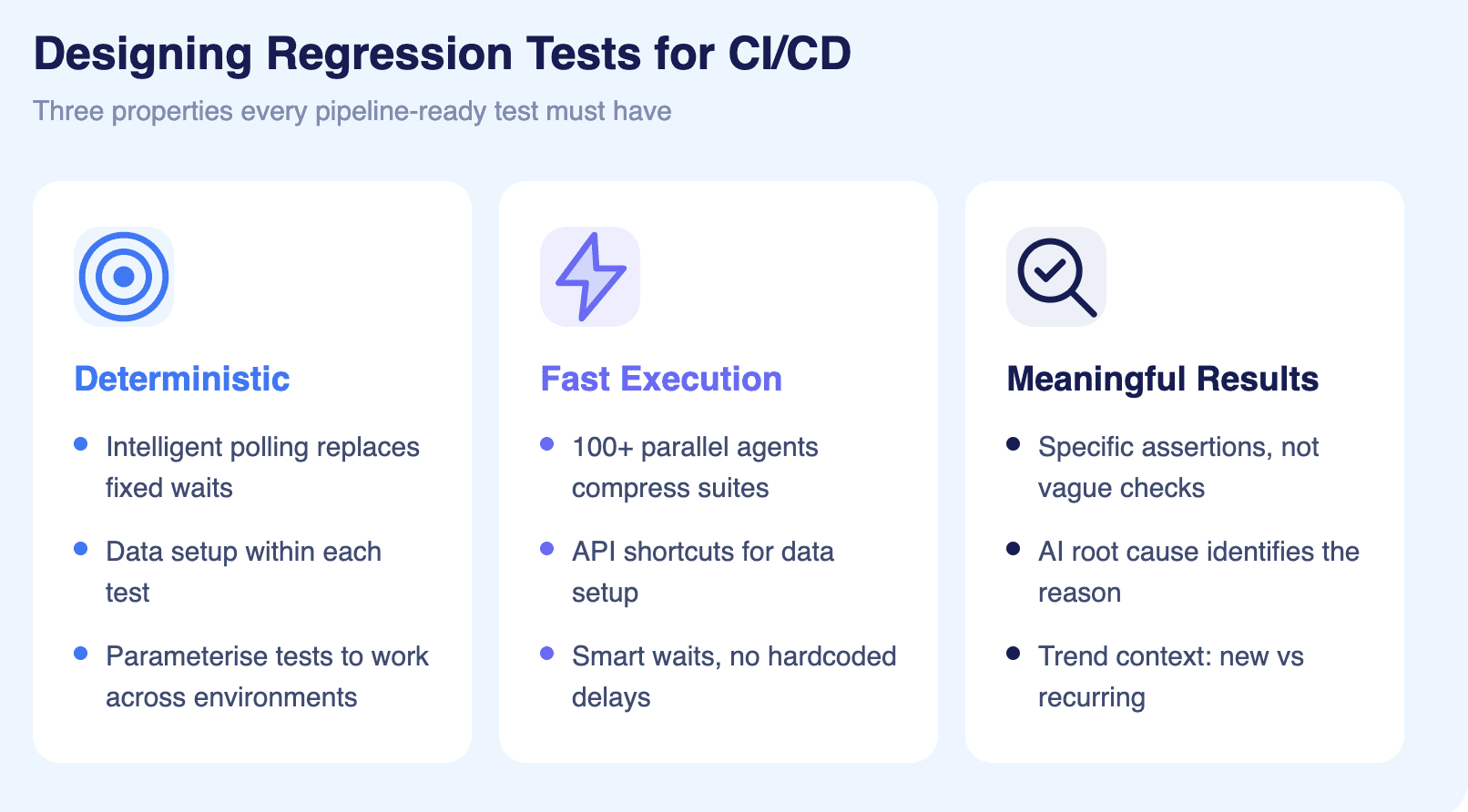
Deterministic Outcomes
Pipeline decisions depend on consistent test results. Tests that pass sometimes and fail sometimes (flaky tests) undermine pipeline reliability. Every flaky test forces a choice: ignore failures (accepting risk) or investigate each run (wasting time).
Determinism requires addressing common instability sources:
Timing dependencies cause failures when systems respond slower than expected. Replace fixed waits with intelligent polling that continues when conditions are met.
Data dependencies cause failures when tests expect specific data that changes. Use data setup within tests or data driven approaches that work across environments.
Order dependencies cause failures when tests rely on other tests executing first. Design tests as independent units that create their own preconditions.
Environment dependencies cause failures when tests assume specific configurations. Parameterise tests to work across environments with different settings.
AI native test platforms address many determinism challenges architecturally. Self healing adapts to UI variations automatically. Semantic identification reduces locator instability. Intelligent waits handle timing variability without hardcoded delays.
Fast Execution
Pipeline gates must complete within acceptable timeframes. Slow tests delay developers waiting for feedback and tempt teams to skip gates entirely.
Speed optimization strategies include:
Parallel execution distributes tests across multiple agents. Test suites parallelized across 100+ concurrent executions compress hours into minutes.
Efficient test design minimizes unnecessary actions. Login once per test session rather than per test. Use API shortcuts for data setup rather than UI navigation.
Validate only what matters rather than checking every field.
Smart waiting eliminates fixed delays. Instead of sleeping for 30 seconds, poll for specific conditions completing when ready rather than when time expires.
Meaningful Results
Pipeline decisions require clear pass/fail signals. Tests must fail for actual defects and pass when functionality works correctly.
Meaningful results require:
Specific assertions that validate expected behavior precisely. Vague assertions checking that something exists miss defects. Specific assertions checking that calculated totals match expected values catch defects.
Root cause visibility that explains failures clearly. Stack traces and screenshots help. AI root cause analysis identifying probable failure reasons helps more.
Trend context showing whether failures are new or recurring. A new failure demands investigation. A known intermittent failure may warrant different handling.
How LLMs and AI Are Transforming CI/CD Regression Testing
Large language models are fundamentally changing what is possible in automated regression. This is not incremental improvement. It is an architectural shift in how test suites are created, maintained, and extended.
LLMs bring three distinct capabilities to CI/CD regression:
Test generation - Drafting test cases from requirements, user stories, or natural language descriptions
Test maintenance - Understanding intent and adapting to UI changes without manual intervention
Root cause analysis - Identifying probable failure reasons with greater precision than stack traces alone
The critical distinction for enterprise teams evaluating AI-assisted testing is not which platform has the most AI features. It is where the AI sits in the architecture.
AI-Native vs. AI-Bolted: Why Architecture Defines Outcomes
AI-bolted tools add AI on top of a traditional automation framework. The AI helps with locator fallback, finding a different way to click the same button when the original locator fails. The result is a 40 to 50% reduction in maintenance effort. But the fundamental brittleness of the underlying framework remains.
AI-native platforms like Virtuoso QA are built from the ground up with AI as the architectural foundation. The system understands what the test is trying to accomplish, not just what to click. When a UI redesign happens, the test understands the intent and adapts. The result is an 85 to 95% reduction in maintenance effort, and a fundamentally different trajectory for regression programmes at scale.
Self-Healing Tests: How AI Eliminates Regression Maintenance
Self-healing automation is the direct answer to the flaky test crisis. Virtuoso QA's self-healing engine achieves approximately 95% accuracy in auto-updating tests when the application UI changes. Element identification is semantic. The system understands the role of a UI element, not just its CSS selector or XPath. When the application evolves, the tests evolve with it.
For CI/CD pipelines specifically, this means regression suites remain stable across deployments without manual intervention, eliminating the maintenance spiral that causes 68% of automation projects to be abandoned within 18 months.
Natural Language Test Authoring for CI/CD Pipelines
Virtuoso QA's StepIQ engine allows tests to be authored in plain English with no scripting required. QA engineers, business analysts, and even product managers can create regression tests that run in CI/CD pipelines without a single line of code.
This matters for pipeline velocity because it removes the SDET bottleneck. Test coverage expands at the speed of feature delivery, not the speed of script-writing. In-sprint automation becomes achievable without specialist resource constraints.
Advanced CI/CD Regression Patterns

Impact Based Test Selection
Running every test on every change wastes time when changes affect limited functionality. Impact analysis identifies tests relevant to specific changes.
Impact analysis approaches include:
Code coverage mapping linking tests to code they exercise. Changes to specific files trigger tests covering those files.
Dependency analysis identifying downstream impacts of changes. Modifications to shared components trigger tests for dependent functionality.
Historical correlation using defect patterns to predict relevant tests. Changes similar to past defect inducing changes trigger thorough testing.
Impact based selection reduces average gate duration while maintaining defect detection. Critical paths always run. Optional paths run when relevant.
Canary Deployment Testing
Canary deployments route small traffic percentages to new versions before full rollout. Regression testing validates canary behavior under real traffic conditions.
Canary regression patterns include:
Synthetic monitoring executing test transactions against canary instances. Automated checks validate functionality matches expectations.
Error rate comparison monitoring canary error rates against baseline. Elevated errors indicate regression requiring investigation.
Performance comparison validating canary response times match baseline. Degraded performance triggers rollback before full deployment.
Shift Left Security Regression
Security testing integrated into CI/CD catches vulnerabilities before production deployment.
Security regression includes:
Dependency scanning identifying known vulnerabilities in third party components. Automated checks flag dangerous dependencies.
Static analysis identifying code patterns associated with security risks. Automated scans find issues without execution.
Dynamic testing validating authentication, authorization, and input handling. Automated security tests exercise common vulnerability patterns.
Scaling CI/CD Regression Testing at Enterprise Level
Managing Test Suite Growth
Test suites grow as applications evolve. Without management, suite growth eventually defeats pipeline time constraints.
Growth management strategies include:
Regular pruning removing obsolete tests covering deprecated functionality. Tests for removed features waste execution time.
Coverage optimization consolidating overlapping tests. Multiple tests validating identical functionality add time without value.
Priority tiering organizing tests by importance. Critical tests run every commit. Comprehensive tests run on schedules or releases.
Distributed Execution Infrastructure
Large scale regression requires distributed execution infrastructure. Single machines cannot execute thousands of tests quickly.
Infrastructure options include:
Cloud based execution providing elastic capacity scaling with demand. Peak regression periods access additional capacity automatically.
Container based execution isolating tests in reproducible environments. Containers eliminate environment inconsistency issues.
Grid based execution distributing tests across physical or virtual machines. Dedicated test infrastructure provides consistent capacity.
Organizations executing 100,000+ annual regression runs through CI/CD typically employ cloud based execution with automatic scaling. Tests execute in parallel across available capacity, with infrastructure expanding during peak periods.
Results Management at Scale
High volume regression generates substantial results data requiring effective management.
Results management includes:
Centralized dashboards aggregating results across pipelines and time periods. Trend visibility identifies emerging quality issues.
Automated triage classifying failures by probable cause. Known issues route to existing tickets. New issues create investigation items.
Metrics tracking monitoring key indicators over time. Pass rates, cycle times, and defect escapes reveal program health.
How Virtuoso QA Transforms CI/CD Regression Testing
Virtuoso QA is built from the ground up with NLP, ML, and RPA at its core. Not added on top of a traditional framework. Built in. That distinction determines everything about how regression performs inside a CI/CD pipeline.
Self-healing tests adapt automatically when UI changes occur, keeping suites stable across deployments without manual intervention. Natural language authoring through StepIQ means any QA analyst can write tests that run natively in the pipeline, no scripting required.
The Virtuoso CI/CD Integration Stack
Virtuoso QA connects natively with the toolchains enterprise teams already operate, requiring no bespoke middleware or custom build work:
CI/CD: Jenkins, Azure DevOps, GitHub Actions, GitLab CI/CD, CircleCI
Test Management: TestRail, Xray
Identity: SAML SSO with Azure AD, Okta
Frameworks: React, Angular, Vue, and all major front-end technologies
Execution: Cloud grid across 2,000+ OS/browser/device configurations, no infrastructure setup required
Measuring CI/CD Regression Effectiveness
Key Metrics
Pipeline Pass Rate
Percentage of pipeline runs passing regression gates. Target: above 90%. Lower rates indicate test instability or code quality problems.
Gate Duration
Time required for regression gates to complete. Track by stage: commit gates should complete in minutes, build gates in under an hour, release gates in hours.
Defect Escape Rate
Production defects that regression should have caught. Track to identify coverage gaps requiring additional tests.
False Failure Rate
Failures caused by test problems rather than application defects. High false failure rates indicate automation instability requiring attention.
Optimization Cycle
Continuous improvement follows a regular cycle:
Measure current performance against targets. Identify gaps between actual and desired outcomes.
Analyze root causes of gaps. Determine whether issues stem from test design, infrastructure, or coverage.
Improve based on analysis. Address highest impact opportunities first.
Validate improvements achieved expected results. Adjust approach if outcomes differ from expectations.

Related Reads
Frequently Asked Questions
What types of regression tests run in CI/CD?
How long should CI/CD regression tests take?
How do you handle flaky tests in CI/CD?
How do you manage test data in CI/CD pipelines?
How does AI improve regression testing in CI/CD?
How do you prevent regression testing from slowing CI/CD pipelines?