Blog
End-to-End vs Regression Testing - When and How to Use Each

Virtuoso QA
Published on

Table of contents
Lorem ipsum
Lorem ipsum
Lorem ipsum
Lorem ipsum
Lorem ipsum
Most testing confusion stems from overlapping terminology. Teams debate whether their e-commerce checkout test is "end-to-end testing" or "regression testing". QA managers struggle to explain why they need both when the same tests seem to serve both purposes.
The confusion is understandable because end-to-end testing and regression testing often use identical test cases but serve fundamentally different strategic purposes. End-to-end testing validates that complete business workflows function correctly from start to finish. Regression testing validates that existing functionality continues working after changes. The same checkout test can serve both purposes: as end-to-end testing when validating the complete purchase workflow, and as regression testing when confirming updates didn't break the checkout process.
This distinction matters because organizations that understand the relationship between end-to-end and regression testing build efficient test strategies. Those confused about the difference either duplicate effort (maintaining separate test suites for the same scenarios) or leave gaps (comprehensive end-to-end coverage without regression validation, or extensive regression testing without complete workflow validation).
This guide reveals how end-to-end testing and regression testing differ, where they overlap, when each approach applies, and how AI-native automation enables both practices simultaneously. Understanding this relationship determines whether testing provides comprehensive coverage efficiently or wastes resources through confusion and duplication.
End-to-End Testing vs Regression Testing: Core Differences
1. Definition and Purpose
End-to-End Testing
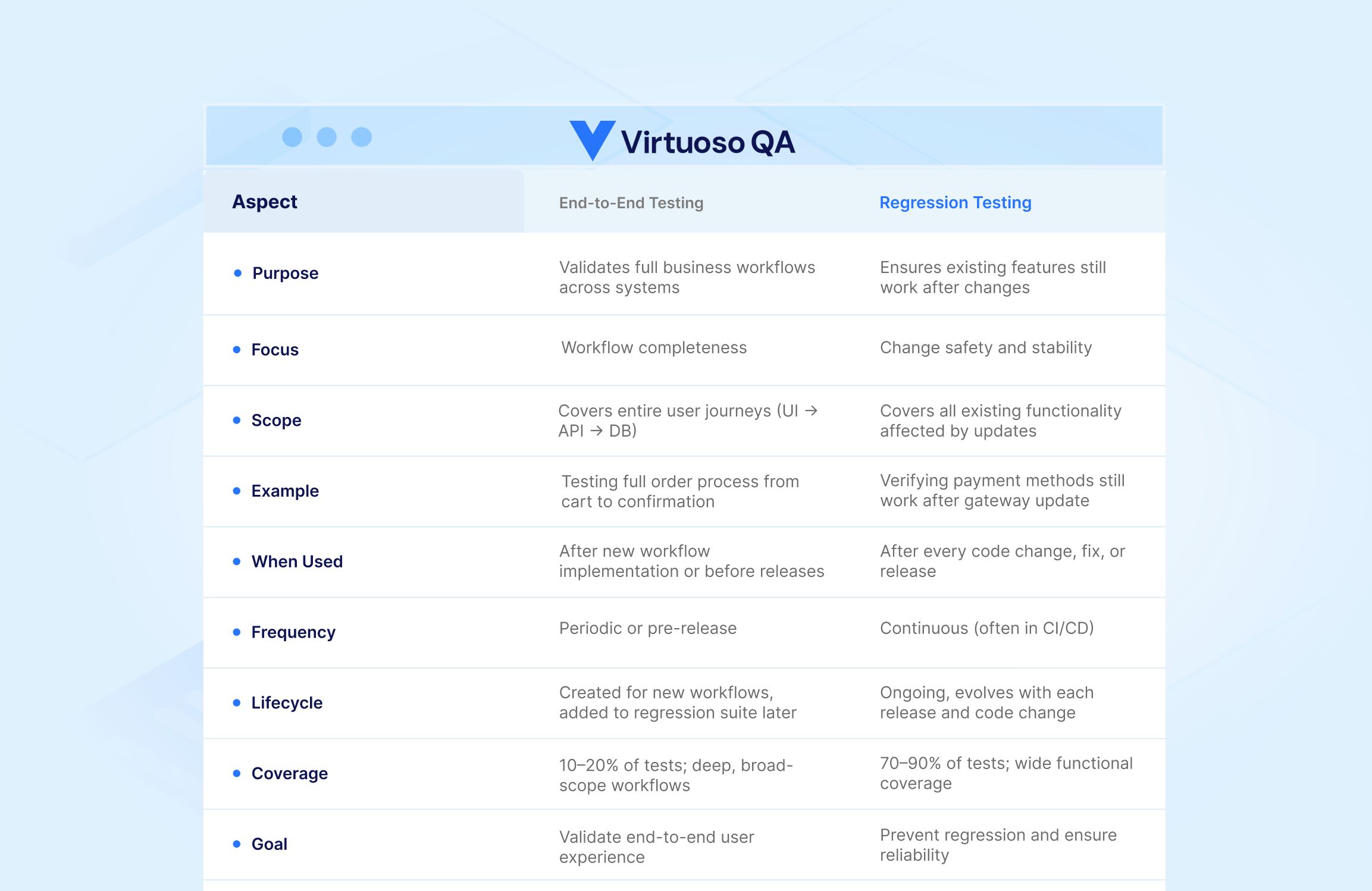
End-to-End Testing validates that complete business workflows function correctly from start to finish, spanning multiple systems, interfaces, and data flows. Purpose: ensure critical user journeys work as integrated processes, not just isolated components.
Regression Testing
Regression Testing validates that existing functionality continues working correctly after code changes, configuration updates, or environment modifications. Purpose: prevent unintended side effects and protect completed work from being broken by new changes.
The fundamental distinction is strategic focus: end-to-end testing validates workflow completeness; regression testing validates change safety.
2. Scope Definition
End-to-End Testing Scope
Complete user workflows from initial action to final outcome
Multi-system integration spanning UI, APIs, databases, external services
Data flow from input through transformations to persistent storage
Business process validation from initiation to completion
Example: End-to-end order processing test starts with product search, continues through cart addition, checkout, payment processing, inventory update, fulfillment system notification, and ends with order confirmation email. The test validates data flows correctly through all systems and the complete workflow succeeds.
Regression Testing Scope
All functionality that existed before current changes
Features that might be affected by modifications
Critical workflows that must continue working reliably
Previously tested scenarios that could break due to new code
Example: Regression testing for a payment gateway update includes all existing payment methods, checkout workflows, order processing scenarios, and refund handling, confirming the update didn't break any established functionality.
3. Strategic Intent
End-to-End Testing Intent
Prove complete workflows function as integrated processes
Validate user journeys succeed from start to finish
Ensure multi-system integration works correctly
Confirm business processes can be completed
Regression Testing Intent
Protect existing functionality from unintended changes
Validate that fixes don't introduce new defects
Ensure modifications don't break established features
Maintain application stability as code evolves
4. Timing and Frequency
End-to-End Testing Timing
After new workflow implementation
When validating multi-system integration
Before major releases to confirm critical processes work
Periodically to validate business-critical workflows
As part of regression suite after workflows are established
End-to-end tests are created for new workflows, then typically become part of ongoing regression validation.
Regression Testing Timing
After every code change (smoke regression)
After bug fixes (corrective regression)
Before releases (complete regression)
Continuously in CI/CD pipelines
After any modification that could affect existing functionality
Regression testing is continuous, providing ongoing protection as applications evolve.
5. Test Case Lifecycle
End-to-End Test Lifecycle
Created when new workflows are implemented
Validated to ensure workflow works correctly
Incorporated into regression suite
Maintained as workflow evolves
Retired only when workflow is removed from application
End-to-end tests have long life cycles, persisting as long as the workflows they validate remain in the application.
Regression Test Lifecycle
Any test validating existing functionality becomes regression test
Executed after changes to confirm no breakage
Updated when intentional changes modify functionality
Expanded when new features add regression scenarios
Optimized over time to balance coverage and execution speed
Regression suites continuously evolve, growing as applications expand and being optimized for efficiency.
6. Coverage Characteristics
End-to-End Testing Coverage
Focused on critical business workflows
Typically 10-20% of total test suite
Deep validation of complete processes
Fewer tests with broader scope per test
Emphasis on workflow integration and data flow
Example coverage: 50 end-to-end tests covering all critical business processes from start to finish.
Regression Testing Coverage
Comprehensive coverage of all existing functionality
Typically 70-90% of total test suite
Broad validation across all features
More tests with narrower scope per test
Emphasis on protecting all existing capabilities
Example coverage: 5,000 regression tests covering all features, workflows, edge cases, and integration points.
End-to-End and Regression Testing - The Overlap
Where They Intersect
End-to-end tests typically become regression tests. A test validating the complete checkout workflow serves both purposes:
As end-to-end test
Validates users can complete purchases from cart to confirmation through all integrated systems.
As regression test
Confirms changes to payment processing, inventory management, or any other component didn't break the complete checkout workflow.
The key insight
Most end-to-end tests should be part of regression suites, but not all regression tests need to be end-to-end tests. Regression suites include end-to-end workflow tests plus component-level tests, integration tests, and edge case validation.

The Problem: Testing Strategy Confusion Leads to Coverage Gaps
Enterprise testing teams struggle with terminology and strategy, leading to inefficient test development and inadequate validation.
The Common Scenario
A retail company builds comprehensive end-to-end tests for their e-commerce platform: product search to order delivery, account creation to purchase history review, cart abandonment to recover email. These tests validate complete user workflows work correctly.
Then QA leadership mandates "regression testing" for every release.
The team debates: Do we create new regression tests or reuse our end-to-end tests? Are these different test suites? Should regression testing only cover changed areas while end-to-end testing validates complete workflows?
Confusion leads to three common mistakes:
Duplication -Teams maintain separate "end-to-end test suite" and "regression test suite" with 70% overlapping scenarios, doubling maintenance effort.
Gaps - Teams build end-to-end tests for happy paths but skip edge cases, negative scenarios, and error handling, then wonder why regression testing doesn't catch defects in these areas.
Inefficiency - Teams run all end-to-end tests as regression tests after every minor change, wasting hours testing unaffected workflows.
Common Misunderstandings
End-to-end testing and regression testing are completely different things - While serving different purposes, they often use identical test cases. The distinction is strategic intent, not technical implementation.
Regression testing is just running your existing tests again - This oversimplification misses the strategic purpose: validating that changes didn't break existing functionality. Some end-to-end tests belong in regression suites; others don't.
We do end-to-end testing for new features and regression testing for existing features - This artificial separation creates maintenance burden. Well-designed end-to-end tests for new features should become part of the regression suite for future releases.
End-to-end testing covers everything, so we don't need regression testing - End-to-end testing validates workflows work; regression testing ensures they keep working after changes. The former is initial validation; the latter is continuous protection.
The Consequences
Confusion between end-to-end testing and regression testing creates predictable problems:
Resource waste - Teams duplicate effort maintaining separate test suites when one comprehensive suite could serve both purposes with proper categorization.
Coverage gaps - Focusing exclusively on complete workflows misses component-level functionality that doesn't fit neatly into end-to-end scenarios. Regression testing finds these gaps too late.
Testing inefficiency - Running all end-to-end tests as regression tests after every change wastes time and infrastructure. Not every workflow needs validation after every change.
Strategy paralysis - Teams debate definitions instead of building tests, losing velocity while seeking perfect categorization.
The solution isn't choosing between end-to-end testing and regression testing. It's understanding how they relate and building test suites that efficiently serve both purposes.
When to Use End-to-End Testing vs Regression Testing
Use End-to-End Testing When
1. Validating New Workflow Implementation
When implementing new business processes, end-to-end testing validates the complete workflow functions correctly before release.
Example: New patient intake process in the healthcare system requires end-to-end testing from patient registration through insurance verification, medical history collection, provider assignment, and appointment scheduling, ensuring data flows correctly through all systems.
2. Confirming Multi-System Integration
When systems must communicate and data must flow between them, end-to-end testing validates integration works correctly.
Example: Order-to-cash process spans e-commerce platform, inventory management system, payment gateway, fulfillment system, and accounting software. End-to-end testing validates orders flow through all systems with correct data transformations at each integration point.
3. Protecting Critical Business Processes
Revenue-generating or mission-critical workflows require end-to-end validation to ensure complete processes work reliably.
Example: Insurance claim processing from submission through validation, adjudication, payment calculation, and disbursement must work flawlessly. End-to-end testing validates the complete process succeeds in all scenarios.
4. Validating User Journeys
When user experience depends on complete workflows spanning multiple interactions, end-to-end testing validates journeys from user perspective.
Example: Customer onboarding journey from account creation through profile setup, product selection, payment configuration, and first successful transaction requires end-to-end validation ensuring new customers can successfully complete the entire process.
Use Regression Testing When
1. After Any Code Change
Every modification risks breaking existing functionality. Regression testing provides confidence changes didn't introduce unintended side effects.
Example: Updating date formatting library could break date displays, filters, and calculations throughout the application. Regression testing validates all date-dependent functionality still works correctly.
2. Following Bug Fixes
Defect corrections can inadvertently break other functionality. Regression testing ensures fixes don't introduce new problems.
Example: Fixing discount calculation bug could affect pricing logic, tax calculations, or payment processing. Regression testing validates the fix works and didn't break related functionality.
3. Before Every Release
Comprehensive regression testing before production deployment provides confidence the release won't break existing capabilities.
Example: Before deploying quarterly update with new features and multiple bug fixes, complete regression testing validates all existing functionality, end-to-end workflows, and integration points remain stable.
4. Continuously in CI/CD
Modern development requires continuous validation. Automated regression testing provides rapid feedback after every change.
Example: Developer commits code optimizing database queries. Automated regression testing validates within 30 minutes that all features using those queries still work correctly, enabling confident merge to main branch.

The AI Transformation: Intelligence for Both Testing Approaches
AI hasn't eliminated the distinction between end-to-end testing and regression testing. It's made both more effective while enabling test suites to serve multiple strategic purposes simultaneously.
How AI Enhances End-to-End Testing
Autonomous test generation. AI analyzes applications and automatically generates end-to-end test scenarios covering critical user workflows, accelerating coverage buildout by 85-93%.
Business process mapping. AI identifies complete business workflows and ensures end-to-end test coverage spans all critical processes from initiation to completion.
Data flow validation. AI tracks data transformations through complete workflows, ensuring end-to-end tests validate not just UI interactions but data integrity across systems.
To know more, explore our article on - What is AI End to End Testing, Its Working and Implementation
How AI Transforms Regression Testing
Intelligent test selection. AI analyzes code changes and automatically selects which end-to-end tests to include in regression suites for specific releases, optimizing coverage and speed.
Self-healing maintenance. AI eliminates 81-90% of test maintenance burden by automatically adapting tests when UIs change, making comprehensive regression economically sustainable.
Impact analysis. AI predicts which workflows are affected by code changes, identifying which end-to-end tests should run as regression validation.
The Synergy
AI enables test suites to efficiently serve both purposes. The same end-to-end checkout test can:
Validate the complete purchase workflow works (end-to-end purpose)
Confirm payment gateway changes didn't break checkout (regression purpose)
Execute continuously in CI/CD pipelines for ongoing validation
Self-heal when UI changes, maintaining validity without manual updates
Organizations using AI-native platforms build unified test suites that provide both comprehensive end-to-end workflow coverage and effective regression protection with 70% less effort than maintaining separate test suites.
Building Effective Test Suites for Both Purposes
The optimal strategy uses unified test suites serving both end-to-end and regression purposes efficiently.
The Unified Test Suite Approach
Rather than maintaining separate "end-to-end tests" and "regression tests," build comprehensive test suites with proper categorization:
1. Critical Business Process Tests (End-to-End Core)
Complete workflow validation from start to finish
Always included in regression suites
High priority for continuous execution
Cover all revenue-critical and mission-critical processes
2. Feature-Level Tests (Regression Foundation)
Validate individual features and components
Included in regression suites based on change impact
Medium priority for selective regression
Provide granular coverage of all functionality
3. Integration Tests (Bridge Layer)
Validate system and component integration
Included when changes affect integration points
Essential for multi-system architecture validation
Cover API contracts and data flow between systems
4. Edge Case and Negative Scenario Tests (Comprehensive Coverage)
Validate error handling and boundary conditions
Selectively included in regression based on risk
Important for comprehensive quality but not all run continuously
Cover unusual scenarios and failure modes
Tagging and Categorization Strategy
Effective test management uses tags to serve both purposes:
End-to-End Tags:
@critical-workflow
@business-process
@end-to-end
@multi-system
Regression Priority Tags:
@smoke-regression (run after every deployment)
@selective-regression (run after feature changes)
@complete-regression (run before releases)
Functional Area Tags:
@checkout
@payment
@inventory
@customer-account
Example: A complete checkout test might be tagged:
This test serves multiple purposes: validates complete workflow (end-to-end), runs in every smoke regression, provides checkout and payment coverage, and is recognized as critical business process.
Execution Strategy
Continuous (After Every Commit):
Unit tests (seconds)
Smoke regression including critical end-to-end workflows (5-10 minutes)
Integration (After Merge to Main):
Selective regression including affected end-to-end workflows (30-60 minutes)
Comprehensive (Nightly or Pre-Release):
Complete regression including all end-to-end tests (2-4 hours with AI-native platforms)
Example: Payment gateway update triggers:
Immediate: Unit tests + smoke regression (checkout workflow)
After merge: Selective regression (all payment scenarios + related workflows)
Nightly: Complete regression (all features + all end-to-end workflows)
Common Mistakes and How to Avoid Them
Mistake 1: Maintaining Separate Test Suites
Teams build distinct "end-to-end test suite" and "regression test suite" with 60-80% overlapping scenarios, doubling maintenance burden.
Solution: Build unified test suites with proper tagging. The same tests serve both purposes through intelligent categorization and execution strategies. Use tags to identify critical end-to-end workflows that should always run in regression testing.
Mistake 2: Only Testing Happy Paths End-to-End
Teams create end-to-end tests for successful workflows but skip error scenarios, negative cases, and edge conditions, leaving regression gaps.
Solution: End-to-end testing should include error handling and alternative paths, not just successful completion. Test what happens when payment fails, inventory is insufficient, or users abandon workflows midstream.
Mistake 3: Running All End-to-End Tests as Regression After Every Change
Teams execute complete end-to-end test suite after every minor change, wasting hours testing unaffected workflows.
Solution: Implement intelligent test selection. Not every end-to-end workflow needs validation after every change. Use AI-powered impact analysis to identify which workflows are affected and run targeted regression testing.
Mistake 4: No End-to-End Testing, Only Component Testing
Teams thoroughly test individual components but never validate complete workflows work as integrated processes, missing integration defects.
Solution: Balance test pyramid appropriately. Maintain strong unit and component testing foundation but ensure 10-20% of test suite validates complete end-to-end workflows. Critical business processes must have end-to-end coverage.
Mistake 5: Treating End-to-End Tests as Separate from Regression
Teams create end-to-end tests for new features but don't incorporate them into regression suites, leaving new workflows unprotected in future releases.
Solution: Every end-to-end test should automatically become part of the regression suite. Tests validating new workflows are tomorrow's regression tests. Build this assumption into test development processes.
The Virtuoso QA Advantage: Unified Testing Excellence
Virtuoso QA's AI-native platform enables organizations to build comprehensive test suites serving both end-to-end and regression purposes efficiently.
True End-to-End Testing Capability
Traditional testing tools struggle with genuine end-to-end validation because they separate UI, API, and database testing. Virtuoso QA unifies all three:
Unified test journeys - Combine UI interactions, API calls, and database validations in single workflows. A checkout test can validate UI displays correctly, call payment APIs directly, and verify database records update appropriately, all within one test journey.
Business Process Orchestration - Maps tests to complete business workflows, ensuring end-to-end coverage spans all critical processes from initiation to completion. Gap analysis identifies missing coverage in multi-step business processes.
Natural Language Programming - Enables test authors to create sophisticated end-to-end workflows in plain English, handling complex scenarios including conditional logic, loops, and data-driven parameterization without coding expertise.
Comprehensive Regression Protection
Virtuoso QA's AI capabilities eliminate the traditional barriers to comprehensive regression coverage:
95% self-healing accuracy - Automatically adapts tests when UIs change, maintaining both end-to-end and regression test validity without manual intervention. This eliminates the 81-90% maintenance burden that makes comprehensive regression unsustainable with traditional tools.
Intelligent test selection -Automatically identifies which end-to-end workflows to include in regression testing based on code change analysis, achieving 95% defect detection with 70% fewer test executions than running complete suites.
10x faster execution -Through parallel testing across 2,000+ browser/device combinations completes comprehensive regression including all end-to-end workflows in hours instead of days.
Unified Test Suite Management
Virtuoso QA eliminates the need for duplicate test maintenance:
Single test, multiple purposes - The same test serves as end-to-end workflow validation and regression protection, eliminating duplication.
Flexible execution - Tag-based test selection enables running appropriate test subsets for different purposes: all critical end-to-end workflows for smoke regression, affected workflows for selective regression, complete suite for comprehensive validation.
Composable testing architecture -Enables reusing end-to-end workflow components across multiple tests and projects, accelerating coverage expansion by 94% while maintaining consistency.
Choose Both: End-to-End and Regression Testing Together
The question isn't "end-to-end testing or regression testing." It's "how do we efficiently provide both complete workflow validation and comprehensive regression protection."
End-to-end testing ensures critical business processes work as integrated workflows. Regression testing ensures existing functionality remains stable as applications evolve. The same tests often serve both purposes when properly designed and executed.
Organizations that understand this relationship build efficient test suites providing comprehensive coverage without duplication. Those confused by terminology waste resources maintaining separate test suites or leave coverage gaps by focusing exclusively on one approach.
The difference between effective and ineffective testing strategies isn't test count or tool selection. It's understanding how end-to-end and regression testing relate, building unified test suites serving both purposes, and using AI-native automation to make comprehensive validation economically viable.
Related Reads
Frequently Asked Questions
Can end-to-end tests be used for regression testing?
How much end-to-end testing is enough?
What tools are best for end-to-end and regression testing?
How long should end-to-end tests take to execute?
What happens if you skip end-to-end testing?
Can you automate both end-to-end and regression testing?