Blog
What is Happy Path Testing and How AI Enhances the Process

Virtuoso QA
Published on

Table of contents
Lorem ipsum
Lorem ipsum
Lorem ipsum
Lorem ipsum
Lorem ipsum
Happy path testing validates that your software works perfectly when users do exactly what they're supposed to do. It's the foundation of functional testing, the first line of defense against regression, and the baseline for measuring software quality. In modern development cycles, happy path tests must execute fast, heal themselves when applications change, and integrate seamlessly into CI/CD pipelines. AI-native testing platforms now automate happy path creation, maintenance, and execution at enterprise scale.
What is Happy Path Testing?
Happy path testing verifies that a system functions correctly when users follow the intended workflow with valid inputs and expected behaviors. The term "happy path" describes the optimal journey through an application where everything works as designed, no errors occur, and the user achieves their goal without friction.
Also called golden path testing, positive testing, or nominal case testing, this approach focuses on the primary use case that delivers business value.
For an eCommerce checkout flow, the happy path means: user adds items to cart, enters valid payment information, completes purchase, and receives confirmation. No edge cases. No error handling. Just the core functionality working exactly as intended.
Why It's Called the "Happy Path"
The metaphor is simple. When everything works smoothly, both the user and the system are "happy." The user accomplishes their task effortlessly. The system processes requests without exceptions. The business delivers value without friction. This optimal scenario represents the most common path users take, typically accounting for 80-90% of production traffic in well-designed applications.
Why Happy Path Testing Matters
1. Foundation of Quality Assurance
Happy path tests establish the baseline for software functionality. Before testing edge cases, error handling, or security vulnerabilities, teams must confirm the core features work. If the happy path fails, nothing else matters. A login page that rejects valid credentials, a payment processor that declines legitimate cards, or a search function that returns no results on basic queries renders all other testing irrelevant.
2. Regression Detection
Happy path tests serve as canaries in the coal mine for regression bugs. When a previously passing happy path test fails, something fundamental broke. These tests catch unintended side effects from code changes, dependency updates, or configuration drift. Running happy path tests first in a CI/CD pipeline provides immediate feedback on whether new code preserves existing functionality.
3. Speed and Efficiency
Happy path scenarios execute faster than comprehensive test suites. They require less test data, fewer system states, and simpler assertions. This speed makes them ideal for smoke testing, sanity checks, and rapid validation during development. Teams can run happy path tests multiple times per day without slowing down delivery velocity.
4. Business Value Alignment
Happy path tests map directly to user stories and acceptance criteria. They validate the features that users actually requested and that product teams prioritized. This alignment ensures testing efforts focus on business-critical functionality rather than obscure edge cases that rarely occur in production.
Happy Path vs Negative Testing vs Edge Case Testing
Understanding the distinction between testing approaches clarifies where happy path fits in a comprehensive test strategy.
Happy Path Testing
Tests valid inputs, expected workflows, and successful outcomes. Example: User logs in with correct username and password, system grants access, user sees their dashboard.
Negative Testing
Tests invalid inputs, unexpected workflows, and error conditions. Example: User enters wrong password five times, system locks account, user receives error message with password reset link.
Edge Case Testing
Tests boundary conditions, unusual but valid inputs, and rare scenarios. Example: User enters maximum allowed characters in a form field, system accepts input without truncation or error.
Boundary Testing
Tests limits of acceptable inputs. Example: Testing a date field with December 31, leap year dates, or dates at the edge of allowed ranges.
All four approaches complement each other. Happy path tests confirm core functionality. Negative tests validate error handling. Edge cases verify robustness. Boundary tests ensure limits work correctly. A mature test suite includes all four, but happy path tests provide the essential foundation.
Happy Path Testing vs Positive Testing
These two terms are often used interchangeably but they are not identical.
Positive testing is the broader category. It covers any scenario where valid inputs are used and correct behaviour is expected. This includes filtering products by price, sorting search results, viewing account history, and comparing items in a wishlist. These are valid positive scenarios but they are not necessarily the happy path.
Happy path testing is a subset of positive testing. It focuses specifically on the primary end-to-end workflow that delivers the core value of the application. Not every valid scenario is a happy path scenario. The happy path is the one journey that, if broken, makes the application fail its fundamental purpose.
The distinction matters when prioritising test coverage. Positive testing is broad. Happy path testing is deliberate.

How to Design Happy Path Test Cases
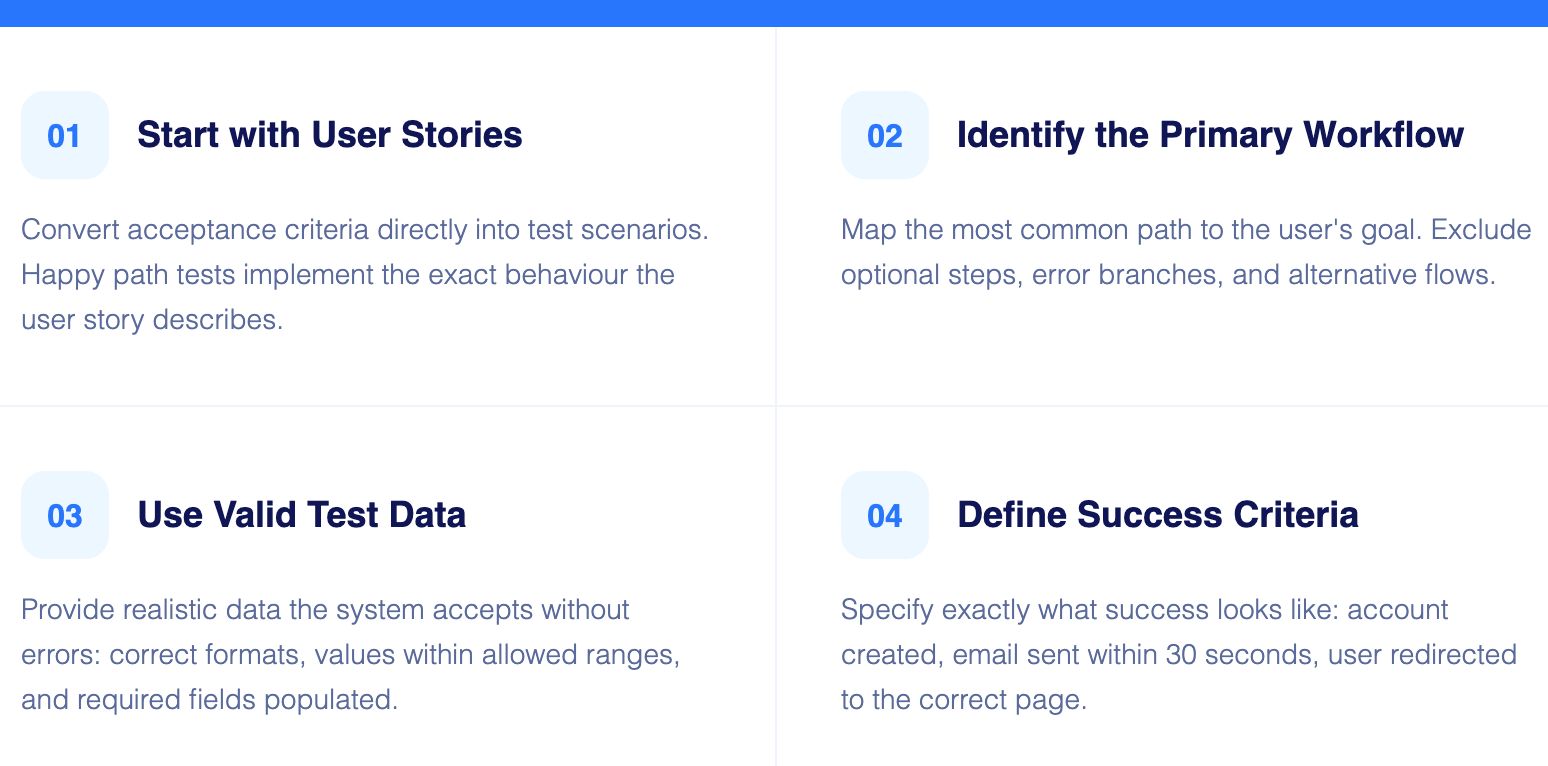
1. Start with User Stories
Happy path tests directly implement user stories. Convert acceptance criteria into test scenarios.
User Story: "As a customer, I want to search for products by category so I can find items quickly."
Happy Path Test:
User navigates to homepage
User selects "Electronics" category
System displays electronics products
User sees product names, prices, and images
Products load within 2 seconds
2. Identify the Primary Workflow
Map the most common path users take to accomplish their goal. Exclude optional steps, error branches, and alternative paths.
Example: Hotel Booking Flow
Primary workflow:
Search for hotels (location + dates)
View search results
Select a hotel
Choose room type
Enter guest information
Provide payment details
Confirm booking
Receive confirmation email
Alternative paths (not happy path):
User modifies search criteria multiple times
User compares hotels in detail
User abandons cart and returns later
User applies discount code that fails
Payment processor times out
3. Use Valid Test Data
Happy path tests require realistic, valid data that systems accept without errors.
Valid Test Data Characteristics:
Correct format (emails with @, phone numbers with proper digits)
Within allowed ranges (quantities between min/max limits)
Passes validation rules (required fields populated)
Represents common values (standard shipping addresses, typical product selections)
4. Define Success Criteria
Specify exactly what "success" means for each happy path test.
Example: User Registration
Success criteria:
User account created in database
Confirmation email sent within 30 seconds
User redirected to welcome page
Welcome message displays user's name
User can immediately log in with new credentials
Happy Path Testing in Modern Development
Agile and Sprint Testing
Happy path tests align perfectly with sprint-level acceptance testing. As developers complete user stories, QA engineers validate happy paths immediately. This tight feedback loop catches defects before code moves to the next sprint or gets deployed to staging environments.
In two-week sprints, teams might execute happy path tests 20-30 times as stories move through development, code review, and QA validation. Manual execution becomes unsustainable. Automation becomes essential.
Continuous Integration and Deployment
Happy path tests form the core of CI/CD smoke test suites. Every code commit triggers a pipeline that runs happy path tests first. If these tests pass, the pipeline continues to more comprehensive testing. If they fail, the pipeline stops immediately, preventing broken code from progressing.
Modern CI/CD systems execute thousands of pipeline runs per day across distributed teams. Each run must complete in minutes, not hours. Happy path tests provide fast feedback at the speed development teams require.
Enterprise Testing at Scale
Enterprise applications involve hundreds of interconnected features, thousands of user journeys, and millions of possible test combinations. Happy path testing provides a tractable approach to validate core functionality without exhaustive testing of every permutation.
Large organizations might maintain 500-2,000 happy path tests covering their most critical business processes. These tests run continuously, providing real-time visibility into application health across development, staging, and production environments.
AI and LLMs Transform Happy Path Testing
1. Autonomous Test Generation
AI-native platforms now generate happy path tests automatically by analyzing application behavior, user interactions, and business logic. Instead of manually writing test steps, teams describe what to test in natural language and let AI create the tests.
Example: Natural Language Test Creation
Traditional approach (100+ lines of code):
AI-native approach (natural language):
The AI platform translates natural language into executable tests, identifies elements intelligently, and generates assertions automatically. This reduces test creation time by 80-90% while improving test readability.
2. Intelligent Self-Healing
Applications change constantly. Developers refactor code, designers update interfaces, and product teams adjust workflows. Traditional test automation breaks every time the application changes, requiring constant maintenance.
AI-powered self-healing automatically adapts happy path tests when applications evolve. The platform detects UI changes, updates element selectors, and adjusts test flows without human intervention. This capability reduces test maintenance by 75-85%, freeing QA teams to expand coverage rather than fix broken tests.
Self-Healing in Action:
Change: Developer changes button ID from "submit_order" to "checkout_button"
Traditional test: Fails immediately, requires manual update
AI-native test: Automatically detects button based on context (location, text, function), test continues passing, maintenance effort drops to zero
3. Composable Test Assets
Modern platforms enable teams to build happy path tests from reusable components. Common workflows like login, navigation, or data entry become composable building blocks that teams assemble into complete test scenarios.
Example: Composable Login Flow
Create once:
Login checkpoint (navigate to login page, enter credentials, verify success)
Reuse everywhere:
Ecommerce checkout test (login → add to cart → purchase)
Account settings test (login → navigate to settings → update profile)
Order history test (login → view orders → check status)
Composability accelerates test creation, improves consistency, and reduces maintenance. When the login flow changes, teams update one checkpoint and all dependent tests automatically inherit the change.
Learn more - Composable Test Automation: The building blocks of brilliant testing

Best Practices for Happy Path Testing
1. Prioritize Business-Critical Flows
Not all happy paths deserve equal attention. Focus on workflows that:
Generate revenue (checkout, subscription signup)
Serve the most users (search, browse, view content)
Enable critical operations (patient record access in healthcare, trade execution in finance)
Represent regulatory requirements (compliance workflows, audit trails)
2. Maintain Independence Between Tests
Each happy path test should execute independently without relying on other tests. Avoid test dependencies where Test B assumes Test A already ran. Independent tests enable:
Parallel execution for faster feedback
Selective test runs based on code changes
Easier debugging when tests fail
Flexible test suite organization
3. Use Realistic Test Data
Happy path tests should reflect production usage patterns. Avoid generic placeholder data like "test@test.com" or "John Doe." Use realistic names, addresses, product selections, and transaction amounts that mirror actual user behavior.
AI-powered test data generation creates contextually appropriate data automatically. For a healthcare application, the AI generates realistic patient records, medical codes, and treatment plans. For financial services, it creates valid account numbers, transaction histories, and regulatory-compliant scenarios.
4. Keep Tests Simple and Focused
Each happy path test should verify one primary workflow. Resist the temptation to combine multiple scenarios into sprawling "mega-tests" that validate everything at once. Simple, focused tests:
Execute faster
Fail with clearer root causes
Require less maintenance
Communicate intent more effectively
5. Integrate with CI/CD Pipelines
Happy path tests deliver maximum value when integrated into continuous delivery workflows. Configure pipelines to:
Run happy path tests on every commit
Block deployments if happy path tests fail
Report results to development teams immediately
Track happy path test metrics over tim
Happy Path Testing and BDD
Behaviour-driven development maps naturally onto happy path testing because both centre on expected user outcomes rather than implementation detail.
In BDD, happy path scenarios are written using Gherkin syntax following a Given/When/Then structure:
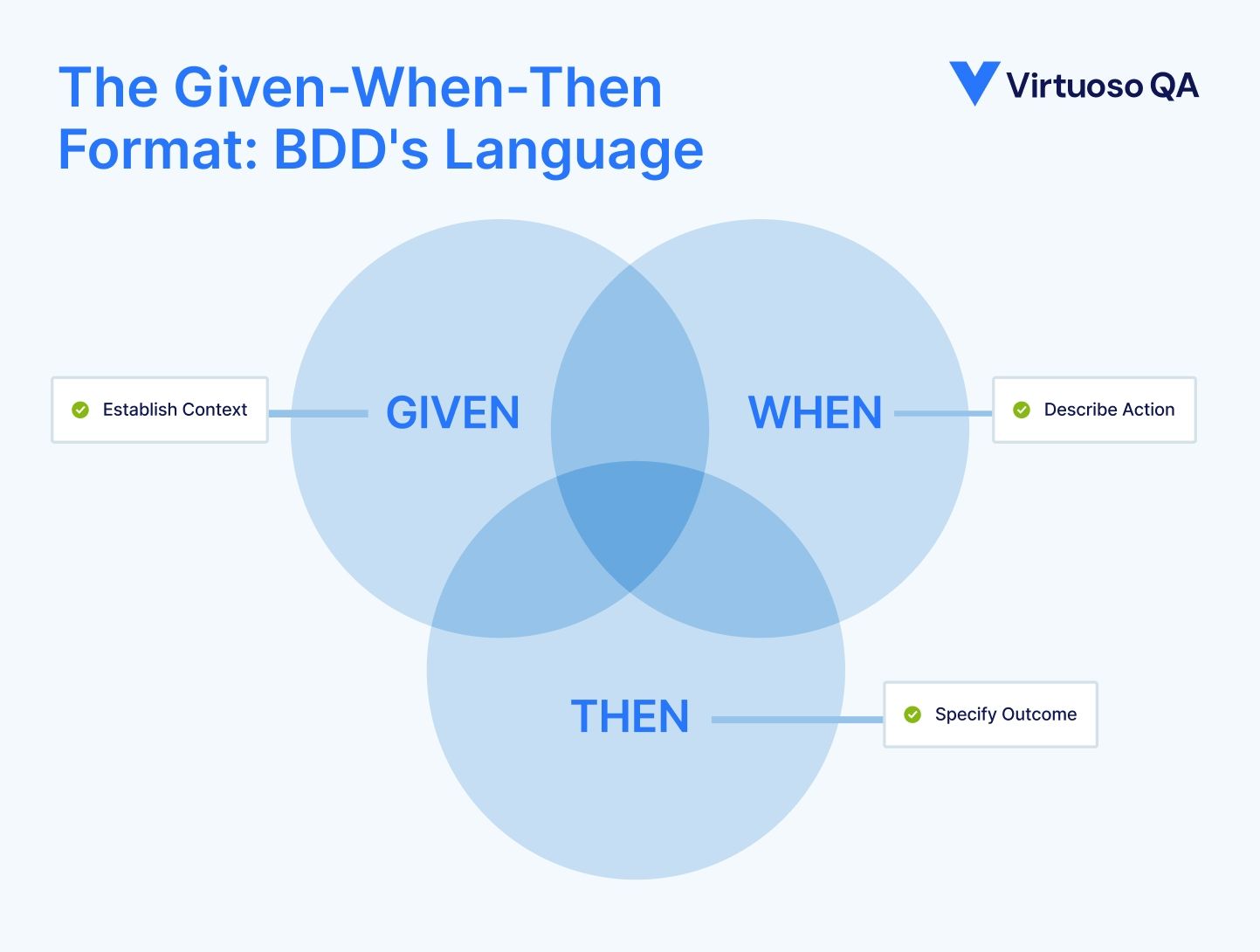
Given a registered user with valid credentials
When they enter their email and password and click login
Then they should be redirected to their account dashboard
This structure makes happy path intent explicit and readable by non-technical stakeholders including product owners and business analysts. It also creates a direct link between acceptance criteria and automated test execution, since BDD frameworks like Cucumber translate Gherkin scenarios into runnable tests.
For teams practising agile delivery, writing happy path scenarios in Gherkin at the start of each sprint ensures that the definition of done includes a clear, testable statement of what the happy path looks like for each user story.
Real-World Happy Path Examples
Ecommerce: Product Purchase
Workflow:
User searches for "wireless headphones"
System displays search results with products, prices, ratings
User selects product
User adds product to cart
User proceeds to checkout
User enters shipping address
User enters payment information
User confirms order
System processes payment successfully
System displays order confirmation with order number
User receives confirmation email within 60 seconds
Success Criteria: Order created in database, inventory updated, payment processed, customer notified
Banking: Money Transfer
Workflow:
Customer logs in with valid credentials
System displays account dashboard
Customer navigates to transfer funds
Customer selects source account
Customer enters destination account number
Customer enters transfer amount (within available balance)
Customer confirms transfer details
System validates accounts and balance
System processes transfer
System updates both account balances
Customer receives confirmation with transaction ID
Success Criteria: Funds debited from source account, funds credited to destination account, transaction recorded in audit log, customer notified
Healthcare: Appointment Booking
Workflow:
Patient logs into portal
Patient searches for available doctors by specialty
System displays doctors with available appointment slots
Patient selects doctor and appointment time
Patient confirms appointment details
System creates appointment in scheduling system
System sends confirmation to patient email and SMS
System notifies healthcare provider's staff
Patient sees appointment in their dashboard
Success Criteria: Appointment created, doctor's calendar updated, patient and provider notified, reminder system activated
Common Happy Path Testing Mistakes
1. Over-Complicating Test Scenarios
Adding unnecessary steps, validations, or edge cases to happy path tests dilutes their purpose. Keep tests focused on the core workflow.
Mistake: Happy path login test validates password strength requirements, checks for SQL injection, tests account lockout after failed attempts
Better Approach: Happy path test validates successful login with valid credentials only. Create separate tests for security validations and error handling.
2. Ignoring Test Maintenance
Writing happy path tests without a maintenance strategy leads to abandoned test suites. As applications change, unmaintained tests break and teams eventually ignore failing tests.
Solution: Adopt AI-native test platforms with self-healing capabilities or establish clear ownership and maintenance schedules for test updates.
3. Testing in Isolation
Happy path tests should validate end-to-end workflows, not isolated component functionality. Testing individual functions or API endpoints in isolation misses integration issues that appear in real user journeys.
Mistake: Test validates API returns correct JSON response for product search
Better Approach: Test validates complete search workflow including UI interaction, API calls, data display, and performance
4. Using Insufficient Test Data
Running happy path tests with single test accounts or minimal data sets fails to expose issues that emerge under realistic conditions.
Solution: Populate test environments with representative data volumes and variety. Test with multiple user accounts, diverse product catalogs, and realistic transaction histories.
Virtuoso QA's AI-Native Approach to Happy Path Testing
Virtuoso QA transforms happy path testing through AI-powered test automation that reduces creation time by 85% and maintenance effort by 83%.
Natural Language Programming: Describe tests in plain English using Virtuoso QA's intuitive interface. The platform translates natural language into executable tests automatically.
StepIQ Autonomous Generation: Virtuoso QA analyzes your application and generates test steps intelligently, suggesting validations and assertions based on context.
95% Self-Healing Accuracy: When applications change, Virtuoso QA automatically updates tests. Element selectors, workflows, and assertions adapt without breaking tests or requiring manual fixes.
Business Process Orchestration: Build complex happy path tests from reusable checkpoints. Model enterprise workflows once and reuse across hundreds of test scenarios.
Composable Testing: Create test libraries that teams share across projects. Happy path components become organizational assets that accelerate testing at scale.
End-to-End Validation: Virtuoso QA combines UI testing, API validation, and database verification in single test flows. Validate complete user journeys from interface interaction through backend processing.

Related Reads
FAQs on Happy Path Testing
What is the difference between happy path and sad path testing?
Should I test happy paths before negative scenarios?
How many happy path tests do I need?
Can happy path testing replace comprehensive testing?
How do I automate happy path tests?
What percentage of my test suite should be happy path tests?