Blog
Smoke Testing vs Regression Testing - Key Differences Explained

Adwitiya Pandey
Published on

Table of contents
Lorem ipsum
Lorem ipsum
Lorem ipsum
Lorem ipsum
Lorem ipsum
Smoke testing and regression testing serve fundamentally different purposes in the software development lifecycle, yet teams routinely confuse them or execute them ineffectively. Smoke testing answers one question: does this build work well enough to test further? Regression testing answers another: did recent changes break existing functionality? Understanding when and how to deploy each testing type separates teams that ship confidently from those drowning in escaped defects and delayed releases.
The Build Verification Problem
Every development team faces a recurring dilemma. A new build arrives from development. The QA backlog is already overwhelming. Do you run the full regression suite on a build that might be fundamentally broken? Or do you invest hours testing only to discover the deployment failed and nothing works?
This is where smoke testing enters the picture.
The traditional approach wastes enormous resources. Teams either skip preliminary verification and discover critical failures deep into regression cycles, or they manually execute the same basic checks repeatedly across every build. Neither approach scales. Neither approach is sustainable.
Consider the mathematics. A typical enterprise application receives multiple builds per day during active development sprints. If each build requires manual smoke verification taking 30 minutes, and regression testing consumes 15 to 20 days manually, the testing bottleneck becomes the primary constraint on release velocity.
The result is predictable. Testing cannot keep pace with development velocity. Quality suffers. Releases slip. Teams burn out.
What is Smoke Testing
Smoke testing, also known as build verification testing or confidence testing, is a preliminary testing technique that validates whether a software build is stable enough to proceed with further testing. The term originates from hardware testing, where engineers would power on a new circuit and check if it produced smoke, indicating a fundamental failure.
In software development, smoke testing serves as the first line of defence against wasted effort. It answers a binary question: is this build testable?
Core Characteristics of Smoke Testing
Smoke tests are shallow but wide. They touch the most critical paths through an application without diving deep into any single feature. A smoke test for an e-commerce platform might verify that users can access the homepage, log in, search for products, add items to cart, and initiate checkout. It would not verify every payment method, every shipping option, or every edge case in the checkout flow.
Smoke tests are fast. A well designed smoke suite executes in minutes, not hours. The entire purpose is rapid feedback. If a smoke test takes as long as regression testing, it has failed its fundamental purpose.
Smoke tests are non-negotiable. Every build should pass smoke testing before any other testing activity begins. This is not optional quality assurance. This is basic hygiene that prevents catastrophic waste of testing resources.
Smoke tests target integration points. The failures most likely to render a build untestable occur at integration boundaries: database connections, API endpoints, authentication services, third party integrations. Smoke tests verify these critical dependencies are functioning.
When to Execute Smoke Tests
Smoke testing belongs at specific points in the development pipeline:
After every deployment to a test environment: Before QA invests time in any testing activity, smoke tests confirm the deployment succeeded and core functionality operates.
As a CI/CD pipeline gate: Automated smoke tests should block builds from progressing to subsequent pipeline stages if critical functionality fails.
After infrastructure changes: Database migrations, server updates, configuration changes, and environment modifications all warrant smoke verification before broader testing resumes.
Before regression testing cycles: Never begin a regression cycle without confirming the build under test is fundamentally stable.
What is Regression Testing
Regression testing validates that recent code changes have not adversely affected existing functionality. The term "regression" refers to the software regressing to a previous, defective state after modifications that were intended to improve it.
Unlike smoke testing, regression testing is deep and comprehensive. It systematically verifies that features which previously worked continue to work after changes. This includes direct modifications to those features and indirect changes that might have unintended side effects.
Core Characteristics of Regression Testing
Regression tests are thorough. They cover complete user journeys, edge cases, boundary conditions, and integration scenarios. A regression test for a login feature would verify successful authentication, failed authentication with various invalid inputs, password reset flows, session management, multi-factor authentication, and integration with downstream systems that depend on authenticated users.
Regression tests grow continuously. Every bug fix, every new feature, and every enhancement potentially adds new regression test cases. The regression suite expands throughout the product lifecycle, creating the maintenance burden that cripples most automation initiatives.
Regression tests require significant execution time. A mature enterprise application may require thousands of test cases for adequate regression coverage. Even with automation, full regression cycles can consume hours or days depending on application complexity and test infrastructure.
Regression tests demand maintenance. Applications change constantly. User interfaces evolve. APIs are modified. Business logic is updated. Every change potentially breaks existing regression tests, even when the underlying functionality remains correct. This maintenance burden is why 73% of test automation projects fail to deliver ROI and 68% are abandoned within 18 months.
When to Execute Regression Tests
Regression testing occurs at different frequencies depending on the development methodology and risk tolerance:
After every significant code change: Any modification to existing functionality warrants regression testing of the affected areas and potentially related features.
Before major releases: Full regression cycles validate release candidates before production deployment.
On a scheduled cadence: Many teams execute nightly or weekly regression cycles to catch issues early, even when no specific triggering change has occurred.
After bug fixes: Confirming that a fix resolves the reported issue without introducing new defects requires targeted regression testing.

Key Differences Between Smoke Testing and Regression Testing
Understanding the distinctions between these testing types enables teams to deploy each effectively.
1. Scope and Depth
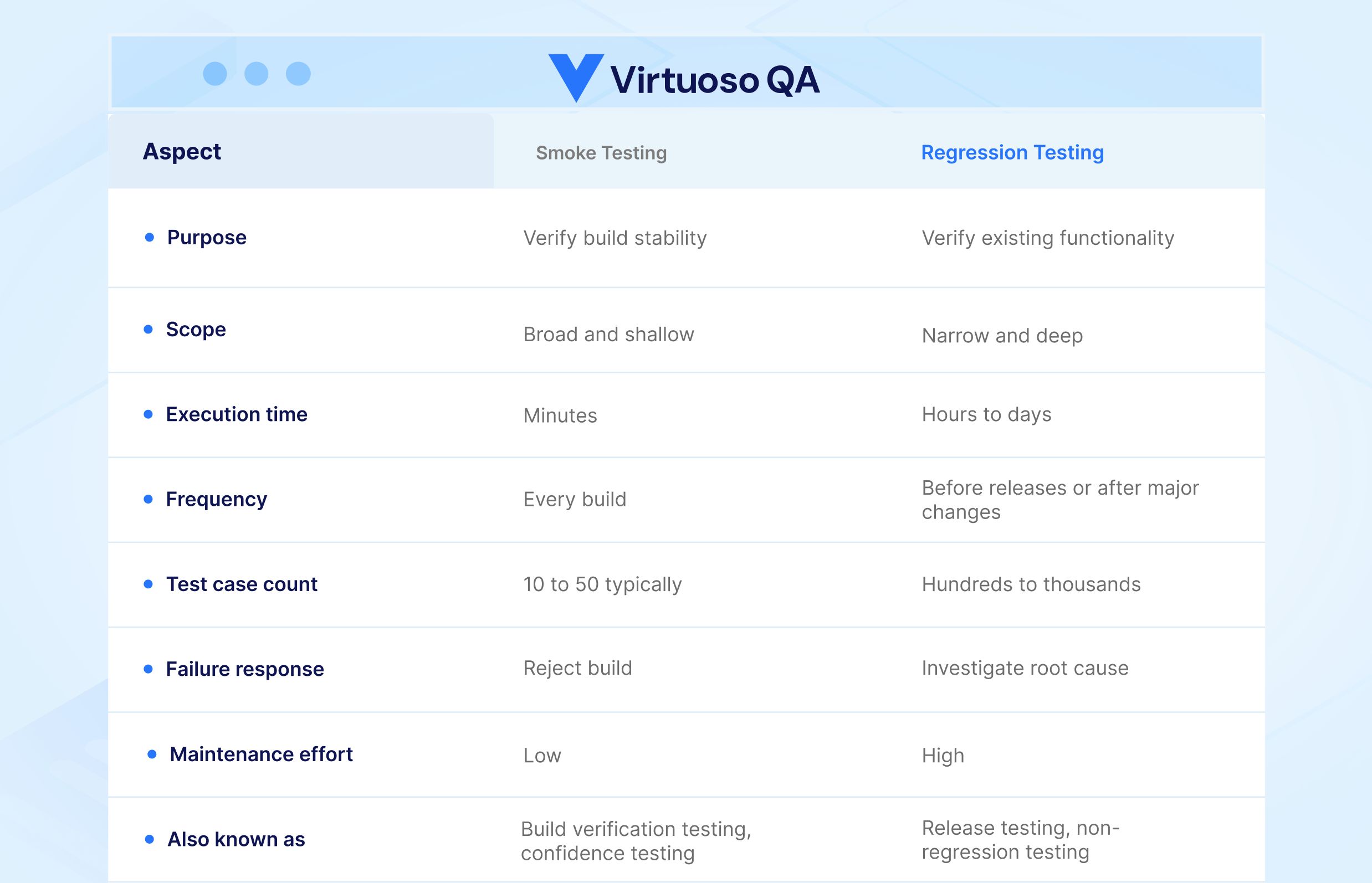
Smoke testing is broad and shallow. It covers critical paths across the entire application without exhaustive verification of any single feature. The goal is confirming basic operability, not validating detailed functionality.
Regression testing is narrow and deep. It may focus on specific application areas affected by recent changes, but within those areas, it verifies comprehensively. The goal is confirming that nothing has broken.
2. Execution Time
Smoke tests execute quickly. A well designed smoke suite completes in 5 to 15 minutes. If smoke tests take longer, they have expanded beyond their intended purpose.
Regression tests require substantial time. Depending on application complexity and coverage requirements, regression cycles may run for hours or even days. Enterprise applications with 100,000 executions per year for regression packs require significant infrastructure to maintain acceptable cycle times.
3. Frequency
Smoke tests run constantly. Every build, every deployment, every environment change triggers smoke verification. Multiple smoke executions per day is normal during active development.
Regression tests run periodically. Full regression cycles occur before releases, after major changes, or on scheduled cadences. Running complete regression after every commit is rarely practical.
4. Test Case Design
Smoke test cases are stable. The critical paths through an application rarely change dramatically. A smoke suite may remain relatively constant for extended periods, with modifications only when core application architecture changes.
Regression test cases evolve continuously. New features require new test cases. Bug fixes add verification scenarios. Business rule changes necessitate test updates. The regression suite is never finished.
5. Failure Response
Smoke test failures halt further testing. If smoke tests fail, the build is not testable. There is no point proceeding until fundamental issues are resolved. The appropriate response is rejecting the build and returning it to development.
Regression test failures trigger investigation. A failing regression test may indicate a genuine defect, an intentional change that requires test updates, or a flaky test that needs stabilisation. The appropriate response depends on root cause analysis.
6. Maintenance Burden
Smoke tests require minimal maintenance. Their limited scope and focus on stable core paths means they rarely need updates. When smoke tests break, it usually indicates a significant architectural change.
Regression tests demand constant maintenance. Industry data shows that 60% of QA time goes to maintenance in traditional automation approaches. Selenium users spend 80% of their time maintaining existing tests. This maintenance spiral is the primary reason automation initiatives fail.
Smoke Testing vs Regression Testing: Real World Examples
1. E-commerce Application
Smoke Test Suite:
Homepage loads successfully
User can log in with valid credentials
Product search returns results
Product detail page displays correctly
Add to cart functionality works
Cart displays added items
Checkout page loads
Payment form accepts input
Regression Test Suite (partial):
Login with valid email and password succeeds
Login with invalid email format displays appropriate error
Login with incorrect password displays appropriate error
Login with locked account displays appropriate message
Forgot password flow sends reset email
Password reset with valid token succeeds
Password reset with expired token fails appropriately
Session timeout after configured inactivity period
Concurrent session handling per policy settings
Single sign-on integration with identity provider ... and hundreds more test cases
2. Enterprise ERP System
Smoke Test Suite:
Application login with SSO
Main dashboard loads with current period data
Navigation to core modules functions
Create new transaction record
Retrieve existing record by ID
Basic report generation executes
Integration endpoints respond
Regression Test Suite (partial):
Purchase order creation with all required fields
Purchase order creation with optional fields
Purchase order validation rules enforcement
Purchase order approval workflow routing
Purchase order modification before approval
Purchase order modification after approval with proper controls
Purchase order cancellation and reversal
Purchase order integration with inventory management
Purchase order integration with accounts payable
Purchase order reporting accuracy ... and thousands more test cases
Why Manual Smoke and Regression Testing Cannot Scale
Manual execution of either testing type does not scale. Manual smoke testing adds 30 to 60 minutes of delay to every build verification. Manual regression testing consumes 15 to 20 days for comprehensive coverage.
The mathematics are unforgiving. If your development team produces two builds per day and each requires manual smoke verification, you have lost at least one hour daily before regression testing even begins. If regression cycles take two weeks manually, you cannot possibly test every release candidate thoroughly.
Yet traditional automation has not solved this problem. 73% of automation projects fail to deliver ROI. 68% are abandoned within 18 months. The reason is consistent: maintenance burden consumes all productivity gains.
Selenium users spend 80% of their time maintaining existing tests and only 10% authoring new coverage. When the application changes, tests break. When tests break, engineers fix them. When engineers fix tests, they are not creating new coverage or testing new functionality. The maintenance spiral accelerates until automation delivers negative value.
The AI Native Difference
Modern AI native test platforms transform both smoke and regression testing economics.
Self-healing automation eliminates the maintenance spiral. When application elements change, AI native tests adapt automatically. Virtuoso QA achieves approximately 95% accuracy in self-healing, meaning tests survive application changes that would break traditional automation.
Natural Language Programming removes the coding barrier. Tests are authored in plain English, enabling anyone on the team to create and maintain automation. This democratisation of test authoring means smoke suites can be created in hours rather than weeks, and regression coverage expands continuously without bottlenecking on scarce automation engineering resources.
Parallel test execution collapses cycle times. Traditional sequential execution means a 2000 test regression suite with average 2.5 minute execution per test requires 83 hours to complete. With AI native platforms executing 100 or more tests in parallel, the same suite completes in under 2 hours.
CI/CD integration enables continuous verification. Smoke tests execute automatically on every build. Regression tests trigger on every merge to protected branches. The pipeline enforces quality gates without manual intervention.
Implementing Effective Smoke and Regression Testing
Smoke Test Design Principles
Identify critical paths
Map the essential user journeys that must function for the application to be usable. These become your smoke scenarios.
Keep it minimal
Resist the temptation to expand smoke tests into comprehensive verification. If it takes more than 15 minutes, it is no longer smoke testing.
Automate completely
Manual smoke testing defeats the purpose. Every smoke test should execute automatically as part of the deployment pipeline.
Fail fast
Configure smoke tests to abort on first failure. If critical functionality is broken, there is no value in continuing to execute additional smoke scenarios.
Make it visible
Smoke test results should be immediately visible to the entire team. Dashboard displays, Slack notifications, and pipeline status indicators ensure everyone knows build status.
Regression Test Design Principles
Prioritise by risk
Not all functionality carries equal business impact. Focus regression coverage on high risk, high value features first.
Design for maintainability
Use composable test components that can be reused across multiple test cases. Centralise element definitions. Separate test data from test logic.
Implement self-healing
Traditional locator-based automation breaks constantly. AI native platforms with intent-based test understanding survive application changes automatically.
Enable parallel execution
Design tests to run independently without shared state or sequential dependencies. This enables horizontal scaling of execution infrastructure.
Integrate with CI/CD
Regression tests should trigger automatically on code changes. Manual regression scheduling creates bottlenecks and delays feedback.
The Future of Build Verification and Regression Testing
The distinction between smoke and regression testing will blur as AI native platforms mature. When test creation takes minutes instead of days, when maintenance burden approaches zero, and when execution parallelises infinitely, the economic constraints that forced testing compromises disappear.
Teams will no longer choose between quick smoke verification and thorough regression testing. Both will execute continuously, automatically, and comprehensively. The question will shift from "what can we afford to test" to "what risks remain untested."
Agentic test generation will create smoke suites automatically by observing application behaviour and identifying critical paths. Self-healing will maintain regression suites without human intervention. AI root cause analysis will diagnose failures instantly, eliminating hours spent investigating flaky tests and broken builds.
The organisations that adopt AI native testing today will establish competitive advantages that compound over time. Their release velocity will accelerate. Their defect escape rates will decline. Their QA teams will focus on strategic quality initiatives rather than fighting maintenance fires.

Related Reads
Frequently Asked Questions
Can smoke testing replace regression testing?
How many test cases should a smoke test suite contain?
How often should regression testing be performed?
What is the relationship between smoke testing and sanity testing?
How does self-healing automation improve smoke and regression testing?
What is the cost of inadequate smoke and regression testing?