Blog
Statement Coverage vs Branch Coverage: Why 100% Can Still Ship a Bug

Adwitiya Pandey
Published on

Table of contents
Lorem ipsum
Lorem ipsum
Lorem ipsum
Lorem ipsum
Lorem ipsum
A team ships a release with 100 percent statement coverage, and a defect lands in production within forty-eight hours.
The code that broke was covered by the test suite, every line had been exercised, and every assertion had passed, yet the bug was real and the customer impact was material. The reason has a name, and the name is the difference between statement coverage and branch coverage. The difference is small in arithmetic and large in consequence.
This guide gives a practitioner-grade explanation, namely the definitions, the formulas, a worked example that makes the difference visible in seconds, the coverage hierarchy the two metrics belong to, the tools that measure them, the common misuses, and how the conversation is being reshaped by AI-generated code.
Definition of Statement Coverage and Branch Coverage
Statement coverage measures the percentage of executable statements that have been run by tests. Branch coverage measures the percentage of decision outcomes, meaning true and false at every branching point, that have been exercised. Branch coverage is the stricter of the two, and achieving full branch coverage implies full statement coverage, though the reverse is not true.
The practical implication is that statement coverage can sit at 100 percent while a meaningful portion of the conditional logic in the code has never been tested. The two metrics answer different questions, and using one as a proxy for the other is the source of most coverage-related false confidence.
A Worked Example That Makes the Difference Visible
Consider a shipping cost function where the logic is simple but the coverage gap is not.
The function has five executable statements and two decision points, and a single test case can run every statement at least once.
The test passes, the statement coverage tool reports 100 percent, and every line was executed. Branch coverage tells a different story, because each of the two if statements has two outcomes, true and false, and the test exercised only the true branch of both. The false branches were never touched, so branch coverage stands at 50 percent.
The hidden risk lives in those untested branches. A boundary defect at weight > 10 versus weight >= 10, a regression where is_express is false but the multiplier still applies, or a typo in the base cost would each slip past a test suite that reports full statement coverage. Branch coverage catches the absence, and statement coverage does not.
What is Statement Coverage?
Statement coverage, sometimes called line coverage in tool output, is the simplest and oldest structural code-coverage metric, and its aim is to confirm that every executable statement has been touched by at least one test.
How Statement Coverage is Calculated
The formula is direct.
Statement Coverage = (Executed Statements / Total Executable Statements) × 100
A program with 200 executable statements where 180 are touched by the test suite reports 90 percent statement coverage. The metric ignores how often a statement was executed, with what inputs, and in what sequence.
Strengths of Statement Coverage
The metric earns its place for three reasons.
It is the easiest coverage metric to understand and explain to non-engineers, which makes it useful in cross-functional conversations about test adequacy.
It is computationally cheap, since most modern coverage tools produce it by default with negligible overhead.
It surfaces dead code quickly, because code that no test ever executes is either unreachable, redundant, or insufficiently tested, and all three are useful findings.
Limits of Statement Coverage
The same simplicity that makes statement coverage easy to compute is what makes it shallow. A statement can be executed without its logic being exercised, and a function can run end to end without any of its conditional branches being tested in both directions.
A high statement coverage number is necessary but not sufficient, and treating it as sufficient is where teams lose accuracy.
What is Branch Coverage?
Branch coverage measures whether every possible outcome of every decision point has been exercised by tests, going deeper than statement coverage by inspecting the logical structure of the code rather than its line structure.
How Branch Coverage is Calculated
The formula mirrors statement coverage but counts branches instead of statements.
Branch Coverage = (Executed Branches / Total Branches) × 100
A program with 40 decision branches where 30 have been exercised reports 75 percent branch coverage. The denominator counts every branch outcome, so an if/else block contributes two, a three-way switch contributes three, and a loop contributes two, namely the loop body taken and not taken.
Branches, Decisions, and Conditions
The terminology shifts depending on the toolchain and the standards reference, and the differences are worth knowing.
Branch coverage counts every outgoing edge from every decision node in the control-flow graph.
Decision coverage counts every decision outcome, which is typically the same as branch coverage for simple decisions but can diverge with short-circuit evaluation.
Condition coverage goes further still, requiring every Boolean sub-expression inside a compound condition to have been evaluated both true and false.
Most popular coverage tools report what they call branch coverage, and in practice the number is equivalent to decision coverage in standard usage. Where Boolean compounds matter, condition coverage and modified condition/decision coverage, known as MC/DC, become relevant, and the metric of choice grows stricter.
Strengths of Branch Coverage
Branch coverage uncovers gaps that statement coverage cannot see. Conditional logic is where most production defects live, and branch coverage forces tests to exercise each path through the decision graph.
The metric also pairs naturally with risk-based testing, since the parts of the code with the highest branching density are usually the parts where business logic is concentrated.
Limits of Branch Coverage
Branch coverage is harder to achieve than statement coverage and can be expensive on legacy code with deeply nested conditionals.
Pursuing 100 percent branch coverage without a risk lens leads to vanity test cases that exist only to flip a flag and produce no real assurance. The metric also stops at the control-flow boundary, so branch coverage does not measure whether the customer outcome actually held.
Statement Coverage vs Branch Coverage, Side by Side
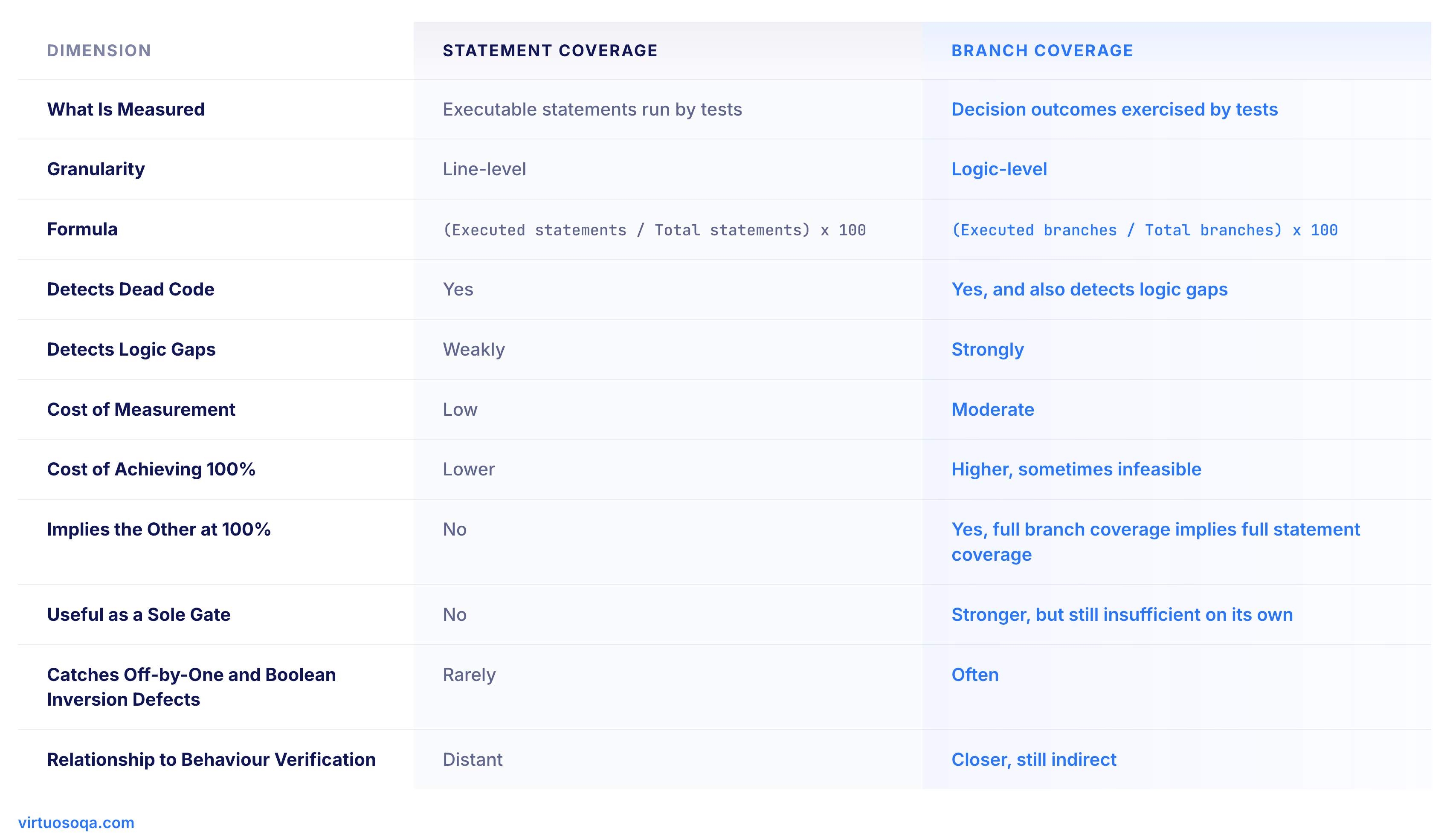
The two metrics are often spoken about as if they were interchangeable, which is exactly the confusion that ships bugs. Setting them against each other on the dimensions that matter shows why one is a floor and the other a working standard, and each point below is a real decision for a QA lead choosing what to measure and what to gate on.
What is Measured
Statement coverage counts the executable statements the tests ran, while branch coverage counts the decision outcomes the tests exercised. One asks whether the line was reached, the other whether the logic was tested, and this is the root of every other difference.
Granularity
Statement coverage works at the line level, treating a block as covered once its lines have run, whereas branch coverage works at the logic level, looking at each fork in the control flow. Logic is where the defects hide, which is why the finer granularity matters.
Formula
Statement coverage is executed statements over total statements, and branch coverage is executed branches over total branches. The arithmetic looks almost identical, which is precisely why teams misread one as the other, but the denominators count fundamentally different things.
Detecting Dead Code
Both catch it equally, since code that never runs shows up as uncovered in either metric.
Detecting Logic Gaps
Statement coverage catches these only weakly, because a line can execute without its conditional outcomes being tested, whereas branch coverage catches them strongly, because it forces every decision outcome to be exercised. This is the row that explains how a 100 percent statement number can hide an untested false branch.
Cost of Measurement and of Reaching 100 Percent
Statement coverage is cheap to measure and cheaper to score highly on, while branch coverage costs more on both counts, sometimes to the point of being infeasible on deeply nested legacy code. That cost is the price of the extra detection power, and it belongs in the planning.
Whether One Implies the Other
Full branch coverage implies full statement coverage, because exercising every decision outcome necessarily runs every reachable statement, but the reverse never holds. Statement coverage can sit at 100 percent with branch coverage far lower, which is why branch coverage is the stronger claim.
Suitability as a Sole Gate
Neither is safe alone. Statement coverage is plainly insufficient, and branch coverage, while stronger, still stops at the control-flow boundary and says nothing about whether the customer outcome held.
Catching Off-by-One and Boolean-Inversion Defects
These live in the untested branch, so statement coverage rarely surfaces them while branch coverage often does.
Relationship to Behaviour Verification
Statement coverage is distant from the customer outcome, branch coverage is closer because it engages the decision logic, but both remain indirect, since verifying that the code branched correctly is not the same as verifying that the claim was filed or the payment cleared.
Where Statement and Branch Coverage Sit in the Coverage Hierarchy
Code coverage is a stack of metrics, each strictly stronger than the one below, and knowing the hierarchy helps teams choose the right altitude for the risk profile of the system.
Function coverage confirms that every function has been called at least once.
Statement coverage confirms that every executable statement has been run.
Branch, or decision, coverage confirms that every decision outcome has been exercised.
Condition coverage confirms that every Boolean sub-expression has been evaluated true and false.
Modified Condition/Decision Coverage, or MC/DC confirms that each condition independently affects the decision outcome.
Path coverage confirms that every realistic combination of branches has been executed.
Function and statement coverage are the floor, branch coverage is the working standard for most enterprise systems, and condition and MC/DC apply where compound Boolean logic is dense or where regulators require it. Path coverage is theoretically the strongest and practically infeasible on any non-trivial program, because the number of paths grows exponentially.
Practical Guidance for Modern QA Teams
A pragmatic position on statement and branch coverage looks roughly as follows.
Use statement coverage as the floor, never as the ceiling, since a team without basic statement coverage in CI lacks the visibility to know what is being tested at all.
Use branch coverage as the working standard at the unit and integration layers, with higher thresholds on modules carrying higher business risk, and avoid uniform thresholds across the codebase.
Reserve condition and MC/DC for code where Boolean compounds are dense or where regulatory frameworks demand it, since most enterprise web and SaaS code does not need MC/DC and the cost of pursuing it usually exceeds the value.
Treat path coverage as a thought experiment, useful for reasoning about complexity and infeasible to achieve.
Pair every coverage threshold with a behaviour signal at the journey level, because a pull request that drops branch coverage by two points is interesting, while a pull request that breaks a customer-critical journey is the actual gate.
The last point is where structural coverage meets its limit. Branch coverage confirms the decision logic was exercised, but it cannot confirm that the customer outcome held after the code changed, which is a different question answered by a different measure. We cover that fuller picture in our companion pages on code coverage vs test coverage and how much test coverage is enough.
How Virtuoso QA Fits
Structural coverage lives at the unit and integration layers, and it remains useful there for catching logic gaps before they reach production.
Virtuoso QA operates at the layer above, verifying the journey through the application as a customer would actually experience it, so that the outcome is checked even when the code underneath has been refactored.
Tests are authored in plain English against expected behaviour, self-healing keeps them aligned as the interface changes, and the same journeys run across browsers and devices without duplication, which is what a coverage number alone can never confirm.
Frequently Asked Questions
What Is Statement Coverage in Software Testing?
What Is Branch Coverage in Software Testing?
Does 100% Statement Coverage Mean 100% Branch Coverage?
Can Branch Coverage Be 100% Without 100% Statement Coverage?
Why Is Branch Coverage Stronger Than Statement Coverage?
How Does AI-Generated Code Affect These Metrics?