Blog
Code Coverage vs Test Coverage: The Real Difference

Modhana Priya
Published on

Table of contents
Lorem ipsum
Lorem ipsum
Lorem ipsum
Lorem ipsum
Lorem ipsum
Code coverage and test coverage answer different questions. Code coverage tells the engineer whether source code was executed, while test coverage tells the business whether the application was verified.
Both are useful, and neither is the other.
The cost of confusing them used to be a quarterly debate, but in an environment where AI produces material amounts of code on a daily cadence, the cost is now a release-day incident on the workflow nobody had verified.
This guide sets out what each metric actually measures, the seven differences that change real decisions, why chasing 100 percent is a vanity exercise, and why behaviour coverage is the metric that survives the AI rewrite.
A Scene Most Engineering Leaders Will Recognise
Consider a pattern engineering leaders in payments will recognise.
A release ships at 23:52 on a Friday, line coverage reads 94 percent, every unit test went green, and the pull request was approved by two reviewers and one model. By 00:14, transactions begin failing in two markets, and the cause sits in a workflow that combines a new fraud check, an existing currency conversion, and a retry path that has never been exercised end to end. The coverage report shows green. The customer journey shows red.
Nothing in that story is a code bug in the classical sense, because every function works as written. The failure lives between the functions, in a workflow that no test had ever simulated. The coverage number was correct, and the conclusion drawn from it was wrong.
There is an old management aphorism that what gets measured gets managed. The harder lesson is the inverse, because what gets miscounted gets shipped, and few metrics in modern engineering get miscounted as routinely as coverage.
What is Code Coverage?
Code coverage is a developer metric that measures the proportion of source code executed when a given test suite runs. A coverage tool instruments the code, runs the tests, and reports what percentage of lines, branches, functions, statements, or conditions were touched during the run.
The number is precise and the methodology is mechanical, but the output tells you what the test exercised, not what it proved.
Common Types of Code Coverage
A few terms get used interchangeably in practice, which is how teams end up with reports that agree on the percentage and disagree on the meaning.
Line coverage, the proportion of executable lines run at least once during the test pass.
Branch coverage, whether each branch of a conditional was taken, both true and false.
Statement coverage, executable statements run at least once, which overlaps with line coverage in many languages.
Function coverage, functions invoked at least once.
Condition coverage, each Boolean sub-expression evaluated to both true and false.
Path coverage, unique execution paths through the code, often impractical at scale because the number of paths explodes combinatorially with the number of branches.
What is Test Coverage?
Test coverage is a product metric that measures the proportion of expected application behaviour verified by tests, irrespective of which lines of source code those tests happened to touch.
The question it answers sits in a different room from the one code coverage answers. Did we verify what the application is supposed to do, did we test what users actually do, and did we cover the workflows that matter to the business and the customer?
Common Dimensions of Test Coverage
Test coverage is not a single number, it is a shape, measured across several axes that mature programmes report separately.
Functional coverage, the proportion of functional requirements verified.
Requirements coverage, the proportion of documented requirements traced to executed tests with auditable evidence.
Risk-based coverage, the proportion of high-risk areas verified at a depth proportional to the risk.
User journey coverage, the proportion of critical end-to-end workflows verified.
Browser, device, and environment coverage, the matrix of platforms exercised.
Data coverage, the variety of data conditions exercised, including boundaries, edge cases, locales, and volumes.
Test coverage is harder to compute mechanically than code coverage, because it requires somebody to know what the application is for. A coverage tool cannot tell you the difference between a critical claim-submission workflow and a settings page nobody opens, so the percentage is meaningful only when the denominator has been defined honestly.
Code Coverage vs Test Coverage - The Seven Differences
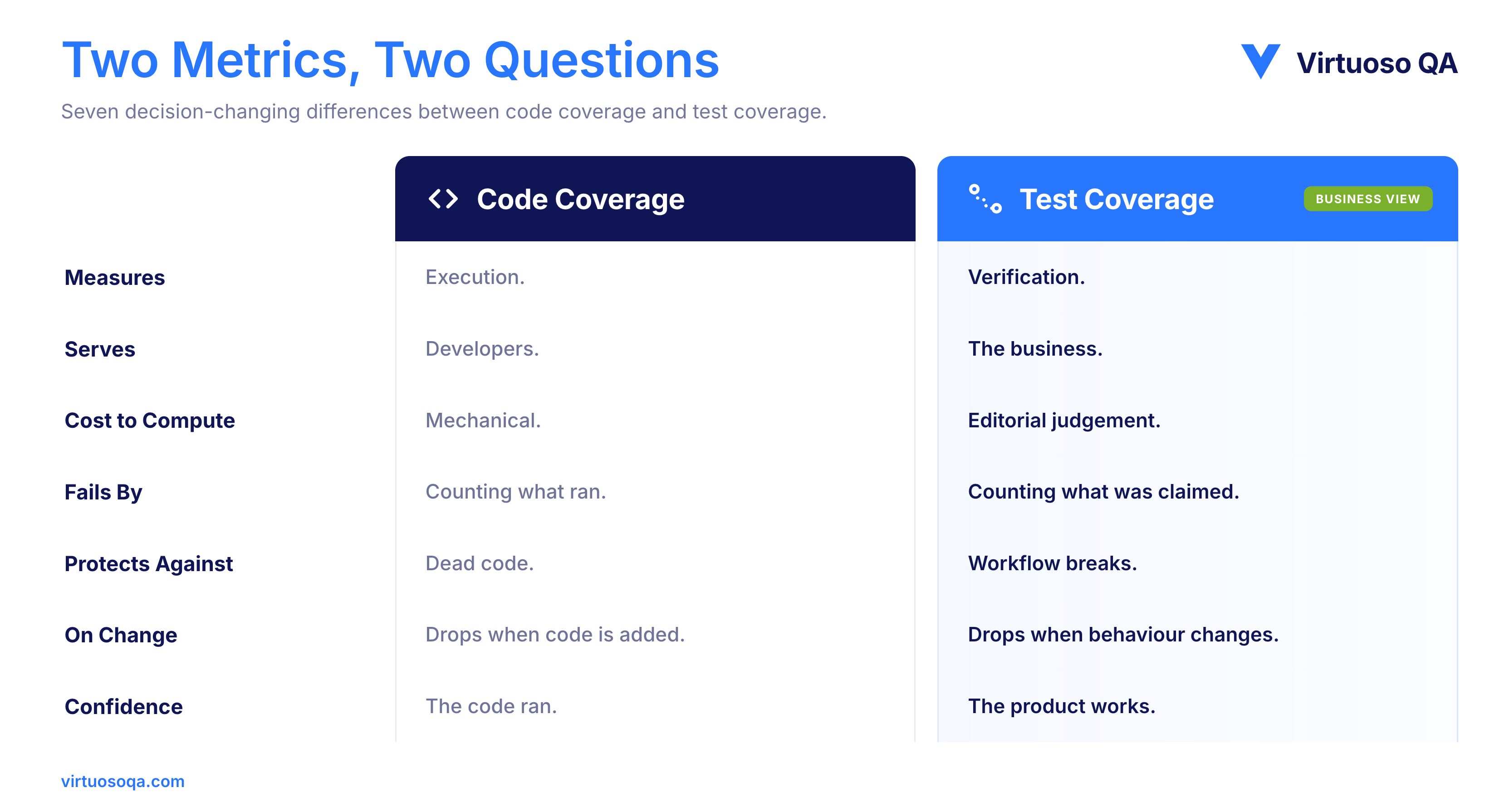
A list of trivial differences can run to twenty entries and change nothing. The seven below are the ones that shape what a release manager decides, what an engineering leader reports, and what an executive trusts.
1. What They Measure
Code coverage measures execution, test coverage measures verification, and the two are not synonyms.
Code can run and produce incorrect output, and a test can run against code without asserting anything useful. The percentage that comes out of a coverage tool tells you the code ran, whereas only a test designed against expected behaviour can tell you it worked.
2. Who They Serve
Code coverage serves developers and test coverage serves the business.
When a developer asks how thoroughly their code is exercised, code coverage is the right metric, and when a product owner asks whether the release is safe to ship to a million customers, test coverage is the right metric. The questions sit in different rooms and require different answers.
3. What They Cost to Compute
Code coverage is mechanical and test coverage requires judgement.
A continuous integration pipeline can compute code coverage automatically with no human input, whereas test coverage requires somebody to define what the denominator is, which workflows are critical, and which conditions count as covered. The discipline is editorial, not numerical.
4. How They Fail
Code coverage fails by counting what was touched, and test coverage fails by counting what was claimed.
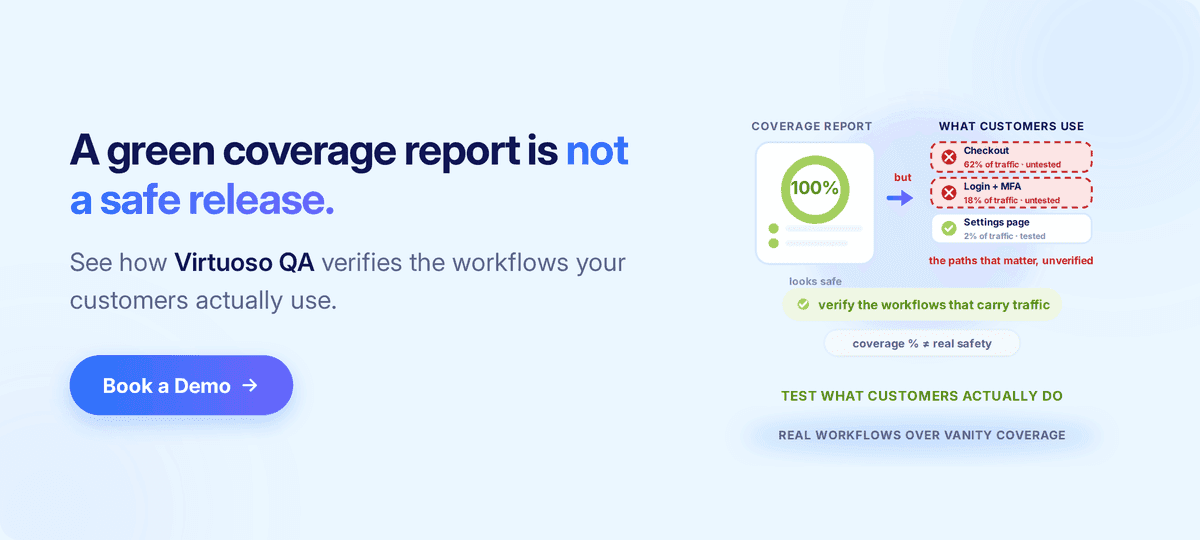
A test that runs every line of a function without asserting anything returns full line coverage and zero verification value, and a team that claims 95 percent test coverage without defining what they meant by 100 percent is reporting an opinion dressed as a number.
5. What They Protect Against
Code coverage catches dead code, unreachable paths, and obvious gaps in unit-level execution, while test coverage catches workflow breaks, integration failures, and behaviour regressions across systems.
The bugs that take businesses down are rarely line-level, they are workflow-level, and code coverage is largely silent on those failures because the lines were executed. The workflow simply was not verified.
6. How They Respond to Change
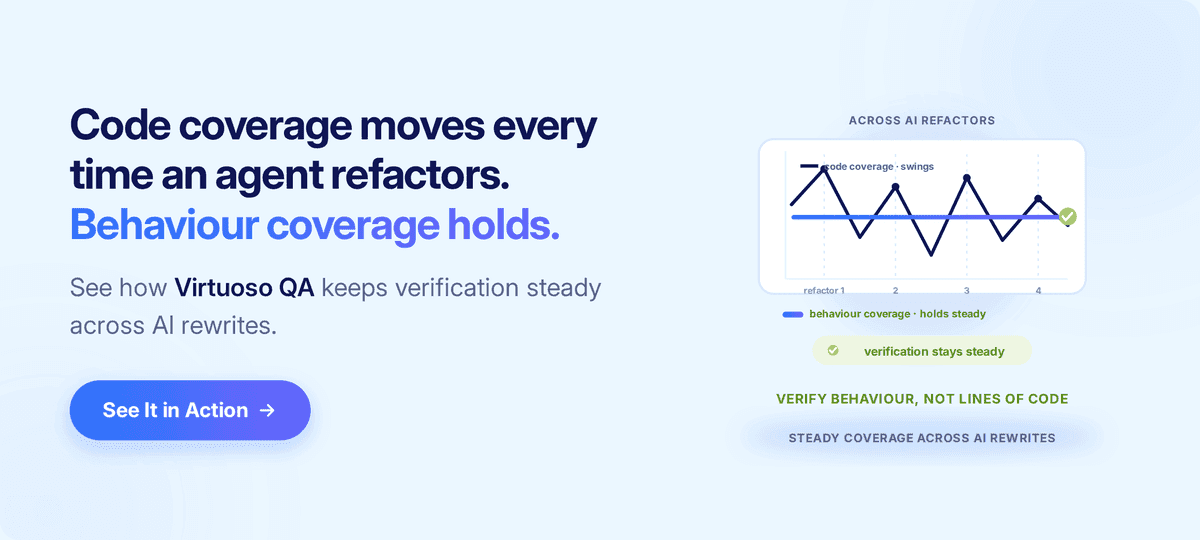
Code coverage drops when code is added, and test coverage drops when behaviour changes. In an AI-accelerated codebase, code is being added faster than ever and existing code is being rewritten by agents on a daily cadence, so code coverage becomes a moving target because the denominator is volatile.
Test coverage, measured against expected behaviour, holds steadier as long as the behaviour itself has been documented and the tests are written at the workflow level.
7. What They Imply for Confidence
High code coverage implies the test suite ran a lot of code, and high test coverage implies the application was verified against what it is supposed to do.
Only the second is a confidence claim a release manager can defend in a post-incident review with a regulator in the room.
What AI Does to Each Metric
The two metrics do not weather the AI-coded era equally, and the difference is worth understanding before deciding which to trust.
Code coverage becomes a moving target. When agents produce and refactor material portions of the codebase, the denominator shifts under the metric every time an agent restructures the code, and the numerator shifts every time a brittle test snaps under a rewrite. A code coverage report on a codebase being rewritten weekly is a report on a building whose floor plan keeps changing.
Test coverage, measured against expected behaviour, holds steadier. Customers do not care which lines were executed, they care that the claim was submitted, the order shipped, the patient admitted, the policy bound. Tests written against expected behaviour, framed at the workflow level rather than the function level, survive refactors because the workflow is what the customer is buying, whereas tests bound to specific lines and selectors do not.
The practical consequence is that as codebases move faster, the two metrics diverge in usefulness. Code coverage tells you less and less about release safety, while behaviour-level test coverage tells you more and more. Deciding how much of each to measure, what to gate a release on, and how to report it to leadership is its own discipline, which we cover in how much test coverage is enough.
Which One Should You Trust?
Both, for what each is good at. Use code coverage as a developer-facing guardrail that flags dead paths and obvious gaps in unit-level execution, and use test coverage as the business-facing signal of whether the application does what it is supposed to.
When the two disagree, the release decision belongs to test coverage, because a high code coverage number on an unverified workflow is precisely the report that ships the incident.
Related Reads
Frequently Asked Questions
Is High Code Coverage Enough to Ship Safely?
What Are the Main Types of Code Coverage?
Is Code Coverage or Test Coverage More Important?
How Does AI-Generated Code Affect These Metrics?