Blog
Ad Hoc Testing vs Exploratory Testing: The Real Difference

Abhilash
Published on

Table of contents
Lorem ipsum
Lorem ipsum
Lorem ipsum
Lorem ipsum
Lorem ipsum
The two terms get used as if they mean the same thing. They do not, and treating them as interchangeable is one of the more common mistakes in QA writing. The cost of the confusion is real. Teams allocate manual testing time to the wrong activity, defects that exploratory testing would have found slip past ad hoc passes, and coverage decisions get made on labels rather than on the actual depth of investigation.
Both practices share one surface characteristic, namely that neither follows a pre-written script. From that single similarity every other comparison diverges. One is essentially reactive, a stream of unconnected ideas thrown at the application. The other is a disciplined cognitive practice with a forty-year intellectual tradition behind it.
This page separates the two clearly, sets out when each belongs in a modern testing programme, and addresses the question most comparisons avoid, namely where they fit in a delivery cycle where AI is writing code faster than scripted tests can be built.
What is Ad Hoc Testing?
Ad hoc testing is unstructured, informal testing performed without planning, documentation, or pre-defined objectives. A tester interacts with the application in whatever way comes to mind, looking for defects through general intuition rather than a method. There is no formal record of what was tested and no expectation of repeatability.
Older literature sometimes calls it monkey testing or random testing, and the intent is the same, namely hit the application with whatever inputs occur to the tester and see what breaks.
What is Exploratory Testing?
Exploratory testing is a structured cognitive practice in which test design, test execution, and learning about the system happen simultaneously. The tester builds a mental model of the application as they go, forms hypotheses about where defects might live, designs tests to probe them, and refines the model based on what the tests reveal.
The discipline is associated with Cem Kaner, James Bach, Jon Bach, and the broader context-driven testing community, and it is most often organised through session-based test management, namely focused, time-boxed sessions with a charter, an objective, and a debrief.
Exploratory testing looks unscripted because the steps are not pre-written, but the absence of a script is not the absence of structure. The structure lives in the tester's method rather than in a document.
The Core Difference in One Sentence
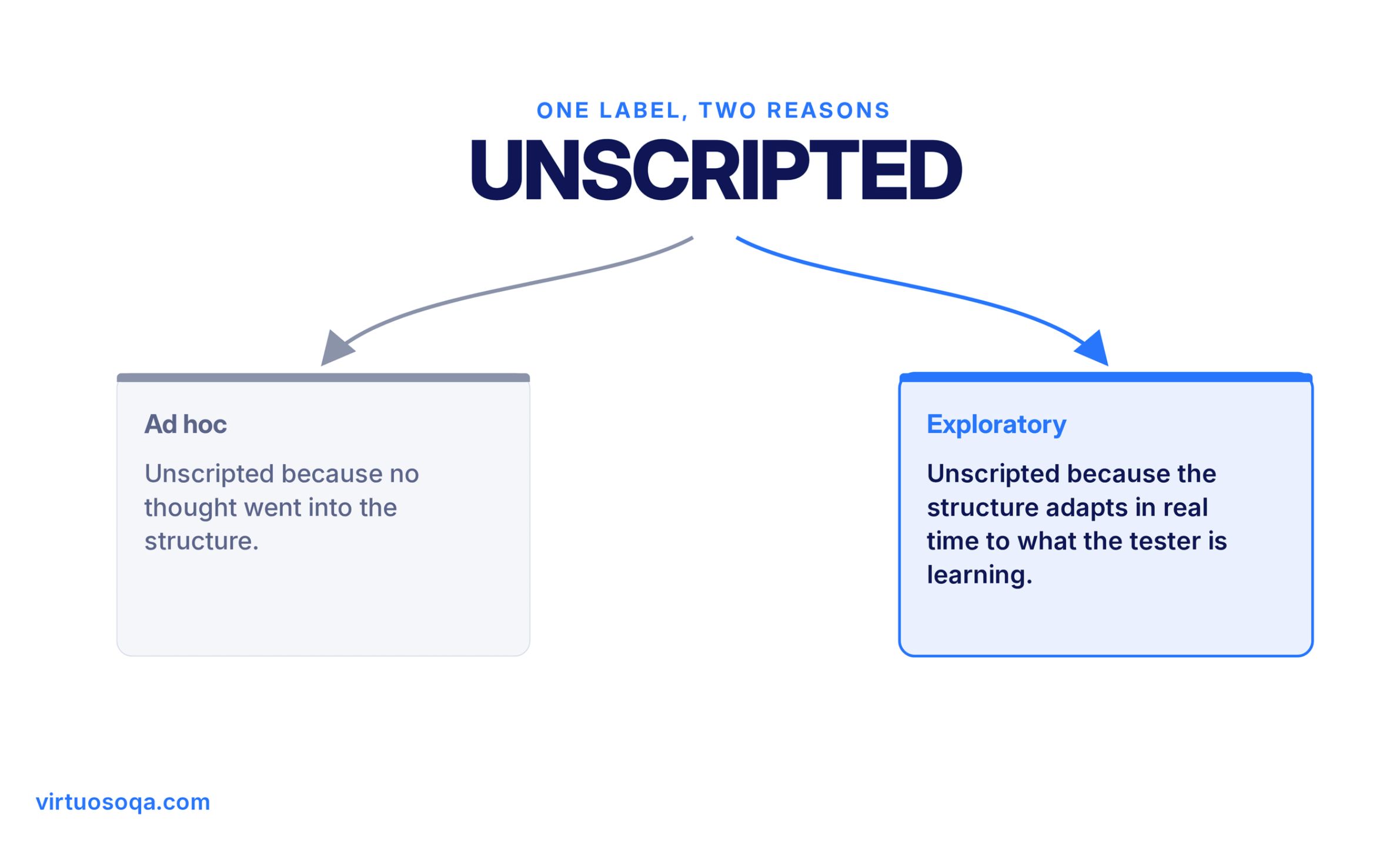
Ad hoc testing is unscripted because no thought went into the structure. Exploratory testing is unscripted because the structure adapts in real time to what the tester is learning.
That sentence carries most of what separates the two, and every other difference follows from it.
Ad Hoc vs Exploratory Testing - Side by Side
The table below captures the substantive differences across the dimensions that matter in enterprise QA programmes.
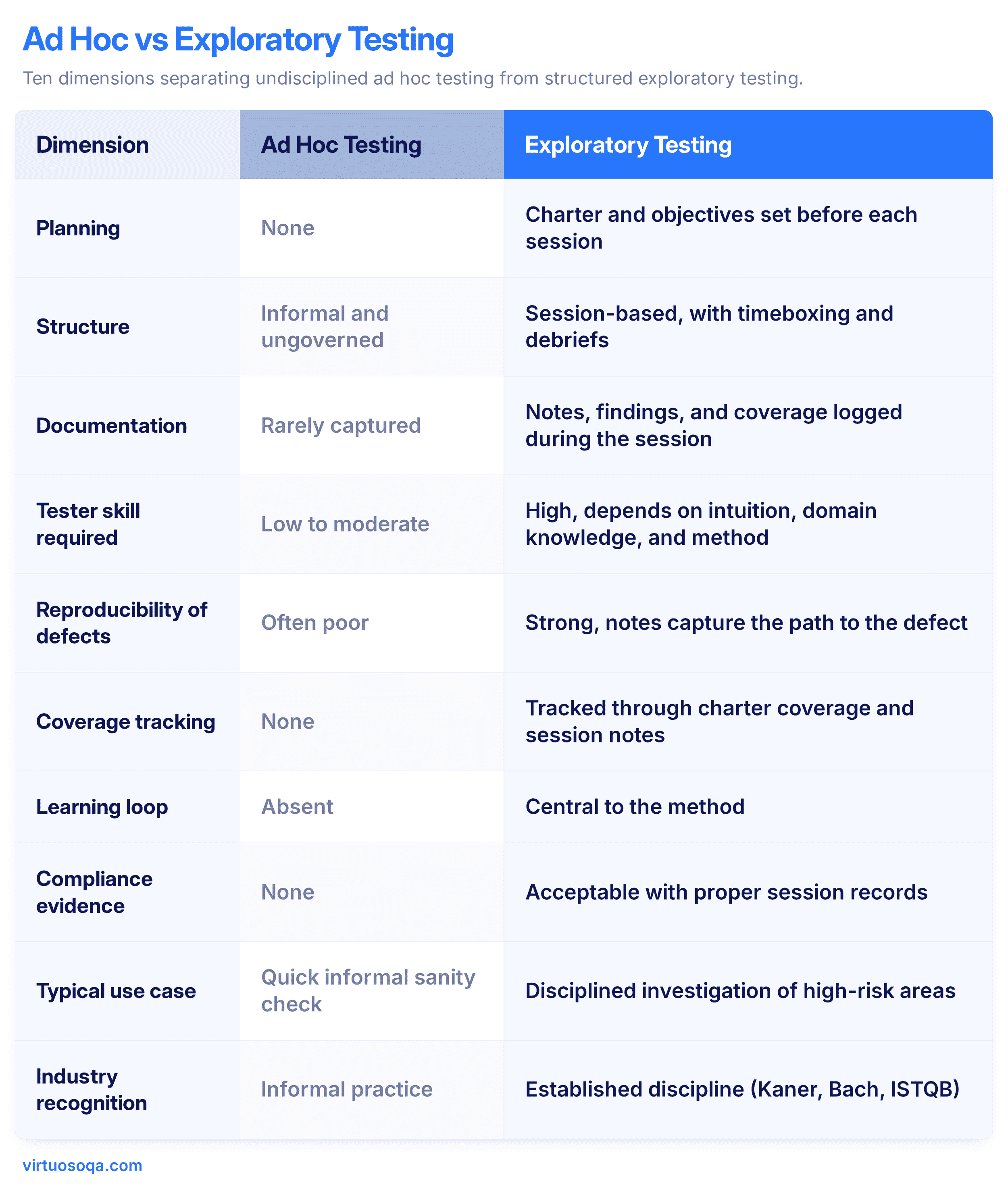
The table scans quickly, but a few of those rows carry more weight than the rest and are worth drawing out.
Planning and Structure
Planning and structure are the root of everything else.
Ad hoc testing begins with nothing set in advance, so what gets tested depends entirely on what occurs to the tester in the moment.
Exploratory testing begins with a charter that names an area and an objective, and it runs inside a time-boxed session with a debrief at the end.
The charter is not a script, since it does not prescribe steps, but it does aim the investigation, which is why two exploratory sessions on the same charter tend to converge on similar risks while two ad hoc passes rarely do.
Documentation and Reproducibility
Documentation and reproducibility move together.
Because ad hoc testing keeps no record, a defect found by chance is often hard to reproduce, since nobody captured the path that led to it.
Exploratory testing logs findings and the route to them as the session runs, so a defect comes with the trail needed to reproduce it and, later, to automate a regression test for it.
That difference is the gap between a bug someone vaguely remembers seeing and a bug the team can act on.
Tester Skill and the Learning Loop
Tester skill and the learning loop explain why the two produce such different results.
Ad hoc testing asks little of the tester beyond curiosity, and it builds no model of the application, so each action stands alone.
Exploratory testing depends heavily on the tester's judgement and domain knowledge, because the method is a loop, namely each observation updates a mental model that shapes the next test.
That loop is what lets exploratory testing follow the application's real risk surface into the corners where the subtle defects live.
Compliance Evidence and Recognition
Compliance evidence and recognition are where the practical stakes land.
Ad hoc testing produces nothing an auditor can use and sits outside any formal body of practice.
Exploratory testing, run with session records, produces an audit trail that satisfies most regulatory expectations, and it is a recognised discipline with a documented method behind it.
For a regulated enterprise, that distinction alone often decides which of the two can be relied on.
The structural differences make the practical ones. Exploratory testing produces evidence, supports compliance, and contributes to institutional memory, while ad hoc testing rarely produces any of the three.

The Cognitive Difference
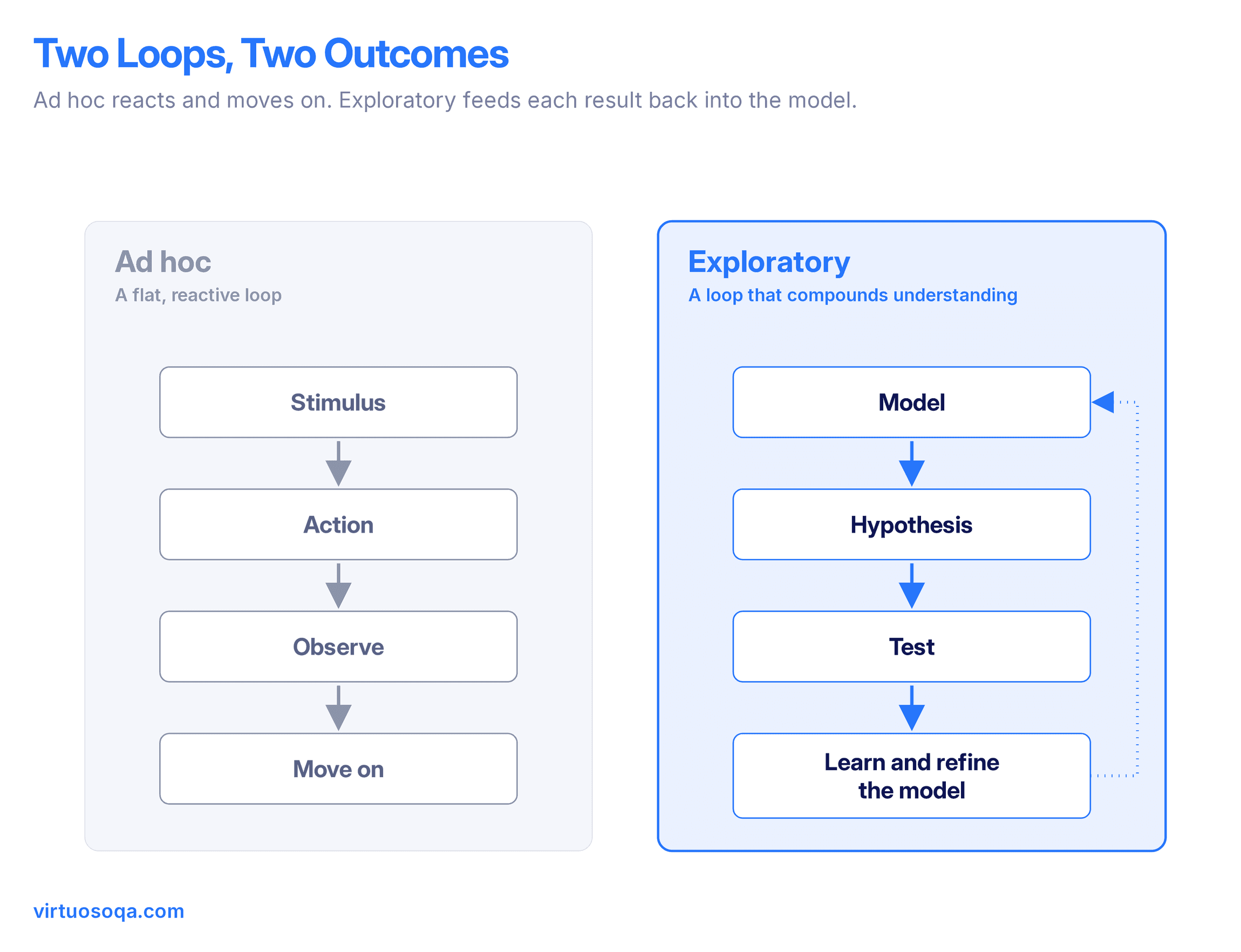
The visible workflow differences sit on top of a deeper distinction in how the tester is thinking, which is where the two practices really part ways.
In ad hoc testing, a stimulus arrives, namely an idea, a recent change, or a hunch, the tester executes the action, observes the result, and either moves on or reports a bug. The thinking is reactive. No model of the application is being built, no hypothesis is being tested, and the next action does not necessarily follow from the previous one.
In exploratory testing, a model of the application is built and refined continuously. The tester is asking what could be wrong here given what has been learned so far, and the next action follows from the answer. Findings update the model, risk areas shift as understanding deepens, and the session ends with the tester knowing more about the application than when it began.
The second mode produces defects the first one misses, because it follows the application's actual risk surface rather than a stream of unconnected ideas.
When Ad Hoc Testing is Appropriate
Ad hoc testing has a legitimate place, but a narrow one, and the conditions below define where it belongs.
Quick sanity checks after a small change: A developer fixes a minor cosmetic defect, and a tester taps around the affected area to confirm nothing obvious broke. Ten minutes, no document needed.
Smoke checks under time pressure: A release window is short and the team needs fast manual confirmation that the application is broadly functional before automated regression begins. Ad hoc passes give rough comfort while the structured runs catch up.
Early-stage prototypes: The product is a sketch and the screens change daily, so formal exploratory sessions would over-invest in something not yet stable. Ad hoc testing matches the maturity of the artefact.
In each case the limitation is the same, namely that ad hoc testing finds the most visible defects and misses the subtle ones that require sustained reasoning to surface.
When Exploratory Testing is Appropriate
Exploratory testing belongs anywhere the cost of missing a defect is meaningful and the application has enough structure to investigate properly.
High-risk feature releases: A new payments flow, a regulated workflow, a major UX overhaul. Defects here carry real consequences, and exploratory sessions let skilled testers investigate in depth with domain knowledge automated tests cannot replicate.
Areas with known historical defects: Some parts of an application carry technical debt that automated regression never fully covers, and exploratory sessions probe those areas with intent.
Pre-release final passes: Once automated regression has run, exploratory testing finds the residual issues scripts could not have predicted, and the combination is stronger than either alone.
Usability and judgement-heavy validation: Some defects only become visible to a human running the journey, namely visual subtleties, flow awkwardness, and accessibility issues experienced rather than measured.
Investigation of intermittent failures. When automated tests fail intermittently, exploratory sessions reproduce, characterise, and isolate the underlying cause, which is exactly what an adaptive method is good at.
The Limitations of Each
A fair comparison covers limitations as clearly as strengths.
Ad hoc testing produces little evidence, supports no traceability, depends entirely on the tester's mood and recent experience, scales badly across teams, and is essentially unmanageable as a programme. As a one-off check it is fine, and as the foundation of a quality programme it is structurally inadequate.
Exploratory testing depends on tester skill, which makes it expensive and hard to scale, and the quality of the output varies sharply with the practitioner. Coverage is bounded by the tester's time, attention, and domain understanding, the method does not fit naturally into CI/CD pipelines, and it cannot be repeated identically across releases. Exploratory testing complements automation rather than replacing it.
Where Both Sit in a Modern Testing Programme
The right question is not which of the two is better, it is what role each plays inside a complete programme. A mature programme runs three layers of validation in parallel.
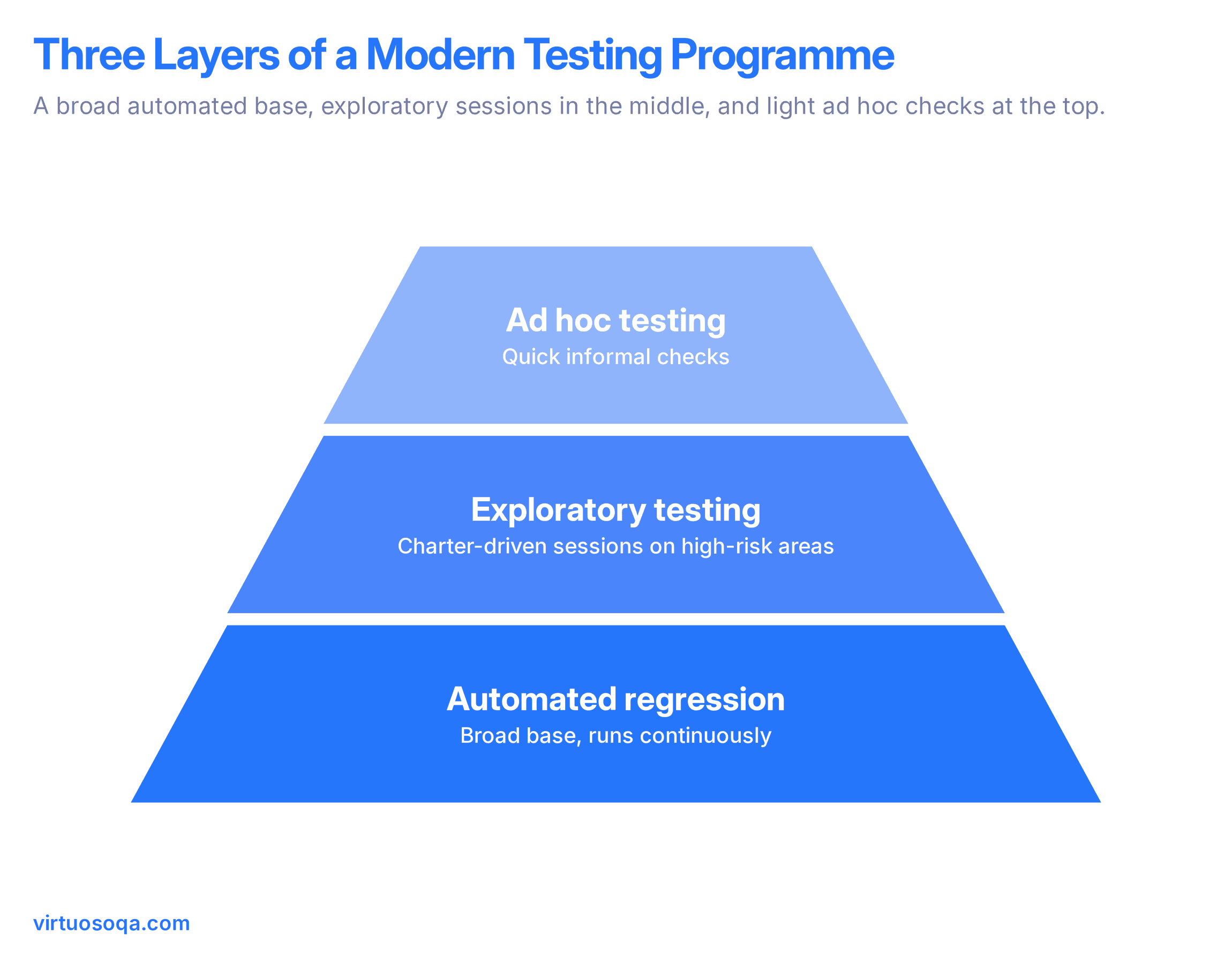
Automated regression: Anything that can be reliably automated belongs here, running on every commit, pull request, and release candidate with a speed and scale human testers cannot match.
Exploratory testing: Skilled human testers investigate high-risk areas with discipline, applying intuition, domain knowledge, and adaptive reasoning, in charter-driven, time-boxed, documented sessions.
Ad hoc testing: Quick informal checks and sanity passes, the moments when a tester taps around to confirm a small fix landed cleanly.
The proportions vary by context, and the presence of all three is the constant.
How AI Changes the Picture
For the last decade, manual testing teams have spent most of their time on regression coverage that automation should have absorbed, which has left exploratory testing chronically underfunded. The most cognitively valuable work in QA was crowded out by scripted regression that humans should not have been running.
AI-native test automation changes the economics. Plain-English authoring, autonomous generation, and self-healing maintenance compress the cost of automated regression, so the hours that previously went to manual regression can move to exploratory testing, where they produce defects automation never could. Three shifts matter specifically.
Generation expands exploratory readiness: Autonomous generation produces functional and exploratory starting points from UI screens, requirements, and existing suites, so exploratory testers begin from a structured position rather than a blank document.
Self-healing reclaims tester time: Self-healing absorbs the maintenance burden that historically consumed automation programmes, so tester time shifts from updating broken scripts to investigating risks automation cannot reach.
Session documentation gets lighter: AI-assisted session capture, with screenshots, logs, and journey summaries attached automatically, removes the documentation overhead that once made exploratory testing administratively expensive.
The cumulative effect is structural. AI does not replace human testers, it redirects them from low-value scripted work to the high-value exploratory work humans are uniquely good at.

Best Practices for Combining Both
A working programme blends ad hoc, exploratory, and automated testing with intent, and the practices below keep the combination productive.
1. Map the Surface Explicitly
Categorise each area of the application by risk and by the approach that fits, so high-risk judgement-heavy areas get exploratory sessions, stable areas get heavy automation, and cosmetic touches get ad hoc.
2. Fund Exploratory Testing as a Deliberate Activity
If exploratory testing is only what is left after automation, it never happens, so allocate sessions in the sprint plan with charters, time boxes, and debriefs.
3. Use Session-Based Test Management
Sessions of around 60 to 90 minutes with a clear charter produce stronger results than longer unstructured ones, since the charter sets focus, the time box maintains energy, and the debrief captures the learning.
4. Capture Findings Consistently
Even a light note structure, namely charter, areas covered, issues found, and follow-ups, preserves institutional knowledge and supports compliance.
5. Feed Exploratory Findings Back into Automation
When a session surfaces a recurring defect or an unmodelled risk area, add the regression coverage that will catch it next time, so the exploratory layer feeds the automated layer over time.
6. Treat Ad Hoc Testing as a Complement, Not a Strategy
Ad hoc testing supports quick comfort, and it should not be the foundation of a programme or carry release decisions.
What Different Stakeholders Should Take From This
The implications of the distinction differ by role.
QA managers: The mix matters, and a team that calls all its unscripted work exploratory but does it informally is doing ad hoc testing under a different name. The session-based discipline is what makes exploratory testing produce its value.
SDETs and automation engineers: Exploratory testing is not a threat to automation, since the two strengthen each other. The more effectively automation absorbs regression, the more bandwidth there is for exploratory work, which then drives the next wave of automation requirements.
Product owners and business analysts: Skilled exploratory testers find defects scripts and automation never catch, so funding them is investing in the parts of the product that need human judgement to validate.
Engineering leaders: Treat exploratory testing as a capability rather than a cost to minimise, since hours moved from manual regression to exploratory testing produce more defect catches per hour, not fewer.
How Virtuoso QA Fits
Virtuoso QA is built to absorb the automated regression burden that has historically crowded out exploratory testing. The result is not a replacement for manual testers, it is more time for the work where humans add the most value.
Plain-English authoring: Natural Language Programming lets manual testers author automated tests in readable language, so building regression coverage no longer demands scripting skill.
Autonomous generation: GENerator produces tests from screens, requirements, and existing suites, including structured starting points for functional and exploratory validation rather than a blank document.
Self-healing maintenance: Self-healing keeps tests stable as the application evolves, which collapses the maintenance overhead that has consumed so many automation programmes, with proposed repairs running at approximately 95% user acceptance under human oversight.
Unified layers: UI, API, and database checks sit in a single test, so the automated regression layer covers the full stack a journey crosses.

The Future of Unscripted Testing
Exploratory testing is one of the few testing activities AI is unlikely to replace, because it depends on intuition, domain context, judgement, and the construction of a mental model of an evolving system. AI accelerates the regression work around it rather than replicating the human cognition at its core. Three forward shifts will define the next phase.
Exploratory Testing Becomes More Valuable, Not Less
As AI generates more code faster, the surface area for subtle defects grows, and the disciplines that find those defects, session-based exploratory testing in particular, are the ones that protect quality.
Documentation Overhead Keeps Falling
AI-assisted session capture and summarisation keep removing the administrative cost of doing exploratory testing properly, so skilled testers spend more time investigating and less time logging.
Ad Hoc Testing Keeps Shrinking
As release frequency and quality bars rise together, the role of unstructured informal testing narrows, and while the category will not disappear, its share of the testing budget keeps falling.
The teams that win the next phase of software delivery will run heavy automation, deliberate exploratory testing, and almost no formal reliance on ad hoc work.
Frequently Asked Questions
What is the Main Difference Between Ad Hoc Testing and Exploratory Testing?
Is Exploratory Testing the Same as Random Testing?
Can Ad Hoc Testing Replace Exploratory Testing?
When Should Ad Hoc Testing Be Used?
When Should Exploratory Testing Be Used?
How Does AI Affect the Role of Exploratory Testing?